Discussion keeps the world turning.
This is Roundtable.
You're listening to Roundtable.
I'm Niu Honglin, joined by Steve and Fei Fei.
Around the world, countless oral traditions are disappearing, not because they lack value, but because modern life leaves little room for slow spoken memory.
Languages vanish, elders pass on, and with them, entire ways of understanding the world.
Against this global backdrop, Imakan's revival stands out.
Its journey from near extinction to international recognition offers a rare glimpse into how cultural heritage can survive, not by freezing the past, but by re-entering the present.
And what's the last time you tried something new and immediately thought, I'm terrible at this?
Most of us stop right there.
I know I do.
We retreat.
We decide it's not for us.
But what if that moment awkward humbling, slightly painful, isn't a warning sign but an invitation?
This show is about what happens when we don't turn away from that feeling.
But before that...
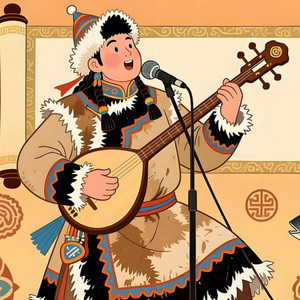
These days Imacan, the oral heritage of Hezhen people in northeast China, is making headlines because this intangible cultural heritage is moved from UNESCO's list of intangible cultural heritage in need of urgent safeguarding to its representative list, a huge milestone that highlights China's success in keeping this tradition alive.
But how exactly has China revived Imacan and how is it thriving communities these days?
To answer that question, I've never heard of Yimakan before.
To be honest, no, before the show.
I didn't really know about this.
I was exposed to a lot of other type of intangible cultural heritage of minor groups, but not this one.
So tell me about this one.
So well, this is very reasonable for you to be to heard about Yimakan in the first place, because the ethnic group Hezhen has only more than 1500 people right now living in China, mostly in northeastern part in the province called Heilongjiang.
Even more remarkable.
Yes, very, very far away.
They are one of the people called they are the eastmost people in China.
And their storytelling.
Called Yi Ma Kan, is a traditional oral art that combines singing and spoken narratives that communicated in the Hezhen language.
And what they're singing is basically about their history, their legend.
That's mostly carried out in narrative forms.
And there are also songs singing about their fishing and hunting customs, their ritual practices, their moral values and also their community identities many things.
Because their culture, the culture for the Hezhen people, surrounds fishing and hunting in the forests of the Heilongjiang province.
Well, it's really boring just to hear me talk about their storytelling, talk about Yimakan.
But to have a better understanding of this tradition, we have this extract from a piece called The People of the Rising Sun about the Hezhen people themselves, because they live on the eastern border of China and they are one of the first peoples in the country to see sunrise.
Wow.
Chanting Chanting Chanting Thank you for watching.
Well, what's being sung is about.
There is a river called the Heilong River, and by that river lived us, the Hezhen people.
And generation after generation.
We live on the eastmost side of China and we are among the first peoples to see the sunrise in the country.
And the singer is actually a national level inheritor of Ima Khan.
His name is Wu Baocheng.
And this clip is from the CMG production, China's Intangible Cultural Heritage.
It's such a fascinating group of people because they have faced endangerment because of a limited number of practitioners.
The language
And there's also no written script. for the Hijin language itself.
Because there's no written language.
That makes it very, very challenging to pass down from generation to generation, and that's why it's so important that this gets protected.
As of the beginning of the 21st century, only five elders could perform the full Imikan Kantos, And that, of course, would place the tradition at risk as well.
We have talked about, and also observed, many types of oral sons and intangible cultural heritage of different ethnic groups.
We've seen the Mukham, we've seen the Manas, also Chengdiao.
I think Chengdiao is from Mongolian, and it's their way of recording history.
And there are a lot of different styles and different ways of, Different ways to pass it on, different ways to pass it down, different ways to learn it.
And most of these ones don't have a written script.
And some would even be as hard as that.
They have different lyrics based on what they're talking or singing about, what they're recording.
And even the singing skills and styles might be different. based on where you are.
But I think for this one, for Imakan, it's even harder because they only again have 5000 people in their ethnic group, meaning that selecting those who are interested in doing this, interested in learning it, and finding those who would like to have it be passing down to them, would be even harder, which is why technology plays a really important part, a vital part in preserving
Yeah, exactly.
Because when we are talking about this storytelling form of singing or cantos, it's important to document them, isn't it?
For example, back in the 1980s, when the province of Heilongjiang realized that Imacan is on the brink of extinction, they launched this initiative, called Rescue Initiative, to document the singing and cantos and songs.
But right now we have like audiovisual recording of these national level inheritors, like Wu Baocheng we just heard about that document their singing and document the lyrics.
The history is mostly important.
And then, for example, when it comes to their language, they can take online classes now.
So they don't have even for us who are interested, maybe that I find their culture fascinating.
I want to learn about the Hezhen language.
I can also learn about that as well online.
Yeah.
They have over 1,000 hours of audiovisual recordings of the performers themselves.
Those were put into a digital archive.
They also put in a textual compilation covering the lyrics and the historical context of of the performances as well.
And then the hujan language has entered into school curriculums in local communities, and that, of course, will promote this intergenerational transmission and the revitalization of the language.
It's just such a really wonderful, heartwarming thing.
The, the youth, We'll be able to carry this on.
You know what I just realized?
With enough hours of the overall visual recordings, you can even put it as a database and for AI to learn about it.
Recently, when talking to some scientists, they say yeah.
They say that the key to have AI learn about a culture or a language is to have enough high quality database.
And we still have those who are really familiar with Imakan, with the Hezhu language.
And we have those who can separate the really good singing materials with the kids or people running around and singing casually, kind of material.
So that yeah, maybe one day you can learn it not only from people from this Same ethnic group, from or even from your own computer assistant.
Yeah.
I mean, it sounds like such a juxtapose to take something that's been around for so long and was on the brink of extinction and introduce it to AI.
But it's kind of like. the perfect storage slash teaching assistant for this.
Yes, yes.
And here in China we know the intangible cultural heritage policy have been there for quite a long time safeguarding a lot of different types of intangible cultural heritage from different provinces, from different places.
And there is even a document and a minority tradition statement archive so that we know, maybe this the reason I'm talking about this is that there are so many different ones and some are in really dire needs for protection, for a little more attention, and some are doing pretty well and they're generating good examples so that other people working in the same area can learn from them.
So what are some other fun examples we're looking at right now?
Well, for example, the Lee ethnic groups on the Hainan Island, their traditional spinning dining, weaving of the embroidery techniques are also on the list.
They actually also follow the same path of Imacan.
They're not following the path of Imacan, but very similar to Imacan.
They're also moved from the same urgent need for safeguarding list to the representative list of UNESCO's back in 2024.
And their, you know, embroidery techniques is sort of also telling the stories of theirs.
And also these techniques are only transmitted through generations of females in the communities.
So by enlisting, inscribed in the international list, I think it's not only just about safeguarding their traditions, but also about spreading the knowledge of their cultures, their identities, their techniques on the international space.
And then that would be appealing to the younger generation.
100% it would.
I was just thinking, you know, from an expat's perspective, and I think this might be the belief for a lot of people who have never visited China before or don't know too much about China, and I was included in that group.
I think non-Chinese people might think Chinese people know everything about China.
Right?
Like.
You know everything about the culture, you've been everywhere in this country, you've tried every single dish, and that's just not the case.
No.
Because China's so vast...
It's got so much tradition and cultural differences, so many cultural differences.
Depending on the region you are, there are so many different languages.
There are so many different ethnicities.
And it's almost.
It just struck me as we were chatting here that even when we have a conversation like this, it's an opportunity for Chinese people to learn more about China.
And then that holds true for the states, too.
You know, Americans don't know everything about America.
Canadians don't know everything about Canada.
But that just kind of struck me as we were chatting.
And when we were chatting this, I previously also talked about this to some friends saying, huh.
You know, when you go to a certain place you see the minority or ethnic group there and you see their way of singing and dancing and celebrating and starting a bonfire party at night and enjoy their food.
And you buy the kind of souvenirs that are really really pretty and gorgeous, totally suitable for your appetite.
And you go to a second one, similar activities.
And you go to a third one, similar souvenir.
Is it worth it that we are transforming their tradition, their intangible cultural heritage, into these relatively more commercialized form so that they can pass down?
We're using basically the same kind of method.
Should we do this or should we find a more customized and personalized by saying personalized i mean ethnicalized way to to do the preservation and the passing down of the kind of knowledge or the kind of heritage?
Well, I think when it comes to commercialization, there is always a problem in the back of it.
Are we over-marketing it?
But for, well, I think it depends.
For traditions like Imakan that is basically very unfamiliar to most of the people outside of that region.
It doesn't really matter, as long as we are spreading their traditions, their knowledge, and it helps.
Yeah, I agree with that.
Whether it's commercialized or not seems kind of moot to me.
How you get that message to people...
Whether you're giving it to them or selling it to them, as long as they're getting the information and getting the message and seeing the costumes and hearing about the traditions and hearing the singing.
Can we play that clip one more time?
As long as we get to hear it and experience it, then I don't think it matters how it's delivered and also the reason that we're seeing the magnet, our fridge and that we are buying the little beautiful purse from wherever it's made and bring them to our home.
And we're talking about these stories, talking about how they're preserved and how they're now celebrated.
They're gaining international recognition.
It's because the method works.
It works and it benefits those who are interested in the culture.
It benefits those who generate the culture from their own group, from their own community.
And if you go home and take a look at all the magnets that you take home, you bring to your home from different destinations, you will know each and every one of them is different.
And it's a treasured memory.
And it doesn't really matter what kind of method are we using?
Well, it matters in the sense that we can learn from each other.
But there is no, not really something that has to be unique for a certain preservation, for a certain intangible cultural heritage, in my opinion,
As long as it's not being oversimplified.
I guess that's one of the dangers of commercialization.
But sticking as close to the originals as you can is a good thing.
Yes.
Any final suggestions or final advice or final, not warning, but maybe we spot on some challenges that are in the process of preserving and protecting local culture and we want to speak up.
I would say just what I just said.
Make sure it's as accurate as it can possibly be.
Don't water it down.
Sometimes the message can get lost when you're delivering it from one group to another group, to another group, as you keep passing it down until it finally loses its original meaning.
And that's why I said stick as close to the original as you possibly can.
Well, for me, I think, for example, for traditions like Imakan, that's basically a lot of singing, a lot of spoken narratives.
I'm thinking about going into the future.
We can't just for, especially for those living in those communities.
They can't just relying on their traditions how to keep this tradition alive in the modern days.
For example, in mongolia communities there are a lot of singers, young musicians who are trying to implement sort of embed, the traditional mongolian singing and lyrics into modern pop music to help it spread, to make it more fun to younger and younger generations.
And the new form is not only an adapted form for younger generation.
It can be the new tradition that you're currently making for, the tradition you've been or your ethnic group have been living in for thousands of years.
You're listening to Roundtable coming up next.
Let's try to find out why there's a joy and benefit in being bad at something.
Don't go away.
Looking for passion?
How about fiery debate?
Want to hear about current events in China from different perspectives?
Then tune in to Roundtable where East meets West and understanding is the goal.
It's Roundtable with me, Steve Hatherly and Fei Fei.
We've all felt that sting of being the worst person in the room, the person tripping over their own feet in the yoga class, the one whose kitchen receipt looks, well, their kitchen recipe looks terrible. suspiciously like it was made by a four-year-old or the one whose diy ikea sofa is viewed backwards that's me really i did that well we've been conditioned to hate that feeling but what if we well i told you that being bad at something truly wonderfully is not just okay, but a genuine source of joy and a path to deeper learning.
Is that so?
Is that the case that being bad at something is really can be good for you?
I took a painting class once in my life, and it was one of the most fun afternoons I've ever had.
And the reason I enjoyed it so much is because I learned from a very early age that I have Zero artistic ability.
And when I went to that class I didn't have any expectations personal expectations about performance.
And that's why they say the joy of being terrible at something.
When you try something and you know you're not good at it, or if you do it repeatedly and you know you're not good at it but you're okay with that, then it removes the performance anxiety and the expectations that you have for yourself.
If you think about something that you really, really want to learn.
I remember wanting to learn guitar and I tried to learn the guitar about five or six times.
My fingers, they look like fried mozzarella sticks.
They're short and chubby and they're not conducive to playing the guitar very well.
But I got so frustrated and I got so disappointed in myself that I couldn't do something that I really wanted to do.
But with the release of that attitude, that's the whole point of this, the joy of being bad at something.
When you release that attitude and you just try it for the joy of trying it, then you can actually have a great time being bad at something.
It's still a little difficult for me to comprehend.
Yes, me too.
Wouldn't that trigger some level of anxiety?
And also I think I kind of get the fact that we should learn to fail better, so that when we fail we can prepare ourselves to try for the next time and to improve ourselves.
But if we have already accepted the fact that we're bad at this, where are we going?
Because it's not the point of where you're going.
It's not the outcome.
It's the process that you're enjoying.
It's not the destiny.
It's the data, if you want to put it in a more modern terminology.
That's why when we say failing better, it sounds like a paradox, but it's actually not.
Because it allows you to focus on having fun in the moment rather than worrying about that destination or the outcome, meaning I'm not going to be good at this in the future.
You just have fun doing it at the time.
Can you really have fun being bad at something?
I mean, while you're doing it.
The reason or the kind of fun that i can get is from repeated try, and maybe after 10 times i got it right once.
Let me answer your question.
Can you have fun being bad at something?
No, this is advice for the general public, Not the perfectionist in the room.
You know, now I start to get it.
It's like learning to accept that you don't need to be good at everything.
That's the key word right there.
You don't need to be good at this.
Some of our hobbies that we pursue, that's the goal, is to be good at something.
If you sign up for a gym membership and your goal is to get more muscle or lose some weight, then you have a goal and you want to get good at your exercise so you can achieve your goal.
If you go, for example, to that painting class with zero expectations about the outcome.
I took my painting home with me.
It looked like a cat drew it, but I didn't care.
I had a great time because I knew I wasn't good at it.
I went to one pottery class in my life as well.
I was thinking it was going to be that, who were the actors in that movie?
Ghost, was it Patrick Swayze?
Remember? they're sitting in front Demi or sitting in front look romantic but I was there by myself but the spinning thing I thought it was gonna be that it wasn't that I made something that could you put it there and it wouldn't even stand up it would fall over I didn't care I put my name in the clay I took it home I loved it I had a great time so it's it can be good if you want to cure your persistent pursuing of perfection In a way, does it really help?
I think so, you know, because I think it helps when you are really trying to achieve something, professionally or otherwise, that in the back of your mind you know that is okay, that you fail.
Sometimes it's okay to make a mistake, and that's the problem with perfectionism is that it's fundamentally fear-based.
It's not.
Perfectionism isn't growth-based, is it?
It's the fear of making a mistake when you're trying to be perfect.
It can lead to Hobby paralysis, if you want to call it that, and it can cause people over time to avoid new challenges.
You mentioned yoga when we were starting this discussion and I was always curious about yoga.
I avoided it for years.
But I knew I saw my male friends who took yoga classes and their physique got so much stronger and their outline, their body outline, got so much stronger and clearer.
So I was really curious about it.
But I didn't want to be the worst person in the room.
I didn't want to go to a class with a bunch of yoga experts and be the dummy there who knew nothing.
But I finally did it.
My wife signed up for yoga classes and she pushed me to go with her.
And I was the worst person in the room.
I didn't know what I was doing.
And these people are like some of them were like 65, 70 years old, doing all these amazing yoga moves.
And I couldn't do one.
I got over that fear of being the worst person and I just enjoyed the process and I had a great time.
I just had an epiphany.
I think the key here is not only to be bad at it, but also genuinely want to do it and can enjoy doing it, can enjoy the process.
If you feel terrible practicing yoga, if everywhere hurts...
If, after the session, you feel like you're being tear apart and then put back together and you don't feel the release anyhow, it may not for you.
Maybe it's not for you.
But if you enjoy the process and no matter how the outcome come at the end ended up being, it doesn't really matter the joy of being bad and also it's nice to have a space in life that, without a goal setting in your head, just do it, just enjoy the process of it.
Do you agree with this idea or would you always run away from the things that you're really bad at?
Please let us know in the comment area.
Thank you so much for listening bye.