Welcome to Spotlight.
I'm Anne Muir.
And I'm Liz Waid.
Spotlight uses a special English method of broadcasting.
It is easier for people to understand no matter where in the world they live.
A woman in the United States is making a meal.
She chooses a recipe from a recipe book.
She will follow this recipe, adding each different food at the right time to make a good tasting meal.
The recipe begins with common foods.
She adds some juice from a sour lemon.
Then she puts in some olive oil and a small amount of sweet honey.
She adds some salt and pepper spice.
Finally she is ready to add the protein or meat into the meal.
Does the recipe use chicken?
Fish?
Pork?
No, the final ingredient in this recipe is katydids, a kind of insect.
For many people in the United States, insects would be a very surprising ingredient.
There, eating insects is not common.
But this recipe book is trying to change the way people in the United States and other Western countries think about eating insects.
This book contains recipes for people to make food from insects.
It is called The Eat a Bug Cookbook The writer of this book is David George Gordon.
In his book, he tells about the reasons that people should eat more insects.
Eating insects is good for the environment, public health and also the economy.
Today's Spotlight is on eating insects.
Experts estimate that by 2050 there will be 9 billion people in the world.
Almost a billion people already suffer from hunger every day.
Our Earth has a limited amount of resources like land and water.
If we do not have enough food for the people on our Earth now, how will we have enough for another 2 billion people in 2050?
These are the questions that experts around the world are struggling with.
The Food and Agriculture Organisation of the United Nations released a report in 2013.
It explained, The problem will be worse in the future.
We need to think about what we eat and how we produce it.
We need to find new ways of growing food."
The report suggested that raising and eating insects was one way people could solve this problem.
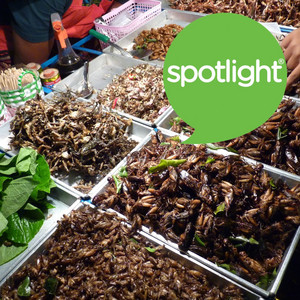
There are over 1,900 different kinds of insects that people can eat.
The most common are beetles and caterpillars.
Many people around the world already eat insects.
In fact, insects are part of the traditional diet of over two billion people.
For example, in China, some people cook insects over a They put the insects on a stick.
The cooked insects are served on the street as street food.
They are also served in restaurants where food costs a lot of money.
In the country of Ghana, people collect the termite insect in the springtime.
They grind the termites into a kind of powder similar to grain.
They use the ground termites to make bread.
Insects are a part of traditional diets because they are a very healthy food.
They contain almost as much protein as a serving of meat from a pig or cow.
Protein is a substance all people need to eat to stay healthy.
Insects are high in vitamins and minerals.
And insects are also low in fat and cholesterol.
Substances that are necessary for the body, but only in small amounts.
Eating insects is also very good for the environment.
Insects need fewer resources, like land and water, than larger animals.
90% of the fresh water people use goes to farming, and raising animals.
Marcel Dicke studies insects.
In a TED talk, he explained how insects also produce more meat from the food they eat.
For example, imagine a farmer.
Imagine the farmer feeds a cow ten pounds of food.
Those ten pounds of food produce about one pound of cow meat for people to eat.
However, imagine the farmer gives cricket insects ten pounds of food.
Those ten pounds of food produce nine pounds of cricket meat for people to eat.
Eating more insects can also help people in poorer communities.
Many people can raise and sell insects.
Raising and selling insects can provide a job and food.
But insects will not replace livestock meat very quickly.
First, people in some countries would have to change how they think about eating insects.
Many people in North America and Europe eat a lot of livestock meat, like cow and pigs.
But they do not traditionally eat insects.
They do eat some products of insects like sweet honey from bees.
But it is not normal to eat a whole insect in any form.
In fact, for many people in the West, eating insects sounds insane.
They believe insects are dirty and dangerous.
Insects make people feel uncomfortable.
Some people are trying to solve this problem.
For example, we talked about David George Gordon's recipe book at the beginning of this programme.
His recipe book tries to show people that eating insects can be delicious and easy.
Other insect experts travel and tell people about the great effects of eating insects.
But they still have a lot of work to do.
Another challenge is creating rules and laws for insect producers to follow.
There should be rules about how to raise insects safely to eat as food.
People also need to decide how to eat insects.
Will they be whole?
Will they be ground into powder like a grain?
Or will food scientists discover a way to take all of the great food substances from insects and serve them in a very different form?
These are all questions that people will have to ask and answer in the near future.
But there are people who want to answer those questions now.
José Andrés is a master chef in the United States.
He has won important awards for his cooking.
He serves insects in his restaurant.
He believes that finding new forms of food is important for the future.
He told the New Yorker magazine, We need to feed people in a sustainable way.
In the future, the people who know how to produce protein will have an advantage over everyone else.
Will insects become the world's main source of protein in the future?
Do you eat insects?
If you do, what insects are your favorite and how do you prepare them?
If you do not eat insects, would you start?
Let us know what you think.
Leave your comments on the script page of this program.
Or find us on Facebook.
Just search for Spotlight Radio.
The writer of this program was Liz Waid.
The producer was Michio Ozaki.
The voices you heard were from Scotland, the United States and England.
All quotes were adapted for this programme and voiced by Spotlight.
You can listen to this programme again and read it on the internet at www.radioenglish.net.
This programme is called Eat Insects. save the world.
We hope you can join us again for the next Spotlight program.