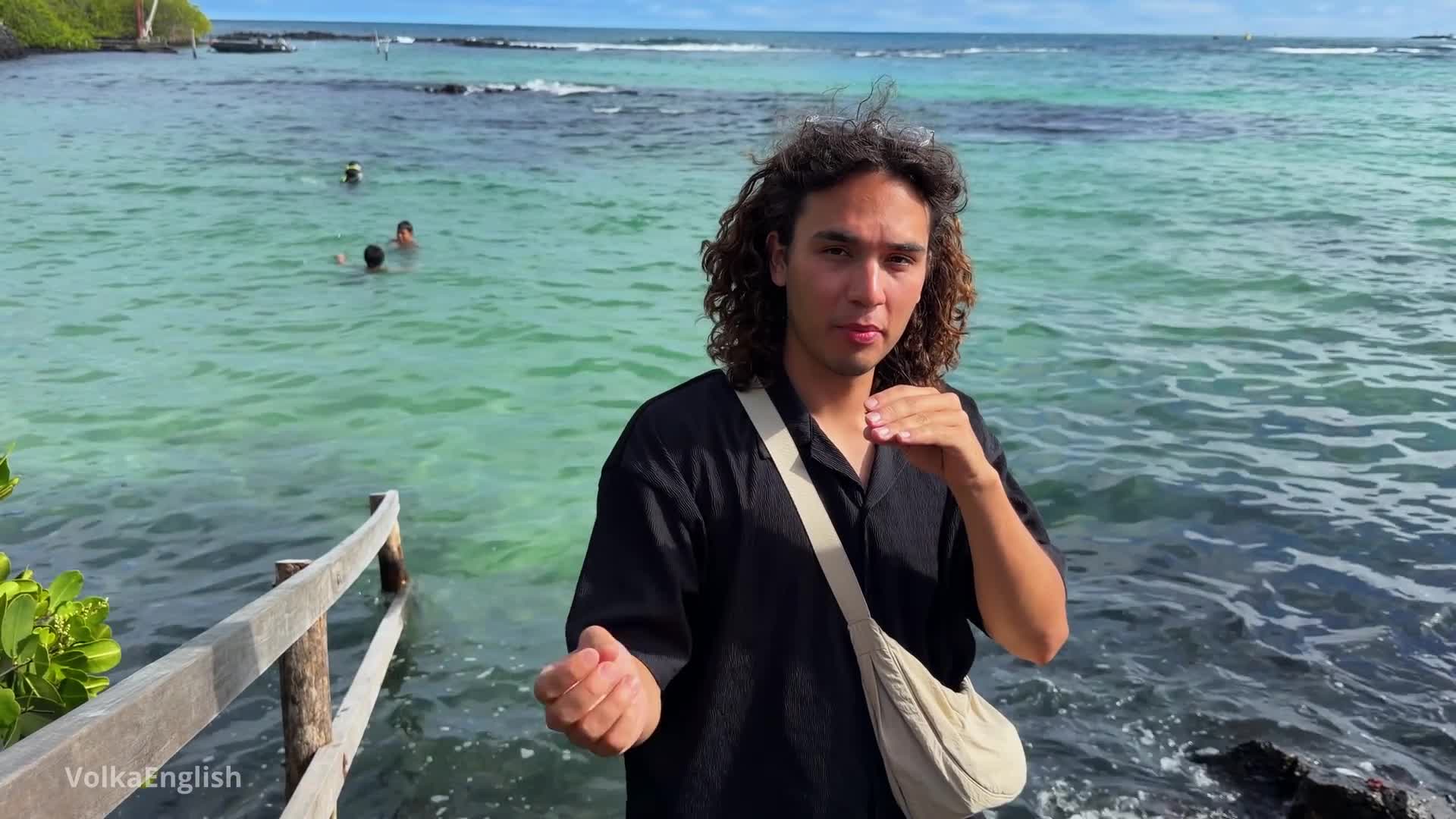
welcome back to another video guys today we're going to be learning easy beginner english with beautiful nature that's a yacht and over there there is a couple taking photos this is the skeleton of a whale right here this part of the ice cream is called the cone we are in the shade right now the tree is giving us shade just sleeping put your head in more start the word count and let's go You can see here, this guy is riding his bicycle.
So this right here on this side of the road is a bicycle path.
So this is just for bicycles.
And then that one is a one-way street.
One-way means it just goes that way.
Just goes that way.
That is a one-way street for the vehicles and also for motorcycles and stuff.
But yeah, you can see it just goes that way.
It's just one way.
And this is the hospital that apparently is very busy all the time, eh?
Yeah, the population has grown very fast and furious, and they can't cope.
I feel like a lot of people moved to the mainland, right?
Yes, I'm sure accommodation is more expensive here.
Oh, the ice cream is right here.
Oh, it's closed.
We were going to eat ice cream right here, but they're closed.
We had it earlier.
Earlier in the week.
Earlier in the week.
So they said there was another one way down there, but we have to go down there anyways to drop off this bag.
This right here, these are wetsuits.
This bag has wetsuits inside.
I think that's like some school activity or something going on over there.
Yep.
Right?
It looks like it.
I will have a look if I can see.
I think they're taking it down, though.
It's fine.
It doesn't look that interesting.
And they're dismantling the thing.
So this is just providing us a little bit of shade.
And this is the pier.
And this is where, like, boats come and you can get on, like, disembark or embark from here.
So the pier.
This is also where you get the taxi to go to Playa de las Alimanes over there.
So this is where you get boat taxis to different islands or different locations on this island.
But you get it from here, from this pier.
So there's two.
There's a boat taxi and then there's a ferry.
We can point out if I see one.
Those are all the taxis.
These are all numbered.
One, three.
That over there is a dock.
But this water is so blue.
It's like really nice.
This reminds me of water in... bam look at these sea lions you could literally sit on a bench right beside a sea lion look at those guys just sleeping right under this bench so i mean i guess if you're not careful you might accidentally step on a sea lion here although i would not recommend that because i think they might bite you because they're playful And when I was doing snorkeling, they would come and play around you and maybe give you a little nibble, a little small, soft bite.
All of these boats here, all of these boats are all anchored.
All these boats are anchored in the water here.
That's a ferry.
So you see the seats inside there?
So they go from island to island, between islands.
So that's a ferry.
It doesn't look like a traditional big ferry.
No, these ferries are just small.
And back there, you have the yachts.
That's a yacht.
That bigger ship is a yacht.
And there are also some cruise ships around here that could fit like 100 people.
I think 100 is the max you can have here.
You can only have a 100-person cruise ship.
Sorry about my beard.
I need a shave.
I haven't shaved in a while.
I'll do that tonight or today or tomorrow morning.
Right now we are just sitting on this pier.
Oh, these people are embarking.
They are embarking on that taxi.
So that right there is a boat taxi.
So they are going to embark and go somewhere.
I'm not really sure where.
They also call it a water taxi.
But yeah, they're walking down that platform.
They're walking down it into the boat taxi.
So here you can see the shoreline.
You can see the shoreline and this shoreline is very rocky.
There's not really a beach or anything very rocky shoreline, but i think there is a beach.
We can go to right that white white sand beach.
Yeah, we're going to do that, probably tomorrow when the weather is a little bit better, but this guy is huge.
Here there are some more sea lions.
It's only one, because he's so big it looked like two.
That is a big boy.
Yeah, I thought it was two-two, but it's only one big boy.
And the thing about these sea lions is that these sea lions are not scared of people.
Like, they're not scared.
Actually, most of the animals are not on the Galapagos.
So you could just be like this close to it, even this close, and they won't even do anything.
Look, it's got nails.
You see?
You see the nails on his flipper.
But yeah, this is a big boy.
And they actually poop like a dog.
Pretty much all the animals in the Galapagos are not scared of humans.
They are not scared of humans.
It is very hot.
So now I'm going to apply some sunscreen.
It's Korean.
Yeah, korean sunscreen.
My face is gonna burn and i'm you can tell.
I don't know if you can't tell on camera, but i am very tanned right now, my face at least is very tanned.
I'm gonna apply this korean sunscreen.
Where did you get it from?
From my favorite son, the one that loves Korea.
South Korea, obviously.
And who is that?
It's the one that recently vacationed with me.
Recently or currently?
Well, it's currently.
It's the one that is currently on vacation with me.
It's good sunscreen because it doesn't feel like oily or whatever.
No, it's really, really good.
You should bring me some more when you come home.
I usually hate putting on sunscreen.
No, me too.
I'm just going to take out my big hat because it's kind of sunny.
Go ahead.
Now she's taking out her hat from her bag.
So this is a sun hat.
You need it.
Now let's go drop this off.
The wetsuits.
Tighten this.
I'm going to tighten this so it doesn't come off.
So now we're in a souvenir shop. think we're gonna buy a souvenir this bird right here is the blue-footed booby a very famous bird from the galapagos and these right here are the giant tortoises this right here is a marine iguana this is a land iguana boobies flamingo sea lion iguana penguin giant tortoise crab hammerhead shark so we're in another souvenir shop looking for key chains these right here these are key chains All of these are keychains.
These are all the different types of animals you can find in the Galapagos.
All of these.
All right, let me show you guys something real quick, because I'm literally using today's sponsor, Filmora 15, to edit this video right now.
I'll show you three new tools I actually used today and you'll see the difference on my travel footage.
Let's go.
You know when a beautiful clip ends too fast and the moment feels rushed?
Watch this.
I hit AI extend and Filmora stretches the shot so it keeps breathing Naturally.
Now the scene feels cinematic instead of jumpy.
And I could let the English line sit so you can actually understand it.
Next is the pen tool.
This one is perfect for travel storytelling and teaching.
I can draw routes, circles, arrows, anything right in the video.
So when I say a word like ocean, boat, or beach, you see exactly what I mean.
Last one, animated charts.
I drop the numbers in and Filmora turns it into a clean animated chart in seconds.
It's a quick way to add info without killing the travel vibe.
If i've got a couple seconds smart cutout, lets me isolate a subject fast for teaching, clarity and overlays.
If you want to edit like this, get started with filmora 15 today using the link in my description.
Thank you filmora, for sponsoring today's video.
You like this.
It's the traditional color.
Yeah, i like this color.
It says national parking lot goes 85 us dollars, which is kind of a lot for this pants, but it's pretty, pretty thin.
You can you can roll it up like small.
It doesn't wrinkle either, so it's already wrinkled.
Yeah, i think it's a great traveling fan, so you might be able to.
That's what i was thinking.
Yeah, but you might be a little bit cold, like traveling specifically for like stuff like this, where you only want one bag or something and then you're gonna wear clothes a lot and you want everything light, like light pants very, very light.
Something like this is nice and then a t-shirt to match it.
There's also a different color, but i like this beige, this color, this beige.
Yeah, but this, this is going to be the one that you want.
I would get the beige.
Yeah, art movies.
So we're inside another souvenir shop here and these are all hand woven so you can see weaving.
These are all woven by hand and you see, these ones look good.
These designs they put effort into these designs like, i think this.
This looks like a, like a rock.
Oh, açaí.
That's like a Brazilian smoothie thing.
It's kind of like a smoothie.
Açaí bowl.
Let's just go and check the menu.
It's like a thick berry smoothie, but it's always super expensive.
Oh, let's go and check the... Açaí bowl.
Let's go check the menu.
Okay, let's go.
Now we're going to cross the street.
Once there are no vehicles, just cross the street.
It's like this berry that they pick in, like these really tall trees in Brazil, and it's like super popular in America now.
So these are the different ice cream flavors.
Okay so now we are having ice cream.
This right here, this part of the ice cream is called the cone.
And that is the ice cream.
So this is an ice cream cone.
And my mom also got one.
What flavor did you get, mom?
Sour soft.
I have the fruit, the sour soft.
So she got sour soft.
And I got, I guess, mixed berry with yogurt.
That's what I got.
But it's very good.
So where are we headed to right now, mom?
We're heading to the Charles Darwin Research Station, I guess.
Charles Darwin Research Station.
There are also two beaches over here.
One is called the Rat Beach, isn't it?
Ratoneras, yeah.
Yeah, so we're headed to the Rat Beach.
This is a police vehicle.
You could call it like a police cruiser in english, or you just call it a police car and we're walking on the side here, on the sidewalk.
It is pretty hot today and it's humid, since we are so close to the water so it is pretty humid.
But the path is actually kind of nice, like look at this, look at the way they cut these trees.
It's an umbrella, it's like this.
Tomorrow we're going to go to tortuga bay.
We're going to pack some snacks and lunch, we're going to make a sandwich or something and then we'll go and hang out there.
Oh yeah, this is so beautiful, that beach, so so beautiful Portuga Bay.
Is that like the super white beach?
Big, huge beach.
And you know what all that white stuff is?
Not sand.
You know what it is?
It's poopoo.
Yep, it's fish poop.
All the sand on the beach is fish poop from a parrotfish.
Parrotfish.
We are in the shade right now.
The tree is giving us shade and now we're not in the shade anymore.
So we are in the sun.
We're in the sun.
And that is the shade.
We just got to the beach, the entrance to the beach.
And now we're going to walk down this path.
But first, I'm going to take my shoes off and carry them.
So I'm going to carry my sandals.
Look at these finches.
I think we're birded out.
This is the path to the beach.
And this is just where you park your bicycles because no bikes allowed.
All right, you can see the beach there.
And all this right here guys, all this along here, that is volcanic rock.
Volcanic rock.
You got to be careful because you might stub your toe.
This is stubbing your toe.
When you hit your toe like wow, that is stubbing your toe, usually like that and stubbing your toe hurts a lot, so you don't want to stub your toe, but this is the beach.
I'll be honest, not too much of a beach.
A little small.
Compare today's with tomorrow's.
Yeah, so remember this beach, guys.
We'll see another beach tomorrow.
But this beach to me is very rocky.
The beach is very rocky and very small.
Of course, I don't think we're going to swim here because I don't even have my swim trunks on.
So right now we're at the Charles Darwin Research Station.
Charles Darwin.
So if you didn't know, Charles Darwin came here to the Galapagos Islands.
And this is the Charles Darwin Foundation as well.
Is this him?
And what is Charles Darwin famous for?
For his theory on evolution.
Yeah, his theory of evolution.
The theory of evolution.
Charles Darwin.
That is what he is famous for.
So these are the tortoise shells.
Guess those ones are older.
Please do not touch.
How old is this one?
Okay, so there are two tortoises the giant tortoise, all from different volcanoes, around 6 300 or 6 300, and then this one, 2 600 or 2 600 oh, and number one is 120 plus years old.
That one, this one, there are only 250, making it critically endangered because there are only 250.
So this one is extinct.
That means there are no more of these tortoises.
So this is what they look like and that is a map.
That is a map of all the tortoises in the Galapagos archipelago.
That's what they look like when they hatch of cute.
What bone is this?
This is oh, a sperm whale.
Sperm whale jaws.
It's huge.
So i guess it's this part right here.
Did you know that darwin and wolf island have the largest concentration of sharks on the planet?
So, darwin and wolf, We saw 20.
20 of that largest concentration.
Yeah.
And we made it out alive.
Yeah.
This is a hammerhead shark.
This is a tiger shark.
Where's wolf?
Wolf is one of these, huh?
I think they're smaller islands right here.
Those, they're right here.
They're small.
But yeah, we saw, I saw 20 sharks.
20 sharks when we were snorkeling. they're harmless though these sharks don't attack you but i saw 20 in the water so this is the skeleton of what is this some sort of whale this is the skeleton of a whale so the skeleton of a whale or the bones of a whale so we started we started here and then we went there and we went all around here all around all the way down here and then here and then back to here so we did this we did this whole loop right there and then we did this and then we were dropped off there so I think this is the shark we saw 20 of that right there is the blue-footed booby birds this is the spine the spine of a dolphin it looks like the spine of a dolphin and then just a bunch of other animal things very cool oh and here's like the full skeleton of an owl oh no full skeleton of a blue-footed booby and then this is the skeleton of an owl and that is an owl so you have the the long neck tortoise the short neck tortoise and then the sea turtle and then all their shells iguana it's a marine iguana that is a big that's a big shell though charles darwin perhaps i'm charles wood darwin put your head in more more that's the max oh your head's too fat or your charles darwin looks like me by the looks of it okay so we're headed to the second beach The rat beach.
So we're headed to the rat beach.
I'm not sure why they call it the rat beach.
I hope it's not because it's filled with rats because they do control rats here in the Galapagos.
They try to kill all the rats so they have rat control because they are bad for the animals.
I don't think this is it.
I think it's more down there.
Yeah, a little bit more down.
It's just to see the iguanas.
This is a beach.
This is the beach.
Look at this beautiful view.
The waves back there are crashing against these rocks here.
These are all volcanic rocks.
It's a little overcast today.
So there are a lot of clouds in the sky, a lot of clouds in the sky.
But one benefit of all the clouds in the sky is that it's not too sunny.
Not too sunny so that you know we don't burn our face and our skin and anything, because i've already burned.
Same with my mom her shoulders are burned.
So one benefit.
And it's also not too hot, so i'm not sweating like sweating a lot.
But uh, let's continue to the rat beach.
Eh, your shoulders are burned.
There are a couple of kids surfing over there in the water and over there there is a couple taking photos, maybe anniversary photos or wedding photos or something.
Okay, guys.
So we just got back to our hotel room and i'm pretty tired.
We were walking for about four hours.
I think now we're just gonna relax and then go out at night to the night market and get some food at night.
Okay, so we are now out.
It's like 6 pm and we're just gonna grab a quick bite to eat.
I'm pretty hungry.
Oh, i see meat on a stick over there.
The guy is cooking up some meat on a stick.
Maybe that will be the dessert when we come back, but anyways, we're gonna get some food now.
I'm not really sure what we're gonna eat.
I usually do like eating meat on a stick, and they have my meat on a stick.
But that's also the first place we saw.
So we're just gonna keep on walking and see what else there is.
Yeah, just so you know, it will be cheaper here because this is all residential area.
Yeah, this is where the locals are.
I have empanadas here.
I already checked out.
Empanadas here to the left.
And then the guy in that car, he was selling humitas.
But I think it's only sweet ones.
That's fine.
I wanted to bring a bag.
You want to buy some?
Yeah.
Take with us?
Of course.
For tomorrow or to eat it for breakfast?
This guy here on the left.
Breakfast.
Should we buy some now?
Buy some after.
He should still be there.
He's just going to eat quickly.
Yeah, I don't want to stay here.
I'm kind of tired.
Yeah, me too.
I woke up at 5 a.m.
And now in seven days of snorkeling and hiking.
And then you added four more.
I can do it.
So I guess this is a popular street where you can eat.
That side is busier because they catch the guys as they turn the corner.
We've eaten here a long time ago.
Seafood.
Okay, so now we're eating dinner here.
Right, mom.
Yes, i'm having uh, what am i having?
Seafood soup, seafood soup, and i'm having beef soup, a beef soup.
And look at our view here.
Nice view.
What do you have there?
I have two empanadas.
Two empanadas just for you yeah not, none for me, no.
Well, the one with all the sugar is yours, Yeah.
So she has two empanadas and we're about to eat these.
They were $1.50 each.
But they're heavy.
Yours is really heavy.
I'm sure it's got a lot of cheese in.
Here is my empanada.
It's good.
Hola.
Buenas.
¿Cuánto el helado?
Un dólar.
Un dólar.
Un dólar de vainilla o mixta.
Un mixto.
I guess we gotta come back tomorrow and get the... Yeah, mañana.
Mañana regresamos por el coco.
Gracias.
Hasta luego.
Buenas noches.
This is ice cream.
I had to support your boy.
If you guys want to become fluent in English, it's important to improve how you speak.
You guys want to improve your pronunciation, your accent and, most importantly, your confidence when you speak english?
Then check out my patreon in the description there.
I help you master these three things with videos every single week.
So if you want to become fluent in english and sound like a native english speaker, check out my patreon and i'll see you guys there.
If you guys want to get the 3000 most common english words, it's in the description.
This was my favorite comment from last video and these were the top three countries you were from last video.
And then that one is a one-way street.
We had it earlier earlier in the week.
This right here.
These are wetsuits.
This bag has wetsuits inside and this is the pier sea lions.
That's a fairy.
That's a yacht.
Like they're not scared.
This bird right here is the blue-footed booby.
Looking for keychains.
It doesn't wrinkle either.
Because it's already wrinkled.
Yeah.
And these are all hand-woven.
So these are the different ice cream flavors right here.
This part of the ice cream is called the cone.
We are in the shade right now.
The tree is giving a shade.
You got to be careful because you might stub your toe very rocky.
So this one is extinct.
The largest concentration of sharks on the planet.
This is the skeleton of a whale.
This is the spine and then this is the skeleton of an owl.
And that is an owl The long neck tortoise.
The short neck tortoise.
The waves back there are crashing against these rocks here.
And over there, there is a couple taking photos.
This is where the locals are.
Now, well, the one with all the sugar is yours.
And remember, guys, you will become fluent in English.