We are passionate about exotic fruits and guarantee a worry-free shopping experience.
Leave your name and phone number, and our customer service team will reach out to you within 24 hours.
Your satisfaction is our priority.
This is me hitting another dead end on the trail of a fruit that can be kind of hard to get hold of here in the US.
I also had a hard time finding a fresh one.
The first two places I called only had frozen.
The third place I called their website had almost no English on it and the person who answered the phone struggled to understand me.
Hi, do you carry fresh durian?
Yes.
D-U-R-I... Yes, durian.
Yes.
A few phone calls later, I ended up tracking down the goods too.
My durian dealer texted me pictures of a couple of options to choose between.
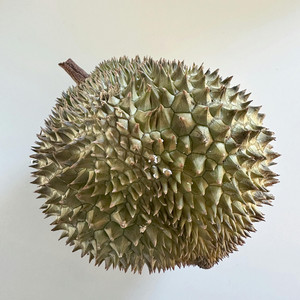
Check out this durian.
$110.70.
I guess it is.
I can't actually read how heavy it is in Chinese.
We were undaunted.
We were determined to get a hold of a fresh durian.
We, of course, are Gastropod, the podcast that looks at food through the lens of science and history.
I'm Cynthia Graber.
And I'm Nicola Twilley.
And this is an episode about how shall I put this fruit.
That is not normal, at least here in the US.
These are fruits that are deeply beloved in some places and totally unknown, or even kind of feared, in others.
The durian is one.
It's a fruit probably most of you have at least heard of.
The other one that stars in this unusual fruit episode is called the fejoa.
That's how I pronounce it because my only experience with this fruit was in Colombia.
Whereas in Los Angeles, where I am based, it's called the pineapple guava and many English speakers call it the Fijoa.
So what makes these fruits so beloved in their home countries and why is it so hard to get a taste of them here?
This episode, what do the weird fruits of the world have to tell us?
This episode was supported in part by the Alfred P Sloan Foundation for the Public Understanding of Science, Technology and Economics.
Gastropod is part of the Vox Media Podcast Network in partnership with ITER.
Before we start tasting all sorts of new fruits, we wanted to remind you that there's still time to sign up as a special supporter and get the invite to our exclusive, once yearly fan favorite gastro hang.
It's going to be taking place on October 8th.
You can get on the invite list at gastropod.com slash support.
We welcome your support at any time, of course.
But if you want to hang out with us on October 8th, sign up by September 26 at gastropodcom slash support.
Support for this episode comes in part from Starbucks.
Fall is finally here.
After a summer full of beach days and backyard barbecues, those moments can't touch the best that fall has to offer.
Starbucks Pumpkin Spice Lattes.
Embrace fall with the seasonal classic, pumpkin spice latte.
Handcrafted with Starbucks signature espresso, steamed milk and real pumpkin, then topped with whipped cream, cinnamon and nutmeg for comforting tastes of fall.
Starbucks pumpkin spice latte.
Get it while it's hot.
Or iced.
Support for this episode comes in part from Anthropic, the team behind Clawed.
Every ingredient has a story, but connecting these culinary dots across history and science takes real exploration.
Clawed is an AI thinking partner for food lovers who enjoy digging deeper.
Instead of quick answers, Claude can help you trace how ancient agricultural innovations shaped modern cuisine, or how chemistry explains why certain flavor combinations work perfectly.
Try Claude for free at claude.ai slash gastropod.
I don't remember the first one because I was so young.
My parents had Feijoa trees like as a hedge planted around their orchard.
Kate Evans is a science journalist and the author of a new book called Feijoa, a story of obsession and belonging.
The earliest memories that I can sort of actually access are coming home from school on autumn afternoons, like walking up the driveway with my backpack and chucking off my backpack and just eating a bucket full of Feijoas.
A bucket full of fruit most Americans have never heard of.
They look kind of fairly nondescript, like you'd imagine sort of an egg-sized, bright green fruit.
And because they're green, people tend to think that they're unripe, but they're green the whole time.
Looks wise, the Pejoa is not going to stop traffic, but it has more important things going for it.
What's special about them, I think, is the smell.
As soon as you cut one open, this really distinctive smell comes wafting out.
They've got a really strong fragrance and it's really hard to describe.
It's been variously described as like a mixture of raspberries, pineapples and banana, and then okay, what you're looking at when you've cut it in half is it's like jelly, like stuff in the middle and then around the edge it's gritty and creamy colored, and so the texture is also quite interesting, because you've got grittiness and then you've also got jelly likeness.
It doesn't sound very delicious when you describe it, does it?
But it is incredibly delicious.
When I had my very first one in Colombia.
I loved it so much that I was super excited to find feijoa ice cream a couple of days later, and then feijoa liqueur at a fancy restaurant after that.
The fruit is not the only part of the feijoa you can eat, though.
The flower also sounds pretty tasty.
They flower in the kind of late spring for us, early summer.
They finish kind of just before Christmas time for us, because we have Christmas in summer obviously.
And their flowers are beautiful.
They've got like white petals and bright red stamens.
So they're quite sort of Christmassy flowers, which is nice.
And you can actually eat the white petals as well.
They're really sweet and they taste like cotton candy. or like marshmallow.
These sweet flowers appear in the summertime, but the fruit is finally ripe and ready to eat in the fall, which is around April in New Zealand.
We don't have many deciduous trees, but we do have feijoas.
And so it's really associated in my mind and for a lot of other New Zealanders, with the kind of change in seasons.
Somebody also described them to me once as a consolation fruit.
It's a consolation for the end of summer.
Summer's over, but at least you've got feijoas.
And in fall, the feijoas literally fall.
That's how you harvest them.
Oh, you know it's ripe because the tree throws them to the ground for you to eat.
It's very convenient.
Basically, as soon as they fall, that's the perfect moment that they're ripe.
There are so many Fejoas at that time that sometimes they're called lawnmower fruit, because some people just literally roll their lawnmower right over the fruit and create a sticky mess rather than bothering to pick them up.
We definitely call it the glut here.
Fejoa season means lots of Fejoas and Fejoas mean a lot to New Zealanders.
We're quite obsessed with them here.
And they've become quite a kind of a symbol of home and identity for New Zealanders.
Kate didn't even realize how much these fruit felt like home to her until she lived in Australia.
The Hoas aren't well known there, though you can find them if you look hard enough.
I used to try to buy them from the markets in Canberra and would pay like three or four Australian dollars for a single Fijoa.
Which, if you're used to getting them from your neighbors for free, feels kind of extortionate.
But that's how important they were as a taste of home.
Still, the true weight of that importance didn't really hit Kate until she moved back to New Zealand after living overseas for more than a decade.
Like when you're an expat New Zealander you come home in summer, you come home at Christmas, you come home December, January.
You're never home in April in Feijoa season.
And so I was so excited to be back for a whole Feijoa season and just eat, you know, buckets and buckets.
And just having lived overseas and coming back and thinking about what it meant to be a New Zealander and the sort of idea of return and a sense of place.
But Kate also realized that even though she thought of the fruit as typically New Zealand, it's actually not from there.
The Te Hoa originally is from the other side of the planet.
The feijoa comes from Uruguay and the highlands of southern Brazil.
I just was really curious.
How do they get from Uruguay to New Zealand?
How do they become the taste of home for me when they come from this completely other place?
And that was the start of 10 years of writing a book.
Oh, tell me about it.
10 years per book is about my pace too.
10 years might sound like a long time for a book, but the Feijoa has been around for a lot longer than that.
Yeah, if I go back to the 23 million years ago, the Feijoa was evolving in this South American forest with all kinds of strange and interesting creatures.
Giant terror birds with beaks like meat cleavers and sort of early mammals and all kinds of things.
The terror birds sound pretty terrifying, but the Feijoa was probably more interested in the mammals, to be honest.
Birds have really good eyesight, so fruits that appeal to birds are typically colourful and they don't have a very good sense of smell.
So smell isn't so important for bird spread around seeds.
Also, like, the size of the seed is important.
It's sort of tailored to the size of the animal.
And so it looks like for feijoas, which are kind of boring coloured but strongly smelling.
They're sort of designed to appeal to mammals.
But Kate also said the petals of the flowers are delicious and it turns out that those flowers don't make any nectar.
So what's pollinating them?
Cynthia, you are not the first person to wonder this.
Okay, so there was this German guy in Brazil in the 1880s and he really wanted to know what was pollinating the Fijoa bush in his garden.
This German guy was a naturalist and friend of Charles Darwin, and he decided that there was only one way to get to the bottom of this botanical mystery.
He set his five-year-old grandson the task of sitting by the tree and making a note of any bird that came to visit the bush.
And this was a very well-behaved five-year-old because he actually did the task.
He sat there and he said, quick, grandpa, come, come.
There's a black and brown birds are in the feet of a tree.
A black bird is eating the flowers.
And so he came and watched the bird pulling off each of the petals and brushing the Feijoa pollen over its feathers in the process.
And that was how he discovered that Feijoas are bird pollinated.
This is actually pretty weird, because most plants that are pollinated by birds attract those birds with nectar that the birds can sip and get at the sugar.
Fijoa is not like that.
It's extremely unusual in this sense.
Instead of providing nectar, it provides food.
It provides sort of fruit-like petals.
And this is the reason that the petals are so delicious to eat is they're full of sugar.
They're really juicy and they actually attract birds to eat these little white petals and, in the process, pollinate the flower.
But it's a really unusual strategy among plants.
It was a German naturalist, with the help of his five-year-old grandson, who figured out this strategy.
And Germans turn out to be all over the Feijoa, botanically speaking.
Its scientific species name is Celloiana, which comes from another, even earlier German guy.
Friedrich Cello, who was a German naturalist and explorer who left his home in Prussia, in in what's now Germany, in 1815 to travel to Brazil to try to discover new plants.
Basically was his aim.
Sela was part of a whole community of people at the time who were entranced with the idea of exploring the world and quote, discovering and naming plants that Europeans, at least, had never heard of before.
It was a very exciting time for botany in general.
Alexander von Humboldt was kind of a global celebrity.
He was a naturalist who had traveled to Colombia and Venezuela and other parts of South America and had a bunch of epiphanies about sort of the way that nature was interconnected and was traveling around Europe giving speeches and writing articles and writing letters.
And there was another generation coming up of young naturalists who wanted to be just like Alexander von Humboldt.
Friedrich Sello was one of these Humboldt fanboys.
As a teenager, he apparently trained himself for the rigours of botanical exploration by sleeping outdoors on bare earth, washing outside in winter and eating raw fish and freshly slaughtered poultry.
In his early 20s, he got funding to travel, and he decided to head to Brazil.
Now, until this point Brazil had been colonized by the Portuguese, but any information about the country, like the plants and animals that were there, was kind of considered a state secret and other Europeans weren't allowed to visit.
But that had just changed, thanks to Napoleon, who had invaded Portugal, which led to the, At which point Brazil opened its doors to other nationalities for the first time.
It was kind of this whole new exciting territory.
In Brazil, Zelo met up with a fellow explorer and they set out to collect samples of plants and animals.
They had all kinds of adventures with giant spiders and shooting birds so that they could stuff them and put them in their barrels and send them back to Europe.
It was all super fun, until it wasn't.
He travelled around Brazil and Uruguay on the back of a mule for...
16 years until he unfortunately drowned in a river.
Before he met his untimely demise, it seems like he sent a number of samples of the Feijoa plant back to Europe, but only one of them made it.
A number of the other ships that Selo had sent his material in had caught fire and sunk.
But the Fijoa did make it and it was sent back to the Herbarium in Berlin awaiting discovery and description, which took another 30 years.
That was the very first Fijoa to make it to Europe, the one that all other Fijoas are named after.
And it was off to a slow start.
It was ignored for 30 years and later tragedy struck again, meaning that we don't really know anything about that very first Fujowa specimen.
What's missing from Sello's records is his botanical notes, which probably existed.
They may have contained a description of where he found the Fijoa and what he thought of it, what his first impressions were, which is the kind of thing I would have loved to have found.
But unfortunately the Berlin Herbarium was bombed by the British in World War II and millions of botanical specimens were destroyed, and probably Salo's botanical notes, if there were any, would have been in there, so it's one of the things that have been lost to history.
But that dried sample in the herbarium was enough to eventually earn the fruit its Latin name, as Kate said.
And that name was bestowed by a guy who'd never met Sello.
So the sample that Sello sent back to Berlin and was sitting in the herbarium sat there for decades.
And eventually, a scientist called Otto Karl Berg came across it.
He wasn't an exploring botanist.
He was a hanging out in the museum botanist.
They spent...
60 years or so, working on this massive document called the Flora Brasiliensis.
I think the idea was to catalog, like, literally all the plants of Brazil.
The Fijoa sample Salo had sent was probably from Uruguay, not Brazil, but never mind.
Berg decided he would call this new fruit Saloiana, in honor of the guy who first mailed it to Europe.
So that was one part of the name, but a Latin botanical name has two parts.
And so he looked around for another name and came up with Fijoa, which was the name of a Brazilian naturalist called João da Silva Feijão.
I don't know why he chose this guy.
I don't know if they were friends, if he just thought there was a Brazilian connection there or he wanted to honor him somehow.
But that led me down a whole new path of exploring João da Silva Feijão and his story, which was also fascinating.
So this guy João was kind of a jerk.
He left his wife and kid and he refused to pay child support until he was forced to by the government.
But it turns out that Feijó wasn't actually his given name.
He was originally João da Silva Barbosa.
But when he went to university, he was so captivated by the writings of a Spanish philosopher monk from the 17th century, so 100 years before.
His name was Benito Jerónimo Feijó.
And so João adopted the last name Feijó, or in Portuguese, Feijó.
And although we are not big João Feijó fans, the original Spanish Feijó sounds amazing.
Awesome.
He was the eldest child from a wealthy family, but he gave it all up to become a monk and study his whole life and he became very enlightened, especially for his time.
He wrote a whole treatise about how women were just as intelligent as men and deserve to do any job that men can do, and that maybe, if men treated their wives with a little more respect for their intelligence, women would be less likely to commit adultery.
Love it.
On top of that, he was also a committed debunker.
He fought against popular superstitions like menstrual blood is poisonous, goblins exist.
And another of my personal favorites.
He argued that Jews do not in fact have tails, which I can say from experience.
He's right.
But it was a common and very anti-Semitic belief at the time.
So ultimately, the fruit is named in part after someone very cool.
That said, at that point in history, all any Europeans really knew about the fruit was its name.
They didn't know about the marshmallow petals or the raspberry pineapple banana aroma.
That one sample fruit cello scent was dried.
About 30 years after the plant was given its botanical name, another intrepid traveler finally brought a live tree back.
So the next sort of character in the story of the Fijoa is a French landscape gardener called Edouard André.
He was also a really interesting guy.
After his wife died he was heartbroken and he went off to Colombia and Venezuela.
He sort of followed in the footsteps of Humboldt looking for more plants.
He traveled to Uruguay too, and he was looking for all sorts of exotic plants to bring back to France.
And there he found the Fijoa, and he brought it back with him to the south of France and grew it in his garden on the French Riviera, near Cannes.
And he grew the first Fijoa in Europe and He waited seven years for it to flower and fruit.
And when it did, he was able to write an article which made a big splash all around the world.
It was in rural newspapers in New Zealand and Australia, this new fruit that he was introducing.
And then he was also conveniently selling cuttings of the thing.
So most of the Fijoa plants in New Zealand and in the United States descend from this one plant that he brought back from Uruguay.
This was right at the end of the 1800s, and it truly seemed as if the Fijoa was poised to be the next big thing in fruit.
But, and this is not a spoiler, it obviously did not end up taking over the world.
So what went wrong?
That story coming up after the break.
Fox Creative.
This is advertiser content brought to you by Vitamix.
Throughout human history, in homes and restaurants in every corner of the planet, kitchens have always been full of noises.
Okay, so long before the buzz of the fridge and the whir of the Vitamix, the story of kitchen noise started with the sound of fire.
Its crackle has been part of the Essential Kitchen soundtrack for over 1.5 million years.
With the Stone Age came Essential Kitchen tools like the mortar and pestle, rolling pin, the knife and even the humble spoon.
Skip ahead a bit, and we have the modern kitchen.
Following the Industrial Revolution of the 1850s, electricity brought a whole concert of beeps and buzzes.
First there was a dishwasher in the late 1800s, the garbage disposal in the 1920s, the electric blender in the 1930s and the microwave shortly after that.
But all these sounds from across kitchen history the clank of the mortar and pestle, the buzz of the Vitamix, the click of the stove form the course of experimentation, nourishment and love that fill the kitchen up.
Kitchen noise is nothing short of the sound of joy.
Dinner is served.
Vitamix knows your blender is one of your kitchen's essential noisemakers.
Its whirring is the sound of making your family's famous hummus the creamiest strawberry smoothie, or that perfect summer pesto to enjoy around a crowded, noisy table.
Add a little more joy to your kitchen and shop only the essential.
Like the new Vitamix Ascent X5 at Vitamix.com.
Support for this episode comes in part from Life Kit.
Life doesn't come with a manual, but we all have times when we could use a little bit of guidance.
That's what the Life Kit podcast from NPR is here to provide.
From fitness routines to mental resilience, navigating personal goals to tackling burnout, Life Kit offers real stories about real people dealing with real issues.
There are thoughtful conversations that unpack the emotional and practical side of personal wellness.
There is actionable guidance you can actually use.
No fluff, no judgment.
And there's expert advice from trusted voices to help you take the next step.
If you're looking to move with more intention or just need thoughtful guidance on living better, LifeKit delivers strategies to help you make meaningful, sustainable change.
Get help tackling common issues like relationships, finances, parenting, and your career.
Then walk away with a game plan you can implement right away.
Recent topics include how to avoid mosquito bites, how to grow your dating confidence and how to accept compliments.
LifeKit isn't just another podcast about self-improvement.
It's about understanding how to live a little better starting now.
Listen to the LifeKit podcast from NPR.
Support for this episode comes in part from Starbucks.
And just like that, we're into the fall season.
I love fall because I love watching the leaves turn glorious shades of yellow, red, and orange.
I love breaking out my favorite cozy sweaters and roasting seasonal Brussels sprouts.
We are on team Brussels sprout.
And of course, all the squash.
What's more, now you can enjoy one of fall's greatest traditions, and that's getting yourself a pumpkin spice latte from your local Starbucks.
That's right, PSL is officially back.
Handcrafted with Starbucks signature espresso, steamed milk and real pumpkin, then topped with whipped cream, cinnamon and nutmeg for the comforting tastes of fall.
Real pumpkins are harvested to make the iconic pumpkin sauce used in your favorite fall drinks like the pumpkin spice latte or pumpkin cream cold brew.
So now that fall is in full swing, coffee lovers everywhere can return to Starbucks cafes to embrace all the warm moments that come with the fall menu.
Starbucks pumpkin spice latte, get it while it's hot or iced.
Edward Andre did make millions of dollars off his horticultural treasures.
Today, we might accuse him of botanical piracy, but that wasn't the point of view at the time.
But the Ferro wasn't his big moneymaker.
Still, some people were intrigued by the plant and its fragrant fruit.
One of the people that bought one of his plants, said In California, was an Italian nurseryman called Francesco Franceschi in Santa Barbara.
And he was another Fido booster.
He was convinced it was going to be the coming fruit of the century.
Francesco Franceschi was born with a completely different name in Italy, but relocated to Santa Barbara, age 50 and reinvented himself as a plant guy.
He was known for his distinctive wardrobe.
Apparently his look included baggy trousers and a small tamashanter tilted on one side of his head but also for being a passionate one-man hype machine for exciting new plants.
He imported hundreds of new species to Southern California in the early 1900s.
Some were ornamental, some were edible, but there were two edible plants he was betting were going to be huge.
Him and a group of other nurserymen in California at that time were really, really excited about the Fijoa and they believed it had a huge potential.
They also thought the avocado had a huge potential.
Many of the same people working on the avocado were the same people that were working on the Fijoa, but they had a lot more success with the avocado, it turned out in the end.
In his writing, Franceschi claimed that quote all persons who have had the chance of tasting the fruit of Fijoa.
He put the name in block caps just for additional oomph.
He said all persons are unanimous in stating that this is the best introduction in its line during the last 10 years.
And some people agreed.
One early adopter said it was the most valuable new fruit that had been introduced in California in years.
But the nephew of the famous steel magnate, Andrew Carnegie.
His nephew Thomas, said the fruit is about the size of an egg and entirely unfit to eat.
Not a great review.
And ultimately, the Feijoa just never picked up critical mass.
The main boosters sort of got distracted with other projects.
But yeah, it never kind of made it commercially in the United States.
That said, if you're lucky enough to live in California, you can still get a hold of feijoas.
Like I said here, they're usually called pineapple guavas and they're in season from October to December.
There are street trees planted all over Sacramento and LA and Santa Barbara.
You can find pineapple guavas in a lot of places here.
I think they're often planted as ornamentals for the beautiful flowers.
But one of the guys I talked to in California was saying he would have to go and crawl around other people's trees collecting their feeders and having to convince them that they were actually edible.
But it's really just in California that they took off here in the US, and most people there don't even eat them.
So maybe it's not surprising that Americans and the American government might not believe that there's a fruit called the Ferroa.
There's a New Zealand vodka company called 42 Below and one of their kind of famous flavors is the Fijoa-flavored vodka that came out of New Zealand in the early 2000s.
And when they were trying to export them to the US, they were turned down by the FDA, because the FDA said I'm sorry, but Fijois don't exist.
This story may be apocryphal, but I love it anyway.
Yeah.
I mean, no one ever accused the government of knowing everything.
Meanwhile, even as the Fijoa was trying and failing to make it big here in the US, it was also falling out of favour in its original homeland of Brazil and Uruguay.
I was really surprised to discover that the Fijoa was a lot less famous in South America than it was in New Zealand.
Part of the problem, at least in Brazil, is that the fruit grows in the highlands, where it can actually get pretty cold, and that's not where Brazil's big cities are located.
And so people in the city don't really know what it is and the people in the rural areas know.
But again, it's the native range and there's a lot of fruit fly there.
The fruit are small.
Basically no one has taken the time to select the best and most delicious varieties in Brazil.
There are a lot of pests that attack the tree.
And so the fruit is a little hit or miss.
In Uruguay.
The reason they're not as well known there it's that the country had a particularly horrific and extensive slaughtering of the indigenous population.
And many of the people who did survive that history ended up rejecting foods that had been related to their indigenous culture as part of the process of assimilation.
So most Uruguayans don't even know the Fejo exists.
Some activists and chefs there are trying to revive it these days, but it's got a long way to go.
Still, Kate says that there are some groups of people who appreciate the feijoa, at least in Brazil.
The indigenous peoples of these areas still know the feijoa.
They still have traditions related to them.
The Afro-Brazilian communities as well, after five generations in the same spot, have also developed traditions of them.
Oddly enough, there is one country in South America where the feijoa has become super popular, and that's Colombia, even though Colombia isn't where the fruit is originally from.
Starting in the 1980s, a group of people in Colombia were really worried about Colombia's dependence on the international coffee price.
Colombia is really dependent on two main crops that begin with the letter C.
Only one of them is legal.
But with the massive fluctuations in the prices, the country was pretty vulnerable.
And so they were trying to diversify the plants and the foods that Colombia was producing.
And so fidoa was one of the things that they were, or fejoa, as they call it, was one of the things that they were experimenting with.
And they planted out a whole range of different varieties in order to select varieties that did really well in their climate.
And it worked.
The feijoa grew fantastically in Colombia.
It's been such a success that you can find them everywhere.
And everyone I was hanging out with in Bogota certainly knew about them and enjoyed them.
One of the feijoa growers Kate met with in Colombia thinks the fruit could even be a good replacement for cocaine, at least in terms of farmers' incomes.
Although the three- to five-year wait to harvest fruit after planting an orchard makes it tough for small farmers to get on board.
But that said, outside of Colombia, there are literally only a small number of countries where this fruit is popular.
Apparently, some of Edouard André's fejoa plants traveled east from France and now they flourish in Georgia and Azerbaijan and they're popular there.
But the place where they're most beloved is Kate's home country of New Zealand.
If you remember, that's one of the places where Edouard André sent his French fijoas in the early 1900s, and they found an enthusiastic reception.
In the 1920s.
Another nurseryman in Auckland, Hayward Wright.
He really set about kind of promoting it in New Zealand through lots of newspaper articles and he was selling them in his nursery as well.
And they were promoted as backyard trees.
And they were kind of, I think I remember one headline said, lovely and useful, women should insist.
That was the whole headline.
But the idea was that women should insist on having a fito tree in the garden so they could make jams.
And unlike the boosters in Southern California who thought that fejoas would be huge in America, the New Zealand headlines were right.
People did start planting them prolifically all over the country.
In New Zealand, the climate seems to be perfect for them.
You really don't have to do much to look after them.
And because they're outside of their native range.
Until very recently, there were no natural pests of them.
So they just thrived.
And again, unlike in Southern California...
People in New Zealand actually ate their backyard fruit.
They started turning up in kind of recipe books and jams and in cakes, in various kind of mid-century flour and butter-based deliciousness.
Still today, people are coming up with creative uses for their fejoglat when it's the season.
We make all kinds of things out of them.
My favorite is a sparkling Fijoa wine that I used to drink when I was like 16 and still do today.
But there's yogurt and ice cream and like ice blocks and lollies and beer, like cider.
There's like Fijoa cider.
There's beer.
There's little like chocolates with Fijoa centers.
There's so many.
Yeah.
Because you need something to get you through the like nine months of the year when you have no fresh feijoas.
Obviously, the feijoa is adored in New Zealand and that's definitely one marker of success for a fruit.
But it's not a commercial success.
So why hasn't the fresh feijoa made it onto supermarket shelves?
One reason might be that they grow so well in people's yards that nobody has had to buy them in the store.
But also it's just really rare for a newish fruit or vegetable to become the next big commercial success.
I didn't really realize this until I was researching, but actually there's very few plants that in the last century have kind of made it big.
There's the kiwi, there's the avocado, but there's just like a handful of things that have kind of made it out of the background and become huge in the last century.
And so maybe it really takes a lot for something to kind of get over that hurdle and really become kind of internationally ubiquitous.
We ask a lot of our commercial fruits.
They have to be uniform and high-yielding and sturdy enough to be shipped around and, most especially, they have to have a long shelf life, which usually means yes, I'm going to say it refrigeration.
The feijoa just falls off the tree when it's ready to eat, and then it's really something you need to eat right away and they don't keep well in cold storage.
While that might be frustrating to growers who want to make money off this locally prolific fruit, Kate said she's actually glad the feijoa never sold out and became a commercial hit.
One of the things that's so special about Feijoas is the seasonality, like the time boundness, the fact that you have to wait until next year for it.
And that's part of what gives it its sort of emotional power and for the smell to bring back memories.
Whereas like a strawberry is available all year round anywhere you go in the world.
And that ubiquity is like, you know, obviously people make money and it's...
You know, it's maybe good for the plant.
I don't know.
But what makes the Feijoa special, in fact, is that it's geographically specific and temporarily specific.
And I think if it was planted out in big plantations in California, it would have lost that.
We probably would have solved the storage problem that they have.
You'd be able to get them all year round and...
Yeah, maybe they wouldn't mean as much to us.
And I think the kiwifruit is the perfect counterfactual.
It's a huge industry.
Like New Zealand makes a lot of money from kiwifruit, but we don't care about them.
Like they don't mean anything to us.
We don't share them.
We don't tell stories about them.
They come from another country as well, but they really have not made their way into our hearts the way that the Fijoa has.
If all of this has made you eager to try a Fijoa for yourself, you are not alone.
Cynthia and I tried to track some down to taste them this episode.
But it isn't Fijoa season in LA yet.
And they're quite hard to get hold of otherwise.
But you can order them in the US once they're in season in California in the fall.
Some farms do grow them.
And wherever you are, if you do get a hold of them.
Kate has some tips about the best way to enjoy them.
For me...
It's cutting them in half horizontally and not vertically.
And then you get a spoon and you scoop it out.
But other people will tell you that the best way to do it is just to bite off the end and squeeze the whole thing into your mouth.
And so the juice runs down your chin.
It's also possible to peel all the skin off the outside and then put the whole thing into your mouth.
Try them all.
More Fijoa is always more, in my opinion.
Having tried it in the past, we here at Gastropod are definitely on team Fijoa.
And Kate is obviously a Fijoa booster herself.
But we should say that not everyone loves it.
There's two things going on, I think.
I think some people have had them when they're overripe and then they taste like perfume and people think that's yuck.
But then there are people that say they taste like soap, which doesn't make sense to me and with my taste buds at all.
So they're often described as the polarizing, sort of polarizing fruit.
Just like the next fruit in our unusual fruit adventure, the durian.
That is definitely known for being extremely polarizing.
The story of the durian and its notoriously strong scent after the break.
Meeting new people just got way more fun because now you don't have to do it alone.
With Tinder's new double date feature, you and your bestie can match together.
Tap the double date icon to see profiles built for two.
When two pairs match, the group chat kicks off.
Scope the profiles, send memes, flirt a little, maybe plan a hang.
It's always better when you're in it together.
Try the new Tinder double date.
Explore all the possibilities.
Tinder.
It starts with a swipe.
Download Tinder today.
Great brands, great prices.
That's why you Rack.
This episode is brought to you by Swiped, a Hulu original from 20th Century Studios.
Meet the woman who made the first move.
Starring Lily James as Whitney Wolfe, the visionary founder of Bumble.
Through extraordinary grit and ingenuity, Whitney breaks into the male-dominated tech industry and launches an innovative, globally lauded dating app.
Forever changing dating culture.
A Hulu original.
Swiped.
Now streaming on Hulu and Hulu on Disney Plus for bundle subscribers.
Terms apply.
I've had durian in Asia.
It's a fruit with a smell so strong and offensive, airlines prohibit bringing it on the plane.
So you can't bring durian on the public transport.
And also, I would say all hotels forbid people from bringing durian into a hotel or the rooms.
There are no durian signs everywhere.
And a lot of buildings also forbid eating of durian.
I remember I brought durian to visit a friend in his office.
And after we eat durian.
Within 10 minutes the security came up and said are you all eating durian?
Because the smell went through the ventilation system.
There's polarizing, and then there's polarizing.
Even Fijoa haters, their complaint is that the fruit smells too perfumey.
They're not saying the smell is so intense that it can't be brought into public spaces.
But feelings about durian run high.
Binh Tien Tay is the second voice you heard.
The first one was, of course, Anthony Bourdain.
Tay is the deputy CEO of the National Cancer Center of Singapore and the founding director of the Institute of Biodiversity Medicine.
He thinks the durian smell is a large part of the fruit's charm.
Well, as a big fan and lover of durian, obviously I'm a bit biased in my description of durian.
I think it's the most wonderful, very unique fruit with a very pungent smell.
That pungent smell means that even among Teh's own family, durian is not universally beloved.
So this is the thing.
My family members, my wife and two children, can't stand durian.
So I can't eat at home because they will protest against my eating durian at home.
So I have to go to the store to eat durian.
And I will bring my friends or my scientists from the group to go there to eat durian.
I think even in Vietnam or Southeast Asia, some people liked it, some people don't like it.
Thi Nguyen is currently a PhD student at Yale, and she's also a writer who's written about durians.
Her home country of Vietnam is one of the more recent places to jump on the durian bandwagon.
The durian is originally from what's now Indonesia and Malaysia, though these days it's also grown in Thailand and China, as well as Vietnam.
There are about 30 different durian species, several of which are edible, but there's only one, that's the durian that everyone eats.
And just like Tay and Tee said that smell when Nikki and I went on our durian sourcing adventure, we both noticed it right away.
Okay, I'm in Arcadia.
I just picked up my durian.
And they tell me it's from Thailand.
It came double wrapped.
And, uh...
You can smell it.
It's a little like, you know when a place smells like drains?
It's a little bit like that.
But anyway, here goes.
I'm gonna drive it home with the windows down and then, yeah, see.
If you haven't seen one, it's a big fruit.
It's melon-sized and it's heavy.
People can actually get killed by a durian falling off the tree onto their head, which seems ridiculous, but durians are about the weight of an average newborn human and the trees are tall.
When I went to find my durian at the store.
I hadn't spent a lot of time looking at images beforehand, so I was at first kind of wandering the fruit section.
Nothing is large.
Oh, I see something large and spiky on the other side of this aisle.
I bet that's it.
It's actually not labeled.
Oh, no, here we go.
Durian.
These are very sharp thorns.
They look like super spiky footballs.
They are sharp, as my husband Jeff and I discovered when I got mine home.
Yeah, you might need something to protect your hands.
It's a spiny, spiny little guy.
It certainly is.
Yeah, it looks like I'm grabbing a porcupine here.
My partner Tim put on gloves before he tried to cut into it.
And that spiky exterior is the source of its name.
Duri means thorn in Malay.
It's pretty intimidating looking.
Add the smell to that, and it's kind of hard to understand why someone would have decided to dig in.
All right, so I am going to slice my first durian.
Yeah, not as easy as they made it look on YouTube.
It just squeaked.
Cutting into it was hard work, and I can understand why it would hurt a lot if it fell on you.
But the smell, it became stronger once we got the fruit open.
The creamy flesh surrounding the darker large pits made it look like we'd sliced open a fruit filled with like a handful of hard boiled eggs.
I don't know if the egg look influenced me.
It also does have a slight eggy scent to it, but it's not as overwhelming as I expected.
It's a little like an allium.
There's a little kind of oniony garlicky note, which I've read.
So I'm putting it on that, but I do note that also.
But I also, there's definitely a lot of sugar, like it's still fruit.
Yeah, but overripe fruit with a bit of a funk.
So I'm glad we're not in a crowded subway car.
The aroma is something that seems to vary based on ripeness in your particular durian variety.
You can clearly get ones that are more intense.
And also, it builds.
The smell is very strong, in the sense that you can smell it from far away, from even 100 meters away.
You can smell it during the season.
It's definitely something that you notice for sure.
Like if you're in a room and somebody crack open a durian, the whole house will know.
Like if the durian walks in a room, everybody knows it.
Tim and I didn't love the smell, but we didn't mind it so much.
Same with us.
Yeah, I don't think it smells good personally, but the idea that this is like the world's most foul-smelling fruit or whatever, seems a little overblown to me.
The biggest thing to me is that it doesn't go away and it kind of permeates everything.
Like if it's cut open in your fridge, even if it's wrapped, everything starts to smell like durian.
But Tay thinks durian doesn't deserve a bad rep for its pungency.
You know that we all like food with strong pungent smell, right?
Blue cheese, fermented tofu...
That strong some say stinky scent.
As Tay said to its fans, that's a big part of what makes durian delightful.
The other thing people love, or hate, is its texture.
I would describe that.
It has a very creamy taste and it seems like every time I eat a durian it seems like I'm indulging myself.
I do believe in indulgence in general.
Sounds like it's time to try some durian.
I have to confess, I'm feeling nervous, but I'm going to do it.
It's creamy, almost puddingy, with an sulfury, oniony undertone.
Eating it is nicer than smelling it or the aftertaste.
That onion taste is quite strong.
It's got a very sort of grassy onion, spring onion sort of taste.
The texture is almost like cold, unreheated chicken breast.
And those two combinations mean that I don't think I'd seek this out again, but it's definitely an interesting thing to try.
And visually it's quite astonishing.
Our durian was super creamy and rich and quite sweet, but yeah, kind of oniony.
It's definitely the most savory fruit I've ever eaten.
Yeah, the texture is a little odd because some of it is really custardy and other parts are quite stringy.
So it's a strange texture to chew, but I agree.
I think the flavor is pretty nice.
It's very rich.
I don't think you could eat very much of it, but it's not bad.
I found myself going back to it.
It was kind of what we Brits call moorish in a weird onion-y way.
We did like it.
We didn't finish it, as we said it was super rich.
But we also didn't keep it around after we were done with our tastes because well, we didn't want everything in our fridge to smell of durian.
And that's probably the last time we'll have the chance for quite a while, because fresh durian isn't available all year round.
The fruit comes into season twice a year, and that's when durian fans go wild.
During these two seasons, you can see durian stores all over the place, at the market, on the roadside.
So it's very popular.
I mean for me.
I started eating durian since the day I was born, I think as young as I can remember.
So I think everybody here knows durian.
Out of season, you can get frozen durian and durian-flavored things.
There's all sorts of durian-flavored products for sale in Southeast Asia, everything from pizza to condoms.
But in season, people will spend a lot of money to get the fresh fruit.
And this durian obsession kind of makes sense if you think about what it's been called in the region for hundreds of years.
It is the king of fruit.
I think that's best summarized status.
It's an elite fruit.
Early European travelers to the region first encountered the durian when it was served at high-status banquets and to honored guests.
The first European to describe a durian in writing was an Italian merchant in the 1400s.
He said, quote, the taste varies like that of cheese.
He might have been saying it smells like cheese, but maybe not.
It's not clear.
But he was likening the durian to a food that was very highly esteemed in Europe at the time.
If it was like cheese, then it was noble and good.
In the 1500s, the Portuguese operated a trading post on the Malay Peninsula and they had only great things to say about the durian.
It was tasty.
It was charming.
It was handsome.
Several Portuguese writers called it the best fruit in the world.
No one even mentioned a pungent aroma.
But then the Northern Europeans started showing up in the region to colonize it and get access to its spices and its riches, and the Dutch had slightly less enthusiastic things to say about the durian.
One traveler said it smelled like a rotten onion, but it was extremely pleasant to taste.
A doctor said it smelled nauseating but was super healthy.
Similar mixed feelings can be found in a lot of early British accounts.
One Scottish pirate described durian as quote an excellent fruit but offensive to some people's nose for it smells very like human excrements.
Which, you know...
Not a rave.
The British started colonizing the region in the late 1700s and in the 1800s and they developed very strong feelings about the durian that it simply wasn't proper or civilized.
And that was the point at which complaints about the durian smell became the headline.
One smell became an emphasis or like, almost like a marker of difference, like a marker of the other or the colonized.
Some people said there was something immoral about it.
Others called the fruit unchaste.
One East India Company surveyor described a meal where he was served a durian quote.
I would have held my nose, did good breeding allow it, but I resigned myself to my feet.
My host proceeded to open up the disgusting entrails of the hard-looking vegetable and they sent forth an odor of rotten eggs stirred up with decayed onions.
Durian was kind of like articulated as the mark between the Elite and the unruly natives.
The only Europeans who did confess to enjoying it were generally dismissed as having spent too long in the jungle.
Otherwise, the uncontrollable urge to eat durian was perceived as a revolting and inexplicable native passion, something that civilized Europeans were not susceptible to.
And somehow that kind of reverberates or echoes until today somewhat.
But there's also one thing that I noticed is that behind that sense of disgust is also desire.
Everyone wants to taste durian.
Everybody wants to try it.
You can see this in action still today.
There's a whole class of videos online of people acting like they're being super brave, but they're also kind of anxious as they try durian for the first time.
It's like the durian challenge.
So I don't know what part you're supposed to eat.
Ew!
I actually don't think that I'm going to be able to eat this.
One, two, three.
Bite right into that.
It looks like a chicken breast.
Even in mainstream media a lot of 20th and 21st century Western discussion of the durian channels, this same kind of horrified fascination.
Julia Child said durian tasted like, quote, dead babies mixed with strawberries and camembert.
Anthony Burgess, the author of A Clockwork Orange, said it was like eating sweet raspberry blancmange in the lavatory.
Many of these people ultimately fall for the durian's charms, but it's usually a case of first having to get over the smell before they can fully enjoy it.
But why is the smell so intense, and how does the durian make it?
That's just what Tay recently set out to discover.
Which in and of itself was pretty weird, because Tay is not actually a durian scientist.
So most of my life I was doing research on cancer, from the biology of cancer to detection of cancer through biomarkers.
But he felt like understanding the genetics of the durian was a personal mission.
Well, as a big fan of durian and being somebody from Southeast Asia, I feel a strong interest, and even obligation, to be able to crack the genome of durian.
And he did it.
Tay and his colleagues were the first people to publish the durian's full genetic sequence.
But they didn't stop there.
The first question we want to answer is what causes the smell?
And the idea we have was actually very simple.
We know that the smell comes from the fruit.
It does not come from the leaves, the stem or the root.
So they combed through all that genetic code and they looked for genes that were only active in the fruit itself.
Lo and behold, we found a gene that is highly, highly expressed only in the fruit.
This particular gene is also only switched on when the fruit is ripe.
And turns out that this gene is a key enzyme in the pathway that leads to the production of volatile sulfur complexes.
So that is why the durian has such a strong smell, a sulfur-y smell.
Tay and his colleagues think there's a reason for the strong, distinctive smell.
We believe that the smell is to attract animals to eat the durian and then eat the fruit, but then disperse the seeds for propagation.
Known durian lovers in the animal kingdom include squirrels and orangutans.
Elephants are apparently also big fans.
Tay says understanding the genome could help farmers in the future deal with say, diseases or climate change.
Also, he wants to continue this line of research and decode the genomes of other species of durians.
Some of the durian species are actually endangered.
So we can now work out the genomes of every species or as many species as we can.
But of course the other big opportunity is now that we know what gene causes the pungent aroma.
Well, durian breeders could get rid of it.
Theoretically, you can create a smellless durian.
But whenever I say that it upsets the durian lover because it's the smells that they want.
And, you know, to create a smellless durian seems very pointless.
Tea agrees.
That's a bad idea.
Oh, odorless durian, i i will have to be against it.
I'm so sorry.
The durian is supposed to be full-on.
That's what it's all about.
It's like a smell that doesn't doesn't really care whether you you like it or not.
Just like up here, you like me, like me if you don't.
There are some fruits you can eat all year round, like the banana and the strawberry, and a lot out there in the world that you can't.
So it's really fun to explore.
We hope you're inspired to go on your own fruit journey.
And I also want to say that I did try a frozen durian from the supermarket H Mart and it was nearly the same as trying it fresh.
So if you can't find a fresh one, that's a great alternative.
Thanks this episode to Kate Evans.
Her book Fijoa, A Story of Obsession and Belonging, is out now, and we have a link to it on our website.
And thanks also to Bin Tiente and Thi Nguyen.
We have links to their durian publications online, too.
And just a reminder, we'll be holding our once-yearly fan-favorite gastrohang.
That's going to be taking place on October 8th.
You don't want to miss it.
But the only way to get on the list is by signing up at gastropodcom slash support by September 26th.
Gastropod is researched and produced without the use of artificial intelligence.
But we do get a lot of help from our fantastic producer, Claudia Geib.
We'll be back in a couple of weeks with a brand new episode.
Till then.
Hello, Spotify.
We interrupt your playlist for an important Journey's announcement.
They say a remix never hits like the original.
We took that personally.
Gus Dapperton covered You Get What You Give and recreated the OG video.
Click the banner, turn it up, forget the rules.
This is your anthem of self-expression.
Journeys, life on loud.