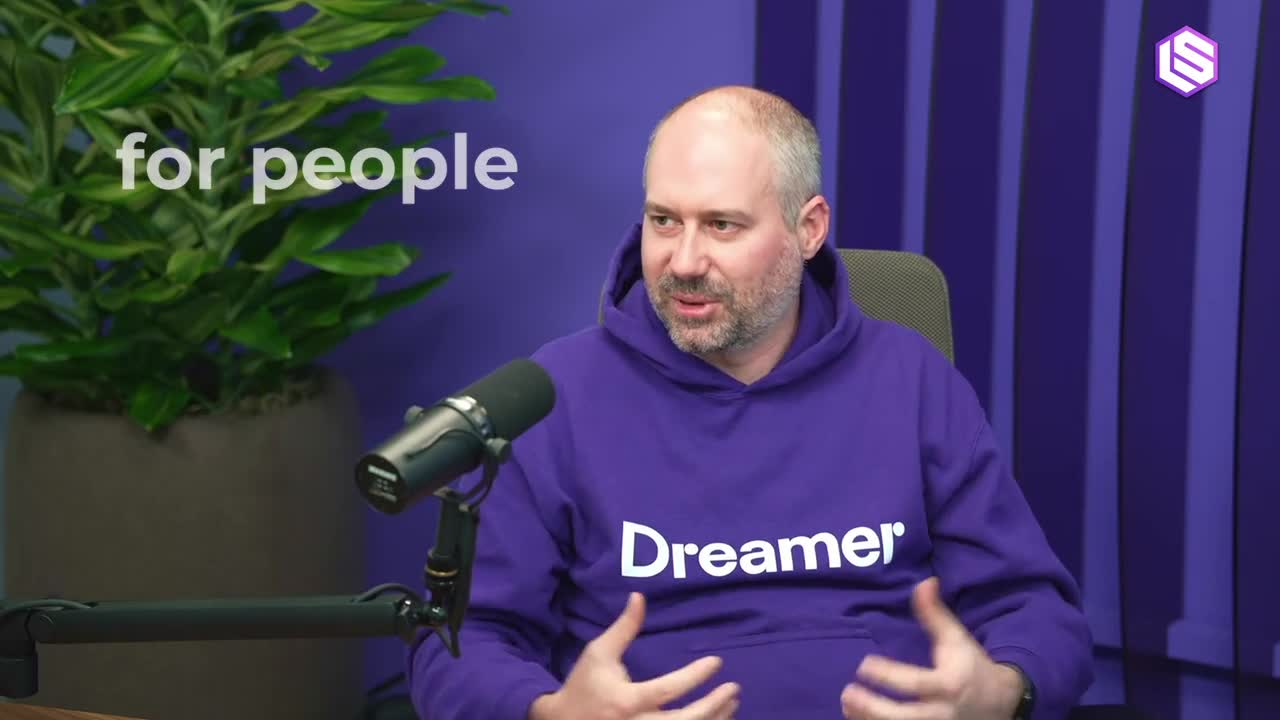
Obviously, it's really cool to have software that will work on your behalf, but it's only useful if you can trust it right.
So privacy and security is very important to us.
And so, as we started to think about this problem, we realized that we actually had to build something that's a bit like an operating system.
The sidekicks like the kernel, the agents and apps are like users.
Different rings.
Exactly.
Because if you try to pick off just one piece of this, you can't actually make it work for people at scale.
Because you could build little five coded apps, but they're gonna grab all your data willy-nilly.
They won't be able to work together.
You actually have to invest in the fundamental core in order to make it work well for people.
And that's what we've been doing.
And it's been a lot of fun.
Okay, we're here in the studio with David Singleton.
Welcome.
Hey, Swix.
It's great to be here.
It's great to have you.
We have very simpatico that your company color is the same as Latin Space's color.
That's right.
Creamer purple.
It used to be dev agents, which I thought was very cool.
It's like a callback to dev payments.
And you were obviously CTO of Stripe.
And talk to me about just the origin or thinking process behind Dreamer.
And maybe start with like what is Dreamer?
Yeah, so dreamer is a new product which everyone can come and play with.
Today, it's a place where everyone literally everyone can discover, build and enjoy and use ai agents and agentic apps, and we really did design it for consumers, for folks who are not necessarily have any kind of technical background.
It's really aimed at everyone.
I think often of my sister, she's very smart.
She's not in the slightest bit technical.
She has lots of problems in her life that she would like to be able to have great software and intelligent software to solve.
But even with the rise of tools like Cloud Code and so forth, she's got no way to get started.
And Dreamer is a place where she can come in, grab some intelligent apps that other people in the community have built, start using them right away and solve real problems in her life.
And At the core we have a personal agent called the sidekick.
You can give your sidekick a name, you can give it its own personality, and it really helps you across your entire day, your life.
It helps you use all of the agents on the platform, and it also helps you build anything you want.
And we've been working on this for a little while.
We recently launched in beta.
So anyone can go to dreamer.com, join the wait list.
And we have many many, many people in the community now who are building really fun, really powerful, really useful agents and agentic apps for themselves.
I think we're going to go right into a demo.
I just want to make an observation that you put discover first before build, but actually at least for the engineers in the audience, because we are primarily engineers and you're primarily targeting consumers, right.
For engineers, there's a huge full stack of stuff which we're going to dive into.
That's right.
It's so impressive.
I'm like, holy shit.
This is what I've always wanted.
So I think that's really good.
And in some ways, I think given your background, given Hugo's, is it Hugo?
Hugo Barrett, yeah.
It's not surprising that you basically kind of build an app store. for agents.
Yeah.
So Hugo is my co-founder.
Hugo and I met with our other co-founder, Nicholas Chekhov, in the very early days of Android at Google, where we were building Google's first mobile apps.
We then contributed to very core pieces of Android itself.
And you're right.
We were really excited about building two things.
One solving a bunch of problems that this breakthrough technology here I'm talking about mobile needed to have solved in order to make it work for real people at scale.
And then secondly, building this ecosystem of third-party developers using the Play Store and able to deliver way more value on the platform than we could have delivered on our own.
And we think about Dreamer in exactly the same way.
I was working at Stripe, as you mentioned, and we had the opportunity to put some of the very first AI agent systems in the world into production.
And from the moment we did the first of those, I was just struck with a strong sense of conviction that this is breakthrough technology that's going to change how all of us work with computers and phones and so forth all of the technology in our lives.
But there's a lot of problems to be solved for real people to be able to make this approachable.
And it really is kind of a direct analog for what we were solving back in the early days of mobile apps at Google and on Android.
So it's been fun to bring that to life.
Yeah, let's look at it.
Yeah, let's take a look.
So dreamer.com, this is our homepage.
This is where you can come and watch some videos about what is here and sign up for the waitlist.
I just want to say for those listening, because we have a lot you know, switch to YouTube, look at the animations.
So much care.
We really care about this product being fun and interesting to use.
Obviously, a lot of people are using it to do real important stuff.
You can do real work here, but also you can build fun things too.
Once you get off of our wait list, you'll come into the product.
The first thing that happens is you'll have a conversation with your sidekick, which is this little friendly character here.
And sidekick will seek to get to know you and understand you what do you care about and will help you discover and build your first AI agents or agentic apps.
After that you're you're going to have a dashboard.
This is my dashboard.
Everyone's is different.
You can see, i have a few things here.
I have a feed, so a lot of our agents do things in the background, when you're not looking, and the feed is how they let you know what they've been up to.
I have some widgets from apps that I have built.
This one is called Calendar Hero.
This is something that I installed from the gallery.
It was built by someone in our community.
It's a really powerful calendar app because for each of my meetings, if it's with someone i don't already know well, it'll actually go off and research it and give me both a history of my interactions with those people and also a bunch of, you know public, useful information to get started, one of the things i love about this particular app is that every day it generates a podcast, a daily briefing.
And one of the things that we've done with the platform is we've made it possible for all the things that agents do to show up in places that you care about.
So if you look over here, this is the screen of my phone.
And if I go ahead and open my Apple Podcasts, you can see right here your daily briefing podcast is ready.
This was produced by an agent running in my Dreamer account.
And it was very easy by scanning a QR code to connect it to my Apple podcast.
That's what I listen to in the car now every morning on my way to work.
It preps me for my day.
So one additional bit of context.
I asked you immediately after seeing this was like what about?
I want to talk back to my agents.
And you said you actually started with voice and then you went to podcasts because it's nice to have it pre-downgraded.
That's right.
Yeah, you can talk to your sidekick.
So on mobile, we have a Dreamer app and you can talk to the sidekick right here.
But we've actually find that making things show up in the other apps that you already use in your life is incredibly powerful.
So let's take a look at what's kind of under the hood here.
So I already mentioned we have a gallery.
So this is where you'll find a lot of agents from our community.
There's many at this point, hundreds, and they are solving all kinds of use cases.
I'd say the top use cases are on personal productivity, but also a lot of information management.
That can range from personal information like docs and so forth, managing your e-mails.
It also ranges out to public information that you might be interested in, but you need something to help manage the fire hose of stuff that's coming at you.
For instance, I have an agent which looks at all the AI news all the time.
There's a lot of it and it finds the stuff that I would actually be interested in and I find it incredibly useful.
So these are agents that you can install that other people have built.
Anything that you install on Dreamer, you can actually just say, I wanna start making some changes.
And we'll look at that in a second, but in natural language with the Sidekicks help, you can change any of these experiences to work just the way you want them.
But the base layer of the system are tools.
So you know as well as anyone Swix that any AI system is only as good as the quality of data that it can pull in and the quality of action it can take.
So before we launched our beta, we worked very hard to make sure that we seeded our tools with a bunch of very high quality and powerful integrations.
So for instance, this is real Google search.
This is actual Gmail.
You can do very useful things with those.
But also, this is a platform for everyone.
As we got started talking to people in our Alpha community, a whole bunch of sports use cases popped out.
We realized if you want to build something cool for sports with AI, you need really high-quality live data.
Look at these, Formula 1, MLB, NFL.
These are tools that we've built.
These are not data scraped off the web.
This is a direct data feed integration.
Because it's live and because it's high-quality, you can build really powerful stuff.
But tools is not something that we're just going to control ourselves.
The platform is open for tool builders. to contribute tools that anyone on Dreamer can use.
So this is actually the place in the platform where I think software engineers well number one would love for you to come and play with it, but software engineers are really gonna build a lot of powerful stuff into the system.
And we're actually sharing something for the first time on this podcast, which is tool builders on Dreamer get paid.
So if you publish a tool to the platform and a lot of agents use it, you'll actually get paid in proportion to their usage.
And we'd love for folks to come and give this a try.
We've got good docs that help you get started.
And you can build things that scratch your own itch.
For instance, someone built this ski bum tool, which provides live snow conditions for a bunch of ski resorts.
I'd love to show you how I've used that in a second.
And also we have some tools partners where the tools themselves are pay-per-use.
So for instance, Parallel Web Systems is a premium tool.
You can do really cool stuff with it.
It's an agentic web research tool.
And that one, because it's expensive to operate, is paid on a per-usage basis.
But if you're coming in to build agents on the platform, Even the premium tools you get a free trial.
So you get a chance to actually try them out.
Make sure that the use case is good for you before you decide to sign up.
So that's tools.
So we have the gallery, we have tools, and then the Sidekiq helps us put all of this together to build agents.
We do that in the Agent Studio.
You can also do this on your phone.
But if I open up Agent Studio here on desktop, Psyche is just going to start a conversation about what you want to build together.
I'd love to show you one that I made recently.
Let's do it.
Let's look at something that hopefully is near and dear to your heart.
One of the things I love about Dreamer and this kind of moment in technology is that, if you think about it, there are all these things in your life.
Where have you ever gone to a conference?
I know you have, right?
And big conferences have apps, and these apps are usually built by agencies and they're usually actually quite expensive to build.
I've been involved in running some of these myself.
And how many conferences have you been to where the app was good?
Honestly.
Exactly zero.
Maybe one.
I've been to one conference that was pretty good.
Wait, wait, wait.
Stripe sessions?
Stripe sessions, yeah.
But the point is that they're rarely great pieces of software.
They're also expensive to build, but they're interesting because they're episodic.
They last for this one thing and then they're not relevant anymore.
So it's the worst feeling to invest in them because you know it's got a limited date.
Absolutely.
So I decided to build a conference app for your AI engineer conference on Dreamer.
One of the things that swix has done uh, which i thought was very forward-looking, is actually put a whole bunch of data about the conference on the web page in an llm readable way.
There's an llmstxt file.
There's a feed of all of the sessions in json.
So I used the data from your conference last year and built this intelligent app just by talking to our sidekick in Dreamer.
So just to give you a quick tour, this is my dream conference app.
What I always want to do for conferences is I want to be able to search for speakers.
I'm usually there because there is a speaker I care about.
You know, Swix, you're the speaker I care about.
I can actually see here who you're on stage with.
So here's Greg Brockman, your friend at OpenAI, and this is his session.
And look, Greg and Swix are the speakers, so let's add that to my schedule.
Great.
And then maybe there's a couple others I might see here.
Like on day two, I remember there were some keynotes.
So building the OpenAgentic web, that sounds fun.
So yeah, that's my schedule.
She's now CEO of Xbox.
Awesome.
Which is interesting.
So cool.
So I've gone through and picked out a couple of sessions that I cared about.
That's as far as I usually get with any conference app.
But of course, you've got the whole of the rest of the conference to figure out what to do.
So here is where the native intelligence of these things we build in Dreamer can come in.
So I'm going to click guide me.
Dreamer's sidekick actually parsed out the whole schedule and figured out what some of the themes are.
And I can choose what I'm interested in here.
I'm definitely interested in agents.
I'm definitely interested in code generation and also reasoning and RL.
So now I'm going to say build my schedule.
So what this is doing is it's going across every time slot for the conference and it's choosing among the things I could go to, which one it thinks is best for me, based on my interests.
It also uses its own memory of me that's part of Dreamer to understand what I might like best.
And there's an LLM prompt running for each one of these time slots.
So this is not super fast, but it'll be done in about 30 or 40 seconds.
And I'm going to have a special custom schedule for the conference.
This, like I said, is my dream conference app.
It's exactly what I've always wanted.
I was able to build this yesterday morning.
I did it between some meetings.
I think I spent a total of 25 minutes of wall clock time on it.
I did it over the course of a couple of hours.
And, uh, here is my schedule for the conference.
I can see it in a calendar view.
This is what I should do on Tuesday.
This is what I should do on Wednesday.
Ooh, no conflicts.
But you know it may not go to every single thing.
And there you have it, built in.
You know dreamer.
So let's take a look at what the building experience actually looks like.
So this is the, the actual account that I made it on.
Oh, of course I should say anything you build on dreamer. also works on your phone.
So here is my AI engineer conference app right here on my phone, got all the same functionality.
And of course, this is the best place to jump into my schedule.
Yeah, you could generate a podcast about it, just completely multimodal sort of thing, right?
To me, I mean, this is why I outsource.
I mean, I posted the LMS TXT, the JSON, because you cannot run an engineer conference in 2025 and not let engineers do whatever they want.
Yeah.
And since all conference apps suck, I'm just going to put up a minimum viable app and just let people do whatever they want.
Totally.
And the cool thing about this on Dreamer is I published this to the gallery and you can use it.
So you've got one that's built to my taste of conference apps, I think it's pretty cool.
But you might want something different, in which case you just start telling the sidekick how to change it.
So let's just very quickly look at our- What's great is also you can fork it, right?
That's right.
I can publish your one and go, this is the base starter.
It's got good defaults, but go customize whatever.
That's right.
That's right.
Yeah.
So let's take a look at how I actually built this.
This is real.
So I'm gonna say make changes.
This experience we're looking at now is our agent development studio.
Like I said, you can do this on your phone as well.
And in fact, this one, I started out on desktop. let's look at my actual prompts.
I said, let's make an agent called AI Engineer Schedule Planner.
It should be a custom schedule planner for the AI Engineer Conference.
I'm not going to read this all up.
You get the point.
I told it where to get the data from.
That was the first prompt.
Actually, after I gave it that prompt, I actually had a simple version of this app working after the Sidekiq took one turn.
The Sidekiq is like a professional software engineer.
We've worked very hard to make this work and build functional apps for folks that might not have any engineering experience whatsoever.
So down here we have build logs that are technical, but you can hide those away, and Sidekiq, as it is building, will actually translate everything that is coming out of the harness into English that you can actually read.
And by the way, this English is in the personality of your sidekick, which is fun.
And the way that we build agents and agentic apps.
It's a little different to what you might have seen in some other platforms, for a couple of reasons.
One, just the build process.
The very first thing that Sidekiq does.
It understands all the agents you've got set up.
It understands all the tools and it will come up with a plan for how to realize your goal, how to make sure it actually has the data and the capabilities to complete it.
It will occasionally refuse.
If it can't do what you're asking, it will tell you, I can't do that, it needs another tool.
And that's a good jumping off point for any of the tool builders out there to build a new tool.
So it'll first figure out how, then it will build it, and then it will actually test it.
So it will actually make sure that the thing that it has generated is realizing your goal.
And you probably know as well as anybody that anytime you can get any modern state of the art coding model into a loop where it can make changes and perceive its own output and then fix bugs, magic happens.
So these builds, the first build, will often take 10 to 15 minutes on dreamer, which is a little bit longer than you might have seen on some other platforms, but the first thing that it creates will work most of the time and then, of course, as you start making smaller changes, you can like ask it to tweak the ui in any way that you like.
Those are much faster.
And just to give you a sense for this one, here's something I asked put a logo.
I gave it a logo file and static files use that as the title.
So for folks that actually really want to dig into a bit more detail, we've provided a powerful IDE here.
So I can actually see here's the code that was generated.
And some pieces of the code are more accessible than others, like the prompts.
So this is the prompt that's used by a powerful LLM in order to do that schedule picking.
And I can actually read it here directly.
I can edit it without having to ask the sidekick if I want to do that.
So this is very nice.
This is for the more sophisticated users.
Yeah.
This is other people's entire startup is prop management.
This is true.
The other thing that is different about Dreamer is, once you've built something here, it's ready to go.
We host it.
So you don't have to worry about getting a database from a database provider signing up, getting API keys.
You don't have to worry about your LLM provider tokens.
All of that is hosted on the platform.
And you can use it yourself.
You can share it to the gallery for other people to riff on it.
You can also share it with your friends and coworkers to use your instance of the agent or agentic app.
And we're seeing that happen a lot.
In our community we've seen a whole bunch of folks who built little applications for their personal life and shared them with their significant other.
We've seen people who are building little productivity apps for their team at work and sharing it among them.
And we actually do this a lot inside of the company.
So at this point we We pretty much run the company on Dreamer agents for all kinds of important things.
Maybe a good example of that is our wait list.
People are signing up.
Every time someone signs up for our wait list, a Dreamer agent will actually research that person.
And we're looking for folks who are builders, not super technical, to build agents and come in and give us a lot of feedback.
And we're prioritized bringing those people off of the waitlist first.
Just a quick question on that one.
It may not come up again.
Do you find enrichment APIs to be useful, like the Zoom info?
Clear a bit.
Enrichment is a very common use case on Dreamer.
Any application on Dreamer can kick off a sub-agent to do a particular task.
So this actually is a powerful agentic harness that runs inside of its own VM.
We call them sidekick tasks because they actually run in the context of the sidekick.
I'll talk more about sidekick in a second.
Enrichment is a very common use case.
And the cool thing about a sidekick task is that it has access to all the tools on the platform, but also public data as well.
And so very frequently, enrichment on our platform happens using public data that can be found in the web.
There are some tools for getting people data from various bespoke systems, and so that works pretty well.
But actually, you'd be surprised.
I mean, we would love if someone out there would like to build a Zoom info tool.
We don't have one today.
We'd love to see that on the platform, and I'm sure it will be very powerful.
But we're also seeing that this powerful agentic harness can pull a lot of data in.
On that note of tools that make experiences better, we're constantly adding more tools because people in the community are building them and publishing them.
We review the tools carefully and then they go live for everybody.
Yesterday, we added granola.
And that was pretty cool.
So I was talking to.
Actually, Sarah on my team was talking to someone building on the platform this morning.
And they actually, they have an agentic app that they built, which is a kind of magic to-do list.
So they put stuff on their to-do list.
And for each thing it kicks off one of these sidekick tasks to figure out how to move the ball forward in that thing.
Sometimes it will complete it Charlie, often by calling another agent on the platform.
And sometimes it just kind of researches it and helps them take the first step.
Do you know this is Sam Altman's number one ask for an AI app?
It's the self-completing to-do list.
Yeah.
The self-completing to-do list is something that a lot of people have built on Dreamer and are getting a lot of use out of and finding it actually genuinely.
I actually should try that.
Please do, and you'll even find some in the gallery that you can remix.
So he was saying this morning that he built this self-completing to-do list on Dreamer already, but he connected the granola tool yesterday and now something really magical happens, which is when he says in meetings that he's going to do a thing, it magically shows up on his to-do list and then it can magically get completed.
Then as I mentioned, All the agents, all the apps on Dreamer can actually work together.
So our coding agent, as it builds them, does something very special where it exposes the internals of each of the experiences to the system.
And then Sidekiq can manipulate those to get stuff done.
So he has built another agent, which he uses for recruiting.
It kind of keeps track of candidates and also it's got a kind of mini CRM function so he's able to introduce candidates to each other.
He told us this morning that something he'd committed to do in a meeting that was recorded on Granola yesterday showed up on his magic to-do list.
And his magic to-do list it was like introduce a person for recruiting used his recruiting agent to get it done.
And this is the dream.
This is why we started the company.
It really is the case that you can build and use these very powerful bespoke experiences that can automate your life by working together.
And I'd love to talk a little bit about how they work together.
So obviously it's really cool to have software that will work on your behalf, but it's only useful if you can trust it right.
So privacy and security is very important to us.
Making these things accessible and useful while also being trustworthy is hard.
So the model that we have, which is working very well, is that the sidekick is at the core of everything here.
So it is both your companion, your helper, but it's also the traffic cop in the system.
So when one agent wants to work with another agent in Dreamer, it doesn't do it directly.
It does it via the sidekick. will ask the sidekick to do the thing.
And the sidekick understands both.
Everything, all the expectations that have been set with me as a user about what agents can do, which tools I've given them permission to use,
And it will make sure that whatever is going on is actually aligned with my own interests.
And that's part of the background that I bring to this problem domain.
I've worked for years keeping very important information safe and secure.
And so, as we started to think about this problem, we realized that we actually had to build something that's a bit like an operating system.
The sidekicks like the kernel, the agents and apps are like users.
Yes, different rings.
Exactly.
Because if you try to pick off just one piece of this, you can't actually make it work for people at scale.
Because you could build little vibe-coded apps, but they're going to grab all your data willy-nilly.
They won't be able to work together.
You actually have to invest in the fundamental core in order to make it work well for people, and that's what we've been doing, and it's been a lot of fun.
One other thing I wanted to mention is I've obviously talked about two things tools and agentic apps.
We really designed Dreamer to be an ecosystem and a platform.
And one of my favorite quotes about platforms I think it's from Bill Gates is that you can only be a platform if you create more value for the folks participating and using the platform than the platform itself creates.
And that's our goal here.
So we, at every step, have been thinking about how do we make sure that other people are deriving even more value from Dreamer than we are.
So in that vein I already mentioned, tool builders get paid and people can build agents that solve their needs and share them with others.
And we are already thinking about ways that they can actually monetize those as well.
Against that backdrop, one of the things that we are launching today is our Builders in Residence program.
So there are tons of people building really cool stuff and contributing it to the gallery already.
But we've been really inspired by programs we've seen at other companies where artists might be in residence, people that are very creative and might have ideas outside of what the folks at the company or in the ecosystem already have.
And so we're looking for creative people who have fun ideas and want to really figure out how to apply their creativity at the cutting edge of technology today to come and work with us.
So if you go to dreamercom latent space, you'll find well, we love latent space.
You'll find a link both to our tool builder information and our builder in residence program and for builders and residents, We'll let you in off the waitlist, quickly build an agent and then, for a small number of the most creative folks, we're going to pay you to build agents.
You can work directly with our team.
You know, this is like building Legos.
So you know we've got some of the basic blocks together already.
But if you need a round steering wheel and we don't have one already, like we'll build it for you.
We really want to be inspired by these builders and residents.
This Legos thing is pretty common as an analogy.
And there's a thing I call the master builder.
The actual Lego company has master builders that they employ to inspire people and post on socials.
That is exactly what inspired us as well.
Honestly, we talked about the Lego Master Builder program.
So that's our builder in residence program.
And then finally back on tools, like I said, anyone can come in and build tools today.
If you follow the Latentspace link dreamercom, slash Latentspace again, we'll get you directly off the wait list so you can build right away.
You can monetize by publishing onto the platform.
That's for everyone.
The very best tool gets added to the platform by mid-April.
We have a 10000 prize that we want to give out really, because we just want to seed the creativity of everyone out there.
So we're excited to do that.
Yeah, and you know, this is completely a flywheel, right?
Like the more tools, the more builders, the more the third thing, agents.
You know it just feeds into each other.
That's right.
Yeah.
Just on the payments thing, because probably we won't touch on that again.
But I have to ask the former CTO of Stripe on payments.
Presumably you're using Stripe Connect.
Yeah.
Any pain points that you're, because people are very interested in agentic commerce and micropayment and all these things.
Presumably stablecoins get in a conversation at some point, but maybe not now.
Yeah, we're really, really excited about agentic commerce.
The first step we're taking is help people in the world who have never been able to build these kind of experiences in software before, to build stuff that meets their passions, share it with the world and get paid.
So that's all commerce that happens on our platform.
And so we don't need anything new to facilitate that.
Stripe Connect has existed for quite a while and is the perfect solution for this kind of stuff.
So we're excited about that first and foremost.
However, a lot of the things that people are already doing on Dreamer.
We just talked about a self-completing to-do list.
A lot of the ways that you want to complete to-dos is by actually closing the loop in the real world, and that's going to involve the exchange of value.
So we have some folks that are building tools already, that actually do have money move in order to complete that loop.
So far, we just want to be open and agnostic to all the protocols out there.
I honestly think this moment in time is a little bit like the early web.
So I personally started coding as a kid and I think I got access to the internet in about 1995, 1996.
And back then the web existed.
HTTP was a protocol, but there were also other protocols I was using all the time, like Gopher and UUCP and various others.
So the point is like the web, HTTP and HTML, was just one among many protocols.
And of course it became the winner and it's awesome.
But the others were also kind of interesting and viable at the time as well.
And I think the world of agentic commerce is like this right now.
CP, ACP.
Exactly, all the CPs.
You know, on Dreamer, we hope that folks will build tools that kind of make use of all of these things.
But I'm sure that at a certain point one or two will emerge as the winners and then we'll be able to build like really deep support in.
Yeah, this is like maybe a complete tangent, but I do think about how a lot of these companies, AI companies in particular, have to switch from seed-based to usage-based because, of course, But then they end up having to sort of obscure the margins a little bit.
And then they end up inventing their equivalent of Robux, where they're like well okay well, every company should have their own currency.
And it's like a very short lead to a token.
Yeah.
And I'm like, okay, well, where does this end?
I can't really play out the next step as to like, is this chaos?
Is this okay?
Well, I think it is kind of like the Wild West.
I don't mean that in a completely disorganized way, but there's just so many things that could happen from here.
The Overton window is very wide right now for how this might land.
And I'm just very excited to be building a platform that can take advantage of all of those opportunities.
And we're just going to be there working for our users to make sure that the things that emerge work.
You're going to own the consumers.
You're going to be the OS for the App Store, for everything.
So, i mean, one of the ways to think about this is um dreamer actually uses all of the state-of-the-art models as a user you don't have to think about.
Should i be using, you know, a Opus 46, or should I be using the 54 model from OpenAI?
We are continually doing evals and so forth to make sure that the best things are there for you.
You can just build on the platform and know that, as the world ships around, you're going to get the right stuff for you.
And I think that's something that is needed to actually have folks take advantage of this technology at scale.
I'd love to show you another example of something I built.
Let's do it.
This is another example of software that just lasts for a certain moment in time.
So recently I went on a ski trip with a bunch of friends.
Ski bum.
So use a ski bum.
Yes.
I went on a ski trip to Big Sky.
I'd never been there before, and I made this little intelligent app for us.
You can see it says it's loading Big Sky condition.
So it's actually calling the ski bum tool that I just showed you, which is published in our gallery.
So what is this?
This is a little app that was just for our weekend trip.
It shows the current status of all the lifts at Big Sky using that tool from the ecosystem.
It shows the forecast for the upcoming weekend.
It shows our accommodation.
This is just like where my group was staying.
This is just for us.
And also a bunch of dining information that one of our friends put together.
Who's an expert on Big Sky?
So I was able to take this app, share the link with my friends.
They weren't on Dreamer yet.
Just send it to them on iMessage and they get a version they can use on their phone.
And of course, here's the real kicker.
So I've been on ski trips before and other weekend adventures with my friends.
People pay for different things and at the end of the weekend it's always a pain to figure out who needs to pay.
Who to settle up.
So we used this during the weekend.
We added all of our expenses in here.
And then at the end of the trip, we passed split and we settled up and we're done.
So there's another example.
This was all through Dreamer.
So the actual payment?
No no, because we paid for stuff in the real world.
It was like okay, this person needs to pay that person 20 bucks, this person already paid enough, right?
So it just helped us all settle up.
We didn't move the money on Dreamer.
You could do that.
And in fact, if you're a tool builder, thinking about this and getting excited like, come build a tool to do that stuff,
We really think of our tool builders as design partners.
Yeah, I got it, got the tool.
Uh what, like?
I hate i use bank of america.
I hate back.
I hate the app.
I hate the web banking websites just horrible yeah.
So just build me like, build a thing on top of plaid yeah, and then just so vibe code by banking app.
There's already a tool for that.
So um, Attain Finance is a tool a builder in our community built and it uses a secure system, like Plaid, to access your financial data.
And you can build powerful personal finance agents on Dreamer today using this tool.
And like I said, we review tools carefully.
So when bringing Attain Finance onto the platform, we did actually quite a detailed security review with that company to make sure that if folks build stuff with it it's going to work well.
So yeah, check that out.
I think I'm pretty certain it connects to Bank of America, so you'll be able to build the app that you wanted already.
Yeah, there's a couple of points I wanted to sort of dive in on, maybe highlight to folks, because obviously I spent more time with Dreamer.
So we're making a point where you choose on behalf of your users, because they are meant to be consumers, so maybe less technical.
But obviously people can, our users can override if they need.
But it's not just LLMs.
It is also the transcription.
There's a first party curated set of here's the house opinion on what the thing is.
What's the list?
Yeah, so actually if you look in the tool gallery, the first-party kind of curated set are all the ones that have these grayscale icons.
So we have a built-in tool for image understanding, for image generation, for RSS exploration, text-to-speech and so forth.
Recipes?
We actually do have a built-in recipes tool.
It turns out that a lot of people in our alpha wanted to do stuff for cooking.
Yeah.
You can scrape the web to get good recipes, but we were able to quite quickly find a good repository of recipes that works great here.
So the point behind these, though, is that we'll keep the interfaces stable, so they'll always work.
But the best translation model, and there are people using this translation tool to translate Chinese podcasts into English.
It's pretty powerful.
It can deal with very long text.
But the best translation tool today might be different from the best translation tool sometime next year.
And we're just going to make sure that that translation tool is always pretty close to state of the art so you can build something and you know it's going to continue to work well.
Of course, some of our tools are branded.
You may actually have a preferred way of buying groceries, like maybe you prefer Instacart and that's great.
You can use the Instacart tool specifically.
Yeah.
Your partnerships.
I mean, I don't know if you're ahead of partnerships, but this is going to be a bonanza for anyone wanting to do deals.
We have an amazing person who works on all of our partnerships, and it's part of what you have to do to build a platform like this that's going to work for people.
Like we've gone and done that This is a lot of work.
One talks to lots of different companies in order to make sure that you've got good tools at the core.
And then, of course, because we're open to tool builders contributing to the platform.
This is only going to get better and better and better.
One observation I have.
This is kind of a massive thesis I've been pursuing, which is what I've been calling an agent lab, where you're sort of different than a model lab in the sense that you never train your own models, but you are the router evaluation layer.
Subject domain expert for choosing between models.
And you're explicitly doing these things.
And so, like in my sort of construction, every agent lab does some version of this where, like here's the image understanding endpoint and we will route for you and don't worry about it.
So I think it's kind of cool.
I think it makes total sense.
And again, to make this work for folks that don't follow the AI news every day.
It's an actually it's a really important thing to do.
Yeah.
And it's been been a real pleasure.
I mean, i'm i'm personally a total geek for this stuff.
I love it, and being able to go and dive into all those details in order to make it work well for other people, it's a true pleasure.
I cannot imagine working on anything else right now.
It's just so much fun.
The tricky part is multimodality when some of these things do merge.
And this is your imposing structure on things that fundamentally don't want to be structured.
And so sometimes that might work against you, but for 99% of these cases, this is fine.
Yeah, I mean, I think it's gonna be very interesting to see how the world matures.
Because a lot of the power of Dreamer is the ability to kick off these sub-agents, so these powerful agentic harnesses which can actually change how they work, based on the data.
I actually think that we will be able to kind of keep up with and stay at the forefront of the changing landscape of how tools and systems work together.
And that's new.
Software didn't used to work like this and now it does.
So even just figuring out how to design the right primitives to make that possible has itself been a lot of fun.
This is a sort of maybe two-part question, that why can't Streamr make its own tools, then why don't you let you builders maybe stand up their own routing group?
I call this a routing group right, like where it's like yeah, thanks.
So two things.
To some extent, dreamer does make its own tools, in that agents appear to the system as tools, so they can be, they can be used to accomplish things, so you can build an agent that is essentially a tool.
Which is, to me, very useful for reuse.
Right.
Because I like this is the way I like it.
Now my next five apps, I don't want to do this whole series of back and forth again.
Right.
Yeah.
Then at the tool layer of the system, it's open to anyone.
So it's actually quite powerful and flexible.
So if you wanted to add a tool which was imagine that you're training your own foundation model, Swix.
It might be fun.
And imagine you wanted people to be able to play with it.
I don't know.
Maybe you make like you know NanoChat or whatever and you want to let people play with your own NanoChat and see how it works.
You could publish a tool that is NanoChat and nano image generation behind a tool, and it could be your own writer if you wanted to.
I see.
And honestly, if that's the kind of thing that gets you excited as a builder, please come and do it.
We really are believers in this idea that we aren't going to figure out every single detail ourselves.
We're going to make sure it's a safe and fun place to build this stuff, but we're really open to these ideas coming from other people.
And so I'd like nothing more than you come in and build a tool that does some of that cool stuff that you have in mind.
Yeah, awesome.
And just as a reminder, if you'd like to do that, the way to find the links is dreamercom slash latent space.
And for a limited time, on that page.
Anyone who's listening to this podcast will also get directly off of our waitlist.
It's quite long right now.
We are working hard to bring SQL in, so skip the waitlist.
You know, I think, I think that's fantastic.
I think it's, it's really sort of pro builder way to do it.
I wanted to jump back to the, the bar.
Yeah.
You know, you know, I get excited about this.
Yes.
Okay.
Let's get back in there.
Like let's, you know, this is the engineer podcast.
Let's get as technical as you can.
Yeah.
On everything you've built, like have a show off.
Yeah.
Okay.
So let's go wild in the aisles in the Asian studio.
So, as you can see over on the left, here is a conversation with the sidekick where you ask it what to do and it will explain in English that anyone could understand what's going on.
But if you want to pull back the covers and look under the hood if you're an engineer like me then we have this debug drawer at the bottom.
So you can see the full build logs here, but you can actually also dig in and see the files and prompts that have been generated.
You can upload files from your computer in Static Files.
Very important.
Indeed. you can actually read the prompts that have been generated for you.
We intentionally put an example in here just so you can see what the format looks like.
And then we already looked at this one that was generated for this particular app.
But if you actually want to bring the code out of Dreamer and work on your own local machine, you can.
So at the core of everything here is an SDK with a powerful command line interface.
And we built that first.
It's actually possible to build agents on Dreamer without talking to the sidekick.
You can write code with your fingers on a keyboard if you want to.
I know that sounds very antiquated now.
But actually this can be a lot of fun.
So if you want to pull it out onto your laptop, you can use our CLI and you can edit it in cursor or in cloud code.
You know, you don't have to use our sidekick.
And the CLI actually has full access to the rest of the platform with you as the user, so obviously it is secure and privacy sensitive.
And this is a way that some of our most technical builders do build stuff on the platform.
The really cool thing is the sidekick when it's in coding mode, it uses exactly the same CLI.
So the way it builds stuff on Dreamer is using the same tools that you might as an engineer.
And that's actually a very powerful abstraction, because it turns out that the right way to give a lot of context to agents to use CLIs is to write great documentation.
Make sure that all of the things that you could do are actually possible.
And guess what?
That makes it a delightful developer experience for real humans as well.
Yeah.
So that's pretty cool.
We've been telling developers to do this and they ignored us until now they have to.
I've been saying this for a long time.
We're actually Stripedogs.
I mean, come on.
Absolutely.
Come on.
Absolutely.
But actually I was chatting with folks at Stripe last week and saying hey, you've got to make the Stripe CLI.
Actually tell agents what they can do on Stripe, because that way they're going to use more stuff on Stripe.
I think this is a real trend for the entire industry.
So we've been doing that.
To me this download and Git push and everything is complete confidence in that you're not hacking it.
Because there's other, let's call them AI builder platforms that impose their stack on you.
And if you?
And so therefore they don't allow you to do this?
Because they cannot, because they impose some degrees of freedom restrictions, so that they can get it to work.
Yours is a fully general like VM running the full code.
Correct.
Do whatever you want, any language you want.
Correct.
Yeah.
Correct.
Well, in terms of language, if you use the SDK, you could build stuff in other languages.
We've actually found that TypeScript is the best language for building these experiences, because it's strongly typed.
So you find out at compile time if you've made mistakes, and there's nothing better than getting a coding agent in a loop where it can see its mistakes and test them.
So TypeScript is the language that everything gets built in by default here.
Did you see that TypeScript overtook Python?
I did.
For what it's worth.
When we started the company, we started writing stuff in Python, and I love Python.
If I do add vendor code, I always write it in Python.
It's my favorite language as a developer with my fingers on the keyboard.
But TypeScript is an amazing language for AI because there's tons of training data in the models And it's strongly tight.
And actually at the company, we built most of the stack in TypeScript.
And we have this amazing property, which is we have type safety all the way from the database to the front end.
And there's nothing better for working with coding agents than being able to have them check their correctness at compile time.
So the same ideas behind building the company's code base we've put into the agent SDK here as well.
Yeah.
Do you know if you'd use one of those tools like Prisma or whatever, or is it tool-level for you?
We actually have crafted most of our own tools.
For instance, we had LLM-driven code review before the thing that got published from Anthropic this week.
You know, we've been doing this stuff on our own bat.
You know, we all pay $25 per review.
We pay a lot less than that.
However, i hear that those reviews are excellent and possibly worth 25 dollars.
Yeah, you know it's an option, right?
Yeah, it's good to have it, just to give you a tour of some other stuff here.
So um, i can also see all the versions.
Um, this is not get.
This is not get.
This is built into dreamer.
I can see all the versions that have been pushed before.
Why is it not get?
It's not Git.
Because we can make it work more efficiently than Git.
And we actually we do some work behind the scenes to kind of understand what's in each of these versions.
One of the things I'm pursuing and I have a lot of pieces right.
One of the thesis is like does Git go away?
Does GitHub go away?
And like, what is the AI out of re-adventure?
For what it's worth, to some extent, in anything you build, there's a lot of path dependency.
If we started over, we might make this Git.
Within the company.
We use Git for our platform source code and we like it, and it works well with coding agents as well.
The very first versions of this.
We wanted to be able to make it possible for the sidekick to manipulate it easily, and this was an expedient way to do it.
You can also see all the activity that has happened in the workflows that you build.
A lot of agents you'll build on Dreamer do things in the background.
So they run on triggers.
These are stimuli from the outside to kick them off.
And this is a nice way to see all of the things that might've kicked off your agent.
You can have an agent that kicks off on a web hook, so you can plug it into external systems.
You can have an agent that runs when you receive certain emails that match filters, including LLM filters.
And so here you can see, oh, when did it run?
What did it do?
You know, if I open up one of these guide me prompts or guide me events, you can see it.
Well, I told you it was calling an LLM for every one of those time slots.
Here's all of the LLM calls.
Here's the actual prompts.
And you don't mind exposing all of this, right?
No, we want builders to see what's going on under the hood if they want to.
Okay, yeah.
So, okay, right now that one was Haiku.
Like I said, we work with all the models and Sidekick will actually pick the best one for the job.
And you saw that was pretty high quality and pretty fast.
So Haiku 4.5 is the one that I picked for that job.
We also have logs.
As I mentioned, there's a database spun up on demand for every agent.
You don't have to go and figure out how to do your own hosting.
This is a SQLite?
This is a SQLite database.
It's a multi-user SQLite database.
But each one is, you get a database that is unique to this agent.
But then if you share the agent with multiple people we take care of like who are the owners in each row, and all of that stuff is just there out of the box.
And again, in-house.
In-house.
Oh my God.
Yeah.
Well, we do work with a bunch of infrastructure providers, but the technology for how to manipulate this is in-house.
Fun fact, we actually did a lot of our own infrastructure development early on at the company and realized we need to spend our energy in the stuff that we're uniquely doing in the world.
So we're very delighted to partner with a bunch of great partners in some of this stuff.
And then finally, i mentioned that agentic apps.
Agents expose all of their internals to the system so the sidekick can manipulate them and use them just like a user can.
So you can see how it's decided to break this problem up into functions.
Some of the functions, the ones with the little i here are exported.
That means that there's probably visible from outside exactly, and others are internal.
And if you want to, you can dig right in here and call individual functions and see what happens.
But mostly, you don't need to think about that at all.
You can keep that little drawer closed and you can talk to your sidekick and build really powerful and enchanting experiences.
Yeah.
I mean to me like showing this gives the engineer a complete mental model of what you've done, what you can do with it.
For example, the first thing, I look for a mental checklist of things, right?
Like, is off in the database?
Off looks like it's not, right?
So that's a separate layer.
That probably means it's hard to do multi-user apps on the same app, right?
So you actually, we've solved that.
So yes, the platform builds in off.
So you as a user sign into the platform.
If you're using an agent that was published by someone else, then your identity is kind of taken care of by the system.
And when you query the database, you're going to get the stuff that is for you, unless the builder specifically said this is public data that everyone should see.
So they actually get a chance to think about that.
And again, Sidekiq can guide you through building agents and apps that work that way.
So you're right.
That's another thing that people have to think about when they're trying to figure out how to build software experiences.
On Dreamer, it's built in.
You talk to the Sidekiq as if it were a human being about what you want, and that's what you get.
So you know my my big sky app that I just showed you.
That was designed for multiple people to use it.
And, of course, the things that we were putting in as expenses were supposed to be visible to everybody.
And I just told the sidekick that's the way I wanted it.
Uh, but by default.
If I'd built an app like that, the data from each user would not have been visible to the others.
Yeah, yeah.
This is.
I presume this is a mood question, but basically you've had to build your own coding agent, right?
Which is Sidekiq slash whatever is inside Sidekiq.
Obviously there's a lot of people with a lot of desire for Cloud Code and Codex and attachment to it.
I know under the hood, they're basically reduced to a loop.
But like, would you let people use Cloud Code and Codex or is the harness too specialized?
Yeah, if you, if you want to use um cloud code and codex, then you go down here yeah hit, get the sdk.
And we even say this right here edits your heart's content, zed cursor cloud code.
Like people want to use it inside of psychic right?
Yeah, they want to switch the engine.
Yeah, that's the coding engine.
Yeah, We are not doing that right now.
You know again, the goal really is abstract the complexity, because the real target for building agentic apps is folks who can't do this already today.
I can't tell you how many users in our community I've spoken to who are like Dreamer has changed my life because I used to have all these ideas.
If only I could find an engineer to help me implement them, I'd be able to get them done.
And now I can talk to my sidekick and get it built.
I think that's really how we think about the people that should get a ton of value and fun out of the platform.
And so they're not asking to be able to plug in their own coding agent.
And for those folks, the opportunity is massive.
If you've never been able to do stuff in code, now you can build stuff for you, for your friends, for your family, for your coworkers.
And also there's a huge opportunity for folks who do build stuff in code to actually contribute to this ecosystem.
So that's how we think about it.
It yeah, amazing.
That's most of what i wanted to cover dreamer wise, i think.
Personalization and memory yeah, it's probably like the single most important job of the os.
Maybe we could talk about that.
And then i wanted to zoom out on the company building stuff.
Yeah yeah, sounds good, Yeah.
So how do you handle memory?
What have you found?
What have you tried and failed?
Yeah.
Okay.
So first of all, at the core of Dreamer is the sidekick.
The sidekick gets to know you and it builds up a memory about you over time.
And that turns out to be very important.
So Dreamer gets better the more you use it.
For instance, a lot of agents in the platform.
When you start using them, the first thing that they'll show you here's what I think is relevant to you for this particular use case.
A very popular kind of agent on Dreamer is a weekend activity planner.
So- Like just tell me what to do?
Well, tell me what to do, especially if I've got kids, right?
So I have two kids and a dog, and my wife and I often spend a lot of time trying to figure out what are we gonna do with the crew this weekend?
And we have interests that are very consistent.
It actually can take a ton of work during the week to figure this out.
So there is an agent on Dreamer called Weekend Activity Planner and it helps me find things to do with the family at the weekend.
In fact, this morning I got a message from my Weekend Activity Planner telling me about the St.
Patrick's Day parade on Saturday at Civic Center.
I'm Irish, my kids are technically Irish as well.
I mean, they have multiple citizenships, but you know, they're Irish.
What a better thing to do than take them to the St.
Patrick's Day parade.
Why did that get recommended to me?
Because in the profile that Weekend Activity Planner knows about me, it knows that I'm Irish, right?
So all of that comes from the memory that Sidekick builds up about me over time.
We have invested in this a bunch.
We will continue to invest in this more.
We've tried actually many different techniques.
As you know, the cutting edge of agentic memory has changed over time.
Very early on we were putting lots of facts into a vector database and doing embeddings and pulling them back out using reverse lookup embeddings.
RAG.
That actually worked, but turned out to be much more complexity than was actually required.
So today we've replaced it with a different system.
I think we use a system that's pretty similar to what you'll find in lots of other products.
But it's an area that we're actively investing in.
There's more than one person at the company specifically working on memory, and so expect us to just continue to make it better.
Did you try Knowledge Graphs?
We've tried Knowledge Graphs.
The system that we have now is not a Knowledge Graph, but we've probably implemented most of the papers you've seen out there on agentic memory and the current system is working pretty well.
Yeah.
Excellent.
Zooming out just on the company stuff, this is your first time in a CEO seat.
Correct.
You were CTO before.
Correct.
What's different?
Yeah.
The difference between being a CEO and a CTO really is just like making sure you're looking across everything.
So I have run products before.
So for instance, Android Wear.
You're basically a CEO of that product.
I was running that as a general manager.
However, when you do it for your own company and the buck truly stops with you, it definitely kind of raises the temperature a little bit.
But it's been a lot of fun for me to think about a lot of go-to-market topics.
I spend a lot of my time these days meeting users, talking to folks about what they could do on the platform, being very active on X and LinkedIn which, by the way, is a huge pleasure.
It is so much fun to be able to engage with users and potential users directly and understand what they would like to do.
And that's the biggest difference between this role and being the CTO of a company.
At the same time, I am someone who always likes to look for why are we doing this?
Who are the people that benefit from it?
So even as a CTO, I was always paying a lot of attention to topics across the company.
So I feel very grateful for all I learned in my previous roles that kind of got me ready to do this at this kind of scale.
Yeah, to me, this is a natural lead into when I went into your office.
Yeah, surprisingly small.
Yes.
So, and I have another thesis I'm pursuing for Latentspace, which is the emergence of tiny teams where, you know, the classic sort of image is teams with more millions in revenue than employees.
Yeah.
So yeah, that's revenue efficiency definition.
But I do think as a CEO, you are going to run a smaller team than you used to.
Yeah.
So I believe very strongly in the power of small teams.
So the more people you add to a team, the more communication overhead there is.
And it doesn't even grow linearly.
If you think about it, the more people you add.
Everyone cares about getting to know everybody else and sharing what they're doing with everybody else.
And that's great.
I'm not saying they shouldn't.
I want to work in teams that are fun, where people are talking to each other and sharing ideas and so forth.
But there's just a kind of gravitational weight that comes from larger and larger teams.
So just inherently large organizations are less nimble than small ones.
And if you run a large organization you have to keep thinking about how do I kind of like prune things so that it can act like a small team?
So at Dreamer the, the core team that built everything I just showed you was was honestly about six people.
Uh, we're larger now.
We're about 17 people at the company now because.
But still.
For everything you just showed.
It's still a small team, which is great.
A very, very high talent density team.
We've been very, very careful and kind of obsessed as we grew to make sure that everyone that's joining the company is joining a team that they're gonna get a lot of learning out of, but also they're actually going to kind of help everyone else a lot as well.
There's something very special about that, too.
You know every single person at our company I'd be delighted to do any project with at any time, because they're just all great.
And you know, the smaller you keep the team, the easier it is to make sure that that talent density is there as well.
Of course, It's a real luxury to be building a company.
We started this company in late 24, but it's a real luxury to be building a company today because we can build with agents.
So we're using coding agents.
We're using Dreamer marketing agents.
All of our operations, we're looking at how we can actually accelerate what we're doing using our own tools.
Actually, any agents that you don't build that you want to shout out, just that you love?
Yeah, is it?
Other people's?
Agents that we built for the company?
No, no, other people's stuff.
Like you shouted out Granola.
Yeah.
I showed you Attain Finance.
Attain Finance has an agent as well, which helps you manage your money.
I find this really amazing.
I always have this lingering feeling that I've got a whole bunch of subscriptions, that if I just had a bit of time to go across them I could figure out how to consolidate them.
And the person who built Attain Finance doesn't work at our company.
They were part of the early alpha group.
So they got to kind of look at how all this stuff works pretty early on.
And they built this really amazing experience that actually helps you like save a lot of money, because it will kind of help you analyze your purchases.
It's almost like a kind of a financial fitness coach.
He's called Andrew who built it.
He came and showed it to us.
And the first thing it did was it recommended that he should buy fewer burritos.
And he was like, it's true.
Like that is actually how I could save the most money.
So that's a pretty cool example.
I noticed he was first, because he's... It's alphabetical order.
It's alphabetical order.
So I'm wondering how come there's no, like, aardvark.
Yeah well, if you're a builder right there and you're wondering how do I SEO myself on the Dreamer platform, Swix suggests you name your tool aardvark.
In all seriousness though, those are the tools I have connected, so they're in alphabetical order.
If you haven't yet connected them, we actually put them in the right order for you.
So Tidekick understands you and puts them in the right order.
But I'd say aardvark is going to come before anything else.
Right?
Yeah, exactly.
And then I think how's hiring changed?
Yeah, you've hired plenty of software engineers in your life.
I assume something's changed.
Yeah, absolutely.
So one of the main things that I look for now when hiring engineers is how well do you work with coding agents?
Our team actually is quite experienced.
A good number everyone at Dreamer other than well, I guess I write a lot of code too.
Everyone's an IC, an individual contributor.
Many of the folks that work on the team have previously been managers, and it turns out being an engineering manager.
As long as you stay very close to the code and are able to continue to craft it yourself is actually a great skill profile for being able to make agents work for you and for your team in this age.
And so that's definitely something that we look for quite intently when hiring engineers.
We still have folks write some code like with their fingers.
It's just important to know that the kind of core of the craft is there.
But the vast majority of what we spend time doing is building quite significant and elaborate stuff together in a fun collaborative environment with coding agents right, um?
So what is the interview loop like?
Sit there with codex, do something.
Yeah, i mean, our interview loop is one a coding screen to make sure that the base is there, and then we actually do a couple of short projects uh, with an engineer on our team and whoever is thinking about joining where we'll actually put out a very fully formed product idea.
We'll riff on it together, make sure that we kind of test product sense a little bit.
Then we'll actually try to build the whole thing with Codex or Cloud Code or whatever whatever the person is most familiar with.
And watching how someone thinks about prompting the agents what they do while the agent is working, because you can.
Actually this is a kind of interesting dynamic in the industry.
Anytime I'm working on code these days, I always have more than one agent going at the same time, because while one agent is going and reviewing the output of the next one and if you get them in a nice round robin you can be very, very productive.
You can also chain agents together.
You can have one agent producing code, another agent reviewing it.
And actually just seeing how folks have adapted their workflow is a big part of what we're looking for in our interview process.
Amazing.
I guess last question, but also open to you to bring up any topics that I haven't touched on.
Have you wanted LLMs to do that they still cannot do today?
That's a great question.
And it's amazing because the capabilities of LLMs just advance so quickly.
You know, if you'd asked me a year ago, I would have said well, you know, music generation, I like music.
And Soon was amazing, by the way.
But previous generations.
Yeah, i can kind of tell that that's ai generated today.
I listened to the latest tracks made by suno.
I'm like that's, that's pretty impressive.
If we went back six months, i'd be asking for better image generation.
The latest NanoBanana which, by the way, is a tool on the platform that you can use on Dreamer is producing spectacular infographics, spectacular painterly images.
When I ask for those as well.
So that's quite impressive.
So I think as we go forward into the future, there is still a lot of room for human creativity.
And so that's also maybe where I'm going to have to say the LLMs are most lacking.
So I think that when you think about building software, the thing that's really important and that we all need to bring is taste.
You have to actually truly understand people, their motivations.
How do I build something that's really delightful?
We had to do a lot of work on Dreamer to make it possible for the experiences that we build to not look like AI generic Slop.
There we go.
And we've done that by putting a lot of our own taste into the templates and the prompts and the harness.
So I hope you have fun playing with it.
I think Dreamer today generates experiences that don't feel super generic.
But that's a ton of work, right?
The LLMs do not do that by default.
And in fact, if you ask for a simple to-do list app or something built by the models, I can tell which model built it just by kind of how it looks.
So taste creativity, sense of individuality is still something that I think the LLMs are not producing out of the box.
And I think that's going to be an interesting front. here.
What do you think?
Usually, this is my from builder to researcher question, because we do have researchers listening.
Yeah.
And I'm just like, well, that's it.
But like, soft taste for me, please.
It's like a very broad topic.
What do I think?
I mean, I agree.
I just think that it's too big of a topic to break down.
Mm-hmm.
Particularly because there's a lot of I'll know it when I see it type email which is unverifiable for researchers to do.
Yeah, I mean, I do talk to researchers quite often and we talk about this topic and I think most people agree that.
You know, one of the great things about building models to generate code was just, you know, it's so verifiable.
So you know it's very tractable and they agree that.
The next problem is how do you kind of step up that hierarchy of needs and get into these taste questions?
And quantifying taste is hard.
But I'm actually kind of excited that some people are going to start doing this.
And that's when I think that some of the really iconic companies in the world will start to become places where folks really try to debug and understand the creative process.
And I get pretty excited about that.
Yeah, I think we are slowly uncovering what intelligence really means.
And the benchmarks that we adopt and then abandon because they're solved is basically us evolving the machine intelligence in a different way than we evolved.
But we are slowly understanding what it means to be intelligent.
Right and uh and it's.
It's interesting i wonder how they suppress us in the future, but like we're not even there yet, we're just like get it to a place where we like what we get from the machine is sometimes, you know, it used to be 30, now it's like 95, but still there's that five percent.
That's right.
Yeah, any other topics we should have touched on?
No, i think we've covered everything, but i want to remind everyone Dreamercom slash, latent space.
Yes.
No, it's a very good deal.
I mean, like, come on.
Like, yeah.
So thank you for offering that.
Cool.
Well, Swix, thank you so much.
This was fun.
Yeah, thank you.
We will get Alejandro to put like flashing neon signs on the YouTube.
Cool.
Wonderful.
All right.
Thanks so much.
Cool.
Awesome.
Thank you.