Chat with Traders is brought to you by Trade the Pool.
Did you know that every decade the market reinvents itself?
Online brokers open the doors.
Mobile apps made trading seamless and commission-free trading erased barriers.
Now a new era has begun.
Meet Trade the Pool Limited Risk Trading.
And now you also have unlimited time to reach the profit target.
From now on, your trading risk is capped. and your trading opportunities are limitless.
Trade the Pool funds home-based stock traders with up to $200,000 in buying power.
That means you can trade larger positions and scale your strategies without risking your own savings.
It's time to trade with more capital, making it truly worth your time and effort.
Ready to trade the pool?
Click the link in the description and join the stock trading revolution today.
Trading in the financial markets involves a risk of loss.
Podcast episodes and other content produced by Chat with Traders are for informational or educational purposes only and do not constitute trading or investment recommendations or advice.
There's one idea from that world that they brought with me into trading, called side channel analysis with statistical analysis.
Meaning, as you said, the hackers hide, but there are side channels where we, as quant traders or algorithm engineers, can utilize to get information that they're trying to hide.
Side channel analysis is not about breaking into the system directly or decoding the software.
Instead, it's about watching the system's behavior from the outside, like how fast it responds, how much power it uses when it comes to software, or even the tiny noises it makes.
And those clues, what we call indirect signals, can reveal what's going on under the surface.
So in trading I saw The exact same thing happening.
The real intention of big players isn't about in the price itself.
It's in the timing, the volume behavior and the order flow anomalies.
That's what I call the hidden order flow.
And that's the foundation behind the system I developed that I'm currently using, which I use daily in my trading.
Markets, speculation and risk.
This is the Chat with Traders podcast.
Hey traders, this is Tessa.
We meet again.
Thanks for tuning in to episode 310 on Chat with Traders.
I can't believe we're nearing the end of the year.
If you are a trader, do you feel like you just wish it wasn't so close to the end of the year, because you want to continue to focus on your trading and do nothing else?
If that's you, that's also me.
Although I'm feeling a little burned out from trading, to tell you the truth.
Trading is so hard.
No duh, right?
For 99% of people who trade, even for successful traders.
But when you put time and money pressure on your trading, it makes trading like even more difficult, like 10 times more difficult.
If you're listening to this and struggling with that right now, know that you're not alone, but you may want to rethink about how you are approaching trading.
It's a long game for me now.
When I switched to that mindset, I felt a lot of weight lift off from my shoulders.
So anyway, I just wanted to share that with those who are going through this so that you don't feel like you're going crazy because you're not.
You're not crazy.
Trading is crazy.
Let's turn our attention to the focal point of the episode, our latest guest.
Ian and I speak with a trader who's a cybersecurity researcher with a PhD in computer science and AI from Israel, who got into trading futures using an unusual edge.
Side Channel Analysis, adapted from her cyber defense background.
In cybersecurity side channels.
Reveal hidden intent by watching indirect signals.
Timing power use tiny anomalies.
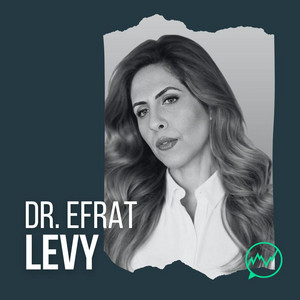
Dr. Ifrit Levy applies a similar idea to markets.
Instead of chasing price after the fact, she fingerprints.
I like that, fingerprints.
She fingerprints big players through non-repainting single-tick key levels that her models generate.
Before the open.
Then she waits for synchronous reactions across correlated indices like E-S-N-Q-R-T-Y at those precise levels.
Normally we don't dive into specific indicators on the show because there's just too many out there and we don't want to like really promote any one specific indicator.
But in Dr Levy's case, her indicator is an essential tool that is part of a broader system that she built to support her correlation logic strategy.
So it's hard not to talk about it, because it's such a clear example of how a well-designed tool can express a well-defined concept.
So if you're a systematic algo or quant trader, I think you're going to appreciate this.
If not, I think you will still find her strategy intriguing.
And who knows, maybe it sparks a new idea for you too.
I find her strategy on correlations personally really fascinating because...
Hearing her talk through the logic really sparked some trading ideas that have been brewing inside my brain for a while now.
Hey, also at the end of Ian's interview with Dr. Levy, I catch up with Dr. Levy myself.
So stick around.
Ladies and gentlemen, please help me welcome Dr. Efrat Levy from Israel.
Well, everyone, I'd like to welcome Dr. Efrat Levy to Chat with Traders.
Dr. Levy, welcome.
Hello.
Thank you.
How are you?
Yeah.
Very good.
Let's get a little bit of background about you.
Where are you located?
You sound like you have a little bit of an accent.
Yes.
So I'm based in Israel.
Graduated from a PhD degree in Ben-Gurion University in Israel.
I have two children.
Oh, fantastic.
Fantastic.
What did you get your PhD in?
In computer science and AI.
And AI.
Wow.
That's offered now as degrees or...
Yeah, my expertise is cybersecurity and, you know, AI is just a tool.
It's technology you can use, you can utilize in many domains.
One domain can be cybersecurity, another is image recognition, medicines and market analysis and trading.
How did you first get interested in financial markets or how did you first get exposed to it?
About four years ago, one of my family members reached out to me telling me hey, you have so much knowledge in AI, computer science algorithms, statistics.
What about building an anomaly detection algorithm for the derivatives market?
And it was very new to me.
I just started exploring what is the meaning by derivatives and why it's important to build an anomaly detection algorithm for it.
And then I realized that most of the market moves, the most interesting moves, are happening on anomalous scenarios.
So I started to build an anomaly detection for the derivatives.
And then a few months later, I learned about futures.
Specifically, I started from options and then futures.
I took a great course about futures trading.
I learned everything from scratch.
And then I started to realize that there are common things between cybersecurity and and market analysis.
It's cybersecurity you're trying, you know, as a defender.
You're trying to identify the hackers using advanced methods, advanced statistical methods In market analysis and trading.
What you're trying to do is identify the big players, to fingerprint them, to understand their behavior and to mimic them.
So two topics, two completely different topics, common techniques, and the similarity is amazing.
So then, are both hackers and big market participants trying everything to hide um, how they get in, or how they get into the computer system, or how they acquire shares?
Can you share us, share with us a little bit about, at least start with the hacking side.
Um, what do hackers do, because we're all seem to be vulnerable to um, to this on a frequent basis.
That's a great question.
Before I was deeply involved with the market, my background was actually in utilizing machine learning techniques in cybersecurity, as I explained.
And there was one idea regarding your question.
There's one idea from that word that they brought with me into trading, called side channel analysis, with statistical analysis meaning, as you said, the hackers hide information.
But there are side channels where we, as quant traders or algorithm engineers, can utilize to get information that they're trying to hide.
So side-channel analysis is not about breaking into the system directly or decoding the software.
Instead, it's about watching the system's behavior from the outside, like how fast it responds, how much power it uses when it comes to software, or even the tiny noises it makes.
And those clues, what we call indirect signals, can reveal what's going on under the surface.
So in trading, I saw the exact same thing happening.
The real intention of big players isn't about in the price itself.
It's in the timing, the volume behavior. and the order flow anomalies.
That's what I call the hidden order flow.
And that's the foundation behind the system I developed that I'm currently using, which I use daily in my trading.
So you mentioned the an early AI or is it something very different?
I developed proprietary machine learning based algorithm for fingerprinting the big players, specifically highlighting key levels where statistically, I expect the market to react.
And these are my core building blocks in my trading.
So when i've looked at the say, one minute chart or even a tick chart uh, to me it looks often like a zillion hundred, hundred lot trades, hundred share trades going through.
And how can we detect whether it's an institution or a whole bunch of small players?
Because uh, They're just in such small lots, right.
How do we detect it?
Yeah, that's a great question, because my strategy utilizes both historical behavioral analysis for spotting key levels and real-time analysis for confirming my entries on these key levels.
So when you say key levels, are you talking like support and resistance?
This is the professional name, right?
The common name for key levels where we expect buy at support, sell at resistance.
When a support line breaks, it becomes...
It turns into resistance.
So you can call it support and resistance, but there are a few differences between common support and resistance available in the market and what I build that I'm currently using.
The key levels I'm using do not repaint and they are created by my machine ahead of time, 10 hours before the market opens.
So they do not repaint.
What does that mean, repaint, for some of our listeners?
OK, in many cases, indicators repaint to adjust dynamically to market changes.
So, when it comes to support and resistance, it means that you have key levels where you look for trading opportunities.
But if they repaint it's a little hard to understand what's going on, I mean especially in backtest.
When you look back, you see, oh, the levels worked awesome.
But in real time, you see that they just move to align after the fact.
So repainting indicators mean that in many cases they act almost perfectly, but only after the fact.
So when I build my key level systems, I made sure that I spot ahead of time key levels that do not change.
They are fixed.
And so tell us a little bit about your kind of your first trades, first strategies out the door, and how did it go for you?
Yeah, so first of all, I mean, I was told that I need to go with the trend.
So I tried to go with the trend.
But then when I looked at different timeframes I saw okay, but on one minute timeframe it looks like an uptrend.
Moving to five minute timeframe it's still uptrend, but then hour, four hour daily, it becomes the opposite.
And then on monthly timeframe, it looks like uptrend again.
So I asked myself, okay, if we need to go with the trend, How do I detect the trend?
Because on different timeframe, the trend looks very different.
It can be the opposite.
Even between 15 minutes and one minute, the trend can look differently.
So I was confused.
At first, and then I understood that I need to look for tools or techniques that can give me a clue of what the market wants to do ahead of time and not lag.
So at first, you know, I saw, okay, the market went up.
So I bought and it was the high of the day.
Then it reversed on me.
Then I said, okay, I need to change the technique.
It doesn't make any sense that every time I enter a trade, it just immediately reverses on me.
Something's wrong with what I'm doing.
So Maybe I need to go the opposite.
Maybe if I want to go long, if I see an uptrend, maybe I need to change and go short.
But then, okay, it retraced a little.
I didn't know where I need to take my profit.
And then it went up.
Then I said, okay, I had to stay in a position.
Slowly relying on a trend, I saw that it wasn't enough for me to manage my risk, to understand where the price is likely to react, where I should cut my loss, where I should take my profit.
When I started, I didn't have a system that can give me Better position management insights, right?
Tools techniques, where I realize that the market goes against me or in my favor, where I should enter to get the lowest drawdown.
And one of the most important things I realized is that about the risk to reward ratio.
Because statistically, I want to optimize.
There's a trade-off between risk-reward ratio, success rate, Maximum drawdown, maximum profit.
There's trade-off.
So I try to optimize this to get profitable with the lowest drawdown.
So I struggled with it.
Did you start off, I mean, was the intention to be a day trader right from the get go?
And if so, like, did you have, did you know anyone else who are traders who you were influenced by?
Or how did you kind of educate yourself?
Or did you read books, videos, that kind of thing?
I had a friend who was very old to the trading world giving me some indicators, you know, And it was very interesting because he was very profitable.
So he was a good friend, but he was also my mentor.
I tried to mimic him.
I tried to view the market the way he viewed it.
And he gave me some indicators.
He tried to model the way he viewed the market.
And he found scripts of indicators asking me to explore them.
And then I saw in my eyes that they repaint, they give signals after the fact and things like this.
And when I tried to model the way he viewed the market, I saw that he looks for specific prices, to look for opportunities there.
So my journey started By engaging with all the traders, trying to model the way they view the market, understanding what works and what doesn't work, what can be modeled and what can't.
And once I learned how they view the market trying to mimic the way they view the market then I get similar view on the market.
And right now I'm trading for myself.
So my journey began from trying to model profitable traders.
By the time I try to understand exactly what they are looking at to model them, I got similar view.
And now I have I'm using them for my own advantage.
You mentioned about indicated, about kind of creating your own system.
What about all the numerous indicators that come standard with um every brokerage account?
You know just countless the thousands of indicators i've lost count, at least in my platform That come default.
And so it's like why would we want to reinvent anything new when we already have?
All these tools have been created for us in the past.
Okay, my common sense is use whatever everybody already have does not give you an edge.
Okay, this is my common sense.
Everyone uses it.
You know, there's a basic rule in physics that there's no, we cannot expect everyone to win.
To succeed in trading, you have to have an edge.
If you use tools that everyone uses, then by definition you don't have an edge.
There's a difference between tool that you use and a strategy.
Tool is not a strategy.
That's correct.
So people can have one tool and trade completely differently.
But to reduce emotions, I try to build a system that gives you an end to end clue about entries, stop loss, profit taken meaning from transforming from indicators to more like concrete strategies.
And I built my own system to have an edge.
On the topic of AI, have you used a variety of different LLMs and do you notice a significant difference between them when it comes to using AI for market purposes?
During my PhD studies, I worked with the biggest researchers in the world people who invented the LLMs.
They invented the LSTMs.
They... created them from scratch.
I worked with them.
I learned from them.
The algorithm I created was not published in a paper.
It's a proprietary machine learning algorithm.
It's not similar to anything published in the academia.
Like there's an LLM, there's an LSTM, there's a decision tree.
You know, there are common models, algorithms.
Mine is the hidden one.
It doesn't have a name.
It doesn't have a name yet.
So well then, question from your videos that I saw previously that you have two patents and written eight academic papers.
Have you attempted or have you already patented patents? this system or whatever that you've developed?
In trading, it's problematic to patent because then you need to make it published.
So no, I haven't.
I haven't.
This is a tool.
The methodology on how to use the tool is published.
So tell us about the tool.
Okay, so my trading style involves fixed key levels that refresh every day because I'm a day trader.
What they really do is capture where the statistical imbalance lies between buyers and sellers.
So I think of them as x-ray vision into where big players are likely to make the move without broadcasting into the tape.
And the methodology takes into consideration that there are statistical errors of the key levels.
So I build a statistical model that gives me these fixed key levels daily.
Still, not all of them work with 100%.
So to hire the percentage, to hire the success rate.
My methodology is about intersecting between correlated markets along with their key levels, to get a higher chance.
You don't need millions or even thousands to start trading the U.S. stock market.
Bypass the PDT and tap into over 12000 US listed equities, from penny stocks to big caps ETFs, even the newest IPOs and short anything you like with zero locate or hard to borrow fees.
Start your evaluation.
Get funded with up to 200000 in buying power so you can go big without risking your own savings.
And now you can also have unlimited time to reach the profit target.
It's a game changer.
Not ready to trade yet?
Trade the Pool offers a free demo and educational resources.
Practice on live data.
Master the platform and build confidence risk-free, before you even pay a cent.
Click the link in the show notes to start trading with Trade the Pool's capital.
Because if you look at correlated assets, let's say ESN QRT, YNYM you see that they bounce at specific price points together.
That's why they create similar shapes.
ES and NQ look very similar.
Why?
Because they bounced together from a certain point.
Whether from below or from above, they bounce back together.
These are the key levels we're looking for probably the highest probable one.
So my methodology is about taking the key levels for each instrument.
And whenever they hit their key levels together.
It looks at synchronous reaction of three or four correlated assets to their key levels.
This is where I find the highest probability trait.
So the key levels, are they different than for, say, the S&P 500 or the NASDAQ, what have you?
Do they have their own key levels?
And if so, can they be quite different from each other?
Exactly, exactly.
So the algorithm I developed creates key levels daily.
And my methodology is about monitoring four correlated assets whenever they hit their key levels together simultaneously.
I find that this is the highest probability trait.
Yes.
So the key levels?
Is that something I mean?
Most traders have been used to?
Just visually looking on the chart and say hey, this is the support level and this is the resistance level.
And you can see it here.
It's fairly clear, you know, people eyeballing it.
How different is what you do versus what traders have done for many, many years of being able to just visually see it on the chart?
That's a great question.
So we understand that to monitor correlated assets whenever they hit their key levels, it means that the key levels should be there already, not lag.
In many cases, traders identify these key zones after they have been reacted already, making it in many cases too late to act.
So this is one huge difference.
Another difference if you speak about drawing manually, it's not trivial to draw a single tick line.
So if you draw, if you identify zones of reactions, usually if you draw it manually, you draw a zone of resistance and a zone of support.
My algorithm creates single tick levels that when the market hits, for instance, from below, there is a high chance of bouncing back.
And when it breaks, retest, in many cases, it turns into support.
So the more the line is wider, the harder to anticipate whether it's true break or a false break.
So these levels are single tick levels.
When I'm looking at Correlated assets whenever they hit their single tick levels, it helps me understand whether the line holds or breaks.
It's not a zone, a wide zone of resistance where I don't know where exactly I need.
What should I do with the zone?
You know, in a zone, the market can turn resistance into support and you don't really understand what's going on in a zone.
So the edge the algorithm gave me because it analyzes the order flow historically.
The edge it gave me is clear understanding how the market reacts to these key levels, whether the resistance or the market wants to immediately turns into support.
I see the retest in many cases with a very low drawdown.
Again, because the algorithm analyzes the order flow and understanding specific ticks where the market is likely to react.
Do you use any options data like gamma exposure for key levels?
Yes, my algorithm does not create key levels for options but it utilizes market data of options to understand on the futures market where the market is likely to react.
I see.
So you use that data in conjunction with your other data to help create a more pinpointed area of support and resistance on a tech level.
Is that correct?
That's correct.
Yeah.
I see.
So what happened?
What you're using, like a one minute chart, five minute chart or what?
When you say tick, are we literally talking like a tick or or a minute chart?
For example, the line is single tick, it's not a zone.
When I trade, I do not take into consideration the timeframe because I trade prices.
Whenever the market hits a key level.
This is where I start looking to take my trades, regardless of the timeframe.
It can be one minute, five minute, one hour.
I trade from key levels with pinpoint precision.
I see.
So...
So what do you do with your orders then?
I mean, if you know in advance of what these levels are, these tick levels are, wouldn't you just say hey, I'll just go ahead and put my buy order in now and I'll go out and go get some coffee and get filled when I come back, or not?
Because it's already set.
I already know what it is.
Yeah, because my strategy relies on synchronous reaction of correlated assets.
There's a need to wait for synchronous reaction and then to take the trade.
Yes, I'm entering a trade with a limit order, but not immediately.
I in many cases, time my entry at the exact timing when I see that correlated asset hits their key levels.
This is where I take my trades off.
Say okay.
So what makes you decide which to go long or short between these correlated assets, NQ or ES or RTY or whatever?
Do you wake up in the morning and say, well, I'm just going to choose this one.
And then the other correlated assets are going to be supporting me.
Or how do you go about your choosing?
The rule is pretty simple.
Buy at support and sell at resistance.
I see.
So you just choose on the fly, like, okay, RTY just hit this level.
Okay, I'm going to buy that instead of SPY.
Okay.
So first of all, let's say I open my chart.
I look at the market.
I see where the levels are located relative to the market.
Everything above is resistance.
Everything below is support.
This is simple.
Now, and I know that statistically I have back-tested the key levels and I know that statistically there is a high chance of rejection.
There is a high chance of reaction.
Still, to reduce errors and false positives...
I filter out key levels where I do not identify correlated ones hitting their key levels at the same moment.
So the basic rule is buy at support and sell at resistance.
Not every support and not every resistance, but only the correlated ones.
Correlated points.
Correlated prices meaning price points where I know that there's a high chance of rejection, but simultaneously hitting them with correlated assets.
I see.
So say you're looking to go long the SP and it goes down and it hits that key level support, but the correlated assets are slightly lagging behind and they hit their support level say, a minute or two or five minutes later.
Would you still want to get in the trade or do you just scratch the whole idea?
Because no, they didn't simultaneously get all the exact same time.
So I'm just going to wait for the next opportunity.
That's a great question.
I can tell you from my back testing and I have many many, many screenshots where I looked at one minute timeframe identifying one candle of one minute timeframe hit its key level ES, NQ and RTY at the exact same moment.
It's a matter of 10 seconds.
And how often does that happen?
Like say, during the trading day or trading week?
What percentage of the time do these correlated assets all tick and hit at the exact same moment?
That's a great question.
It depends on how strict, or whether you want to rely on four assets hitting their levels, or two of them are enough for you.
The more the assets you require to hit their levels together, the lower the chances you have to take trades right.
So my setup is trade when there are three assets hitting their key levels, as long as the fourth one does not contradict.
What is the meaning by contradiction?
It means that if they hit their support lines at the same time, contradicting means that it hit its resistance line while they are hitting their support.
This is a contradiction.
Why?
Because we expect when they hit support, we expect them to go up.
When they hit resistance, we expect them to go down.
So if there are two correlated assets, let's say ES and NQ, ES hits its support and NQ hits its resistance, because they correlate, one of them will break its level.
We don't know who. who's going to be the leader.
The leader is the one who's going to respect its level.
And the follower is the asset, who's going to break its level?
Since we don't know who's going to be the follower and who's going to be the leader, it's like coin flipping in trading.
We want to avoid coin flipping taking, you know, a plus setups.
These setups where are established, where correlated assets agree on the direction.
Now, the direction is defined as whether they hit a key level or not.
If they hit support, we expect them to go up.
If they hit resistance, we expect them to go down.
If they hit in the opposite, ES support and NQ hits its resistance, we don't know.
So we don't take trades.
I see.
And then where do you do you set stop limits?
And if so, where do you place them once you get into the trade?
Okay.
My approach with trading is the lowest drawdown as you can.
I'm driven by reducing the risk rather than increasing the profit.
This is I'm driven by and it's not trivial.
Many traders, many people around the world are looking to increase their profit.
Yeah, like asking me how much money do you make a week?
So okay, if I tell you how much money I make without telling me what risks I should have taken, it's really meaningless.
So I'm looking... to time my entry to get the lowest drawdown.
So I work with constant stop loss, but I time my entry.
To me, the stop loss should not get hit.
My approach is that stop losses are for catastrophic scenarios. they should not get hit, okay?
So they are there to keep me out of catastrophic, but they should not get hit.
So I'm driven by timing my entry rather than estimating the location of the stop loss, whether it should be here or here.
So I'm working with mental stop loss or whatever you want to call it.
And so do you have a certain percentage that you target for your stop loss, or do you set it at say, a lower level of support or resistance, or I mean certain indicators on the chart that help you choose your stop.
The way I enter my position is by timing my entry according to what the correlated assets do relative to their key levels.
So my stop loss is initially constant sized, tight.
But I have a buffer.
I allow myself to move my stop loss.
Why?
Because in many cases, assets, the market likes to retest a key level.
So let's say I go long on NQ and I identify that RTY wants to retest its support.
To retest its support, it needs to go lower and NQ must follow it.
And I know that it's not a break.
It's probably because RTY wants to hit its support and then to go back up.
So there's an initial stop loss I use against catastrophic and there is a buffer.
I allow myself to move my stop loss a little to give room not necessarily to the asset I trade but to its correlated ones to test their levels and then to go up.
So this is my strategy.
Another thing, as I mentioned beforehand, the risk reward ratio is very important.
So I do not take every correlated key levels.
I take them as long as I identify that each one of them has enough room to go in my favor.
This is very important.
So I take my trades.
My setups are when three or four correlated assets hit their pinpointed key levels.
However, my requirement is that each of which has enough room to go in my favor, and it gives me more flexible.
I can manage my stop loss in a more flexible manner. again, to increase the risk to reward ratio.
I know that statistically they will go up.
They will give me enough movement, let's say, from support.
They will give me enough movement to the upside.
So the risk to reward ratio statistically should be higher than three to one or four to one.
So you're looking even after you get into say, the NQ for example, and you go long.
You're looking at the other correlated assets as time unfolds to help you create a flexible approach to adjust your stop loss orders, because you're looking at the movement as a family together.
Yeah, I monitor them to time my entry to get the lowest drawdown.
I have a buffer where I allow myself to move my stop loss.
And the setups I take are setups where there's a high chance of giving me a large movement.
So even if my stop loss is big yeah, it's all relative to your profit.
Still, I anticipate that the movement they give me is big enough to statistically give me a high risk to reward ratio.
And how do you how do you what's your target to get out?
And what kind of risk reward ratios are you looking for?
Great.
So first of all, I enter a trade whenever I identify that there is a large room for each one of the instrument.
So my initial entry is statistically good.
Now, how I manage my position, I combine between trailing my stop loss, again, against catastrophic.
You know, in many cases I entered a position it worked in my favor.
And then news.
And then you know Trump, the Fed started talking without any announcement beforehand.
So again, I'm driven by securing profit, reducing risk.
So whenever they hit a certain percentage of the movement I expect, then I trail my stop loss to break even a little above if it's support to cover the commission.
And from that point, my profit targets increase. mainly depend on correlated assets' key levels.
Because remember, if I go long and there's a correlated asset hitting its resistance, there's a high chance of rejecting.
This is where I take partials.
Oh, I see.
So...
Uh-huh.
So say if you're along the NQ and the S&P and the RTY are hitting its resistance, or at least one of them is resistance, does that then encourage you to scale out of the position that you're long in, even though your position hasn't yet achieved the resistance levels.
Exactly, exactly.
This is where partials come into play.
The way I see trading, you know, everything relies on statistics.
Trading is about statistics.
Still, I want to give NASDAQ, I trade NASDAQ and gold and crude oil.
I want to give them the opportunity to give me the large movement I expect.
So I leave a runner.
But I manage my position considering the correlated assets resistance.
If I go long, you know, this is the way I optimize my profit and drawdown.
So you're looking for just a day trade only?
Yeah, only day trade.
I see.
And as you mentioned other assets, are there any other markets that you apply this to precious metals or grains or anything else?
Yeah, so I trade NASDAQ in correlation with ESRTY and YM.
I trade gold in correlation with silver, copper, and platinum.
And I use CL crude oil in correlation with HB.
You know, I even don't remember the name.
I don't trade the other instruments.
RB and HO.
What are those symbols for our listeners?
They stand for what?
Heating oil?
Yeah, I can tell you.
Honestly, they are new to my algorithm.
So RB is...
RBOB, Gasoline Physical Futures.
This is RB.
And HO stands for Harbor ULSDNY.
Okay, you got quite a bit there.
So I'm curious about the- I do not trade them.
Oh, you don't trade them?
No, no, I don't trade them.
I use them as reference because they correlate with the asset I trade, which is crude oil.
Okay, so you also mentioned precious metals and gold.
That's a market I've been following for a while.
I'm just curious, how correlated do the assets need to be?
Because, for example, if I do a comparison between gold and silver, or platinum and palladium and copper, they can have wildly different correlations depending on the timeframe, whether it's a week, a month years, five years.
Do you have a minimum target for correlation?
My definition of correlation seems to be very different than how others define correlation.
And it has to do with the trend we talked about a few minutes before that.
On different timeframe, the trend looks different.
So on different timeframe, the correlation between them also varies.
So my definition of correlated assets has to do with key levels.
If they react to their key levels when they're hitting at the same moment.
Similarly, they correlate.
I see.
So you don't care whether they've disconnected years ago or what have you.
Exactly.
It's timeframe agnostic.
My approach in trading is timeframe agnostic.
If they hit their support line together at the same moment and they react together at the same moment, even if they are in opposite trend.
In many cases, I see that RTY is a downtrend.
We speak about day trading, so let's say in 15 minute timeframe.
In many cases, I can see that RTY is downtrend, while NQ is an uptrend.
But every time RTY hits its critical level, NQ reacts, meaning RTY is in a downtrend, Broke support, turned into resistance.
It reacts to resistance.
Looking at NQ, when I look at NQ and this happens, I see that NQ makes a pullback.
Then RTY hits support, then it goes up with its direction.
So, even though they are in a different, in an opposite trend, their reaction to the key levels simultaneously is identical.
Interesting.
It's time for agnostic.
Yeah.
So what about your percentage win rate with this kind of strategy?
What percentage of the time do you get stopped out?
What percentage turn into winners and losers?
Okay, I run a live trading room.
Every day I go live and trade.
Take an average between five to six trades a day with my audience.
They report...
85% success rate when they follow me.
Well, your followers in your systems report an 85% win rate.
Wow, that's quite astounding.
How does that translate into a annual say, like an annual percentage gain regarding the PLL PNL percentage?
So for instance, one reason I like about ProFirm is the leverage I get.
I do not trade a live account because I realized that to get, let's say, 1000 dollars payout from ProFirm I need to risk 90 buying this account.
This leverage is outstanding.
There's no reason for me to open a real account, putting whatever margin, whatever I need to get enough margin.
When I win $1,000, when my trade gives me $1,000, I win $1,000.
If I lose $1,000, I only lose $1,000.
This is the cost of the account.
So overall, my risk to reward ratio, I mean, I risk $90.
The last month I got a payout of $11,000.
Mm-hmm.
From five accounts, I bought each for $90.
Whenever my followers are not watching me, it's not mandatory for me to follow the trading rules and I can be more humans and make more mistakes.
Uh-huh.
Yeah.
So I realized that I want the live trading room to keep running, because then I have I must follow the rules, because I cannot do it something different than what I teach my followers.
So it turns out that trading live helps me more consistently profitable than trading alone.
Because I follow my rules, because they are watching me, I cannot do the opposite.
So it's not surprising that my success rate when they are watching me is very high, because I cannot make human mistakes.
Now still, I'm making human mistakes, even when they're watching me, but much less than when I trade alone.
Well, maybe that's a good habit for all of us to get in to follow, right?
To have where other people can hold us accountable and we hold them accountable.
And so we're less likely to fall vulnerable to our own instincts.
Exactly.
The thing is that not everyone can trade live in front of other people.
So it's not easy to trade when people are watching you.
But I found it very beneficial because they judge me.
I cannot make, make, you know, huge mistakes.
I make mistakes.
Of course I do.
I do things that, you know, uh, on average four times a week, I'm profitable.
And, uh, the fifth day I'm not, yeah, I have, it's, it's a losing day and they like, shocked.
Oh, Dr. Levy, what the hell did you do here?
Okay, so I'm a human.
I'm a human, but overall I find that it's beneficial for me to trade when they watch me.
I follow my rules.
I cannot go against my own rules.
Thank you so much for having me.
Also, if you haven't subscribed to our email list, please hop on to chatwithtraderscom and click on subscribe, so we can keep you posted of information that may be of importance.
Thank you.
Now back to the chat with our guest, right?
Uh, so just curious.
When you get into a trade, it has.
Has there ever been a time where the trend is looking so good?
Um, with the asset that you're in and the correlated assets, where you feel tempted to hold overnight and say hey, this thing looks like it's going to continue to run.
Or do you just simply, no matter what, you exit the position before the end of the day, and then you try it again the next day?
Because I trade pro-firm, I cannot stay overnight position open.
I need to close it before the market closes.
I see.
Do you have your own personal account or you just simply go through the prop firm because of the leverage that it provides?
I applied for a live account and then I realized that I need to risk $90 to get on average $1,000.
Nothing will give me this leverage.
So...
So far, I do not find any reason to trade a live account because of the leverage I mentioned.
When I win 1,000, I win 1,000.
When I lose 1,000, I lose $90.
Well then, why wouldn't everybody simply just everyone ditch their live accounts and just go with the prop firm, and everyone will be happier, hopefully.
That's correct.
So, the way they manage their risk, they rely on a very low percentage of profitable traders to pay to the profitable ones right.
This is their business model.
But in the long term, my plan, and it's more a mental plan, okay?
I don't like to lose money.
No one likes.
So my plan is to make enough profit from profit trading, take the money and put it on a live account where I can be more flexible, you know, to hold trades overnight and especially for swing trades that I cannot take on pro firm accounts.
And to trade these accounts mentally, it will be easier for me to trade real money that I got without risk.
So my mental strategy is to be stable, to be consistently stable profitable, with four firms to take this money, open a real account and trade this real account without risk right.
I mean trading is risky, but if you made this money without risk, Even though you trade your live account, it's like trading without restrictions of profiles and without a risk, because you made the money without risk.
So this is a mental strategy.
So I can trade my live account using money I made without risk from trading.
To wrap things up, so what do you find are the biggest challenges for you as a trader?
There are many challenges, mental challenges.
Like okay, there are scenarios when I get anxious and then Over leverage, you know, let's say, if I have a row too many losers in a row, I want to get my money back.
So I go against my rules, trying to leverage.
This is one scenario.
If I have too many winners in a row.
This is also a dangerous scenario I need to identify because, after so many winners, getting the first loser, and it will come.
Statistically, at some point, I'll have a losing trade.
After so many winners I feel high confidence.
So when the loser comes in then I feel so confident that I can make my money back.
I over-leverage. and the account can get blown immediately.
So my challenge is identify the scenarios when I have a high probability of making these mistakes.
That can get me completely down to a huge drawdown.
Like too many winners, too many losers, losing an A-plus setup.
In many cases, I come to the computer and I see, oh my God, this was an A-plus setup.
How can I, I didn't take it.
It's very dangerous.
If I lose an A plus, if I miss an A plus setup, if I have too many losers, if I have too many winners and if there was an A plus setup that did not work.
This is where the ego come into play.
Yeah.
How often do you see A plus setups?
After the fact or once a day?
While you're there, live.
Once a day.
Okay, once a day.
After the fact, then once a day.
When I'm speaking after the fact, I'm not saying that after the fact I see, okay, it worked.
I mean, if I monitor the correlated assets as these happened, it was an A-plus setup.
The A-plus setup is not after the fact.
But after they hit their key levels together and they bounce back, it's after the fact for me, okay?
But if I was in front of the screen, I wouldn't miss it.
Good.
So tell us about... whether you do any backtesting?
I've backtested the system I created because I'm a programmer.
Before I'm a trader, I'm a programmer and I've backtested my strategy, my signals.
I see.
And then a lot of talk about backtesting is the issue of curve fitting.
How do you get around curve fitting or how do you avoid curve fitting?
What do you do?
I define strict, simple rules of A-plus setups.
The rules are pretty simple, right?
When three or more correlated assets hit their key levels at the same moment.
This is the rule.
So I cannot overfit anything.
Then I measure the maximum drawdown and the maximum profit to see that these entries are not random, that these entries on average give you more reward than risk.
There's nothing about overfitting here.
So is there anything you're looking forward to next?
Yeah, to embed more statistics into the position management technique, like anticipating how far the market can go, to go out maybe partially but to catch larger moves based on statistically how far the market can go.
Great.
Well, Dr. Levy, I'd like to thank you for coming on Chat with Traders.
You're welcome.
Thank you for inviting me.
Yeah.
How can our listeners get in touch with you?
So they can visit my website or email me directly.
My website is called ctpacademycom or they can email me if they have any questions, thoughts they like to share at ifratlevy, at egindicatorscom.
Great.
Fantastic.
Thanks for coming on the show.
You're welcome.
Okay, Dr Levy, I have to say I really envy your computer science background with those programming skills that you've built into your career, your system, your trading system, your proprietary machine learning algos, and then you're able to apply them to the markets.
I noticed that Traders that have a programming background they might actually have a really great advantage.
Maybe sometimes even unfair, but I would say great advantage over traders who don't have the same skill set.
So...
What are your thoughts on that?
I mean for traders who don't have the programming background, what do you think that the best way for them to still capture?
You know kind of some of the concepts that you use in your trading.
Okay, that's a great question.
One option for traders who do not have the programming skills is collaborate with someone who has the programming skills.
In many cases, professional traders have spent many hours of their life to learn how to trade and to learn the market, to learn to read the market.
And they have, I would say, advantage relative to computer science engineers that most of their life they spend on learning computer science and programming.
So I think that at the end of the day, they can complement each other.
And I don't think it will be.
I mean, for traders who are really professional, it should not be hard to find a highly skilled programmer where they can collaborate and take advantage one from each other.
Yeah.
So you're saying like working, you know, like maybe hire a programmer and work with them, or work with a programmer who has a trading experience as well.
Yeah.
Work with a programmer who has trading experience.
I think, you know, at the end of the day, we are time limited, right?
So for highly skilled programmers, you know they spend lots of time in learning and getting those skills, while the traders have spent time to get trading skills.
So they can complement each other.
Yeah, this is my opinion, statistically.
Got it.
But even with you, even you with your deep, you know, computer science background programming experience, you still had to still collaborate with other professionals as well.
Exactly.
My trading journey started with learning from professional traders, trying to model the way they view the market.
And then I went trying to implement, to program what they taught me.
So, you know, it was a mutual benefit.
Relationship, mutual collaboration.
Yes, thank you for that.
So another thing is you've mentioned that building your own system helps reduce emotions and trading by giving you energy, more of a systematic, you know, like more clear entries and things like that, based on key levels and all that um.
Can you talk about?
How much of trading success in your view, comes from?
Comes down to managing emotions versus having the perfect system.
If I understand you correctly, what you're trying to understand is how much the software system I've built helped me in managing my emotions.
Is that correct, in other words?
Like you know, like even with a system that helps to remove, reduce the emotions, you know help you manage your emotions because you have a more of a systematic approach.
You have a system.
Do you notice, like even with that though, do you notice certain moments where emotions still slip in?
And how do you catch yourself when that happens?
Yes, of course, emotions still step in.
The way I catch it is by trying to identify the moments where the emotions kick in, trying to build a software or an indicator or, you know, subsystem that can help me in those scenarios.
But the real challenge is identifying The scenarios where my emotions, you know, take control over me.
Once I identify it, I can build a software system that can help me.
But it's not easy to identify the scenarios, to model them.
Like you know, for instance, traders who have a lot of, a lot of winning in a row, for instance, and then statistically the loser will eventually come.
So if you have a system that can track it and identify that, there is a high chance that the next trade will be a loser, because statistically, eventually a loser will come.
It can help you by, you know, just blocking the trade or things like this.
But the trick is that Emotionally, we will not install this system.
We will probably disable it.
Our emotions can control us disabling Even systems that we've built to help us emotionally.
Yeah, that's the emotion.
This is exactly what our emotions can do.
Yeah.
I mean...
Yeah.
So like, for example, even though you have your system and you wait for the indicators, you wait for the signal to get in, but maybe you might see something on the chart or something happening and you're like you know, like maybe the price moved up and you feel the excitement and you feel the FOMO.
Have you ever still just kind of went for it, even though your system...
I could tell you a real example from the past.
I had a friend who was a professional trader.
She reached out to me asking me to build an app bot and automation that after five trades it just disables all the trades for the day.
It just disables, cancels, you know, shutting down.
So I built it for her and she installed it and it took two days for her to remove it from her computer.
You know, as part of the emotions.
Wow.
Is she still using it now or how is she doing with that now?
I'm not sure.
I didn't ask her.
But what I'm trying to say?
That even though you have, you know, the best system that can help you control your emotions, your emotions still can kick in, disable the system and, you know, letting you do whatever you want.
Exactly.
Still have control.
So that's the part of trading, you know, that we have to forever manage.
I feel like, you know, we're humans.
So, you know, it's not like we can mask everything.
I don't think it's like we can ever ever, you know master emotions, because we have our days right.
No matter what, we have our days.
And even after many, many years of trading, it's like a challenge we also always have to deal with.
You know exactly, exactly.
But overall i think yeah, programmers have advantage.
Um yeah, because you know it gives you a systematic.
You know um, how would I say it?
You stick to the system and if you have a loser, you know it can be because of the system, not because of you.
So, you know, less bad emotions are getting involved.
The more you use software, I would say.
And it helps you stick to rules and not to you know, only rely on what the market has done or you know your own perspective about the market.
Like the responsibility is moving from your side to the software side, making it emotionally easier for trading.
Oh, just to be clear, you're not 100% automated though, right?
You still have to, even though your system gives you signals when to get in.
You still have to make the decision to get in or not, right?
It's not like it takes...
Yeah, it doesn't take the entry for you automatically.
Exactly, exactly.
But since in most cases it will not give me the signals, then you know this is so.
It reduces over trading, which is a good, which is a great advantage.
Yeah.
You know, most traders, I think that most traders feel lonely.
And whenever they have a system that has been built for them, you know, aligning with their trading style, it can help them feel less lonely and maybe perform better in their trading.
Yeah, I think a lot of people say that.
I mean, I can totally see it.
Trading is a very individual, very solo type of business, I guess you can say.
And when you're alone, you sometimes make up things in your mind that make you trade when you shouldn't trade, or things like that, right.
Exactly.
I can see what you're saying.
You feel more responsible for your trading performance, while when you have a software system, you know some of the responsibility is.
Is it less pressure in a way too?
Yes, of course.
I think so.
Yeah.
So not only does it help you to you know, to not have to have too many, like you know, decisions in your brain that you have to make decisions, because the system kind of makes you know, kind of gives you the indicators, the signals to get in and get out.
You kind of like have to trust the system.
You kind of have to trust the process.
And I think it comes down to trusting the process, trusting the system.
Yeah.
And feeling that you're not the only one who is responsible for the trading performance.
Yeah.
Like you share responsibility with someone.
Yeah, that's a good point.
So then you also said that I remember in the interview that too many losses and or even too many wins can be dangerous because they tempt you to over leverage or break your rules.
How do you recognize when you're starting to tilt and what's your process for pulling yourself back before it affects your trading?
That's a great question.
I can tell you from my perspective...
As long as you have a well-defined strategy with strict rules, you only need to stick to A-plus setups, regardless of how many losers or winners you've already had.
I think that traders need to separate between emotions or, I would say, things that have nothing to do with statistics.
They need to know their strategy's statistics and stick to it.
Meaning, for instance Yeah, I mean statistically, after too many winners in a row, there's a high chance of getting the loser eventually.
Right.
But this is not because of your emotions.
This is because of the strategies, statistics.
That's how traders should treat the performance of their trading.
Not saying.
It's due to the strategy's statistics and has nothing to do with how many winners you had so far, and you know things and all the emotions involved in it.
Yeah, so like track, track your actual performance, track what you've actually been, how your strategy, just track how your strategy has been actually performing And then you know, review the numbers, like the.
You know the win percentage and the risk reward.
Exactly.
That's why journaling is very important.
Yes, journaling.
And what do you think of?
This is what I also do.
I not only track my actual performance, but I also model.
I do some forecasting, like visualization model in Excel.
You know, to so that it helps me know that, oh, these are just the statistic numbers.
Like, if I get two losses in a row OK, you know, just trust it, because statistically some wins will come back, you know, or something like that.
Exactly.
That's why it's important, incredibly important, to backtest your strategy, to know the statistics of the strategy and backtest your performance relative to this strategy.
Once you have sufficient backtest results, you need to stick to it, understanding what you can expect Once you go live trading this strategy, and then you need to read, and then emotions can be dramatically reduced, in my opinion, because whenever a loser comes, as you said, then traders understand that it has to do with this strategy, with their strategies statistics, nothing about their emotions.
Exactly.
That's that is really good.
That's a good point.
Yes.
So it helps you to remove the you know, you don't take it as personally.
Right.
Exactly.
Right.
Exactly.
Yeah, so you don't identify yourself with the losses, but more with, hey, this is the strategy.
This is part of the game.
It's a numbers game in a way, right?
Exactly because there's something called self-destruction, which is, I think, the biggest enemy of traitors.
They punish themselves due to I don't know one loser they had.
They punished themselves and then the self-destruction kicks in.
Whenever they separate the trading performance from their own.
You know I mean taking less responsibility, personal responsibility, and just know your strategies, statistics.
And then all the bad things like self-destruction, and just all of them are being reduced dramatically, I think.
Yeah, but you know what?
If your strategy sucks, though, then, I mean, okay, so journaling is good.
You have to review your strategy.
But if you notice your strategy sucks you know it's not that great, it doesn't have an edge then it's also good to stop.
Stop that or see what's wrong with your strategy.
How can you improve the win percentage or how can you improve the risk reward?
And this is the real advantage that programmers have that traders who do not have the programming skills don't have.
Because when you have programming skills, you can really backtest your strategy and not rely on OK, let's look left, let's analyze the chart three four, five days backward, and this is my backtesting.
When you have the programming skills, you can check hundreds of scenarios in the past, making you feel more confident in your strategy, And this is the real advantage, as I see, that programmers have.
They can really backtest their strategy.
They can rely on hundreds or even thousands of scenarios in the past and the statistics is stable.
They can rely on the statistics.
So there are two phases here, to trust your strategy This is one phase.
The second phase is to trust your statistics.
So if you do not trust your statistics about this strategy, you cannot trust your strategy.
And programmers can trust their strategy because they have the ability to backtest.
You know one year, two years, three years, even 10 years of backtesting.
The statistics are more reliable.
Therefore, they can trust the strategy even more than traders who have yet to backtest their system due to lack of programming skills.
But it's a good point.
So many traders can complain, OK, how can I control my emotions?
If I don't trust the strategy, And then, you know, everything becomes very confusing.
Okay, my tilt is due to what?
To emotions, but I trust the strategy.
Emotions, and I don't trust the strategy.
You know, everything becomes... more confusing, I think.
So the basic thing is to have the ability to backtest your strategy.
Then once you backtest it, you know, enough trades, then you can trust the strategy.
And once you trust the strategy, it can be very helpful in reducing the emotions around it.
Why?
Because you can trust your strategy.
Yes, right.
So programmers have that advantage, like you said, with access to, or the ability to, quickly you know, confidently access, get the data to go back many years, and things like that.
They have the infrastructure to do that.
But I think, you know, non-programmers like myself... I feel it.
I'm very confident in my strategy.
Very, very, very confident.
And one reason for it is because I know the statistics over hundreds of trades, because I programmed it and I could see it.
Which would not...
For non-programmers, they still have access.
I believe there are services out there too, that allow you to have access to data and things like that to go back and use for testing right.
Yeah.
Exactly.
There are backtesting systems.
That's correct.
There are systems traders can use for backtesting their strategies.
However however, Right now, the technology does not allow for modeling the way humans see many things in the market.
Meaning to backtest your strategy.
You have to have advanced technology that can model the way you trade, so you can rely on these statistics.
Hmm.
I know.
And there are still, there are things that can be modeled, that can be backtested.
And this is what I've done.
Meaning?
I had to build a system that I can backtest, that as close as much as possible to the way I view the market.
But, you know, it wasn't 100%.
Mm hmm.
When I say that I've backtested my strategy, it means that I could partially model the way I trade and backtest whatever I could.
Because it partially modeled the way I trade, it means that its performance was the reports.
The success rate was less than my manual trading success rate.
That's what I'm trying to say.
I mean the performance you get from such a system is the lower bound of the statistics of your strategy.
This is the point, because right now the technology does not allow completely modeling the way humans see the market.
What programmers usually do is approximation of the way they see the market and they backtest it.
The approximated system.
Do you think in the future that's going to change like more and more?
There will be the ability to customize it so that it can trade the way you would really see the market more and more.
It's like asking whether I believe that there will be autonomous driving system.
You know, researchers have been working on building autonomous drivers for decades and still no success.
No success.
It's happening.
Not really.
I mean, if you look at it carefully, you see that it's happening in a very well-defined environment, when they have well-defined roads where they can drive.
Drive, it's more of a train and not a real autonomous driving.
There are very specific, specific areas where they can drive and that's it.
Yeah.
So it's under a controlled environment in some way.
Exactly.
It's a controlled environment, well-defined environment.
They ensure that there are.
I don't know, there are no humans around or I don't know exactly the details, but The fact is that you cannot take the same car, autonomous car, and put it in Tel Aviv, in Jerusalem, in I don't know, in New York.
New York is a very crowded zone.
You cannot take this car, this autonomous driving car, and put it in New York.
Why?
Why you can't do it?
Because it requires very specific conditions to perform.
So it's limited.
That's what I'm trying to say.
So the technology is still limited.
Whenever I see an autonomous driving system driving in New York streets, then I'll understand OK, the technology is there, but it's not the case.
It's not the case.
Not yet.
So as long as there's no autonomous driving system driving in New York.
Mm hmm. there will not be fully automatic traders.
Therefore, there will not be complete systems that can backtest your strategy.
It's only approximation.
You know, it's like you know, these autonomous driving systems can only trade specific environments.
They are limited.
And in similar, your back testing system is limited.
It's exactly the same.
It's exactly the same.
However, since it's limited, then if the performance is sufficient, then it's the lower bound of the performance to me.
That makes sense to me.
I know our time is kind of limited, but do you have one or two more minutes, for I started doing this very rapid fire questions.
And, you know, you can just answer them quickly.
It's just kind of fun.
If you could only trade one market forever, which would it be?
Futurists.
Okay.
Candles, bars, or lines.
What's your go-to chart view?
I do not consider candles where they closed, where they opened.
In day trading, I solely rely on price.
And this is what I trade.
I can enter my position in the middle of the candle before it close after just the first tick of it's open.
It doesn't matter because I slowly rely on key levels.
Okay.
Coffee, tea or something else before the screens?
Coffee.
Do you have any quirks, habits or lucky charms when you trade?
Not something specific.
Okay.
If you can spend one day trading side by side with anyone, past or present, who would it be?
I think my business partner.
Love it.
Well, thanks for playing along, Dr. Levy.
Thanks for the update.
Real market insight and zero hype on the way soon.
So to stay updated with each great new release, subscribe to the podcast on iTunes.
And we'd love it if you'd leave a rating and review.
We'll catch you next time on Chat with Traders.