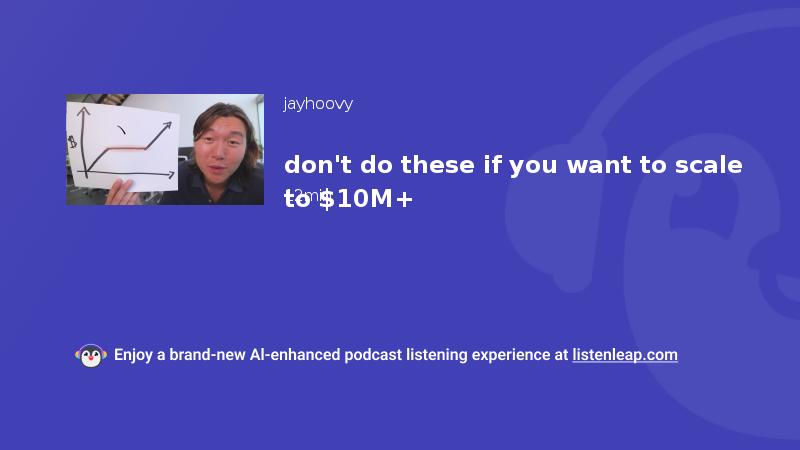
This is my startup.
And this period here, where we plateaued at 25 million in revenue, was one of the most painful periods of my entire life.
But now we're rocket shipping again.
And it's because I figured out the five mistakes that I was making that I'm going to teach you here today so that you can grow way faster.
All right, let's get this down now.
So mistake number one will only happen to you once you become successful.
It's kind of this cruel twist of fate that comes out of your own hard work and earnestness just trying to get your business off the ground.
Basically what I mean by that is, when you first try to get your company off the ground.
You have to do literally everything right.
You're the one pounding the phones.
You're the one making all the sales, talking to all the customers, building out your product or your service, trying to raise money, make your website, create your incorporation like doing everything in your business just to will it into this world.
And there's probably one or two things that you're disproportionately good at right.
So maybe you're really good at coding and developing a product, or maybe you're really good at sales and developing relationships with your customers, and so, for me, when getting my startup stand off the ground, i didn't realize it at the time, but i started to build an identity about being really good at these things, where i started to derive my self-worth and my own value out of, but specifically, doing those activities.
But the reality is, if you're just doing those day to day activities, you can only get to a certain level.
Like as good as I was and this is me here smiling.
I was only this good alone which, to be clear, it's really great when you first start, because this here is millions of dollars, but you have to realize you're playing a much bigger game because, no matter how hard I worked or how well I sold, this output here could never beat 30 effective salespeople who are well-trained and managed, which is a very different skill set.
But my mistake in all of this is that my ego and my identity were so tied up into being the Michael Jordan of the team of being the one who gets to dunk the basketball that I didn't realize that I needed to evolve into the Phil Jackson or the owner or the general manager of this team.
Like, what i valued and what i cared about and what i spent my time thinking about were the wrong things of the stage of the business that i was now in, and that's really critical to think about, because the two things that are truly zero sum in our lives are our time and focus, And so the reason why this period was so painful on me was because, when we first hit this plateau, I had built so much of an identity around being the kid who ran a startup that was always up and to the right, was an absolute ripper of a company that I went into fight or flight mode here and started getting really frustrated and responded by just saying okay, I got this business to where it's at today by just sheer volume of cold calling and hustling and what have you, rather than realizing that this new stage of the company required me to evolve my skillset and my identity.
Like I just thought I needed to brute force, cold call or cold email more additional customers to get us to this next point.
But I actually needed to develop a very different skill set in that moment.
And one that I had a really strong bias and judgment against.
And that was that I had a judgment in my head about the managers or generals or leaders who sat in this ivory tower just doing thought, work or setting strategy, rather than being the ones who are on the front lines fighting the fires with their people.
Like how could I not feel bad about myself leaving them to go sit as a manager in some ivory tower and not feel bad that I wasn't with them in the trenches right here?
And so mistake number one that I want you to avoid is don't let what you're good at define who you are.
Because in this game of entrepreneurship, you're always rising and hitting new levels.
And to master those next levels, you have to be open to letting go of your prior identity and how you thought about solving problems.
And up-leveling into those levels fundamentally requires you to let go of the things that you were holding onto too tightly before.
Like how else could you grow and seize that next opportunity if you're too busy holding onto the railing from before?
Because if you can figure this out, it actually tees you up really well to solve mistake number two, which is the real world manifestation of solving mistake number one.
And that is the mistake of continuing to work in the business rather than on the business where, when you hit this scaling stage, your default whenever you encounter a problem will likely be to immediately try to jump in and solve things.
Where you immediately get into the weeds, your brain starts working.
You're in the moment trying to figure out how do I optimize this sale.
Or how do I solve this problem?
Or how do I figure this thing out?
Rather than zooming out and asking yourself how can I build a system or a process that will make sure that, going forward, we will repeatedly never have this problem again.
And this is a really big shift in one's mindset and mental model of how you actually approach life or solve things.
And it's also the reason why they always say that the best salesperson isn't necessarily always the best VP sales, because the good salesperson that you started as it's always in the thick of things, right.
Like you're always thinking about how do I close this next day?
How do I optimize this?
How do I manage this relationship in a way that gets me the most ROI possible versus a good VP?
Sales is zooming out and seeing the broader forest from the trees.
They're thinking about questions like how do I build a broader pipeline across my entire team where I make sure that I'm building a engine that every single quarter delivers results, no matter who I have in place, because my engine or my system or process is number one, finding the best talent, then training them in a certain way and then making sure that they always have leads to call.
And then in the actual deal process there's some sort of mechanism or trigger that makes sure that they're being helped or advised or optimized through their actual sales process.
Basically, it's the question of how do I make my next sale versus how do I build an engine or a machine that makes money for me in my sleep.
And so there's two things I want you to start thinking about in order to solve this mistake.
Number one is to make sure you're not mistaking sheer hustle for leverage.
Because, no matter how hard this version of John runs in sprints and tries to hustle making sales, that has so little leverage to get me to my actual desired end goal.
Because scaling requires systems and leverage and not just pure sprinting.
Now, the second thing I want you to do here is to fire yourself from your job immediately, or at least 80 of it.
What I actually mean by this is that the nature of our jobs building our own business is that every six months, our jobs have fundamentally changed.
And so one of the easiest ways, I think, to get objective clarity on what you should be doing now is to actually ask ChatGPT to write you your current and new job description, based off of all the factors of your business today.
Like literally ask it, what should my responsibilities be today?
And how should I delegate out the responsibilities I currently have that don't give me energy and don't give this business leverage.
And if you start doing that, you'll avoid the mistake that entrepreneurs make when they start to plateau, which is that they don't evolve with the needs of their business.
Now I want you to think about the implications if you actually successfully build this system.
Where, by definition, if you're working on building a system and zoomed out from that system, you're going to need people in the system actually building that for you.
And so you need to make sure that you're believing in other people sooner, because a lot of first time entrepreneurs will say to me well John, I'm the best person at doing this job in my business, at doing sales or trying not to get run over by a car behind you, or actually just understanding all the context in business.
But that shouldn't be your goal.
Your goal should be to hire people who are even better than you to run your business for you, because that, by default, means that you'll be even more successful.
Because the definition of scaling is passing off what you're currently doing to other people or, in the age of AI, building agents that will actually do your work for you.
But the reality is is that building this kind of system and hiring these kinds of people is going to take you 12 plus months.
All right, let's hit this downhill.
But I can tell you that this investment is worth it because I have the best team here at Stan.
They're a bunch of fucking badasses.
But here's the thing.
A lot of you guys are gonna say well John, every single time I hire someone, they always disappoint me.
I just, I feel like I can always do a better job.
And to that I say, take a harsh look at the common denominator.
It's you.
Because you're likely making the mistake of assuming that everyone else has the same context as you.
But the reality is it is your responsibility as the manager to make sure that everyone has the same context to actually do their job well.
Where of course that new hire you just made isn't going to be on the same page as you.
They haven't been obsessing over this business over the last three years like you have.
And you can either get really pissed and frustrated about that or you can realize that, as their manager and leader, you need to take responsibility for setting them for success and giving them that context where this thing of ours, this noggin of ours, is both a blessing and a curse, where it creates this sort of reality separation where you're probably already 10 steps ahead of the rest of your team.
And so our job as managers here is to make sure that we give our team the most efficient and best access possible to the context we have in our heads.
And so, to navigate all of this, I always love putting together an onboarding document for a new hire, where I'm always hyper clear about their goal and their North star, as well as their job to be done, so that they clearly understand what exactly success looks like for them.
But then, beyond that, I'm also making sure to give them all the context possible where I'm giving them all the different kinds of content that I believe that they should consume.
That's going to catch them up to speed as quickly as possible.
And then, on top of that, I always make sure to have weekly one-on-ones with my team, where the whole intention of that time is to help them lay out what problem are they facing and for me to do everything I can to help them unblock that.
But, with all of that being said, I cannot tell you how much better your life is going to feel once you figure this out, because all of that weight you're feeling around the world on your shoulders, your business on your shoulders, is going to start to lighten and loosen once you figure out how to train your team.
And most importantly, it's also going to help you avoid this last and final mistake, which is to take more breaks which is much easier said than done because while running a business there are going to be so many moments where things are going to be going wrong and your automatic behavior default is going to be i just need to work more because what happens in this entrepreneurial journey is you're constantly exposing yourself to more and more stressors and that puts you into a fear-based mindset like you're literally in fight or flight and i can guarantee you that during that period i was showing y'all where my business plateaued If I had just taken a chill pill for a single second and instead had just taken a single week off to unplug, I guarantee you that we would have saved ourselves at least a few months of this whole plateau process and all the pain that came with it because rather than trusting about the day-to-day i would have been able to zoom out for just a second catch a little bit of a breather and then diagnose okay here's the problem that's actually solving here's the true bottleneck rather than just frenetically every single day checking my email checking my slack trying to work harder and not actually solving the core root problem because looking back There's not a single vacation that I've ever regretted taking because at the end of the day, you know yourself and you know how you're wired and you are going to obsess about your business no matter if you're actually working day to day, if you're on a walk or if you're just in Bali surfing for a month.
We as entrepreneurs are kind of just wired in this way where we're constantly obsessing and thinking about the success of our business.
And so I want you to remove this bias.
You have in your head that taking breaks is some form of weakness.
Because if you were ever to tell me, John, things are fully falling apart.
I can never take time off my business or else it'll explode.
I'll candidly tell you that's not true.
Because, at the end of the day, did you start this whole thing?
To run a business or be run by your business?
And you're gonna burn out if you are always on.
Because creating more space equals to more clarity, because some of your best ideas are going to come from you being on a walk and not you checking email or Slack for the 15th time.
So go on that run, take a breath and just detach for a little bit, and you will come back even better.
Oh, and like and subscribe.