Hey there. Shankar here.
I'm crisscrossing the country for a series of live shows this summer.
I'll be sharing seven key insights from the first decade of Hidden Brain.
These ideas have made my life better.
I think they'll do the same for you.
Stops on what I'm calling the Perceptions Tour include Clearwater and Fort Lauderdale in Florida, Portland and Denver, Minneapolis and Chicago, Austin and Dallas, Boston, Toronto, Phoenix, and more.
To see if I am coming to a city near you, please visit hiddenbrain .org slash tour.
If you've heard my voice for years, it's going to be fun to come see me in person.
Again, that's hiddenbrain .org slash tour.
This is Hidden Brain.
I'm Shankar Vedanta.
Human beings are wired to seek pleasure.
We all want lives filled with joy, comfort and ease.
At the same time many of us are also curious about some forms of discomfort.
We go on scary roller coaster rides, eat food so spicy it makes us cry, and we shriek in terror as we watch horror movies.
Last week on the show in In the first part of a miniseries, we explore the attraction of some kinds of suffering.
We do like pleasure, but we also like meaning and we like struggle.
We want to be moral, and all of that makes our minds a lot more interesting than if we would simply seek out pleasure.
If you miss that story, you can find it in this podcast feed.
It's titled, Ouch! That Feels Great.
Today on the show, we explore one specific dimension of the pain pleasure continuum.
Doing hard things is hard. Learning to play a musical instrument, caring for a sick child, trying to run a marathon. These things involve frustration, pain and disappointment.
Unsurprisingly, if given the choice, many of us say, no thanks.
Why that might be a mistake.
This week, on Hidden Brain.
Every speaker can play the hits.
But not every speaker can take the hits.
After hits. After hits.
After splash. The new JBL Charge 6!
Waterproof. Drop -proof.
Dust -proof. Life -proof.
Wherever you listen, JBL Charge 6.
Made to be heard. Does it ever feel like you're a marketing professional, just speaking into the void?
Well, with LinkedIn ads you can know you're reaching the right decision makers.
You can even target buyers by job title, industry, company, seniority, skills, wait, did I say job title yet?
Get started today and see how you can avoid the void and reach the right buyers with LinkedIn ads.
We'll even give you a $100 credit on your next campaign.
Get started at linkedin .com slash results.
Terms and conditions apply.
1 -800 -Flowers .com knows that a gift is never just a gift. A gift is an expression of everything you feel and helps build more meaningful relationships.
1 -800 -Flowers takes the pressure off by helping you navigate life's important moments by making it simple to find the perfect gift. From flowers and cookies to cake and chocolate, 1 -800 -Flowers helps guide you in finding the right gift to say how you feel.
To learn more, visit 1 -800 -Flowers .com slash Pandora.
That's 1 -800 -Flowers .com slash Pandora.
Have you seen those ads for vacations that tell you that all you need to do is show up?
Everything after that will be taken care of.
You'll just lounge by the beach or by a swimming pool.
Delicious food, massages, and entertainment await you.
The most effort you'll have to expend is to reach for that frozen margarita or apply a little sunscreen.
Sounds blissful, right?
Well, sure, but it turns out this is not the whole story.
At the University of Toronto, psychologist Michael Inslick studies the science of motivation, effort, and reward. He's found that what we think will make us happy, often does not.
Michael Inslicht, welcome to Hidden Brain.
Thank you so much for having me on, Shankar.
Michael, social science has managed to identify only a few so -called laws of human nature.
One of these was developed a little more than a century ago.
It's called the law of least effort.
What is this law? This is funny because psychology, we like to say is a young science and we don't have very many laws.
I found three accounts of this law of least effort.
Sometimes it's called the law of less work, sometimes the law of least effort, sometimes it's the principle of least effort and three independent scientists discovered this.
And this law suggests that all else being equal, every organism we ever tested, every animal we ever tested, prefers to work less than to work more for the same reward. So the notion that people given the choice will take the less effortful path has been shown over and over again, both in real life and in psychological experiments.
When we look in our own neighborhoods for instance, we find that people routinely ignore neatly laid -out streets and walking paths and instead take shortcuts.
I expect this must be the same on your university campus.
They must be neatly laid out streets.
And you have students cutting across the grass to take the shortest path to their classes.
Yes, in fact, it is a universal feature of all parks and fields across the world.
And apparently it's not just humans that carve these paths.
Animals will carve these paths too.
And the idea here is that even though there's a beautiful path laid out by a landscape architect, People, and other animals like sheep for example, they will carve out their own path with their feet connecting two spots between A and B.
I remember talking to the behavioral economist Richard Thaler some time ago, he said the one rule that he's seen over and over is that people, in his words, are lazy.
Given the choice, we will choose the path of least effort and economists in fact have deployed this assumption to reshape the way we all save for retirement by making it automatic rather than something we have to think about.
That's right. So economists, behavioral economists, famously use nudges.
They use what they call choice architecture to make the virtuous option the easy option.
So for example, if you struggle to save for your retirement, what about if a certain amount of money is withdrawn from your account, put into a savings account automatically without you having to lift a finger.
So an interesting area where behavioral economists have discovered and have used the law of least effort to save people's lives is in the context of organ donation.
So even the simple choice that people need to make about whether they should opt into organ donation, it can be made easier, where the lazy route, you know, the default is that you donate your organs, and then you need to expend effort to opt out to not donate.
Giving them the easy, the lazy, the effortless root means that more people do it and more people then donate organs later.
So the appeal of working less shows up in our books and popular culture almost everywhere.
There're books like the four -hour workweek for example, and they become bestsellers because they promise we can work a few hours a week and then kick back and relax.
Do you see other examples of this in the culture Michael?
Everywhere, I will never forget, I'm born and raised in Canada and I grew up with a commercial for a life insurance product that was advertising you know not just life insurance but also a way to save for retirement and they called it freedom 55 and the idea was that at 55 he saved enough you could live a life of luxury and the commercials always had someone on the beach kicking back with a you know a pina colada in their hand I I remember seeing that as a child and was just in awe, I want that life.
I want to have that life.
So definitely people, you know, when they think about a future that's desirable, that's fun, enjoyable.
It's about relaxation.
It's about being lazy.
It's about being at the beach and just kind of sitting.
So we see this all the time.
During the pandemic, Michael, we all heard the trend of quite quitting and lazy girl jobs.
Did you come by these memes yourself?
Oh definitely. Quite quitting, the great resignation.
The labor force was so tight that people wouldn't necessarily get fired even if it only worked not quite to their full potential.
So yeah, you saw this trend where people were not working as hard. In Canada, we might say half -assed their job.
And because, you know, employers didn't have many options.
This was seen to be a trend, hey, you too can just, you know, have your job and not work so hard. And of course, we don't want to work so hard. We don't want to expend effort because effort is something we don't like.
We are lazy. I wonder whether you've seen this in your own life.
Do you see the law of least effort playing out in the choices that you make, Michael?
I see it regularly.
so I just returned recently from, a trip to Japan and it was toward the end of our trip.
And one thing that I've, my wife and I have wanted to experience, really our entire lives are the cherry blossoms that occur in the spring in Japan.
And we had a long day and we'd seen a few blossoms already.
And I at that point just, I just wanted to get back to the hotel room.
What did I wanna do in the hotel room?
Not much, I just wanted to relax.
Somebody want to surf the internet, read the news, doom scroll a little bit.
My wife, wisely, who just loves, is moved by beauty and plants and trees.
She wisely decided to go to Yoyogi park in Tokyo to witness beautiful cherry blossoms. And apparently they were the most beautiful that we had seen on our entire trip.
And I missed it for what, for really for nothing.
I understand this also plays out when there are social locations at hand then you have to decide whether to go to a party or a gathering?
Yes, and I should say that I'm a very extroverted person.
In fact, I planned, right after this, to go out for beers with friends.
And I find myself, despite being social, despite truly enjoying social occasions, almost invariably, I tell myself, ugh, I wish I didn't have to go out tonight.
I wish I could just stay in and watch, do what?
watch television, doomscroll again.
I have the impetus, I had this laziness in me to, like, not want to go out.
The notion that people will choose the easiest, least effortful option seems to be a law of human nature.
But as we have seen over and over again on the show, humans are endlessly complicated.
it. When we come back, the effort paradox, why so many of us deliberately violate the law of least effort, and the curious relationship between pleasure and meaning.
You're listening to Hidden Brain, I'm Shankar Vedanta.
Support for Hidden Brain comes from LinkedIn.
As a small business owner, you don't have the luxury of clocking out early.
So, when you're hiring, you need a partner that works just as hard as you do.
That hiring partner is LinkedIn Jobs.
They make it easy to post your job for free, share it with your network, and get qualified candidates that you can manage all in one place.
LinkedIn's new feature helps you write job descriptions and quickly reach the right candidates with detailed insights.
At the end of the day, the most important thing to your small business is the quality of candidates.
And with LinkedIn, you can feel confident that you're getting the best. Post your job for free at linkedin .com slash HB.
That's linkedin .com slash HB to post your job for free.
Terms and conditions apply.
Support for Hidden Brain comes from Audible.
Can AI predict the source of the next global pandemic, or at least help convince a Hollywood studio to buy a new screenplay?
From Scott Z. Burns, the writer of Contagion, with guest appearances from director Steven Soderbergh, Laurence Fishburne, and Jennifer Ealy, what could go wrong is a thoughtful, occasionally frightening, and often hilarious, Audible original podcast that asks, can humankind and AI work hand in hand.
Featuring an extraordinary collection of minds across academia, sciences, journalism, and the entertainment industry, What Could Go Wrong follows Scott as he slips deep down the rabbit hole with an ever expanding cast of AI -generated partners, including Lextre, his gifted, sharp -tongued collaborator, as they co -write and pitch Hollywood execs the Contagion sequel.
What could possibly go wrong?
Listen to What Could Go Wrong now on Audible to find out.
Visit audible .com slash what could go wrong.
This is Hidden Brain, I'm Shankar Vedanta.
Michael Inslicht is a psychologist at the University of Toronto who studies how we think about effort and why we often gravitate to the path of least resistance.
He also looks at what happens when we choose to work hard at something.
Michael, we've seen that we have a natural bias against exerting effort, a bias that is then reinforced by our culture in all kinds of ways.
You point out that the unpleasantness of doing things that are hard sometimes leads us to overlook the unpleasantness of doing nothing at all?
That's right. So doing nothing leads us to feel bored.
We find this experience unpleasant.
And in fact, sometimes we'll do really bad things to ourselves and other people when we're bored.
Um, there's a famous experiment where people who were left in a room with nothing other than a shock machine, um, for a few minutes, they decided to shock themselves, uh, instead of just being alone, uh, doing nothing.
We ran a study, in fact, where we gave people an option of exerting a little bit of effort, not much effort, but a little bit.
Or just sit there, take a 10 -second holiday, and do nothing.
And what we found was that it was not clear that people wanted to avoid effort all the time.
In fact, people preferred exerting effort if the contrast was doing nothing at all because doing nothing is boring, and and boring feels meaningless, feels purposeless, and people really don't like it.
But the key to our study is that people made this choice over and over and over again.
And they got to experience what the effort was like, what boredom was like, and it turns out they preferred doing something than doing nothing.
So in addition to staving off boredom, exerting effort has other benefits.
What is the relationship between effort and success?
There are many benefits.
So So, people who do this regularly experience more rewards.
So for example, if you want to learn the piano, the more you practice, the more you try and do the dull, repetitive work of playing your chords, practicing your chords, the better you get a piano, the more rewarding that will be, to the extent that you, again, value piano. The more you study, the higher your grades, and the maybe greater entry into various vocational opportunities will be available to you.
But now this is really interesting, this is true not just for humans.
So animals that exert effort end up flourishing more.
So insects, animals like penguins or fur seals, the more effort they exert to, you know, forage for food, to hunt for food, the healthier they are, the more varied their diet, and the more likely they are to pass on their genes to the next generation.
Ants. Ants show this as well.
So there's a connection between a willingness to exert effort and the rewards that you get.
So it makes sense, you know?
Exerting oneself makes sense just in the sense that probabilistically you will likely get better stuff.
You've looked at the relationship between exerting effort and a feeling of competence and mastery.
Describe the studies that you have conducted for me, Michael.
So what we needed to do was to kind of give people dull tasks, boring tasks even and see if the extent to which they work on them and exert effort on them, they will feel like it was worthwhile in some way.
So, for example, we'll give people a four digit number and we'll have them add three to each digit of that four digit number.
Boring, meaningless, yet effortful.
In contrast, we'll give another group the same four digit number, but this time, the task is not effortful, they have to add zero to that four digit number, which of course is the exact same number, they just have to remember that number and spit it back to us.
Afterwards, we ask people to what extent that task was important to what extent it was meaningful.
And what we find is that people will imbue these silly, you know, objectively meaningless tasks as being more important and more meaningful.
And then afterwards, we might ask them, like what other feelings did this task generate in them?
And what we found is that it led, at least in some cases, for people to feel like they're learning something, that they're mastering something that they are kind of attaining some competence in something.
And this is actually really important because one of the ingredients of feeling self -actualized is feeling like you're competent in the world, feel like you can master certain domains.
So, perhaps exerting effort allows people to play with this feeling, to attain some of these feelings that you wouldn't otherwise get.
Is this a reason why, when I finish building my IKEA bookshelf, I feel prouder of the bookshelf than if I just bought a bookshelf, you know, straight off the bat?
Yes, there is a reason.
The reason for that is that, at least after the fact, we tend to find working exerting efforts, despite it being costly, or maybe because it's costly, we find that thing to be more meaningful.
We even might cherish that IKEA furniture a little bit more, and there's a classic study called the IKEA effect, whereby people who were assigned to build their own little IKEA box, they tend to value that box more.
They think it's better and they demand more money for it than another box built by an expert.
And what's funny about this is that I'm sure you've built some IKEA furniture in your life Shanker and you then know that oftentimes you'll build something and hey I've got a few extra screws here.
Right? Absolutely right.
So the things we build are not perfect, they're often imperfect, yet we think they're masterpieces and we are attached to them.
and part of that story might be because we've exerted effort on them and we then imbue value and meaning and purpose to it.
I understand that you had one such experience years ago on a trip to Turkey, Michael.
What did you do there and what did you end up learning about yourself?
Yes, this was many, many years ago in my 20s and we went on a hike somewhere off the Mediterranean coast in beautiful, beautiful parts of Turkey.
They call it the turquoise coast. And our tour guide was someone new to the job and didn't know the route himself that well, but was an experienced hiker.
So my wife and I, my girlfriend at the time, but now wife, we decided to go on this hike, we expected it to be a two to four hour hike.
It ended up being like six plus hours in the burning heat.
And I remember feeling, it was torture.
Not too much the physical strain, because okay I could walk a few more hours.
It was more, we felt like we were lost and we felt like we didn't know where we were going and we felt like, you know, we're exerting all this effort and I just want to be on the beach right now.
I want to be sitting and relaxing and by the end of it we just felt mentally exhausted.
But I also remember, you know, the next day at the very least, if not like, you know, immediately after, I thought like, Wow, I can do that, too.
I too can go on a trip like this, without great shoes, without great clothing, without all the sun gear that I needed.
And I felt like I'd learned something about myself.
I'd learned that, like, okay, I'm resilient.
I'm a bit tougher than, you know, tougher mentally than I thought.
And I felt like, okay, maybe, you know, maybe I couldn't do Survivor but maybe I'm not quite as weak as I thought I was.
Yeah, I mean in some ways you're learning that you have capacities inside you that you actually didn't know you had before and that has to be, you know, maybe pleasurable is the wrong word, but it is sort of deeply satisfying.
It's definitely satisfying, meaningful, and it was pleasurable is definitely not the right Because it was painful.
And physically, mentally, the anguish.
I remember looking at my wife being like, we were kind of like, oh my God, what are we doing here?
But having gone through that pain and that effort.
If it was easy, if it was just a walk on the beach, we wouldn't have left that moment with any lessons whatsoever.
So you've run a number of studies where you ask people to think of a number of different tasks, routine tasks that they do in their daily life, and you find there's an interesting, in some ways, distinction between the amount of pleasure and joy that people take from tasks and the amount of meaning and satisfaction they derive from those tasks.
Can you talk about this work, Michael?
Yes. So, we have, well, we've done a number of studies.
I've already mentioned one of them, where we give people these arduous tasks that are really meaningless, and then we find that afterwards people ascribe meaning to They don't necessarily think they're fun, but they, they do think it's meaningful.
And then we also, what we did is we want to see to what extent this plays out in real tasks, not just these made up tasks that we give them.
And what we did is we kind of gave people a list of 40 to 50, kind of everyday things you could be doing going to a party, doing your taxes, doing your homework, working out, um, what have you bathing.
Um, and, and then we, we gave people this list of tasks and then we asked them how effortful each of these tasks are, typically.
We asked them how pleasurable, how much joy they derive from each of these tasks, and then we also asked them how meaningful, how important, how significant, how purposeful each of these tasks are.
And what we found was very, very interesting.
We found that the more effortful a task was, the less pleasure we seemed to derive from it.
But at the same time, the more effortful a task was, the more meaning we derived from it.
Effortful tasks are not necessarily pleasurable.
So remember my hike in Turkey.
That was not pleasurable, especially by hour six.
But later on, I described it as being meaningful and important.
So joy and meaning sometimes go together, but effort breaks that apart.
And it seems like effortful things, we seem to imbue them with meaning and purpose.
We have this extra value that things that are merely pleasurable don't have. I'm wondering if this might explain some of the seemingly paradoxical data we get when we ask parents how much they enjoy parenting.
So if you ask parents every few hours, especially parents with small children, you know, are you having a good time now, are you having a good time now, what about now, people will often say they're not very happy, you know, they're doing chores, they're picking up after their kids, they're sleep -deprived, they're exhausted, they're stressed.
But then if you also ask people how meaningful is it to you that you have this child that you're caring for this other human being?
People reported it being an incredible source of meaning, and here's another example of something that's very effortful, takes a lot of effort, might not be pleasurable on a moment -to -moment basis, but it's deeply meaningful.
Yes, absolutely, that's a classic one.
So I think sometimes there's revisionist history going on where we might you know cognitive dissonance pushes us to describe the arduous task of of parenting as being meaningful and important and that's a way for us to kind of say faith to some to some extent to kind of say that effort was worth it yeah right so I think sometimes the the connection between effort and and reward might be an illusion it might be something a trick we we do to kind of keep us going but not always because oftentimes there actually are real rewards that are connected with that effort later.
Is it possible that your trip to Turkey was also the same thing here, Michael, which is that in fact it was pretty horrendous, but in retrospect, cognitive dissonance is basically reshaping your memory of the event to make it more meaningful.
Absolutely. I think cognitive dissonance is a hell of a drug.
I think we want to be consistent.
I could've been sipping Mai Tais, or Arak, in Turkey, but instead I was hiking under the hot sun. So the connection between effort and value is multiply determined.
I think some of it is a bit of a trick, an illusion, but I also think there are real sources and points that are attached to that as well.
And I suppose even if it is a trick, or what you're calling a trick, if it is cognitive dissonance, post -hoc rationalizations, you know, I can't believe I made myself go through that six -hour hike, it must've been a really meaningful and important thing.
As far as your mind is concerned now, it is now a meaningful thing, regardless of the mechanism that produces that meaning.
Absolutely. And that's really, really important because of course, as you know, we're constantly facing choices about what to do and what not to do.
So if I've now encoded that really arduous and difficult hike that I did in Turkey as being worth it, as being valuable, now I have a connection in my mind that effort and value go together.
And so now, when I have a new decision to make, I'm like, yeah, I think it's difficult, but oh yeah.
Effort can also be valuable.
It can also be important.
So I start learning the value of hard work, for example.
I'm wondering, as a college professor, you must deal with students now who have figured out that there are very easy ways of completing their assignments.
They can ask chat GPT or another AI to basically help do the work for them.
And at some level, it is the case that these systems are very, very good at coming up with high quality work.
But I think the story that you are telling complicates what it means for the student to actually have an AI do their homework for them.
Absolutely, I think it complicates it a lot.
And in fact, we've run a study with comparing people's experience of writing an essay themselves, versus prompting Chachibidee to write one for them.
And what we found is, like, I think quite extraordinary.
What we found is their essays were middling.
They were—on an ad, when we graded them, they got, I think, somewhere in the high 60s for their little essays.
And then, when they prompted Chachibidee to write, Chachibidee wrote much, much better essays more like in the 80s but then afterwards when we asked these participants about their experience people who wrote for themselves found the experience more meaningful more important so what this suggests to me is part of the experience of writing an essay is the experience of writing an essay of doing it and you might find that meaningful and important and then you might want to do it more and you're not just doing it just for the end goal of getting a grade.
You're doing it because you're cultivating some skill, and cultivating skill is intrinsically rewarding, as I mentioned earlier.
It's meaningful. You feel like you're alive in the world.
When you're doing something like that, it's kind of outsourcing it to a machine.
So yes, it does complicate things for students.
So there's something of a paradox in all of this work, isn't there Michael, which is we go to great lengths to avoid effort, to choose the path of least resistance, but as you've shown in multiple ways, doing hard things can produce benefits.
It gives us pride and meaning and satisfaction.
Absolutely, and a number of years ago, my colleagues and I, we talked about this paradox.
We coined the term, the effort paradox, to describe this very thing, where on the one hand you've got economists like Richard Thaler, but many others, who look at effort as something we need to avoid, or something that people avoid, and as a result, you know, design tools and products that maximize our laziness.
But at the same time, we do things all the time that require effort.
In fact, effort seems to be the only point of doing it.
And it just seems odd that both of these things exist at the same time.
When we come back, one woman's vivid encounter with the effort paradox.
You're listening to Hidden Brain.
I'm Shankar Vedanta.
This is Hidden Brain.
I'm Shankar Vedanta.
We are all compelled to do difficult things from time to time.
Sometimes those things serve a clear purpose.
You push through years of grad school to get a degree.
You go to the gym to get stronger.
You eat the broccoli, even though you hate broccoli, because you know it's good for you.
But there are some things we do that don't seem to serve a practical purpose.
They are hard for the sake of being hard. And yet we do them anyway.
At times we may even surprise ourselves were the lengths we'll go to in order to finish those things.
My name's Mary Pan, I am a family medicine physician who lives and works in Seattle, Washington.
I met Mary on a trip to the Pacific Northwest. She and some colleagues were going on an early morning hike and they were kind enough to let me tag along.
As we made our way through the hilly hike, which was slushy in some places — it is story.
Yes, so I've been running my whole adult life.
It's a great way for me to de -stress and also get some exercise, get outside.
And a few years ago, I wanted to do something different.
I was just going through a lot of difficult season in life and so challenging myself to try something new, something different, seemed like a good thing to do.
And so what did you have in mind?
So I signed up in the fall for the next trail run that was available and a trail run is, you know, on like a hiking trail often in the middle of, you know, around here in the Pacific Northwest, lots of trees, nature, a place where people would go hiking, but running on that path.
So it's much more uneven.
It's beautiful, often, but but as a nice way to get out into nature, out of the city, and that's how it's really different than a lot of the races I had done previously.
The trail run was in December.
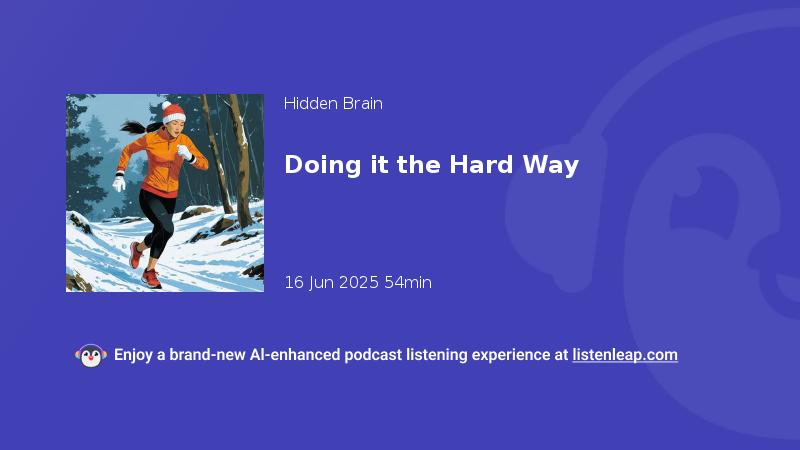
As the date neared, Mary began watching the weather.
The night before the race, she saw that snow was forecast. This would make the run even more challenging.
I woke up in the morning, looked out my window here in north Seattle, where I live, and there was no snow.
So I thought, okay, great.
I'm going to still bundle up, get on my trail running shoes, you know, get my gloves, headband, headed out to across Lake Washington, to where the start of the race was.
So as I was driving, though, about 20 minutes away to the suburb of Seattle suburb, I realized there was some more, I've seen more and more snow as I was driving and I went to the parking ride where the shuttle bus was picking us up to take us, all of the runners, to the trailhead.
And I realized there were patches of snow at the park and ride.
And I thought, okay, well, I'm just going to keep, I'm still going to do this.
Mary got on the bus.
As she and the other runners were taken out to the trailhead, she looked out the window with apprehension.
As we're moving up to the trailhead, there's more and more snow.
And once we get up there and I get off the shuttle bus, I realize there's several inches of snow on the ground And I wasn't prepared for this.
I'd never really run in snow.
I run in the rain a lot, um, in Seattle but not in the snow.
And the other runners, no one else seemed as concerned as I did.
Um, some of them had brought, you know, spikes to put on the bottom of their shoes.
Maybe they were more experienced in running in the snow but I wasn't.
Uh, but it was beautiful and I thought, I -I'm just gonna do this.
I've got my gloves, I've got my layers, I'm gonna start the run and see where it goes.
I'm wondering if some of your trepidation was because you are a doctor and in some ways you see people coming into the hospital after they have, let's say, not had the best run of their lives.
Could that have been part of your trepidation, Mary?
I'm sure it was. I tend to be a pretty cautious person because I've seen so much illness and injuries in my life and in my work.
I exercise a lot. But early to mid -40s, I didn't want twist my ankle or break my leg, and as I mentioned before, trail runs are different and that they're very uneven, and so you've got to pay attention to that, even when just hiking.
Did the possibility of just getting back on that shuttle bus and going back to your car occur to you?
It didn't at the start, I will tell you.
You know, I had bought in anticipation of this race, some running shoes that are more for trails, but not for snow.
And I had, you know, my gloves, I run with gloves in the winter regardless.
But I sort of looked around too and I think I thought, well, these people don't seem too concerned.
Some of them have the similar, you know, just running shoes, gloves, hat that I had.
So I also I think thought, okay, maybe I shouldn't be too concerned either.
This sounds like the classic story of peer pressure.
So tell me how the race began.
What happened? So I started the race and I realized right away, I was very tentative.
Again, I'm not used to running on the snow.
So I'm running much more slowly, I realized, than I normally would.
Much more carefully paying attention to my steps.
There were hills, uneven terrain, the snow was very slushy at parts, other parts very icy.
so I did slip a few times but I'm with a big group at the start.
We're sort of all bunched together and you know I start running and I think, okay there's I can do this.
I'm gonna be slower than than I thought that I can do this.
I didn't know how far I had gone and I realized I was already soaked through.
My feet were you know toes were numb, fingers numb, and I hit the first aid station and I don't know how far I've gone I think I must have gone at least you know six miles or more.
And I asked the poor teenager there who's handing out water and these gel packs, well, how far is this?
Can you tell me how far I've gone?
And he asks around and he says, I think it's about 5K.
And I am just dismayed because, you know, I've only run a little over three miles.
I know it's taken me much longer.
I'm already exhausted and freezing and my muscles are aching, I think, because I'm using different muscles to balance on this snowy trail than I normally would and again at that point you know I'm in sort of its up adjacent to a neighborhood actually but I have a co -worker who lives in that neighborhood and he had said hey if you get stuck or anything you know feel free to just text me and I'll come and pick you up but I didn't stop I grabbed my water and I thought okay I'll just keep past that 5K mark.
What was it like to run where you couldn't feel your toes?
And was it just your toes, or was it your feet that became numb after sometime?
It was my toes and most of my feet and also my fingers.
I'm used to running with some cold or numb toes, but it was much more pronounced, it both my feet and my hands were completely felt really numb and I didn't again I didn't feel as stable or steady on my feet.
I mean if you can't feel your toes you can't feel your feet that's actually quite unsafe because how do you plant your feet?
It probably is. I'm not I don't recall how I I mean I guess it was maybe some sensation if maybe just pain that I was able to do and there were several times where I'd slip and I'd sort of, you know, gain my balance again.
And I would slow down for a little bit and then I would speed up again when I think I gained a little more confidence.
But right after every time I lost my balance and slipped, I was much more hesitant and cautious, I think, right after that.
I'm wondering what thoughts went through your mind as you were doing this, Mary.
What was your internal voice saying to you as you're going through this, essentially half marathon from hell?
I kept thinking, should I just stop?
I think there were these moments of, should I stop?
But for the most part, I, and I realized this is just a pattern in my life, whenever I meet a challenge or I commit to something, I tend to want to finish it, to complete it, even if it's very challenging and painful.
I had started it, I had committed to it, and I wanted to finish it.
And it was so beautiful visually, you know.
It was really a gorgeous morning on that trail in many ways.
But I couldn't really enjoy it fully because my body was really in a lot of pain.
And Mary kept going.
No matter how much pain she was in, no matter how many times she slipped, she kept hearing that voice inside her, you must finish.
As she reached the back half of the race, something happened that certainly made it seem like the running gods were conspiring against her.
Yeah. So I'm running up the hill.
I have about two miles left in the race.
and I'm noticing it's warming up and the evergreen tree branches are heavy with snow and I'm starting to see some of the snow drop around me.
And as I'm running up this hill, one of the branches full of snow just dumps snow right over my head and all over me.
And no one else is around at this point and I exclaim and sort of let out a bit of a laugh, too.
I'm nearing the end, and it was just so ridiculous that I got soaked by this snow on the branch near the very end of the race.
And at that point I could sort of look at it and laugh at myself a little bit for even making the decision to continue on with this and the timing that I would just got dumped on by the snow at the very end.
It's almost as if the gods were trying to tell you something, Mary.
Maybe, yes. That's true.
So the rest of the race, I was able to finish the race.
It was warming up, so it was very slushy snow for the most part at that point, which can also be very slick to run on.
And I made it to the end and felt a lot of relief and a lot of soreness.
And I grabbed my hot chocolate and got on the shuttle bus and headed back to my car.
I'm wondering looking back on it, how your accomplishment of having finished this race under these very difficult circumstances in a lot of pain, what did that tell you about yourself?
What was the message you heard from yourself?
I think that I can do difficult things.
That's a core value of mine is to completing and making it through challenges and difficult experiences.
This is just a core of who I am.
This taking on challenges and I was thinking of, you know, I ran hurdles when I was in middle school and my first track meet.
I remember I started the race, ran over the first hurdle, second hurdle, hit it with my foot, fell down, was bloody, and saw all the other runners in front of me, got up and kept going.
Hit the next hurdle, fell down, got up and kept going.
Hit the next hurdle, kept going, finished the race.
And I remember the coach came up to me after, and I was only, you know, 11, 12 years old, and said, wow, Mary, I've never seen anyone, you know, finish something, you know, when they're bleeding like that.
I mean, I hear the effort paradox, uh, written all over that story.
So, um, first she wanted run a half marathon. Which the act of running a marathon is a really really puzzling thing if we come to think about it.
Running in a circle more or less and you know it's painful it's not necessarily good for you, bad on your feet bad on your knees yet people do this regularly.
And running, uh, it's forget about it being painful.
Normally she also had snow, uh, you know, branch with snow falling on top of her didn't sound like she was having a good time at all.
Sounded very unpleasant.
But yet afterwards, she appraised it as this important experience, this meaningful experience.
And she even connected then to a story of herself running hurdles when she was younger, And she kind of built this story of herself was being a persistent person, a person who, you know, overcomes things.
So I think, you know, these effortful situations in our life give us these like testing grounds, these testing grounds to show what we're made of.
And they allow us kind of to be a hero in our own life story.
And you don't get that by not running the marathon. You only get that by putting yourself in hard places, in challenging places.
Um, and that's why, you know, the economists or the psychologists who talk about, you know, the silliness of effort and how we're all lazy is not paying full attention to, you know, the rest of us and how we, we tell stories about ourselves and we want those stories to be, to some extent, a hero story.
And effort allows for that, allows us to be a hero in our lives.
Effort is unpleasant and painful but effort can also be rewarding.
Michael and other psychologists suggest that we can help other people in our lives cultivate industriousness by offering praise when the people around us display effort, regardless of whether it achieves a goal.
That's something we can do as parents?
It's to teach our children that trying is the key.
We want people to be rewarded for trying.
So you've got someone who just kind of participated but didn't do much. I'm not sure how much reward they need but if they participated and they've tried and gave it their all, and who cares what the outcome is at that point?
Now you're like, you tried hard, and I'm going to reward you for that.
So we're learning that to be industrious is rewarding, to push yourself to try to give it your all to like to tolerate that feeling because it is not necessarily a pleasant feeling and that's something that we can learn.
In fact many cultures teach this.
We receive all kinds of lessons about the value of trying and we can scaffold that in our children or our students when they're trying for things.
Is there any evidence that learning to be industrious in one domain transfers over to other domains?
Yes there is! In fact there's some research that I've just done in my lab that people in fact exerted more effort on a brand new task that that they had not experienced, if previously they had learned that effort is rewarding.
So what I love about this idea is it suggests that you know we can learn to tolerate effort as a general thing.
And the reason for that is because you know the feeling of effort is a generalized feeling.
Yes, when I try hard on my piano, of course, there's something strictly attached to the piano and the finger movements and what have you, but the experience of effort is common. These feelings transfer and then if we can learn that these feelings signal reward is coming, you then become industrious.
I understand that you yourself have absorbed the lesson of your research and you did so many years ago, even before you had conducted the research, during a trip to Indonesia with your then girlfriend, who, again, was the woman who became your wife.
Tell me the story of what happened on that trip, Michael.
Yes, so I'm also cognizant of, I've met lots of stories around trips.
Clearly, you can see that my wife and I like to travel.
And Indonesia is truly one of our favorite places.
And this is after graduate school, and we'd spent this is i think probably about two and a half months now in southeast asia and uh at the end of our trip we were kind of on what i call the the paradise island of bali bali is one of my favorite places beautiful people beautiful culture beautiful nature um and my wife wanted to go to java which is the neighboring island just to the west of bali But it involved a long series of trips on boat, on various buses, you know, I think it involved like over 24 hours of travel.
And I just was tired.
I just, you know, the idea of sitting on a bus, being bored, this is well before smartphones and entertainment on a bus and also, you know, the heat and it's not pleasant to be on a bus for so long.
I just didn't wanna do it.
But I decided, okay, let's, let's just go ahead.
Um, and we then connected on to Java.
We then experienced Jogja carda, which I witnessed, you know, incredible sites there.
But truly the thing that I will never forget as long as I live is the moment I saw Mount bromo not bromo is a, is an active volcano on Java.
Um, and I'd never seen something like this in my life.
I've never been to the moon as most people have and not been to, but the landscape seemed like it would be, you know, what you'd be like on the moon.
And I was surrounded by volcanoes all around me, fires kind of just coming from the ground, and it was an otherworldly experience.
It was tremendous. And we spent a good 36 hours there, and I now see that the effort was so worth it to see this site.
And if I had not had that pain, I wouldn't have seen it.
Now, of course, maybe I'm exaggerating how beautiful it was, because again, cognitive dissonance can play these tricks on you.
But I do think that if anyone ever gets a chance to see this, this kind of otherworldly place, go.
The effort was truly, truly worth it and I do not regret that whatsoever.
It was one of the highlights of my life to see that.
Michael Ensligt is a psychologist at the University of Toronto.
Michael, thank you so much for joining me today on Hidden Brain.
Thank you so much for having me, it's been a real pleasure.
Hidden Brain is produced by Hidden Brain Media.
Our audio production team includes Annie Murphy -Paul, Kristin Wong, Laura Quarrel, Ryan Katz, Audum Barnes, Andrew Chadwick and Nick Woodbury.
Tara Boyle is our executive producer.
I'm Hidden Brain's executive editor.
If you love Hidden Brain, please join our podcast subscription, Hidden Brain Plus.
You'll be helping to support the research, reporting and interviewing that go into every episode of the show.
Plus, you'll have access to episodes you won't hear anywhere else.
To sign up, go to support .hiddenbrain .org.
If you listen to the show via Apple podcast, you can sign up at apple .co slash hiddenbrain.
I'm Shankar Vedanthan.
See you soon. You