Hey everybody, welcome back to my YouTube channel.
In today's video, we are going to cover two verbs that people often mix up, do and make.
If you have some trouble or if you're confused about these two verbs, keep watching this video.
Let's get started.
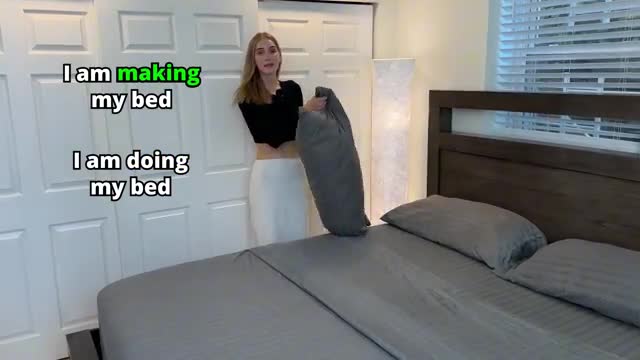
For example, am I making the bed or am I doing the bed?
I am making my bed.
In this example, make is used for actions that involve putting something together, like making a bed.
I like making my bed Every morning.
All right, here's another tricky one.
Let's say I need to go to the doctor, but I have a specific time in mind.
Do I do an appointment or do I make an appointment?
I make an appointment.
If you are calling to schedule or change an appointment, please press 1.
Thank you for calling.
This is Tanya.
How may I help you?
Hi, my name is Ariana, and I would like to make an appointment.
Date of birth, please, Ariana.
Yes, 04-26-01.
And your last name?
Can I get your address, please?
What are you needing an appointment for?
My yearly checkup.
We are booked out to like February, March, and April right now.
Oh, wow.
I've got February 26th available.
I have a 1.40 and a 3 o'clock.
Okay, let me check the calendar.
Let me see.
Do you know what day that is?
It's a Wednesday.
I can do a 3 o'clock.
So we got you down for Wednesday, February 26th at 3 o'clock.
Okay, thank you so much.
Thank you for making my appointment.
Not a problem.
You have a great day.
Thanks, you too.
Bye.
I just made an appointment.
You might think it's strange to say I make an appointment instead of I do an appointment, and that's because you're actually creating it.
So I just talked to the receptionist at the doctor's office and I made an appointment.
She created a date and a time for me that was available, and I'm glad I made it right now October 17th, because my appointment is for next year February 26th.
I have to wait around four to five months for an appointment, so I'm glad I made it.
Okay, so I just made lunch and now I have to wash the dishes.
Do I make the dishes or do I do the dishes?
I do the dishes.
We use the verb do because you're taking action, you're getting something done, but you're actually just washing the dishes.
But make is different because make is used for creating something new, like a cake.
You use different ingredients for making a cake, like sugar, eggs and milk, but I'm not actually making dishes.
That's why we don't use the verb make.
I did the dishes because I washed them.
Now imagine you need a ride to the airport and you want to ask your friend for a favor.
Would you say, can you do me a favor or can you make me a favor?
This one can be tricky, but both of them are actually correct.
What's the difference?
Sometimes when you use the verb make, it might sound like you're asking for a bigger favor.
For example, can you make me a favor and drive me to the airport at midnight?
That's a really big favor.
Think of it like this.
If you want to make a small favor, you can say, can you do me a favor?
For example, can you do me a favor and turn off the light?
Camila, can you do me a favor and take my dog on a walk?
I'm pretty busy right now.
Yeah, sure.
Thanks.
This is a small favor and it's not a big deal, right?
But on the other hand, make is a bigger deal.
Can you make me a favor and pick up my dog from the vet?
This is a really big favor because you might have to take time off of work, go pick up the dog, Take care of the dog and drop him off at your friend's house.
That's a really big deal How are you doing so far?
These two verbs, make and do, can be confusing, but practice makes perfect, and speaking English confidently Doesn't have to be a struggle.
I started using Bussu's conversations feature and to practice speaking.
They have different topics, like giving your reasons for learning English, and you can practice specific phrases.
And their new speaking practice is great for pronunciation.
You listen to a native speaker say a phrase or a common word, and then you repeat everything that he says.
And it gives you real-time feedback.
With 14 language courses like English, Spanish, and Japanese, you'll be ready for any conversation.
And it's not just grammar.
Busuu features interactive lessons with real-life videos from native speakers.
So, whether you're planning a trip abroad, starting a new job or just want to boost your confidence, Busuu can help you reach your goals.
With Busuu, you'll go from struggling with make and do to actually holding real-life conversations.
Download Busuu now, the app that takes you from learning to speaking English with confidence.
Did I do a noise or did I make a noise?
I made a noise.
I honked my horn and I hope my neighbors won't get mad at me.
You might be thinking, why do we say I made a noise?
Because it sounds like you're just doing something, right?
But think about it.
When you're making a noise, like honking the horn, You're making a sound happen.
It's like you're creating something new.
Imagine a baby crying.
The baby isn't doing anything to make the crying sound.
It's just coming out.
So that's why we say I made a noise, because we make a sound with our voice or our body, or just the sound of honking the horn.
Now, what happens if I ordered something totally wrong and I already paid for it?
For example, I ordered a fish sandwich instead of a hamburger.
Did I do a mistake or did I make a mistake?
I made a mistake.
Remember how we talked about making a noise, because we're creating sounds with our voice or our body.
Well, it's the same with making mistakes.
I chose the wrong decision of ordering something like a fish sandwich instead of a hamburger.
I made a wrong choice.
This place has really good ice cream.
I'm going to order ice cream.
Oh no, I made a mistake.
I ordered ice cream, but instead I just got a shake.
Okay, this one should be pretty easy since we kind of talked about it before.
Let's say you want to book a reservation at that restaurant over there.
Which one is correct?
I want to make a reservation or I want to do a reservation.
You should say, I want to make a reservation.
Hi.
Hello, come in.
Can I make a reservation?
Yes, of course.
When do you want to do it?
Tomorrow night.
Tomorrow night.
What time would you like it?
Around seven.
Around seven sounds perfect.
For how many people?
For four.
Awesome.
You might think it's kind of strange to say I am making a reservation instead of saying I am doing a reservation.
And that's because you're creating something when you make a reservation.
This is kind of similar when you make an appointment at the doctor's office.
You have to schedule a specific date and time to see the doctor.
So similar to making a reservation, you have to schedule a specific time and date.
That way they can arrange a table for you.
Let's say, your favorite English teacher, Arianita La Gringa, gives you a ton of homework after your lesson.
Do you do your homework or do you make your homework?
You do your homework.
We say I do my homework instead of I make my homework because you're simply completing a task.
You're just completing an assignment.
You're not actually making the homework itself or making something new.
It just simply exists.
You're doing your homework.
Are you a good student and do you do your homework?
Let me know down below in the comments.
Okay, say you want to create a positive impact in the world.
Do you do a difference or do you make a difference?
I want to make a difference.
This one can be a little bit tricky, because it sounds like you're doing something, but instead you're creating something.
You're creating a positive change or impact.
You're not just completing a task, so we wouldn't use the verb do.
You're making a change, you're making something happen, so we use the verb make.
I want to make a difference.
It's kind of like making a cake.
You create something new.
So when you make a difference, you're making and creating a positive impact.
Hey, Dustin, what kind of difference do you want to make in the world?
Well, I like to bring people together.
I like unity.
I'm all about it, culture, etc.
So I just want to unite.
That's what I want to do.
Okay, everybody, let's summarize what we learned.
We use the verb make when we create something new, like a cake, and we use the verb do when we do things like doing homework or doing the dishes.
If you like this video, go ahead and give me a like, subscribe, and I'll see you guys next week.
Bye!