This is Roundtable.
I'm Steve Hatherly, and today I'm joined by Yushan and Feifei.
Coming up, a philosophical discussion.
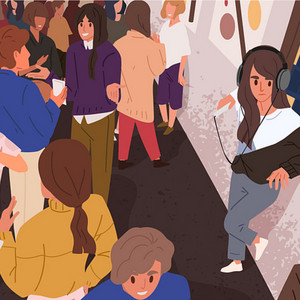
We have never been more connected than we are right now, and yet also never more alone.
Our cities are monuments of congregation, but true meaningful conversation is becoming a lost art.
It brings about the question of relationships.
Are close relationships still the non-negotiable key to a happy life, or have we underestimated the pure empowering potential of solitude?
After that, if you need a little emotional boost to begin your week, we have motivational monday on the way for you.
Our podcast listeners can find us at Roundtable China on Apple Podcasts.
And don't forget, we love hearing your voice.
So please do send a voice note our way with your thoughts on any of the issues that we discuss here on the program.
Here's how you do that.
Roundtable podcast at QQ.com.
One more time.
Roundtable podcast at QQ.com.
And now we inhabit a paradox of proximity.
Our world is woven together by invisible networks, placing us within reach of billions of other people.
Yet in these dense human landscapes, a peculiar silence can grow, a feeling of being alone in a crowd.
Today we'll explore that fundamental human dilemma.
We'll examine whether our age-old craving for close-knit bonds is irreplaceable for happiness, Or if we are evolving into an era where solitude is not just a burden, but it's a valid and sufficient choice for a contented life.
I love these types of conversations that don't have an answer.
Those were my favorite classes in high school, too.
The philosophical classes where, you know, it's not math or science related.
Yeah, and it's not categorized by rights or wrong or one opinion or the other.
I apologize.
I interrupted you before you, Sean.
Go ahead.
I don't know.
I was just going to say that I was telling Steve Fei Fei before the show that by looking at the title alone it sounds so philosophical.
But when you start to think about it, it really makes sense.
And it's really closely connected to the day-to-day lives, especially for young people nowadays who find it hard to form social connections anymore.
And recently labels like introvert, like we discussed quite recently on Roundtable, like introverts or 爱人 in Chinese, meaning that these people are probably shy or quite close up to themselves.
And socially anxious also matching with that kind of labels or 说空 in Chinese.
They're all like openly being embraced in the society more often, meaning that more young people claim that they are 爱人 or introvert by nature or something in some way.
I promised there would be no math, but I lied.
There was a 2023 survey done by China Youth Daily that found that 64 of young people between the ages of 18 and 35 admit that they struggle with socializing.
And 20% said it happens both online and offline as well.
So everywhere.
And those statistics were from two years ago.
If I had to guess, those numbers are probably higher now probably, and especially right now.
I think it sort of makes sense when it comes to the environment, especially in cities currently compared to well, when i was 18 um, you know, i don't know, but i felt it too.
I don't know what it meant, but i felt it, you know, when you you don't have like on apps for chats or, and the only way to get connected to your friends is either by written mails or by telephone.
Do you remember these days Hey, is Fei Fei home?
Yeah.
Yeah.
Yeah.
I don't see that happening around younger young people, you know, between 18 and 35, apparently.
Very often, you know visiting, just popping up to your friend's store, you know just, you know, having a coffee in their apartment and having a chat or having a really really long phone conversation with Among them right now is more of a happening.
You're just texting quick.
Yes, quick, quick interaction, but also fragmented.
Like when you are chatting on whatever app that you are on, messaging app that you're on, you can just stop, get interrupted, for example at work, and you stop replying and you reply one or two hours later.
Think about the other side of the chat.
Is he or she waiting for a reply?
Well, it's an accepted form of communication now, right?
No one takes offense to that.
It's just how the world is these days.
And there are different reasons for it.
Geographic separation might be one of those reasons.
We often live in our own little bubble if you think about it.
You wake up in the morning and you go to work.
You interact with your coworkers, but probably more often than not, those relationships exist within the four walls of the office.
See, this is something I'm trying to, at least on a personal level.
Trying to adjust for myself is because, like you mentioned Steve, I wake up, I realize I'm in a box where I call my apartment.
And then I enter another box called the elevator and get into the parking lot.
And then I enter another box called my car.
And then I move all the way nearby to the office I parked.
And then with that small five minutes walk from the parking place inside our office.
Which is another box.
And here in the studio, it's a box within a box.
The only open air I got was that 5 seconds of walking from where I parked to the office, at least during the morning.
So that's something I realized from last year starting, and just something.
It's not good In the long run if you just stick to that bubble, let's say boxes from boxes, and it's getting really hard to build meaningful long-term relationships if you stick to that.
There's high mobility nowadays as well.
People will frequently change jobs.
They'll move apartments.
They'll shift social circles.
They'll make new friends and stop being friends with other people depending on the context of their relationship, and it's making long-term relationships harder to sustain perhaps.
Well, is that really that big of a problem?
Well, that's the question.
Yeah, because I was thinking about my childhood.
We move a lot.
Definitely, I think every two or three years, basically through my teenage year.
We moved to a different apartment.
And because we move a lot, I also change schools a lot.
And so I also don't have a lot of friends growing up because I'm moving a lot and because of connections that weren't that easy at that time.
Was that stressful for you then?
Not really.
I think I'm really comfortable in my own bubble, which can be good at that time, but maybe it can be bad, because I am definitely an iron and introvert kind of person.
You never saw it as a bad thing.
Yushan, you said you go from box to box to box to walking outside for a few minutes to another box.
And you said this is not a good thing.
But what would the alternative be?
What I'm trying to do nowadays is when there's no urgent say, job-related matter that needs to be handled immediately, or after a round of busy working, I allow myself say, a 15 or 10 minutes walk downstairs.
And just walk around to the cafe area in our office building or outside.
See who I can pop up and say hi with.
That's very social.
Yeah, do some chit-chat with people outside of my nearby, say, office desks.
And just be open about who you might encounter.
And always say hi to those who are willing to say hi back.
That's very friendly.
That's something I've been trying and it's working really well.
I don't...
For example, I don't work with Fei-Fei every single day, but every time we see each other, at least when we are not busy with dealing with phone or in the conversation, at least we say hi.
And that's also how I get to know a lot of coworkers in or outside of our department that I don't sit with every single day to know them.
That reminds me, you know, how quiet offices are these days.
Coworkers don't talk as much as I think 10 years ago, at least.
Maybe because we're relying on the messaging apps so that we don't need to talk to each other.
It's like when you approach someone face to face, it has to be something important or serious.
Or urgent, like it has to happen now.
Those interactions then, are on superficial level, meaning when you pop up to somebody's desk or what have you, or run into somebody outside and you have an interaction, and those interactions are important to you, but they're still very surface level, right.
Kind of, yeah.
But that level of surface level interaction on a daily basis is satisfying for you, not to put you on on in the spotlight here.
But my point is i think you're right yeah yeah, but my point is this do we need strong social ties to be happy on a daily basis, or can we simply exist on this planet with surface level relationships beyond those of our romantic partners and our, you know, children and parents and family members?
I think, at least from the studies that's been conducted, the answer can be yes in some cases, as proved by decades of research.
So by research I mean the Harvard study of adult development that has been following hundreds of participants over more than the last 80 years to identify the psychological predictors of healthy aging, and it found out that the biggest predictor of happiness isn't money or fame, but rather relationship satisfaction how comfortable you feel dealing with people day to day.
Yeah, but relationship satisfaction is a relative term.
Yeah, it doesn't mean that you have to.
It doesn't define the types of relationships that you have.
It just says that you're satisfied.
It just says that you're satisfied with the types of relationships that you have.
Yeah, it can be very close relationships, but do like the superficial relationships that Steve just mentioned.
You know, just say hi to coworkers or just really surface social ties.
I think it's important.
Just imagine, you know, you stay in an office for eight or even 10 hours a day, not speak a word.
That's horrifying. in a way.
Does anybody in our office do that?
Our office feels pretty lively to me.
And it can be loud sometimes, which is good.
Yeah, you know, when it's the loudest friday no, friday afternoon, with about 30 minutes left in the work day, suddenly there's an energy like i don't know, everybody's a rock and roll band is about to come on stage or something.
Yeah, like everybody wakes up.
It's really kind of funny and cute to see.
Um okay, so we've established that then.
Right okay, so harvard study of adult development.
I think you said they've determined that we do need human interaction.
That's not really a secret.
Humans need other humans, But not all social ties are beautiful, correct?
Not all social ties are beneficial.
Yeah, it can be toxic, too, depending on who you are engaging with.
Sometimes a relationship seemingly nice and supporting and encouraging can be draining at the same time and harm the well-being of um for you on a personal level, some people even found a deep meaning in solitude, creativity or spiritual practices, proving that happiness from social relations isn't one size fits all for everybody.
There was.
I wasn't always comfortable in my own skin being being by myself.
I I would get, I would get kind of not bored, I don't, I don't ever get bored, but I would feel like I'm supposed to be doing something.
So I constantly filled up my social calendar when I was younger and then I don't know what happened or when it happened, but suddenly I realized I think I was.
It was when I was on vacation by myself and I did it once.
I didn't like it.
I did it again.
And I really enjoyed just hanging out with me.
And I think maybe that the younger generation of people now has figured that out, like unlocked that key just earlier in life, like i'm just happy hanging out with me and i'm happy with the interactions that i have with people, and i guess that's the most important thing, and it's not like they are refusing any type of deeper in, like interpersonal connections by any chances.
It's like some people benefit from it.
Some people feel like solitude is works better for them to heal and for for them to harness more energy, and then um, Another thing is that nowadays, for young people specifically I know I can't represent everyone that's labeled young people, but in these days I almost feel like how much energy that's left in us really determines how much social networking we're willing to allocate to people around us.
It's almost decided by moods sometimes yeah, but that being said, you know, i still think it's important that people know how to interact with other people right.
Having that skill is important in life.
But it's also important that we're allowing people to not know how and feel comfortable by themselves.
I know what you mean.
Feifei with your child.
If I may ask, do you encourage him to get out and play outside with other kids so that he can develop his social skills?
Yeah, social skills is one of, I think, the key part when it comes to child development.
That when we see doctors, we're seeing that.
And the doctor said the reason is that he doesn't interact with children of his age.
So you need him to social more with children of his age, so that then he can develop other skills of his.
Including vocabulary.
Yeah, yeah.
Apparently it's very important.
I think when it comes to socializing, probably in the sort of skill toolkit we need to have it, regardless if we are socializing for our own relationships or for work, at least we know how to, for example, make small talk.
Just not being embarrassed by just don't know how to make small talk.
Yeah.
I mean, the art of conversation.
Right.
Yeah.
I mean, that's a skill.
That's something that you learn and develop.
It's just not something that some people have.
And I think I realized that when I met people who are not good conversationalists, it made me feel like, oh wow, I'm quite thankful that my dad forced me to learn this type of thing when I was younger.
So it's a fine line, isn't it?
Because I agree with you, Yushan.
I mean, I think it's cool if you're comfortable and happy within yourself with conversations, Somewhat limited social interactions or surface level interactions.
That's that's great.
But I feel like it can also be a slippery slope, that if you cut off your interactions too much, you might be doing yourself a little bit of harm, even though it might not feel like that in the beginning.
Well, I'm really inspired by Feifei and Steve for sharing that because.
Now it seems like, yeah, it is a skill.
By saying that it's a skill.
It means that it's better that we have it in the first place and then execute or decide on how much we'd like to extend that to cover how big of an area around us to how many people that we'd like to just give attention to.
Exactly.
And also when it comes to especially you enter the workplace, it's inevitable you need to socialize with other people, especially strangers.
And to be able to have that skills.
It won't be a burden, at least for you to socialize with those you know, very surfaced relationships.
It won't become a thing.
You don't need to think a lot about it.
If you keep to yourself too much, people start to question you a little bit, somehow, some way.
We had a listener who got in touch through Heart to Hearts talking about that exact thing.
My coworker keeps to herself too much, and I'm just wondering what's going on there a little bit.
We had a chat about it for a few minutes.
Well, we have some more socializing to do on Roundtable today, so don't go anywhere.
Motivational Mondays.
No, they're pointing at each other saying, should I go first?
Do you want me to go first?
Feifei, you go first.
Okay, Feifei, you go first today.
It's Motivational Mondays.
Yeah, I have a quote today from a person called Pylem.
He's the supposedly tea ancestors of the Bulan people from Yunnan province.
He's one of the ethnic groups in Yunnan.
And he said, I could leave you cattle and horses, yet a single disaster could wipe them away.
I could leave you gold and silver, yet in time you would spend it all.
Instead, I leave you this fertile tea garden, the tree, the tea trees.
They shall give without end, a gift inexhaustible for generations to come.
So guard them as you would your own eyes, and pass them from one generation to the next, never letting them be lost.
So this person, Pai Lung, is from Bulong community.
And the reason I get to know them is that I went to the mountain of Jingmai probably a month ago for a podcast project that we're working on, to looking for cues from traditions to help us better understand today's problem and also possibly lead us to solutions.
Wow.
So on this mountain, the local Bulan and Dai people, they farm their tea trees very sustainably.
So they're planting their tea trees basically inside the forests.
So they don't cutting down a lot of, they don't really cutting down trees.
They don't wipe out these weeds and grasses.
They're using existing space.
Yes, and also using insects and spiders as pesticide control.
They don't use fertilizers at all.
So it's a very sustainable way of farming.
And I think a lot of other agriculture are looking at such way of farming as the future eco-friendly way for agriculture.
And I think not only about agriculture, just the quote about agriculture, you know, living sustainably, about how should we live on this planet?
When we are talking about, for example, environmental protection.
I don't think it's only about preserving resources.
It's more of a building a harmonious relationship between us and the planet.
It's not about restraining ourselves.
It's about finding new ways to interact with insects, with the trees, with the flowers, with the air, with the water.
I'm okay with my surface level relationship with spiders.
Where do they get the spiders from?
Once you said spiders, I have a fear of spiders.
And after you said spiders, I could not stop listening to anything other than spiders.
So that won't be the place for you to go.
The spiders are basically on every tree.
I guess... Which part of China are we talking about now?
Places not to visit in China.
The anti-tourism book.
But it's a very beautiful place.
You know, it's sort of the up and downs when it comes to a beautiful forest.
It's very beautiful.
The tea is delicious.
The air is fresh.
But when you step into the forest yes, there will be a lot of spiders, a lot of ants, and also snakes and bees.
Goodness me.
But I guess, you know, it's the trip that makes me realize that I need to get along with them.
Wow, I was...
I'm not saying befriend the spiders.
I'm just saying do not panic when they are crawling or flying around you.
I'm sorry.
I took this conversation in a different direction than what you had intended.
I had a very good point I wanted to make.
Now it's gradually coming back.
Jesus.
No, I don't think it's a different direction.
It's a very big contrast between us.
You know, when the bees are flying around us, we're like terrified of them.
And with the local people, they're like, you know, nothing unusual happened.
And they're like, oh, yeah, the bees would come to the house every day around this time.
You know, I felt that in Xinjiang doing roundtable, we were sitting there, we were being recorded.
So we need to sit still and bees were flying around me.
And you realize they are helping out with the, with the grapes, and it's part of the natural environment and you just sink in and endure it.
And for a while after you become part of it.
Yeah.
Nature is here to help us in certain circumstances.
Even sometimes it bites.
I'll do it for round table for this afternoon.
Thank you very much for spending your time with us today.
Thanks to Feifei and Yushan.
My name is Steve Hatherly and we hope to see you again next time.