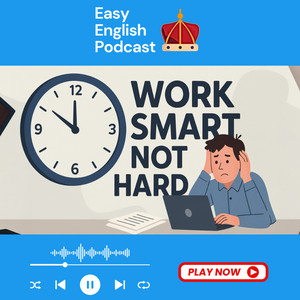
Have you ever felt like you don't have enough time or you're working really hard for a long time and you would like to do things faster?
You need efficiency.
Hi, I'm Oliver and welcome back to the Easy English Podcast, the best place to learn English and practice your listening skills.
While learning English, new vocabulary and phrases.
Today we are going to talk about a very useful idea called efficiency.
So if you've ever wanted to get more done with less effort slash work, then this is the right idea for you.
And that's what efficiency is all about.
Don't worry if you don't understand that word yet.
We will look at it in more detail.
But simply, it's about doing more with less.
Today we are going to explore what it means to be efficient, why it's important in daily life and work, and I will look at some simple tips to become more efficient yourself, which can help with your language learning too.
But before we get efficient in our learning, let's look at our five useful words and phrases that we are going to learn today.
As always, I will read these to you with their definitions, and I want you to listen for these words during the episode.
So practice some active listening.
Some of them you may know and some may be new for you.
But first, if you're new here or you've been listening for a while, make sure you're following and subscribed to the podcast.
It really helps us to grow.
Let's look at our words.
The first word is efficient.
Efficient.
And this means doing things well without wasting time, energy or materials.
An efficient machine might use less electricity, for example.
So it's really doing more with less.
So you're using less and doing more, or at least doing things well with less.
And this word efficient is an adjective.
Our next word for today is waste, waste, waste. which is a noun or a verb.
Waste is material or energy that is not used.
So usually it is left behind at the end.
And in verb, in the verb form, it means to use something carelessly.
So throwing away good food is a waste.
Don't waste your time on unimportant things would be the verb example.
Our third word for today is task, task.
And this is a noun.
A task is a piece of work that needs to be done.
I have so many tasks to complete today.
Our fourth word is resource, resource.
And this is something valuable that you can use like time, money, or materials.
Time is a very important resource.
And our fifth word is productive, productive.
And this is another adjective and it means doing or achieving a lot.
When I plan my day, I feel more productive.
Keep these words in mind as we go through the main podcast and learn about becoming more efficient.
As always, these words, as well as the full transcript, will be available on the Patreon website for patreon members.
So if you want access to that and you would like ad free episodes with bonus extra episodes every week, then check out the patreon link in the description of the podcast below so you can go to the podcast episode description, click that link and support the patreon.
Let's get back to efficiency.
So what exactly is efficiency?
In simple terms, it means getting the best possible result by using the smallest amount of resources.
Think of it like this.
Imagine you are going to cook a meal.
So you're going to cook food for dinner.
If you're efficient, you will use the right amount of ingredients.
You'll cook everything at the same time and finish quickly with a delicious meal and not so many dirty dishes.
You use less time and less waste of ingredients.
If you're not efficient, however, you might use too many ingredients.
You might cook things one by one, which takes a long time, and make a big mess.
You waste ingredients, time and energy.
And to be honest, with cooking most of the time, that is me.
I am not the most efficient, although I wish I was.
So being efficient means that you are smart about how you use your resources, your time, your money, your energy and your materials.
And the result usually is that you complete a task very well.
So why is being efficient important when it comes to, I guess, everyday life and work?
Well, first off, it saves our time.
When you're efficient, you complete your tasks faster and this gives you more free time for hobbies, family or just relaxing too.
It also saves us money.
Being efficient means less waste.
For example, being efficient with electricity means lower bills.
Being efficient with food means less food thrown away, which saves then more money for you.
It also reduces stress.
When you're efficient, you feel more organized and in control.
You complete your tasks without rushing or feeling overwhelmed.
You can greatly reduce your stress this way.
And it also achieves better results.
Efficiency is not just about the speed.
It's about doing things the correct way, doing them well.
An efficient process usually leads to high quality results because it's planned and executed carefully.
And it also increases productivity.
When you're efficient, you will be more productive.
What this means is?
It means that you can do more things in the same amount of time, which is so good for achieving your goals, and it makes your time even more valuable.
Think about that.
So in summary, efficiency helps us to use our resources wisely to live better and achieve more.
Okay, so let's now look at some examples of efficiency and how it can apply to everyday situations, everyday contexts.
The first we used was cooking meals.
Let's look at it in another way with cooking meals, cooking food.
So, instead of cooking a new meal every day, for example a new dinner, some people practice meal prep.
So dinner prep.
They cook a large amount of food once or twice per week.
And this is efficient because it saves time cooking every day.
It saves electricity and it often leads to less food waste.
I've done this before in the past.
I'm not so good at it right now, but I can see how it is very beneficial and helpful for so many people.
The next way is organizing your home.
An efficient home is often organized.
When everything has a place, you don't waste time looking for something for your keys or your phone.
And this can save your time and your stress when you're doing things around your home.
I guess I like a balance of this.
I like to know where things are, but I'm not super fussy.
So I'm not saying, oh, it has to be there or it has to be there.
I just like to generally know where things are.
We can also be efficient with traveling.
To do that, we can plan our route before we leave home, especially when we're using public transport, so that we know times and where maybe the time of a train or the time of our flight and we get there the correct time.
Not wasting time pre-planning your travel can stop you from getting lost or trying to work out where you're going on the day during the process.
But being efficient can also apply to learning English.
You can be efficient in your English studies.
Instead of just reading words, for example, you can use flashcards or spaced repetition, and it's more efficient for your memory.
You're doing something that helps keep it in your mind and create those proper menus.
Watching TV shows with subtitles is also a more efficient way to practice your listening and vocabulary.
And when it comes to business and tasks, we can become more efficient through a number of ways.
We can use automation.
So to set things up with technology to do repetitive tasks, For example automatic emails or replies,
There's lots of technology and software out there to help improve our efficiency with work.
Particularly now, with the development of so many AI companies and softwares, It is helping reduce time.
So reducing our time to do normal tasks, work tasks that used to take a long time.
We can also prioritize to be more efficient, doing the most important tasks first.
It helps us to get things done on time and meet our deadlines.
And really one of the most important things, whether it's personal life or work, is time management.
Using a calendar managing our time effectively allows us to be more efficient with our energy and our time, getting more done and more efficiency out of our day.
Businesses especially, are always looking for more ways to be efficient, to save money, to serve customers better and ultimately, be more productive.
So let's go to my favorite part of the podcast.
And that is our listener spotlight.
But first I want to remind you that, if you want to pick up a new copy of my new book, Phrasal verbs are easy.
It teaches phrasal verbs in English through short stories and exercises.
So the e-book is still available for sale in the link below.
So you can check that out if you're interested.
So listener spotlight.
I think it was last week or maybe two weeks ago.
I asked you on an episode about reading.
If you enjoyed reading books, if so, what type of books and why?
And I had quite a lot of responses this time.
So I'm going to read out some of the replies to this question about if you like reading.
I had a comment on YouTube and it was from a user with the name PopOwen4476 and they said Hi Oliver, I haven't read a lot of books.
I read news about politics psychology, health and celebrities on my smartphone, in English and in French.
For learning English.
I like reading a lot of articles from VOA Learning English.
My other options of reading are short stories, news from podcasts like yours.
Your podcast suits me well because of your speed, speech, subjects, and mindset.
The result is that my reading is better than my listening.
Your podcasts help me well in my learning English adventure.
Thank you for your amazing work.
What a lovely, well-written comment.
I think it's great that you have different ways of practicing your reading.
It's different for everyone, of course, what we do and how we practice reading in English.
So great answer and thank you so much for your comment.
I had another comment on Spotify.
It was from Neeti and she, She or he, I'm not sure on the name, on how to pronounce the name, but they said yeah, I like reading books.
I started reading in my language at first, but nowadays I prefer to read in English because it not only enriches my knowledge, but also learn English.
I also learn English.
One of my favorite books is Atomic Habits by James Clear.
That's an excellent comment.
Really wonderful to both practice your English while learning something new.
And I replied and said, I also like this book, Atomic Habits.
And I made an episode a long time ago maybe a year, a year ago about this book about habits, in English.
I had another comment which was from Anderson and they said, hi, Oliver.
Yes, I read books.
I read every day at least a few pages until sleep.
Although I like reading fiction based on my readings, I think I prefer non-fiction books like poetry, history and philosophy.
That's a great comment.
It seems like you have a very good selection of books to read.
I also like to read books before sleep, but sometimes, if I'm very tired, I don't last for very long until I fall asleep.
Thank you so much, everyone, for those lovely comments and replies.
I know I don't have time to read all of them, but as always, I will pick a few every episode and try to pick different people from episode to episode.
So my next question is what do you do to try and be more efficient with your time?
And if you don't do anything, what could you do to try and be more efficient with your time?
Comment below on Spotify YouTube, or you can email or contact me with your reply and I will choose two or three of them in the next episode and read these out, or in next week's episode usually.
Great.
So today we've explored the concept of efficiency doing more with less resources and achieving the maximum that we can.
And that's why it's important for saving time, being more productive and wasting less.
Thank you so much for listening.
As always, if you enjoyed the podcast, make sure you've rated it five stars on Spotify or a review on Apple Podcasts.
Thank you so much for listening.
And as always, I will see you in the next episode.
Goodbye.