

[The Innovator's Dilemma: Understanding Disruptive Innovation with Clayton Christensen]-[Disruptive Innovation Explained]
📋 Summary
The Essence of Disruptive Innovation
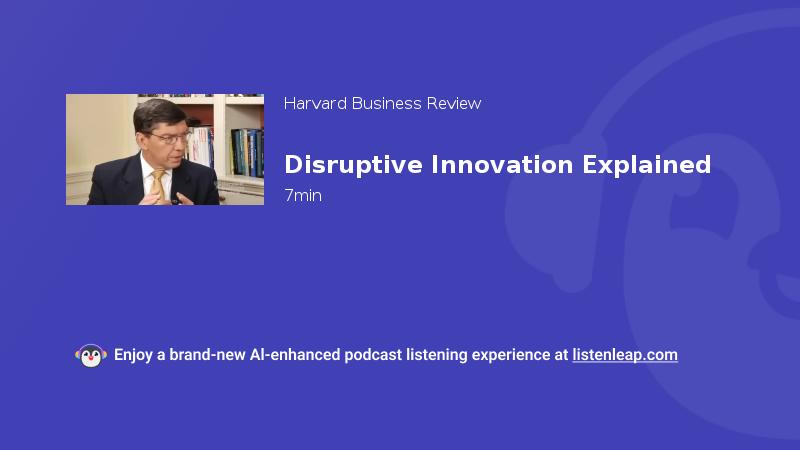
In this insightful discussion, Professor Clayton Christensen clarifies the core definition of disruptive innovation. Contrary to common misconceptions, a disruptive innovation is not merely a "breakthrough innovation" that enhances existing products for current users. Instead, it is a transformative process that takes a product or service—historically reserved for a wealthy or highly skilled elite due to its high cost and complexity—and makes it significantly more affordable and accessible.
Christensen illustrates this evolution using the computer industry: from the multi-million dollar mainframe computers that required specialized experts to operate, through the stages of mini-computers, desktops, and laptops, finally arriving at the smartphone. This progression showcases how technology becomes "democratized," benefiting a much larger population than the original pioneers ever imagined.
The Innovator's Dilemma Defined
The "Innovator's Dilemma," the central theme of Christensen’s seminal 1997 book, stems from a fundamental conflict in corporate decision-making. Senior management is constantly pressured to focus on "making better products" that yield "higher prices" and "better profits" for their existing, most profitable customers.
However, a disruptive innovation requires a company to pursue "new markets"—customers they do not currently serve. The dilemma arises because the products required for these new markets are often "worse" or significantly simpler, which would "ruin our margins." Christensen cites the automotive industry as a classic example, where established giants like General Motors and Ford struggled to decide whether to compete with low-end entrants like Toyota, or continue focusing on larger, more profitable SUVs. This cycle repeats indefinitely; even Toyota eventually faced the same pressure from Korean manufacturers like Hyundai and Kia, who targeted the low end of the market.
Teaching How to Think, Not What to Think
Christensen reflects on his influential interactions with industry titans like Steve Jobs and Andy Grove of Intel. A pivotal moment occurred when Grove demanded that Christensen apply his theory to Intel. Rather than acting as a consultant and telling Grove what to do, Christensen insisted on explaining the theory itself. By illustrating how "mini-mills" disrupted the steel industry, Christensen allowed Grove to grasp the mechanics of disruption and reach his own strategic conclusions.
This experience profoundly shifted Christensen’s pedagogical approach. He argues that the modern reliance on being "data-driven" and "fact-based" is inherently flawed when looking into the future, as data is only available about the past. He posits that:
"In many ways, we condemn them [managers] to take action when the game is over."
Instead, Christensen advocates for the use of theories as a lens. Because every action is predicated upon a theory, teaching managers to view the future through the lens of a robust theory allows them to navigate uncertainty with clarity. By "teaching them how to think" rather than "what to think," leaders can anticipate shifts in the market long before the data confirms them.
Deep Learning with ListenLeap


