Oh no, the ferocious T-Rex is gonna kill him!
Oh, hi everyone!
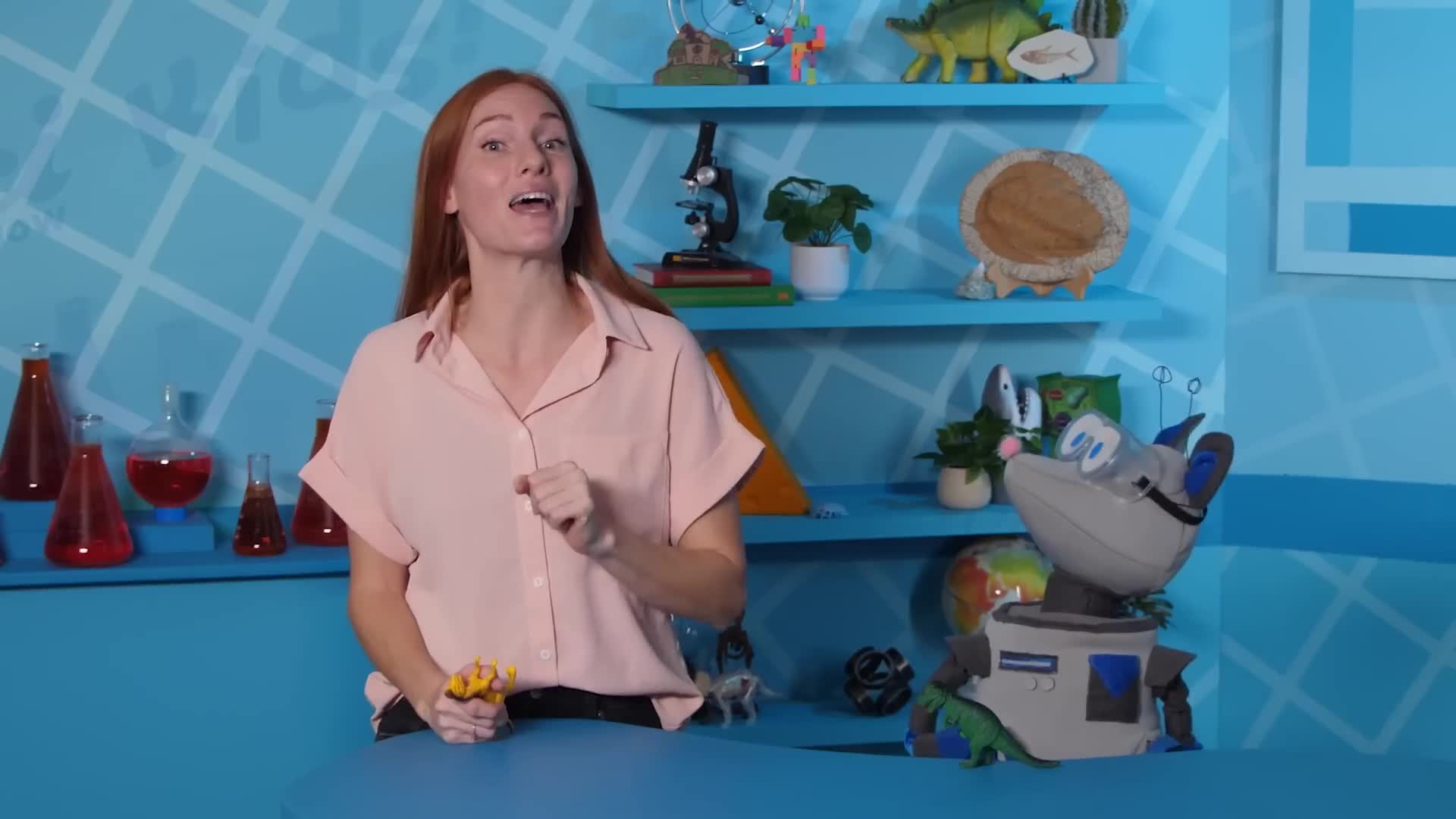
Squeaks and I were just playing with our toy dinosaurs.
They're a lot of fun, but I wouldn't want to play with a real one.
Good question, Squeaks!
He's curious about how we know the dinosaurs were real when they lived millions of years ago.
It's all thanks to the work of paleontologists, a kind of scientist who studies the history of life by finding fossils.
Yeah, that's right, Squeaks!
Like the paleontologists Dino and I learned about a few years ago.
Should we watch so we can learn more?
Oh hey guys, we're just practicing our best dinosaur roars.
If you've met my friend Dino before, then you probably know he's crazy about dinosaurs.
He loves going to museums to see their bones, reading books about them and even pretending to be them.
Wouldn't it be cool if you could spend all day thinking about dinosaurs, trying to figure out things like What did they look like?
Or what did they eat?
And do they like to play, too?
For some people, their job is exactly that.
But this special group of scientists doesn't just study dinosaurs.
They learn about all kinds of things that lived a really long time ago, including reptiles mammals, plants and even teeny, tiny bacteria.
These scientists are called paleontologists.
Now, you probably noticed that the kinds of dinosaurs that you see in museums aren't alive anymore.
I mean, you don't have to worry about bumping into T. rex at the grocery store.
That's because they're extinct.
They died out millions of years ago.
So for paleontologists to do their job, they have to look for clues that dinosaurs and other extinct animals left behind.
Luckily, they left us plenty of clues.
They're fossils.
Fossils are the remains of animals and plants from long ago that slowly became preserved in rocks.
Fossils can be of animals' bones, teeth, and shells, or the imprints of old leaves.
Or they can be rocks that hold other clues to what life was like in the past, like an animal's footprint or even their fossilized poop.
Paleontologists use all of these kinds of fossils to find out more about the history of life on Earth.
For example, they've learned about extinct trees and flowers that lived millions of years ago.
They've found bones of some of the earliest known mammals.
And, of course, if it weren't for fossils, we wouldn't even know dinosaurs existed.
Paleontologists have been able to make all of these discoveries because they're experts at reading the clues they find in fossils.
If scientists find enough bones belonging to an extinct animal, like a dinosaur, they can put them together to figure out what that animal looked like.
And if they find the dinosaur's teeth, they can figure out whether it ate plants or other animals or both.
Just knowing where a fossil is buried can give scientists a lot of information, too.
For example, if paleontologists come across a layer of rock with a lot of the same kind of dinosaur fossils in it, that might mean that that kind of dinosaur lived in big groups.
But before paleontologists can study fossils, they have to find them first.
And that means that these scientists get to spend lots of time outside, digging in the dirt.
First, they go to areas where they think fossils might have formed, and start exploring.
They keep their eyes open for small bits of bone sticking out of the ground or rocks with cool shapes on them.
Riverbeds and hillsides are especially good places to look.
Once they find a promising spot, it's time to get digging.
Paleontologists use picks, shovels, even big diggers to unearth their finds.
If they uncover a fossil, then they take it back to their laboratory to study it.
There.
They can use cool technology like X-ray machines and CT scanners to see inside the fossil, and they can use computers to help them see what the plants and animals may have looked like when they were alive.
And finally, paleontologists spend a lot of their time sharing their discoveries with other people.
Lots of paleontologists work with museums and schools so that they can teach people like you and me about fossils that they find.
And the fossils are usually kept in museums or universities, so other scientists can study them too.
All told, digging in the dirt and dreaming of dinosaurs may look like fun, but paleontologists have a really important job.
Together, They're working to solve a huge puzzle, the puzzle of life on planet Earth.
Every new fossil is another piece of the puzzle helping us to understand how plants, animals and the Earth itself have changed over time.
And you know what?
Many paleontologists say they got into their special kind of science because when they were kids they loved dinosaurs, just like we do.
Yeah!
So keep dreaming and practicing your best dino roar, and one day, it could be your job, too.
Paleontology is so cool.
I can't believe we can study things that happened so long ago.
Oh, yeah, paleontologists do know how long dinosaurs were around.
And it's a lot longer than you might think.
Remember when we learned about the different periods of time, like the Jurassic and Triassic?
Maybe?
I think Squeaks needs a reminder.
Let's explore the long, amazing time dinosaurs roamed the Earth.
Hey there!
Squeaks and I are here with our friend Dino, and our library just got a new book that has pictures of all the different kinds of dinosaurs that used to live on Earth.
And it tells a little about them, too.
Like what they ate.
This page says that some dinosaurs, like Stegosaurus and Triceratops, ate plants, so I was thinking that they must have been friends who ate up the salad bar together.
Uh, Dino.
But they definitely weren't friends with the meat eaters like Allosaurus and T-Rex.
I bet they had amazing dinosaur races as they ran to catch the best food.
Dino.
Yes, Jesse.
What do you think?
I think... that it's fun to imagine what these animals might have done if they'd met.
And I also think we need to remember that stegosaurs and triceratops weren't around at the same time.
Wait, wait, what?
I'm sorry, Dino, but the same is true for allosaurs and T. rex.
These dinosaurs lived in different times from one another.
I don't get it.
They all lived back at the time of the dinosaurs, right?
Yep, you're right about that.
But the time of the dinosaurs was a very long time.
It lasted millions of years, so all dinosaurs didn't live at the same time.
Oh, good point, Squeaks!
We built a pretend time machine to imagine what it would be like to travel back in time and see living things from the past.
But to see all of these dinosaurs, we would have to make more than one trip.
So if we took your time machine back to the time of the dinosaurs, we'd actually have to go to lots of different times.
Exactly!
Scientists divide dinosaur time into three parts. called periods.
There's the Triassic period, which started over 200 million years ago.
Some small dinosaurs like Eoraptor lived then.
Next came the Jurassic period.
Allosaurs and stegosaurs were alive during this period.
The Jurassic period lasted over 50 million years.
It was after that that dinosaurs like Triceratops and T rex came along, in a time called the Cretaceous period.
Oh, you're right, Squeaks.
It can be pretty hard to think about long periods of time like that.
But I have an idea we can use to show how long ago dinosaurs lived.
We can use our bodies as a model.
We use models to help us understand or explain something in the world around us.
By using our bodies as a model of dinosaur time, we can get a better picture of just how long ago those different periods were perfect, but it will be a way for us to think about things that happened a long time ago.
Now let's say, the bottom of your shoes is the bottom of our model when the very first dinosaurs appeared.
That's the beginning of the Triassic period, about 245 million years ago.
Okay.
Stegosaurus and Allosaurus didn't show up until the Jurassic period, about 50 million years later.
That means that these dinosaurs would have lived in the time that starts somewhere below your knee and ends somewhere around your hips.
That distance on your body represents about 56 million years.
Then it was T-Rex time.
The Cretaceous period was about 74 million years long.
That means if it starts at your hips, it should end at about your chest.
And the time of the dinosaurs ended about 65 million years ago.
So everything from your chest to the top of your head represents the last 65 million years.
Question, Squeaks!
Humans and their ancestors have only been on Earth for about 6 million years.
So in our model that would be only the last couple centimeters of your body, maybe from the top of your forehead up.
Wow!
So people haven't been around for very long at all!
No!
Life on Earth was around a long time, even before there were dinosaurs.
And I mean a long time!
And over that time the way Earth looked and the plants, animals and other kinds of life that lived here changed a lot.
Some of these changes happened very fast, like volcanic eruptions.
But others happened very slowly.
So slow that we wouldn't have noticed they were happening, even if people had been around.
Ooh, great question!
Squeaks wants to know how we know plants and animals lived during different times if no one was there to see them.
I think I know this one.
Is it because of fossils?
Good job, Dino!
We found fossils!
Bones, footprints, and other things left behind by ancient animals, plants, and other kinds of life.
We use these fossils as clues to try and figure out how long ago they might have lived.
How?
Well, one way we can tell which fossils are older and which are newer is by how deeply they're buried.
Think about paper in a recycling bin.
The paper that you put into the empty bin last week is on the very bottom of the can.
And it gets buried by the paper you throw in later.
The very top layer of paper in the recycling bin is the paper you put in there today, this morning or even a few minutes ago.
Oh, I see.
So the fossils that are deep in the ground, like Stegosaurus, are older than the ones closer to the top of the ground, like the T-Rex.
That's right.
T-Rex is pretty young.
Well, in dinosaur years anyway.
Yes.
Now let's see what else we can learn about in this new book.
Wow, the dinosaurs sure enjoyed a long time here.
And there were so many of them.
Ah!
Squeaks wants to know if the dinosaurs were the only big animals living back then.
And it turns out there were others.
Some of them even have relatives living today.
Squeaks has a lot of questions.
I think this video will answer all of them.
Should we watch?
Hey guys, we invited a friend over to hang out today.
He's a lot of fun.
His name is Dino, and he loves dinosaurs.
He has all kinds of dinosaur costumes.
It's true.
Dinosaurs are so cool.
And who are you wearing today, Dino?
T-Rex.
My favorite dinosaur right now is actually the Ankylosaurus, but they had four legs, so that costume is kind of awkward.
Plus, it's got grape juice on it, so my dad has to wash it.
Well, I think you look great.
You might already have guessed this, but Dino knows all sorts of things about dinosaurs.
I love reading about them.
I read all the books about them in the library.
Well, why don't you tell us a little bit about what you've learned so far?
Maybe you can start with this.
What makes a dinosaur a dinosaur?
Hey, good question, Jessie.
There were all kinds of dinosaurs that lived millions of years ago.
Some had two legs, like T-Rex here, and some had four legs, like Ankylosaurus.
Some ate plants, and some ate other animals.
But they all had a few things in common.
Like what?
Well, one way to tell whether an animal is really a dinosaur or not is to look at its legs.
Its legs?
Really?
Yeah, let me show you.
First, have a look at this guy.
It's a Komodo dragon.
It's the biggest lizard in the world today.
It lives on some islands in Asia.
But Komodo here isn't really a dragon.
It's a reptile.
It has scaly skin and a long tail and I can totally see how some people might think it looks kind of like a dinosaur.
But look at its legs.
Its legs stick out from the sides of its body, so its feet are out on the sides too, almost like it's doing push-ups.
Okay, I see what you're talking about there, but how did a dinosaur's legs look?
Well, have a look at this skeleton of a Stegosaurus.
This fella lived in North America millions of years ago, and its feet are directly underneath it.
Dinosaurs' legs were kind of like posts or pillars that held up their heavy bodies.
If their legs stuck out to the sides, they wouldn't be able to stand up.
So dinosaurs had their feet directly underneath them, while other reptiles like lizards and alligators and Komodo dragons have legs and feet that stick out to the sides.
Not that there's anything wrong with that.
I mean, some of my best friends are lizards and alligators.
They're just not dinosaurs.
Cool!
I've learned something already!
Well, how else could you tell if an animal that lived a long time ago was a dinosaur?
A lot of things that dinosaurs had in common weren't so much about how they looked, but about how they lived.
For example, dinosaurs only lived on land.
They didn't live in water, and they couldn't fly.
Couldn't fly?
Really?
Really.
You've probably seen pictures of an animal like this before, right?
They were amazing flying reptiles and they lived back in the time of the dinosaurs, but they weren't dinosaurs.
They were pterosaurs, a whole different type of ancient reptile.
Unlike the dinosaurs, they had hollow bones and big flaps of skin like wings which they used to fly.
They also had really long, narrow skulls with big brains inside.
But dinosaurs didn't have any of those things.
I mean, I've never seen a T-Rex with wings, have you?
No.
No, I can't say that I have.
But you also said that dinosaurs didn't live in the water?
Nope.
They only lived on land.
There were all kinds of huge reptiles that lived in the oceans back in dinosaur times, but none of them were dinosaurs.
They were different in a lot of ways, like some were called plesiosaurs and didn't lay eggs like dinosaurs did.
They just gave birth to live babies.
Can you believe that?
And another kind of swimming reptile were the mosasaurs.
They were actually related more to snakes than to dinosaurs.
Just like snakes, they could open their mouths so wide that they could actually eat things that were bigger than their own heads.
Kinda wish I could do that.
Especially with apples.
I'd love me some apples.
So I can see from the fins and flippers on these swimming reptiles that they were adapted to life in the water.
So if I see a fossil or a picture of a reptile that lived a long time ago that has fins and flippers, I know it's not a dinosaur, right?
That's right, Jessie.
Dinosaurs lived only on land and stood with their feet right under them instead of to the sides.
Got it.
Thanks for sharing what you've learned with us, Dino.
Oh, believe me, Jessie, I could go on all day.
Oh, I bet you could.
Ah, I still can't get over the fact that birds are relatives of dinosaurs.
Can you, Squeaks?
But dinosaurs sure were scary.
Don't tell Dino, but I'm kind of glad the big ones aren't around anymore.
Yes Squeaks, we do have some ideas about what happened to the dinosaurs, but I've forgotten some of the details.
So let's watch this video and find out.
Clues, clues, looking for clues.
Oh, it's you.
Hi.
You were probably expecting Jessie, right?
Well, she and Squeaks will be back next time.
But right now, they're off doing a bit of detective work in Yucatan, Mexico.
You might say they've flown south for the winter.
And of course, I approve of that.
Very bird-like of them.
You see, we teamed up because we got curious about one of the greatest mysteries of all time.
What happened to the dinosaurs?
If you know me, you know that I love dinosaurs.
And a long time ago, around 65 million years, the dinosaurs were large and in charge.
They had ruled the Earth for over 160 million years.
And then, something strange happened.
Not just to dinosaurs, but to over half of the Earth's species.
That means a type of living thing, like oak trees, or cuckoo birds like me, or humans like you.
All at once, about 65 million years ago, a bunch of different species just went extinct.
They were completely wiped out.
That's because something big happened, causing huge changes on Earth.
Changes in the weather, changes in the oceans, changes that made it harder for dinosaurs and other living things to find food and survive.
Sure sounds mysterious.
Most species will go extinct sometime, but what I want to know is, what happened?
What caused so many species, from tiny ocean creatures to big land reptiles like T rex and Triceratops, to all go extinct at the same time?
Scientists don't know for sure, but they have a few different guesses.
Some scientists think that it happened because of a giant rock moving through space, called an asteroid that crashed into Earth.
And as it happens, that's just what Jesse and Squeaks went to Mexico to learn more about.
Oh, and here's Jessie giving us a call right now.
How's your vacation, Jessie?
Terrific, Dino!
Squeaks and I are here at the Yucatan Peninsula in Mexico, and we're learning so much!
We learned that 65 million years ago, an asteroid blasted in from outer space and landed right here.
This asteroid was enormous!
It was 12 kilometers wide. so big that it would take hours just to walk from one side to the other.
And when it landed, the explosion left an even bigger crater, a big bowl-shaped dent in the Earth.
It's called the Chicxulub Crater, and it's about 150 kilometers wide.
The explosion sent lots of rocks and other debris raining down on anything nearby.
And it sent billions of tons of soot into the air.
Soot is the dusty stuff that's left over when something burns up.
That's one powerful explosion!
It sure was!
It made the whole world really hot for a few days.
And it started fires, giant waves, and huge, strong winds.
And it shook the Earth in a super-powerful earthquake.
Thanks for the hot tips, Jessie!
Enjoy the rest of your trip!
See you later, Dino!
Now some scientists think that the explosion from the asteroid sent so much soot into the air that it blocked out the sun.
For a while, it was really dark outside, even during the day.
And without sunshine it started to get cold, which meant some of the living things that were used to warmer weather couldn't survive.
There was another problem, too.
Plants need sunlight to live.
So a lot of the plants back then died.
Without plants, the animals that ate plants didn't have enough food.
And without enough plant-eaters, the animals that ate meat went hungry, too.
That's why some scientists think that the asteroid was what caused the dinosaurs to go extinct.
But other scientists think that there may have been another cause and that even before the asteroid crashed into the Earth, disaster was in the air for the dinosaurs.
And they think the culprit was… volcanoes.
Right around the time that the dinosaurs went extinct, one of the biggest volcanic eruptions in history was underway in the area of the world that's now India.
For close to a million years, eruptions sent rocks and dust and soot onto the land and into the air.
And, just like with the asteroid impact, all this stuff in the air would have blocked out the sun, making the Earth cooler and darker.
So we don't know for sure what darkened the skies and wiped out all those species.
It could have been the asteroid, or it could have been the volcanoes, or both.
We have so many clues, but the true culprit is going to remain a mystery.
For now.
Either way, the dinosaurs were pretty unlucky.
A lot of things went very wrong for them, all at the same time.
But even though life was hard, some types of plants and animals were able to find food and shelter while the Earth was changing.
And they survived.
Whatever happened all those years ago.
Life on Earth goes on and we're all here solving mysteries together.
So whatever killed off the dinosaurs, it sounds pretty bad.
But it's fascinating to learn about the things we do know and how paleontologists figure that stuff out.
Well, I don't know if we'll ever learn everything about the dinosaurs, but curious people like us will become the scientists who will teach us more.
If you're curious about science, be sure to subscribe to SciShow Kids, so you don't miss a single episode.
See you next time here at the Fort!