Grownups, Wondery Plus subscribers can listen to Wow in the World early and ad-free right now.
Join Wondery Plus in the Wondery app or Wondery Kids Plus on Apple Podcasts.
Hey, Wowzer fans, Mindy here.
And before we start the show, I gotta let you know that this November, with a special new episode featuring our friends at Circle Round and Terrestrials on Radiolab for Kids,
And don't miss when Elmo from Sesame Street stops by Wow in the World to make us all belly laugh on November 24th.
Oh, but that's not all, Reg.
On December 1st, we are sharing our 250th episode of Wow in the World with all of you.
We think this one is going to be music to your ears.
Literally.
Did I mention it's a musical?
And if you're a member of the World Organization of Wowzers...
Oh boy, do I have a surprise for you.
You can listen to our 250th episode early with me and other members from around the world on Saturday, November 22nd, at 7 pm.
Eastern.
That's right, we are throwing another listening party.
Join us as we dance along to our new songs.
React to the episode with other members in the chat and more.
Grownups.
If you want your wowzer to join this members-only listening party, you can sign up to become a member today at Tinkercastcom.
Slash wow.
Already a member?
Well, you can find the link and password to join the event when you sign in at Tinkercastcom.
Slash wow.
That's it.
It's going to be a November to remember.
But for now, let's get on with the show.
Woo!
Welcome to Inside Tinkercast Studios, the show where I reminisce and revisit my favorite episodes of Wow in the World.
I'm your host, Dennis.
What do you mean change it up?
That's the intro we agreed upon.
Oh, you mean get to the voicemails from my devoted listeners right away.
Like first thing.
Like let's do it right now.
Okay, you're the executive producer.
Okay.
Let me just get the old answering machine pulled up here.
Okay, there we are.
Hi, you've reached Dennis from Inside Tinkercast Studios.
Leave me a message.
Hey, Dennis.
It's Blythe and Tenley from Fayetteville, Arkansas.
And we were wondering, why is the sky blue?
Tell us soon.
Bye.
Why is the sky blue?
Well, first of all, it's not blue.
It's azure.
Yes it is, Reggie.
Everyone knows this.
And second of all, why is grass green?
Why is a strawberry red?
I don't know how any colors work.
I doubt anyone knows.
Reggie, what do you mean?
The surface of an object reflects specific wavelengths of visible light while absorbing others.
How do you even know that?
You are a very mysterious pigeon, Reggie.
Next question.
Hi, Dennis.
I have a question for you.
Do...
Snakes actually poop?
Well, I've never seen a snake poop before, but that's probably because I avoid snakes.
And poop.
However, a wise man named Taro Gomi once said, Everybody poops.
So while I'm not sure what snake poop looks like, we can be certain that snakes do actually poop.
Next question.
Hi, Dennis.
I was wondering...
My sister has a question, too.
Hi, Dennis.
My name is Dixby.
Are you actually Static Man?
Thanks.
Bye-bye, Dennis.
Both of you had the same question.
What a coincidence.
And yes, we all want to know Static Man's secret identity.
What is the dramatic origin story that drives his heroic deeds?
Reggie, I've done lots of heroic deeds.
I mean, a static man has done them.
The heroic deeds, I mean.
Oh, you're right.
We better move on to this week's episode.
Thanks for your calls, everyone.
If you've got a question for me, call and leave me a message.
The number is 1-888-7-WOW-WOW.
I just might answer your question on Inside Tinkercast Studios.
Okay, that takes care of that.
Good question, Reggie.
Today's episode of Wow in the World comes to us from season three, episode 23 Dinosaurs Take Flight.
Reggie, they should have named this episode Dino Flight.
Get it?
Like dynamite, you know?
Because all the kids say that's dynamite for when things are cool.
I'm not old, you're old.
Let's play the episode.
And now...
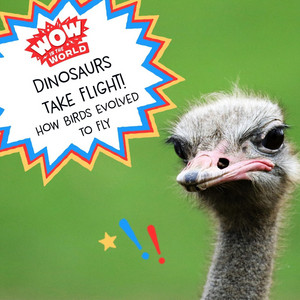
Inside Tinkercast Studios brings to you a special encore presentation of one of my favorite episodes of Wow in the World, Dinosaurs Take Flight.
How Birds Evolve to Fly.
Hey, time to check the local news.
Remote control, click.
For WOW TV, I'm Barb Dwyer, sitting in for Colin Sick.
In today's top story, the local zoo is missing one of its own after a 7-foot, 220-pound African ostrich escaped from its enclosure.
We now go live to the zoo to check in with an eyewitness who claims to have seen the ostrich quote prancing away like a pantless thunder goose.
Who wrote this?
Yeah, that's right.
I saw it.
At first, I thought it was just this dude running around wearing a sombrero and sunglasses.
And then I noticed the beak and the feathers.
And I thought, hey, man, something ain't right about that guy.
And I says, look at there.
His knees has been in the wrong way.
And he ain't got no ears.
Museum officials believe that the pantless thunder goose uh uh ostrich may have been assisted in its escape by this unidentified individual.
Nothing to see here, folks.
Just walking through the zoo.
Walk, walk, walk, walk, walk.
Oh, Mindy.
No!
The zoo is offering a 100 reward for the return of the ostrich and asking that all sightings be reported to zoo officials at 5-5-5-5-5-5-5-5-5.
Ugh, what has she done this time?
Okay, on your mark, get set, go!
Wait, what?
Come on!
Come on, run faster!
You can do it!
Get those little wings and take flight!
Huh?
Mindy, what are you doing?
That was a good one.
Just a second.
Dennis, how fast was that?
45 miles per hour.
16 feet in a single stride.
Wow, and still didn't lift off the ground?
Well, it was hard to tell.
Guy distracted me.
He was making that face he makes when you're being a rascal.
You know, the one with the twitchy eye and the steam coming out of his ears.
That's the one.
Mindy, Where did you get that ostrich?
What ostrich?
Mindy, I think he means this ostrich.
Right here, the one you brought home from the zoo.
OK, Guy Raz, I can explain.
This is a disaster, Mindy.
Calm down.
As usual, I've got everything out of control.
I'm simply helping this ostrich to be able to fly.
And then I'm taking him back to the zoo, new and improved.
You help the live animal escape from a zoo?
Uh-huh.
Mindy, you can't do that.
Sure you can.
You just dress the animal up in a disguise and then roll it away in a shopping cart while everyone else is distracted by the poop-flinging monkeys.
And then you have your best friend and neighbor, who's not annoying at all.
Drive the getaway scooter.
Dennis!
Okay well, we are going to put it right back in that shopping cart and roll it right back to the zoo.
Come on.
Wait, wait, wait.
Unless we can train it to fly back to the zoo.
Huh?
Mindy, are you seriously trying to train an ostrich to fly?
Yeah.
Why?
Well, number one, because it's a bird.
And number two, because I'm trying to understand the evolution of flight.
I'm just using this ostrich here as a stand-in for the dinosaur known as the cadiptrix.
Wait.
Caudipteryx?
You mean the two-legged theropod that lived 125 million years ago?
Yeah.
The one that was believed to be the size of a peacock?
Uh-huh.
And had little feathery flightless wings?
You know it.
The one that looked like a big angry chicken?
Yep, that's the one.
The majestic Caudipteryx.
But wait, did the Caudipteryx even know how to fly?
No, but I just read this pretty wow study from these researchers at Tsinghua University.
Ah, Tsinghua University in Beijing, China.
Uh-huh.
Okay, you've got me intrigued, Mindy.
What was the study about?
Okay, so this group of paleontologists... Which are, of course, scientists who study fossils.
Yeah.
So these paleontologists got together with this mechanical engineer named Jing Shan Zhao, and together they set out on a quest to find out once and for all how modern day birds evolved to be able to fly.
And by evolved, you mean to slowly develop over time from a simple to a more complex form.
Mindy, guys, look at me.
What in the... Dennis, stop riding the ostrich.
He likes me.
You know, we really should return that ostrich to the zoo before Dennis breaks him.
Reggie, will you go get Dennis off the ostrich?
Reggie, do you want to try the... Ah, Reggie, quit it.
Wait your turn.
So, as I was saying, Dr Zhao and his team wanted to find out if the Cudipterix dinosaur held any clues as to how birds today evolve to fly the way they do.
Okay, so let me just get this straight.
You read this study?
Yes.
And you were inspired to understand the connection between the birds we see every day and prehistoric dinosaurs.
Yeah.
And so you helped a 200-pound flightless bird escape from the zoo?
Um, yeah.
So, Mr. Ostrich, where are you from?
Oh, wow, Africa.
You know, I once met an emu from Australia.
Are you related?
Are you related to all flightless birds?
Who would win in a fight, you or a penguin?
Ugh, Dennis!
Actually Mindy, if Dennis keeps this up, your ostrich friend might just return to the zoo voluntarily.
Dennis, you're going to scare it away!
So Mindy, what does a flightless ostrich have to do with dinosaurs and modern-day bird flight anyway?
Oh, so glad you asked.
See, there was a certain group of dinosaurs known as theropods, and theropods are believed to be distant relatives of modern-day birds.
Ah yes, and in that theropod group there were all kinds of two-legged meat-eating dinosaurs, ranging from the teeny-tiny crow-sized Microraptor to the six-ton Tyrannosaurus Rex.
And don't forget about everyone's favorite ancient flying dino...
The pterodactyl!
How is he always able to hear everything we say?
Actually, Dennis, pterodactyls, or more correctly, pterosaurs, were not dinosaurs at all.
No.
Yeah, they lived at the same time as dinosaurs and became extinct at the same time as dinosaurs, but they were actually just giant winged reptiles.
Giant winged reptiles?
Ew.
Anywho, along with Microraptors and the T-Rex, who just happens to be the closest living relative to the modern-day chicken A chicken.
The dinosaur I mentioned before, the Caudipteryx, is also a theropod.
So what did Dr. Zhao and his team do to test their hypothesis?
Hypothesis, a.k.a. an educated guess.
Right, their hypothesis that bird flight as we know it began with dinosaurs.
Oh, yeah.
So this is pretty wow.
And of course, I could tell you.
Yeah?
But I'd rather show you.
OK, but step one better be returning that ostrich to the zoo.
Mindy, Guy, look.
It's wearing a pair of my pants.
What?
OK.
So to test their hypothesis, Dr Zhao and his team performed three separate experiments, all of which I will demonstrate for you today.
But the ostrich, the zoo.
Patience, young grasshopper.
Now, for my first demonstration, I am going to need you to follow me to the laboratory of bad ideas.
Okay.
Hey, Dennis, you good to watch the ostrich while we're back in the lab?
I already watched him.
See, he's wearing my watch.
Thanks, Dennis.
Knew I could count on you.
Walk, walk, walk.
So, Guy Raz, while we walk back to the lab for my first demonstration, I should mention that if you were to ask any paleontologist where flight began, you would get a different opinion from every single one of them.
Oh, right.
Well, I've heard some paleontologists claim that winged dinosaurs learn to fly by climbing trees and gliding from branch to branch, kind of like flying squirrels.
Oh, yeah.
That's the old top-down theory.
And then of course, there's the bottom-up theory that certain kinds of winged dinosaurs first caught wind by running really fast while flapping their wings until they were flying.
You know it.
And other paleontologists think that maybe it was a mix of the two.
Hey, wait a minute.
You know who we could ask and get a final answer once and for all?
Who?
Reggie!
Reggie?
Reggie, moment of truth.
Where did you get your amazing avian ability to fly?
Huh?
What's he saying, Mindy?
Yeah, I don't know, Guy Raz.
Reggie's orthodontist just put this expander in his mouth.
Now it's making it hard for him to speak, and I couldn't understand a word of that.
Sorry, Reg.
Reggie's seeing an orthodontist?
I'm pretty sure that should have been an ornithologist.
Yeah, you would think.
Anywho, here we are at the lab.
Let me just open the door.
Oh, no.
Here we go.
After you.
Indy, we can't keep buying new doors.
They don't grow on trees.
Okay, so, first things first, I'm gonna need you to grab me that bag of bones over there.
And then I'm just gonna power up the computer.
Mindy, who do these bones belong to?
Oh, I've been digging the leftover chicken bones out of your garbage and saving them up for the last two years.
What?
Why?
Well, mostly so I can bury them for future paleontologists to find when they run out of dinosaur bones and all the chickens go extinct.
Uh...
But today, we're going to use these bones to put a chicken back together, fossil style.
Yeah uh, That way we can see how the leg bones and the hips of the chicken work together to help the chicken run.
And then, we're going to make a model of it on the computer here so that we can see it in action.
Huh.
So, you want to hand me that femur bone so we can get started?
Yeah, I'm sorry, Mindy.
There's so much to unpack here.
Wait.
And the drill?
Oh, thank you.
Power on.
So are you telling me that the researchers in the study reconstructed chicken bones and then made the chicken skeleton run on the computer?
Yes, of course they did not reconstruct a bunch of chicken bones, Guy Raz.
Phew.
They reconstructed the fossilized bones of a Cadypteryx dinosaur.
Then they used what they learned from studying the fossils to create a model or a simulation of it running.
Ah.
And then they studied that simulation on the computer.
Ah, I think I understand.
They did this to study how fast the dinosaur legs would move and how the rest of its body like, for instance, its wings, would react.
Winner.
Winner chicken fossil dinner.
No, thank you.
So what did they discover?
Well, they discovered that once that codipteryx got to running at speeds of five and a half to 13 miles an hour, its little wings would start flapping here.
Check it out on my little chicken model.
Okay, not the same thing at all, but i think i get what you're saying here, mindy.
So what was the second experiment these researchers did?
Okay, For the second experiment, we're going to need to dust off that old treadmill in the corner over there.
And we're also going to need to let the robot out of the closet.
Uh... Reggie, release the robot!
What in the... Kairos, what you're looking at here is a life-sized robot replica of the condyptory.
See?
It's got the tiny head, the long neck, the fan of tail feathers, the short little useless wings.
And leg warmers?
The leg warmers are just for decoration.
You know, a sporty little accessory for running on the treadmill machine.
Wait, you're going to put this robot dinosaur on the treadmill?
Well, it's not like I'm going to put myself on the treadmill.
Last time I got on that thing, I flew off the back and dropped my soup and sandwich.
Anywho, doesn't matter anyway.
I'm all out of soup.
The only thing going on this treadmill is my dino robot.
Hey, Roz, you want to give me a hand while I lift her onto the belt?
Anything for science.
Almost there.
There we go.
Now I'm going to power this baby up.
And when I do, I want you to notice the way her wings oscillate or move back and forth while she runs on this ancient prehistoric treadmill.
Prehistoric?
Yeah, Grandma G-Force used it to train for all of her wrestling matches back in the 80s.
I see.
Okay, firing this baby up in three, two, one.
It's working!
Wow, look at it go!
Wow, Mindy, watching this robot Conductorix on the treadmill, it looks just like the computer model.
You can see as her wings are flying. flapping back and forth.
It's not quite enough to get her flying, but you can see how, with a little more time, those little wings could help lift her off the ground.
Yeah, it's almost like a stage of free flight.
Here, let's see what happens when I speed it up a little.
Uh, I don't know if I would do that.
Don't worry, Guy Raz.
As usual, I've got everything out of control.
Mindy, it's too fast.
Cut the power.
Cut the power.
Well, I guess that's one way to get a Caudipteryx to fly.
Mindy!
Time for the third and final try.
Yeah, you know, I think I've seen enough.
We still need to get that ostrich back to the zoo, and then we've got to find a way to fix the door to the lab and the window and the treadmill and the.
Guy Raz, if I can take the bones left over from your chicken dinner and put the chicken back together again, then I'm pretty sure I can put a window door on a treadmill.
Huh?
Now let's go back outside and find that ostrich, so I can demonstrate for you the most wow experiment of them all.
Here, birdie, birdie, birdie, birdie, birdie, birdie.
Here, birdie, birdie, birdie, birdie, birdie.
Mindy, I'm pretty sure that's not how you call an ostrich.
An ostrich call should sound something like, uh, like.
No, no, stop.
Mindy, what's that sound?
Did you steal another ostrich?
But this one fell into a sewer pipe and landed on a ghost playing a saxophone.
Oh, hi, guy.
Hey, Dennis, can you send the ostrich back over here, please?
What ostrich?
Dennis?
Oh, we were just getting to know each other.
Dennis?
Fine.
Go on, Ozzy.
Fly free.
I mean, well, you know what I mean.
Wow, that thing is even bigger up close.
And speaking of big, I should probably point out that this ostrich is about the same shape as its early dinosaur relative, the Caudipteryx.
So I'm guessing you're planning on using this actual ostrich as a stand-in for the Caudipteryx for your next experiment?
You know it.
In fact, Dr. Zhao and his team did the same thing.
Now, could you hand me my adventure toolkit over there?
Because there's more.
Okay.
What do you have in this thing?
Rocks?
Yeah, rocks, cats, hammers.
Oh, and these babies.
Whoa, did you make these wings, Mindy?
With my own two feet.
Okay, so maybe I got a little help from Reggie.
Ugh, fine.
Reggie did the whole thing while I watched Petflix and ate pork rinds.
So what are they and why?
What is this harness for?
Well, Guy Raz, have you ever attached an extra set of wings to an ostrich before?
Never in my life.
Well, in that case, your life is over.
Huh?
Because we're about to attach this harness and the wings to our ostrich pal here, and then we're going to sit back and observe.
And finally and hopefully take the ostrich back to the zoo where it belongs?
Uh-huh.
So Dr Zhao and his team wanted to conduct a live experiment as the final way to test their hypothesis that birds evolved to fly from winged dinosaurs.
And what did they do for this test?
Well, they built a harness just like the one I built, with special motion sensors and an extra set of wings.
And then, let me guess, they put the harness onto the ostrich and...
Watched what happened to the human-made wings as the ostrich ran?
Exactoritos.
Wow, so what did they find?
Well, I could tell you.
But you'd rather show me.
Uh-huh.
Okay, come on over here, ostrich.
Let's get your wings on.
Stop wiggling, ostrich.
Stand still.
You got it.
Hold it.
All right, and?
Oh, look at it with those extra little wings.
Looks just like a condyptoryx.
Okay, now run, little ostrich.
Run like the zookeepers are chasing you.
Because they probably are.
There it goes.
There it goes.
This is so wow.
So Guy Raz, just as we're seeing here now, as the ostrich and the study ran and ran, Dr Zhao and his researchers noticed that the wings were helping to counteract or lessen the weight of the ostrich's body, making it so the ostrich could almost just barely lift itself off the ground.
Wow.
And not only that, but the researchers discovered that the way the wings were oscillating, or moving back and forth in a regular pattern, were actually making it easier for the ostrich to run, and to run fast.
So basically, the same thing they observed in the first two experiments.
Exactoritos!
And assuming that this was also true for the Caudipteryx, is it safe to say that maybe this was indeed the first sign that those wings could evolve to serve a greater purpose?
Well, if by greater purpose you mean flap and flight, then yes.
So then that must solve the mystery.
Dr. Zhao and his team tested their hypothesis not once, not twice, but three times.
And in conclusion, their evidence supported it.
Birds evolved to fly from winged dinosaurs.
Well, not so fast.
Huh?
See, even though they did find evidence to support their hypothesis or educated guess, there are still a lot of things that these scientists don't know for sure.
So there may be more experiments on the way for Dr. Zhao and his team.
But I do think it's safe to say that these experiments helped us to inch a little closer to the truth.
Look, there she is.
She's the one who let the ostrich out of the zoo.
And there's the thunder goose itself.
Hey, where'd it get them nice pants?
Uh-oh.
All right, camera set up over there.
Good.
Okay, Barb, we're ready to go live in three.
Good evening, everyone.
I'm Barb Dwyer, reporting live for WOW TV.
And here I am, on the scene, where the local zoo's escaped ostrich appears to have been found.
Quick, Guy Raz, grab me the harness and wings!
But the ostrich is wearing them!
Just unbuckle the harness from the ostrich and give the wings to me!
Hurry!
I'm trying!
I'm trying!
I'm trying!
Oh, boy!
Am I on TV?
A dream come true!
Hi, Mother!
Hi, Dennis!
Mother, no!
What are you doing here?
Go inside and watch me on TV!
Oh, okay!
Oh, good!
Dennis is distracting the news crew.
Come on!
We gotta hurry!
We're joined by self-identified neighborhood snoop, Oh, actually, I prefer the term meddler.
No, actually, I prefer the term rubberneck.
No, actually, I prefer the term quidnunc.
Who authorities believe drove the getaway scooter as the ostrich and its accomplice fled the zoo.
Dennis?
Uh, oh.
No, no, that couldn't have been me.
It must have been someone else.
Yes, definitely someone else with an amazing fedora and expertly driving a getaway scooter while not spilling my Doritos.
Got it!
Great!
Now help me strap them onto my back.
Mindy, what are you getting yourself into now?
And... Run, run, run, run, run, run, run, run!
Flap, flap, flap, flap!
Fly, fly, fly!
What is the wow?
Mindy, you're flying!
Go back to the zoo, little ostrich!
Your service here is done!
In a surprising plot twist that no one saw coming, it appears that the fleeing ostrich's accomplice is flying the scene.
Join us this evening for Night Night News at 11 as we cover her inevitable fall from grace.
For WOW TV, I'm Barb Dwyer, signing off.
Wow in the World will be right back.
Grown-ups, this message is for you.
Hey, grown-ups, it's Mindy and Guy Raz here from Wow in the World.
Mindy and I have some problems.
We'll be right back.
Our Wow in the World toys help your wowzer learn about their world through play.
Plus, you can hear exclusive audio content from me and Guy Raz to help your wowzer discover even more wows.
Grownups.
Give the gift of wow and wonder this holiday season with our latest Wow in the World toys designed with your curious wowzer in mind.
You can shop our Wow in the World toys at Tinkercast.com slash toys.
That's Tinkercast.com slash toys.
Hi, thanks for calling Wow in the World.
After the beep, get ready to record.
Hello Mindy, I'm Guy Ross.
My name is Victor.
I live in France.
My Wow in the World is...
There are earthquakes every day, but they are so small that we can't even feel them.
Hi, Mindy and Guy Raz.
Hey, Dennis.
Hello.
My name is Sahana, and I live in Fairfax Station, Virginia.
My wow is that if you could drive straight up, it would take about an hour to drive to space.
I love your show.
Hi, Mindy and Guy Raz and Reggie.
My name is Joey, and I'm from...
Fort Atkinson Wisconsin, and my wow in the world is that pyrite is full of gold and when people back in the day were trying to get gold, they actually got pyrite instead.
Bye.
Hello, my name is Evelyn.
I live in Williston, Vermont, and my wow in the world is a Mars year is 687 days, not 365.
Thank you, the head of Reggie and Thomas Finknerling.
What?
I wasn't sleeping.
Bye.
Hi, Mindy and Garos.
My name is Kat.
I live in Louisville, Kentucky.
And my wow in the world is that a teaspoon of a neutron star would weigh six billion tons.
Isn't that bonker balls?
Say hi to Reggie for me.
Hi, Mindy and Guy Raz.
My name is Jack, and I live in Jupiter, Florida.
My wow in the world is that plasma is the fourth state of matter.
Bye, love your show.
Hello, my name is Philo.
I live in Orem, and my wow in the world is that a velvet worm shoots glue guns to catch its prey.
Hi, Mindy.
Say hi to Reggie for me.
What in the World Wide Web are you talking about?
We love your show!
Bye!
Hey everyone, thank you so much for hanging out with us this week on Wow in the World.
And to keep the wow rolling, check out this week's scientific conversation starters at our website.
And grown-ups.
There you can find more info on how your kids can become members of the World Organization of Wowzers shop, our Wow Shop.
Upload photos and videos to us and check dates for our upcoming live events.
That's wowintheworld.com.
Our show is produced by Jed Anderson.
Who provides the bells, whistles, and silly characters.
Say hello, Jed.
Hello.
Our show is written by me, Guy Raz, and Thomas Van Kelken, who also provides silly characters.
Tom?
Hello there.
And big thanks to Sharon Peterson for lending her voice to this episode.
Thanks also to Jessica Bode, Casey Koffer, Rebecca Caban, Kit Ballinger, and Alex Curley.
Meredith Halpern-Ranzer powers the wow at Tinkercast.
Our theme song was composed and performed by The Pop-Ups.
For more info on their two-time Grammy-nominated all-ages music, find them at thepopups.com.
And grown-ups, you can follow Wow in the World on Facebook, Instagram, and Twitter at wowintheworld.
And our email address is hello.com. at wowintheworld.com.
And if you're a kid with a big wow to share with us, call us at 1-888-7-WOW-WOW for a chance to be featured at the end of the show.
Also, if you haven't already done so, please subscribe to Wow in the World on Apple Podcasts or wherever you get your podcasts.
Yeah, leave us a few stars, a review, or just tell a friend about the show.
Thanks again for listening, and until next time, keep on wowing.
Jinx! made by Tinkercast.
Grown-ups, if you like Wow in the World, you can listen early and ad-free right now on Wondery Plus.
Join Wondery Plus in the Wondery app or on Wondery Kids Plus on Apple Podcasts.
Prime members can listen ad-free on Amazon Music.
And before you go, tell us about yourself by filling out a short survey at wondery.com slash survey.