Hey everybody!
Welcome back to my YouTube channel.
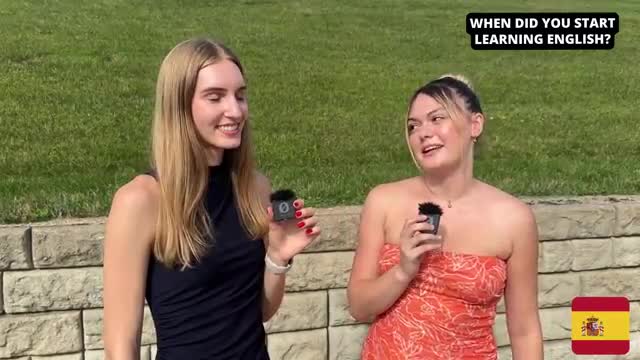
My name's Arianita Lagringa and in today's video I am throwing a party and I invited people from all over the world and they are going to share their experiences learning English.
Let's go!
Hi, what's your name and where are you from?
Hi, I'm Alba and I'm from Spain.
When did you start learning English?
I've been learning English like all my life, but the teacher in Spain, the English teacher in Spain, they are so bad.
As you can see.
What are some words that are difficult for you to pronounce in English?
A lot, but I think The most harder is squirrel.
Like a good animal.
And what is the biggest difference between Spain and America?
Okay, the food.
Yeah, the food here.
I'm sorry, but it's really bad, super processed.
And the food in Spain is really, really good and super healthy too.
And now can you pronounce these two words for me in English?
Okay.
This is the first one.
Laugh.
Laugh.
Laugh.
And the second one.
February.
February.
February.
Yes.
Yes.
You got it.
Hi, what's your name and where are you from?
I'm Patricia, I'm from Ecuador.
And then how long have you been learning English?
I would say 15 years.
Wow, that's a long time.
Yeah.
And then what are some of the most difficult words for you to pronounce?
Brewery, like the beer place.
Brewery, yeah.
That's hard. it used to be hard to say february because you have an r february and then you explain like guys explain like just eat that r and be february yeah squirrel squirrel squirrel that's a hard one that's a hard one everything that has a z I have to, like, make an extra effort, so zip code or Amazon.
That's interesting.
Yeah, like, the first time that I got here, I was talking about Amazon, you know?
And a little kid was like, Amazon, Amazon.
So since that day, I, like, understand the nasally part.
Yeah.
I'm speaking English, and the Z, that part.
Amazon, zebra, zip line.
Yeah, I feel like a V. Yeah, you have to...
Is it hard for you to understand English speakers sometimes?
Sometimes depends on the area.
So the South, they have a twang that is hard to understand.
And sometimes people from New York, I used to have a call center, like customer service, like job.
And it was like, I don't, I, can you say that again?
Yeah.
Sometimes talking on the phone is way different than in person.
Cause it could be muffled and especially the different accents from where people are from too.
Yeah.
And I guess the American accent and the English accent.
So the British, that is a little harder to understand.
And then what are some of the biggest differences between America and where you're from?
A lot of things, but I would say the main thing, the food.
Ecuador has like very, oh, we have everything.
The menus here could be like a page.
In Ecuador you could be like going through pages, because you can have seafood and beef and pork and everything.
And what do you normally eat in Ecuador?
What kind of food?
Ceviche, plantains, like patacones, bolon, fritada, hornado.
You have to know.
I have to visit one day.
And now I'm going to show you two words to see if you can pronounce them.
Okay.
Okay, this is the first word.
Hospital.
Hospital, correct.
Famous.
Famous, good job.
Thank you.
All right, before continuing the video, can you guys pronounce these two words correctly in English?
Did you say actually and colonel?
Well, if you did, you're not alone.
A lot of people struggle with those words, which is totally okay.
But if you want to improve your pronunciation, I have a great solution for you guys.
I want to introduce you to today's sponsor, Preply.
Preply is an amazing language learning platform with thousands of native tutors who can help you speak English like a pro.
They have filters to help you find a tutor who's a perfect fit for your budget and schedule.
Plus, you can learn how to pronounce those tricky words that you might be struggling with, like actually and kernel.
Just practicing English every single day can make you more fluent and confident in no time.
You can get 50% off your first trial with my code ARIANITA50.
Click the link down below in the description box to start pronouncing words correctly in English.
Thanks to Preply for sponsoring this part of the video.
Now let's get back to the video.
Hi, what's your name and where are you from?
Hi, my name is Ali Reza.
I'm from Iran.
Awesome.
And then when did you start learning English?
When I was like a teenager, starting with the series and movies, and then a little bit in school.
And then what are some of the most difficult words for you to pronounce in English?
The words end with TH, like sixth.
Sixth?
Yeah, sixth.
Fourth.
Yeah, those are difficult.
Those are super difficult for me.
And what is the biggest difference between Iran and America?
Economically there's a big difference, but apart from that, cultural like food and tradition and customs okay, so what do people normally eat in your country?
Mostly kebab and different types of curries and rice awesome.
And then now we're going to do a little test to see if you can pronounce these two words correctly.
Can you pronounce this word Cousin?
Cousin, correct.
And this one?
Temperature.
Temperature.
Yeah.
So some people might say temperature.
They might pronounce the whole word, like all the letters.
But some words we don't pronounce all the letters.
You have to watch out for that.
But great.
You passed the test.
Thank you.
Great.
Hi, what are your names and where are both of you from?
My name is Mary and I'm from Mexico.
My name is Paulina and I'm from Veracruz, Mexico.
Awesome.
And then how long have you guys been learning English?
I probably started when I was like eight.
Yeah, maybe high school.
And then what are some of the most difficult words for you two to pronounce?
I would say you.
Jewelry.
This thing.
And then what are some of the biggest differences between Mexico and the United States?
There's a lot of differences.
I would say the medical system in the U.S. and Mexico.
Also, I do think that Mexicans are more like warm people than in America.
So yeah, those two are the ones that come to my mind.
The economy.
Definitely.
What do you think is the best way to start learning English?
So I had one friend that actually used to watch Spongebob or The Simpsons or a show that you know a lot, and just watch it in English or in the language that you want to learn.
That's really good advice, like starting from a series or a TV show.
I think reading and like practicing your writing and listening.
And then now I'm going to do a quick test to see if you guys can pronounce these words in English correctly.
Okay, can you pronounce this word for me?
Colonel?
Colonel.
Colonel.
Oh, this one right here?
Yeah.
Oh.
The first one.
Colonel.
Yeah.
I thought it was colonel.
No.
And then can you pronounce the second word amateur amateur amateur, amateur.
Yeah close close, hi.
What's your name and where are you from?
Hi, my name is catherine and i'm from venezuela.
And when did you start learning english?
I started probably around four years ago when i came here.
And then what are some of the most difficult words for you to pronounce in english?
There's one that they never understand when I go on the drive-thru in McDonald's and it's burger.
Burger?
Yeah, so that's a problem, because every time I'm trying to order a burger, they're like you want a, what?
Do you say booger?
I say like burger, so I guess they say it different, I don't know.
Yeah, you would say burger.
And then the other one is probably.
Probably. yeah some people say like probably yeah they like don't even say the word they say like probably or probably yeah because i say probably so they're like you're saying that weird and then what are some of the biggest differences between venezuela and the united states I mean, there's a few differences.
Definitely the food tastes different.
I feel like the fruit is more flavorful in Venezuela.
And then the people, you know, the people is different too.
If you go to Venezuela, you would feel like the people are more warm and like welcoming sometimes.
And here it's like, you know, they don't talk to you as much.
Like, I don't know my neighbors and that kind of thing.
And then now we're going to play a little game to see if you can pronounce two words in English correctly.
This is the first word archive archive yes, okay.
And the second word quarter, quarter.
That's a hard one though.
Hi, what's your name and where are you from?
Hey, my name is Santiago and I'm from Argentina.
Awesome, and when did you start learning English?
Uh, when I was in high school in Argentina.
Actually, what are some of the most difficult words for you to pronounce in English?
Uh, nowadays I will say literally.
Yeah, so you would say literally, not literally.
I can't, I can't.
And then the other one is rural.
Yeah, that one is hard.
That one's difficult.
And then there's one that you guys say the sport badminton.
It's like badminton.
Badminton.
Okay, yeah, yeah, yeah.
Those are definitely the hardest ones, I would say.
And then what are some of the biggest differences between Argentina and America?
I would say, like, the way we live, the way we care for food.
We take our time to eat all the time.
Like, we gather with family.
Like we really put a lot of love in making our food and sitting down and just like enjoying the moment you know.
Like, taking time to ask, how you doing?
Like, every Sunday with my family is like religion.
We all get together with some other friends and everything, and we stay there from, I don't know, 10 am till 7 pm, eating and just enjoying the day.
Here everything is much more time-oriented, so you're always running and rushing everywhere.
But I would say that that's one of the biggest difference.
Now, can you pronounce these two words in English correctly?
Okay.
Entrepreneur.
Entrepreneur.
Entrepreneur.
Entrepreneur.
Athlete.
Athlete, yeah, correct.
Hi, what's your name and where are you from?
My name is Juan and I'm from Colombia.
And then when did you start learning English?
Fortunately, when I was around four years old, three years old.
And what are some words that are difficult for you to pronounce in English?
Definitely differentiation between bitch and bish.
Bitch and beach.
So right now we're at the beach.
But if you call a person a bad word, a cuss word, you would say bitch.
So beach, bitch.
Yeah.
Beach, bitch.
And then what are some of the biggest differences between Colombia and the United States?
Wow, definitely the food and also the different ecosystems.
Although the US is pretty big and it's not fair to say that you don't have a lot of ecosystems here.
But I don't know.
Colombia is very rich for the population.
It's quite foodish, I guess.
We can call it somehow.
We're the second most biodiverse country.
It's pretty interesting, too, to fit that in such a small place.
And, yeah, I mean, the U.S. is huge.
It has a bunch of stuff that's pretty cool, too.
But I would say the food and how organic you can get.
You know, a meal to your plate is a big thing for me.
Yeah.
And I think that's a big difference.
You eat a chicken in Colombia, the chicken was probably alive in the last 12 hours.
You eat a chicken here, that chicken has been gone for a while.
Yeah.
So I think that's a pretty big difference.
Hi, what's your name and where are you from?
I'm Melanie and I'm from Brazil.
And when did you first start learning English?
I started learning English in school in Brazil like five years ago, but I actually learned it a year after I moved here.
And what are some of the hardest words to pronounce?
World, world and comfortable comfortable comfortable, yeah.
So we don't actually say like comfortable, we say comfortable, i can't comfortable and i can't say it.
Yeah, it's really hard, it is hard.
And then what are some of the biggest differences between brazil and the united states?
Uh, the biggest one for me, it is the drinking age that we can start drinking at 18 in there and to get our license we also have to be 18.
So when we're 15 we can have permit or anything.
We have to be 18.
Here in the united states we can drive at 15 and a half.
It depends on the state.
Yeah, and then also with the drinking age, it's 21.
Awesome, thank you so much, of course.
Thank you, Hi.
What's your name and where are you from?
Hi, my name is Carolina.
I am from Ecuador.
How did you learn English?
I learned in school and then I came here to practice more.
What are some of the most difficult words for you to pronounce in English?
So i would say probably when i have to say t, for example, when you say literally i couldn't say that word before, it was so hard for me.
Yeah, literally.
Yeah, some people pronounce the t like literally.
Yeah, it was so hard.
Do you have any other words?
When i'm like counting the numbers or the days and you say like fourth or i remember my friend has the same problem Yeah, like 30, 30 sometimes yeah,
30, 40, 40.
Is it hard for you to understand English speakers sometimes?
I guess sometimes when I can hear people from the South, that is hard for me, like the accent.
Yes, like the country accent.
They say, y'all, how you doing?
And they don't pronounce the words all the way.
And then what are some of the biggest differences between the United States and where you're from?
I think the culture.
We are super Latino, so we want to hug.
We want to say hi to everyone.
You hear people and it's like hello, you know, like a handshake.
Yeah, you need like a space in ecuador.
We are super nice and warm.
Can you pronounce this word for me?
Totem total, yeah.
And then this one serious serious, good.
Hi, what's your name and where are you from?
Hi uh, my name is jose.
I'm from salvador.
When did you start learning english?
Four years ago And what are some of the most difficult words for you to pronounce?
So, the bear, the animal.
There's beer, what you drink, the alcoholic drink.
Bird, the animal that flies in the sky.
And what are some of the biggest differences between El Salvador and the United States?
The language and food.
Yeah, because we speak English in the United States and you guys speak Spanish.
Hi, what's your name and where are you from?
I'm Christine and I'm from Bulgaria.
When did you first start learning English?
I started learning English when I was seven years old.
What are some of the most difficult words for you to pronounce in English?
I hate ordering water.
And I hate saying girl.
Girl?
Yeah.
And then, what are some of the differences between the United States and from your country, where you're from?
I would say the communication between people.
Yeah, we're more close.
We are like more family oriented.
And then now we'll do a quick quiz.
So can you pronounce these two words for me?
This is the first word plumber plumber, correct.
And then number two, sauce sauce.
Both are correct.
Good job, hi.
What's your name and where are you from?
My name is johan german and i'm from mexico, and when did you start learning english?
Uh, around five or six years old.
And what are some words that are difficult for you to pronounce in english?
For me it's mountains.
I don't know why the t and the dns doesn't go together with me.
Yeah, normally we say mountain.
We have like the glottal stop in the throat.
But you can say mountain, but people just say mountain.
Like mountain dew, the drink.
What are some of the biggest differences between Mexico and the United States?
I think I want to say dancing.
Dancing?
Dancing, yes.
Exclusively parties.
Everybody's on time in America and Mexico.
It's whatever time.
After a certain time, you get there.
And then the dancing part, everybody likes to dance.
So people in Mexico show up late to a party.
Yes.
So if I say the party's at 5 p.m., what time?
Show up at 7.
At 7?
So is that why you showed up to my party pretty late?
Yes, that's exactly why.
I'm in Mexican time.
Now, can you pronounce these two words for me?
Schedule schedule document document correct.
Yeah hi, what's your name and where are you from?
Hi, my name is martina and i'm from argentina.
And then, when did you start learning english?
Um, in the institute, i think, when i was 11, or something like that.
Oh yeah, so it's been a long time.
And then, what are some of the biggest differences between argentina and the united states?
Um, the quality And inflation.
What are some of the most difficult words for you to pronounce in English?
Nervous.
Nervioso.
Nervous?
Yeah.
Yeah, I can't say that.
And then now we're going to do a quick test to see if you can pronounce two words in English.
All right.
Can you pronounce the first word?
Catholic.
Catholic.
Catholic.
Yeah.
We don't say Catholic.
We don't pronounce the O. We just say Catholic.
Catholic.
Oh, okay.
Hi, what's your name and where are you from?
My name is Paola Alvarado and I'm from Puerto Rico.
And when did you first start learning English?
I think I started learning English since I was a child in Puerto Rico.
You actually have English classes at school, so yeah.
What are some of the most difficult words for you to pronounce in English?
Most of them are in the medical field because they're really hard on studying biology, but I think that vegetables maybe.
Vegetables?
Yeah, that guy?
I don't know how to pronounce that.
That's okay.
Sometimes we do say veggies, like veggie or vegetable, but yeah.
And what is the biggest difference between Puerto Rico and the United States?
I think the warm weather and also the culture is a lot different.
People are like warmer over there.
I think that's a big difference.
What has been the best way for you to learn English?
Just practicing, talking with everyone in the work field and even at school, at the university, just talking with everyone.
Hi, what are your names and where are both of you from?
My name is Maiz, I'm from Brazil.
And I'm Mayad, I'm from Brazil too.
And when did both of you start learning English?
I started learning in high school.
I think I started like with five years or something, but very basic English, like colors.
No, like five years old.
Yes, like colors and fruits.
And then what are some of the most difficult words for both of you to pronounce in English?
For me, it is jewelry.
Jewelry?
Yes.
Yeah.
Library or strawberries.
Library and then strawberry.
Yes, those are a bit hard.
And then what are some of the biggest differences between Brazil and the United States?
I think the food is really different.
The music here is really different.
Parties here.
Yeah, I think the culture is the most different.
And how people are warm in South America in general.
And here, it's a bit colder.
And then what do you think is the best way to start learning English?
Like what method?
I think, listen to music in English, maybe watching movies or even like traveling and talk in English.
I think helps.
Movies can help a lot and music.
I remember when I was like 12, I used to grab the lyrics and read everything while I was listening.
So I think that helps too.
And of course, like being in the country, you want to learn the language will help a lot.
Well, that's great advice.
Thank you so much.
Thank you.
Hi, what's your name and where are you from?
Hi, my name is Bayron.
I am from Ecuador as well.
How did you start learning English?
I took a lot of courses after when I was studying in high school.
It has been 10, 15 years.
Wow, that's a long time.
Yeah.
And then what are some of the most difficult words for you to pronounce?
Oh, a lot of them.
The words that end in ED.
ED?
Yeah, also like tired.
I used to say tired.
Even now it's difficult for me.
Yeah, the ED and the last part I cannot pronounce.
That's difficult.
It can be difficult.
Tired, walked.
Yeah, yeah, yeah.
Also, for example, eye and eyes is a small difference.
Or B and V. B and V?
Yeah, the letters.
Yeah, exactly.
Because, well, in Ecuador we don't have that difference.
Yeah, that could be difficult.
Yeah.
Now I'm going to make a little test to see if you can pronounce these two words correctly.
Okay.
Minute.
Minute.
Correct.
You can say minute or minute, whichever.
Yeah.
And then this one.
Second.
Second.
Correct.
Good job.
So what is the biggest difference between America and Ecuador?
I will say that in the United States here, you need a car for everything.
If you don't have a car, you cannot go anywhere.
That's true.
So that is a big one.
That's mostly with like the Midwest, but New York, like in the city, you don't really need a car.
So it just depends where you're at.
But yeah, that's correct.
You have to have a car no matter where you are, no matter where you live, basically.
Yeah, it's a huge change.
Hi, what's your name and where are you from?
My name is Lucia and I'm from Argentina.
And when did you first start learning English?
It was in school, but it wasn't a good level.
So And then?
What are some of the most difficult words for you to pronounce in English?
One of them is jewelry.
Jewelry?
Yeah.
And another one is available.
Available.
Yeah, you got it.
Yeah, it's hard.
What are some of the biggest differences between Argentina and the United States?
The people.
The people?
Yeah.
How are people different in Argentina?
In Argentina people are more like warm.
And here, it's like, they say, hi.
Like, in distance, from distance, yeah.
In Argentina, like, we say hi, and we give a kiss, we give a hug.
It's, like, kind of different.
Yeah, here, it's like a handshake, or, like, we don't even shake hands.
Yeah, it's, like, just hi from distance, yeah.
And then now, a mini quiz.
So you will have to pronounce two words in English, so we'll see if you pronounce them correctly or not.
This is the first word lettuce lettuce yes, okay.
Second one audience audience, audience audience.
Okay correct, good job, hi.
What's your name and where are you from?
My name is rodrigo, i'm from mexico, and when did you first start learning english?
10 years ago, when i came here.
And then what are some words that are difficult for you to pronounce in english?
I think the hardest one was water water, really difficult to pronounce it.
At some point, i know, in british english they say water, water.
That's the tea, Yeah.
What is the biggest difference between Mexico and America?
Definitely the drinking age.
You could be 18 in Mexico.
And the food.
I think Mexican food is great.
There's a lot of diversity.
I love enchiladas.
Enchiladas?
Go try them in Mexico City.
Hi, what's your name and where are you from?
Hi, my name is Diego.
I'm from Brazil.
And when did you start learning English?
Since 2019.
Okay, so a couple of years, like five or six years.
And then what are some of the most difficult words for you to pronounce in English?
For me, the most difficult to pronounce in English is refrigerator.
Refrigerator.
Refrigerator.
Yes.
That's the most difficult to pronounce in English for me.
And honestly, sometimes we just shorten the word and we just say fridge because it's so long.
So instead of saying refrigerator, we would just say fridge.
Fridge.
Yeah.
That's a good tip for me.
And then what are some of the biggest differences between Brazil and the United States?
The culture, like it's totally different.
So I love here, but Brazil, it's so much better.
We are more lovely.
We love people and talk to people.
And here, like some of the people don't like to talk.
Okay everybody, that's all for today's video.
I hope you guys were able to hear different accents from people all around the world and learn English through other people's experiences.
Go ahead and let me know down below what are some other English words that are difficult to pronounce.
And go ahead and give me a big fat thumbs up, give me a like subscribe, and I'll see you guys next week.
Bye!