This message comes from Progressive Insurance.
Progressive makes it easy to see if you could save when you bundle your home and auto policies.
Try it at Progressive.com.
Progressive Casualty Insurance Company and affiliates.
Potential savings will vary.
Not available in all states.
At six in the morning, I remember that somebody called saying that the Navy's coming.
I was told if it happens would be very violent.
So take care, protect yourselves, try to leave your houses.
My name is Sergio Vitar.
Sergio has been a lot of things a civil engineer, an author and, at the time he's speaking about, he's a government worker.
We'll get to all that later.
Right now, Sergio needs to make a decision.
He has to leave his house.
But where should he go?
Where is even safe anymore?
Should I go to the palace, government palace?
It was completely blocked.
The only information he could get was by tuning into the radio.
So he flipped it on in the car as he headed for a friend's house on the outskirts of the city.
The president of Chile.
Salvador Allende came on the radio.
I will not resign, he says.
I will pay with my life for the loyalty of the people.
The seed we planted in the dignified conscience of thousands and thousands of Chileans will not be shriveled forever.
Sergio reached his friend's house.
Throughout the day he could hear bombs, airplanes buzzed low to the ground and gunfire echoed throughout the neighborhood.
That afternoon, over the radio, the announcement came.
The president was dead.
By the radio?
There was a list of people called by the military that we should present ourselves.
The next day, at 7 a.m., Sergio's name became one of them.
I called my wife saying, could you come?
I've been called.
His mind was racing, and some embassies had called and offered asylum.
But if he tried to take refuge there and the embassies fell, then he might be in even bigger trouble.
So Sergio decided to turn himself in.
I have nothing to hide.
This is a democratic government.
So I presented myself.
The soldiers took his documents and detained him along with a bunch of other people, some of them who he knew.
So we stayed 24 hours or 48 hours.
And at the time, I think there was a decision among the heads of the military, what is called the junta.
Should we kill these guys? or send them abroad.
An helicopter arrived, but it was no answer.
They took us, and then they pushed us to a bus with guys with machine guns.
The soldiers told them if anyone moved, they would be shot.
And they took us to a plane.
On the plane, armed men guarded them closely.
We didn't know where we were going.
Just days before, Sergio Bitar worked for the Chilean government.
He was living in Santiago, the capital city.
He was a husband, a father.
Now, he was a political prisoner.
When I look back, I realize my blindness.
Because we were a democratic country for many years, democracy was sure, secure, guaranteed.
Until it wasn't.
I'm Randa Abdel-Fattah.
And I'm Ramteen Arablui.
Chile was once one of Latin America's oldest democracies.
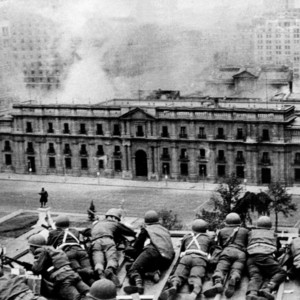
That all changed in a matter of hours after a military coup on September 11th, 1973.
For the next 17 years, Chileans found themselves in the grip of brutal authoritarian rule.
People lived in fear.
There were no elections and the people had no voice.
Today on the show how democracy collapses and how it is resuscitated, through the eyes of four people who lived through it.
The prisoner.
The conditions were how to control your mind, that you feel that you are nothing.
The journalist.
I was not able to use a byline, and as soon as I did, the reprisals came down on me.
The exile.
The dictatorship didn't eliminate just its enemies in the country, but also outside the country.
And the child.
And I don't know anything.
And I am like, you know, a daughter of privilege.
Like, what is this?
It was more than an awakening.
It's like, you see, the kind of slivers of, you know, truth coming.
Coming up, democracy dies in a day.
This message comes from Jackson.
Let's face it, retirement planning can be confusing.
At Jackson, we're working to make retirement clear for everyone, starting with you.
Our easy-to-understand resources and user-friendly digital tools help simplify your entire experience.
You can have confidence in your retirement with Clarity from Jackson.
Seek the clarity you deserve at Jackson.com.
Jackson is short for Jackson Financial Incorporated.
Jackson National Life Insurance Company Lansing, Michigan and Jackson National Life Insurance Company of New York.
Purchase New York.
This message comes from Warby Parker.
Prescription eyewear that's expertly crafted and unexpectedly affordable.
Glasses designed in-house from premium materials, starting at just 95, including prescription lenses.
Stop by a Warby Parker store near you.
Support for this podcast and the following message come from Lisa.
Lisa has a lineup of beautifully crafted mattresses tailored to how you sleep.
Each mattress is meticulously designed and assembled in the USA and designed with specific sleep positions and feel preferences in mind.
Visit Lisa.com for 25% off, plus get an extra $50 off with promo code NPR.
That's L-E-E-S-A dot com, promo code NPR.
Part one.
Estas son mis ultimas palabras.
These are my last words.
I got up that morning.
My girlfriend comes back. and says, things are happening.
This is John Dingus.
He's written several books on Latin America.
My recent book came out in April called Chile and Their Hearts.
In 1973, he was an American reporter living in Chile.
We turned on the radio immediately.
All of the stations had been taken over by the military, except for one, Radio Magallanes.
And I had my tape recorder.
I flipped it on record.
And I recorded them saying, we are about to hear from the president of the republic.
He is in La Moneda.
La Moneda, the presidential palace.
There are troops surrounding the palace, and he is going to address all of Chile.
This is the last opportunity for me to address you.
The people must not let themselves be destroyed or riddled with bullets.
But they cannot be humiliated either.
He was not giving us any hope that he could beat back the coup.
Long live Chile.
Long live the people.
Long live the workers.
He implied that he was not going to leave alive.
These are my last words and I am certain my sacrifice will not be in vain.
It was an amazingly eloquent speech for history.
Then we said, well, what do we do?
In the years leading up to this day, the day of the coup, Chile had been in crisis.
It had some of the highest income inequality in Latin America.
Despite high mining taxes, profits from Chile's main industry, copper mining, didn't trickle down to everyone.
But it was in the hands of American companies.
This is Sergio Bitar.
You met him at the top of the episode.
He was born and raised in Chile.
We don't know what we received for that.
All the profits go abroad.
Mostly, when you go out from the area where middle classes existed, you saw the poverty there, the lack of housing, children without food.
The mortality rate was very high.
Unemployment and kids going, walking barefoot.
A movement of working class people began to demand change.
Enter Salvador Allende.
Allende was a self-proclaimed Marxist.
And in 1970, he ran for president with the promise of a full socialist makeover of Chilean society.
He wanted the Chilean government to take control of the U.S.-dominated copper industry.
He promised to increase wages for the poorest Chileans and vowed that every child would get a free half liter of milk every day.
Allende also wanted to redistribute farmland, taking it from rich landowners and giving it to the poor.
I ask you to go home in joy with the fair victory we have achieved.
Allende won the election.
You'll have to put more passion and more love to make Chile ever greater and life in our homeland more just.
So that's the beginning of my political life.
Sergio was in the U.S. studying at Harvard when Allende was elected.
He didn't consider himself a socialist, but he saw Allende as an opportunity for change.
So I said to myself, I will go back and I will be available to work with Allende government.
He was appointed the Minister of Mining as Allende made moves to nationalize the copper industry.
Alarm bells started ringing in the U.S.
Instead of seeing a movement towards democracy, they were seeing risk to their security, the security of their businesses.
This was the Cold War era and the US government feared communism was spreading across Latin America.
This wasn't Castro era.
This wasn't the Cuban Revolution.
This wasn't a takeover.
This was a parliamentary system that had won enough of a majority to govern, and they were implementing a radical economic and social change.
But still, the U.S. saw Allende's reforms as a threat.
The U.S. government instituted an invisible blockade against Chile.
They cut off loans and foreign aid in order to, as the Nixon administration put it, make the Chilean economy scream.
By October 1972, when John landed in Chile, there was a general strike against the government.
Small businesses and truckers had basically closed down the country.
The rich were panicking because Allende was instituting policies that threatened to take their land and their money and redistribute it.
But the poor were also suffering, as Chile's economy descended into chaos.
Inflation was the highest in the world.
There were food shortages everywhere.
It was in the middle of a crisis.
The country was very divided.
Messing with the economy wasn't the only way the U.S. put its hand on this scale.
President Nixon and Secretary of State Henry Kissinger collaborated with all kinds of US government officials and the CIA to destabilize Allende.
The CIA poured millions of dollars into covert operations to support opposition groups and spread anti-Allende propaganda.
They paid almost 2 million to El Mercurio, Chile's New York Times, to slant its coverage against Allende.
The paper ran headlines like Marxists Threaten Middle Class and Reds Plan to Attack Army.
The U.S. government was also trying to court Chilean military leaders.
Augusto Pinochet is the number two military person in the army.
Pinochet was a bit of an enigma.
He grew up in a middle-class family and joined the military as a teenager.
He climbed the ranks, doing just enough to get promoted, but not so much that he stood out.
In September 1972, Chile's military is trying to purchase tanks from the US government, so Pinochet heads to Panama, where the US had bases.
They wanted to dine him.
And at one point A member of Pinochet's delegation has a conversation with some American officers who tell him I'm not quoting it exactly
If there's a plan to overthrow the Marxist government, we want you to know that we will support it.
And Pinochet did not tip his hand.
And I'm pretty convinced that at that time he hadn't decided whether he was going to be involved in the coup.
But the U.S. has basically given him the green light.
The U.S. was saying, OK, we won't organize the coup for you, but we also won't stand in your way.
And we think it's a good idea.
So Pinochet returns to Chile.
And when he gets back, he gets a big promotion.
Allende names Pinochet as the commander of the army, the top military officer.
People did not suspect.
They thought, OK, that's good because Pinochet is a loyalist.
He's somebody who believes in the Constitution.
In other words, Pinochet could be a stabilizing force that would help uphold democracy in Chile at a time when life in Chile was reaching a breaking point.
In the summer of 1973.
There were demonstrations every week.
And there were demonstrations by the right, demonstrations by the left.
It was chaotic.
In those final days there were a coterie of high-ranking officers who had decided that they were going to pull off a coup.
They met with Pinochet on Sunday, September 9th.
And he was reluctant.
His choice is divide the armed forces and oppose this military coup, which would be bloody, almost a civil war, or take charge of it.
He decides that he's going to lead the coup.
That brings us back to September 11th 1973, when John turned on the radio to hear President Allende's final address.
We said, well, what do we do?
John and his roommates set out for the big working-class neighborhood of the city, the hub for Allende supporters.
They were going to lead the opposition if any coup came.
They get to this part of Santiago, the industrial belt, where all the factories are.
At the first factory... The workers said, go home.
It's going to be really, really dangerous.
Then they went to a second factory where the workers had blockaded themselves inside and were waiting for a weapons delivery.
They'd been told that they were going to arrive in a green truck.
They waited all day.
The green truck never arrived.
The weapons didn't come.
Back at the presidential palace, explosions rang out.
They bombed the Moneda with the Air Force.
And once they bombed it, it was clear that the resistance was over.
The military moved into the palace.
Allende was on the second floor.
By the time they got up there, Allende was dead.
From a bullet to the head.
The people of Santiago must remain in their homes in order to avoid innocent victims.
General Augusto Pinochet was in power now.
There were military barriers on the corners, people with automatic weapons behind sandbags.
The military imposed a curfew.
During that period, we're listening to the radio, there's no information going on.
On a regular basis, we would hear gunshots.
John and his roommates hunkered down for the night, waiting to see what would happen.
Coming up, dawn breaks on a new reality for Chile.
Hi, this is Jewel from Toledo, Ohio.
I love listening to ThruLine on my drives.
You're listening to ThruLine from NPR.
This message comes from NetSuite.
What does the future hold for business?
Can someone invent a crystal ball?
Until then, over 42000 businesses have future-proofed their business with NetSuite by Oracle, the number one cloud ERP, bringing accounting, financial management, inventory and HR into one platform.
With real-time insights and forecasting, you're able to peer into the future and seize new opportunities.
Download the CFO's Guide to AI and Machine Learning for free at netsuite.com.
This message comes from the John D and Catherine T MacArthur Foundation, recognizing extraordinarily creative individuals whose ideas, solutions and discoveries expand people's expectations of what's possible.
Macfound.org.
Part 2.
Las dos caras de la dictadura.
The two faces of dictatorship.
When you are in prison, the most dangerous enemy is the sense of time.
If you lose the sense of time, you lose your mind.
This is Sergio Bitar again.
In the hours and days that followed the bombing of La Moneda, Sergio's whole life was turned upside down.
He was detained and he was taken by Pinochet's forces to the very southern tip of South America, to a prison on Dawson Island.
The South Omajoran Strait is one of the closest islands to the Antarctic.
With the worst guys they had in order to impose on us singing of military songs every day, every morning.
Like the Navy hymn.
The military anthem of each branch.
Day and night.
Sergio and the other prisoners were under the watchful eye of Pinochet's armed forces.
We felt that they had some sort of manual with orders on how to deal with the prisoners or how to break the prisoners.
And the way to do it is to feel that the other one is an animal.
You are not a human being.
That's part of the logic.
Sergio and the others did hard physical labor for 10 plus hours a day with little to no food.
Many were tortured, kept in isolation with glaring lights in their eyes.
It was hard to understand where you were, who you were, what was happening.
The mind is not able to recognize, it's not conscious about what is surrounding you.
What would happen to my wife, to my children, to the earth?
At that time, your body reacts in a different way.
What happens at the moment is survive.
In the days and months after the coup, Chile descended into chaos as the Pinochet regime took control of all facets of Chilean life.
The democracy was over.
They dissolved Congress.
They rewrote the Constitution.
They raided all of the universities and took over them by force.
This is John Dingus again.
As an American reporter in Santiago.
He was on the ground trying to figure out what was actually happening in real time.
It was obvious that they were arresting people because of their sympathy with the Allende government.
People were detained across the city.
They were raiding the poor people's areas, and the factories.
20000 people were held in the National Stadium which overnight, transformed from a soccer pitch to an open-air prison.
Some of the people who were sent there never returned.
We had vague reports of a lot of violence going on in the countryside.
And in fact a lot of the deaths were owners of farms telling the police to kill certain peasants because they had been leading the political movements.
And still, amid this violence and chaos, life was still going on.
Many people were still going to work, to school and to buy groceries.
In some senses easier because the economic chaos that was happening right before the coup, where there were food shortages, there was a black market, there were Protests all over the place
All of that ended, and it was, on the surface, more peaceful.
A veneer of civility and normalcy seemed to return to Chile.
Countries like the United States quickly recognized and legitimized the military government, also known as the Junta.
The immediate violence calms down by the end of 1973.
The patrols, the constant raiding of houses, all of that had died down.
They emptied the national stadium and the other stadiums.
The junta played up the idea that rule of law had returned to Chile.
In the poor, working-class neighborhoods, that narrative was a hard pill to swallow.
There, the number of people who had lost their jobs, the number of people that had been taken to prison or had been forced into exile.
They had seen the violence of the military coup with their own eyes.
It was their family members that were gone, dead, or simply disappeared.
The environment of fear was much, much stronger.
In 1974, some prisoners began to be released, including Sergio Bitar, who immediately left the country.
John and others took it as a sign that the violence had finally come to an end.
So we thought that things were returning to normal.
And for some Chileans, life wasn't just returning to normal.
It was better than ever.
There was the rich neighborhood, the Providencia and Las Condes neighborhoods, and they were overjoyed.
I mean, they broke out the champagne on September 11th.
For them, this was heavenly.
This was what they had always dreamed of that Chile would go back to the time when they were in charge and prosper.
Basically, things were arranged in line with their privilege.
So basically, it depends on where are you.
From where are you looking the dictatorship and who is suffering the dictatorship?
This is Camila Vergara, a lecturer in political theory at the University of Essex.
She grew up in Chile during the 1980s.
Her family, like many middle-class and wealthy families, supported Pinochet.
I am like, you know, a daughter of privilege.
I come from a family of landowner in the South.
The way her grandfather saw it.
Allende and his communist cronies had threatened to destroy everything he had worked for by redistributing farmland to poor farmers.
My grandfather says, these communists, we need to kill them all.
We need to just like get rid of them in a way.
This was the narrative of the regime.
And frankly, as a child from a wealthy family, Camila had no real conception of the regime's violence.
If you are really in the richest 10 percent, which means that you are dressed a certain way, you have a car, you have all these other things that insulate you from the repression.
Because when you're on the top, you're not really suffering.
You are profiting from, right?
After the coup Pinochet, undid Allende's efforts to bring Chile's land and resources back under national control.
They returned more than 300 businesses into private hands and foreign investors.
And with help from a group of Chilean economists educated in the US called the Chicago Boys, transformed Chile's economy into a laboratory of neoliberal capitalism.
They drafted a manifesto of this new society, in which it was based on the individual, rational consumer, in a way.
And it was basically the Bible of neoliberal economics.
And this Bible then became the program of the Pinochet regime.
The idea was simple.
The government had little role to play in the economy.
State-run services were largely privatized.
Price controls were lifted.
No big labor unions.
The economy ran best when there was ample competition and very little to no regulation.
Only the best would rise to the top.
The change was a shock.
Almost immediately, the price of common goods shot up.
The price of sugar, for instance, went up 500 percent.
This was great for profit margins and sugar CEOs like Camila's mom.
And in theory, these riches were supposed to trickle down.
In reality, that's not how it played out.
The system is created for the rich to get richer in a way and the poor to get stuck elsewhere.
John Dinges saw these disparities firsthand.
And it wasn't long before he realized that nothing had actually returned to normal.
Hundreds of people were being arrested and put in secret prisons.
In other words, people that had been arrested and after months had gone by were not appearing.
And this then is the phenomenon that is known as disappearance.
Over the course of Pinochet's regime— more than 1,000 people disappeared without a trace.
3,000 were killed and 40,000 were tortured or imprisoned.
As a reporter for Time magazine and The Washington Post.
John's stories made US readers face what was happening in Chile.
And, ironically enough, even though the US welcomed Pinochet and helped establish the conditions that led to Allende's overthrow, some of the loudest voices against Pinochet's regime were coming from the Chilean diaspora in the United States.
I would say that something that was really very impressive was the capacity of human beings to resist.
Orlando Letelier, the former ambassador to the US under the Allende government, emerged as one of the leaders of Chile's exile community.
When Orlando Letelier came, he had access to ambassadors, even to ministers.
And we decided, of course, that he was appointed as the head of the exiles in the U.S.
This is Juan Gabriel Valdez.
He's Chile's current ambassador to the U.S.
At the time of the coup, he was a student in the U.S. studying abroad.
After Pinochet took power, he decided to stay in the United States and become Letelier's assistant to fight for Chile from afar.
Orlando Letelier.
He was very effective, communicating from a moderate point of view.
What we wanted to do, which was to recuperate democracy.
Letelier had been imprisoned at Dawson Island at the same time as Sergio Bitar, and he wasn't afraid to tell people what he had seen firsthand, including the press.
In 1975, he told NPR this.
There were, I would say, at least 60 or 70 minors, people, boys from 15 to 16, 17 years old.
All of them were church, all of them.
As Letelier's calls against Pinochet gained more and more attention.
Juan Gabriel remembers being afraid that something would happen to his friend and mentor.
The Chilean dictatorship didn't eliminate just its enemies inside the country, but also outside the country.
And that fear proved to be well-founded.
I was with my children at home and suddenly I received a call from Orlando secretary.
And Orlando secretary said to me, something happened.
There was an accident apparently and everybody left the institute and they are running there.
Orlando was so careless when he drove and he's training and probably he had an accident.
And then this woman called me and said are you going home to see the FBI or are you going to the hospital?
And I said, what does the FBI has to do with an accident?
An accident, it was a bomb.
And I couldn't believe it.
The Chilean government denied involvement in the car bombing that killed Orlando Letelier and a young American colleague.
Did you ever buy that story or did you kind of know?
Yeah, you knew it was Pinochet.
I was absolutely sure it was Pinochet.
Decades later, in 2015...
Newly declassified US intelligence documents concluded what Juan Gabriel and others already suspected.
General Pinochet had personally ordered the killing of Letelier on U.S. soil.
At the time, the junta denied involvement, but the opposition was getting louder and louder.
The long tentacles of the dictatorship were starting to create cracks in the facade, and soon they would split wide open.
That's coming up.
Hi, this is Leah Margiela from Paris, France.
I'm a teacher and I love ThruLine.
And you are listening to ThruLine from NPR.
This message comes from Progressive Insurance.
Do you ever think about switching insurance companies to see if you could save some cash?
Progressive makes it easy to see if you could save when you bundle your home and auto policies.
Try it at Progressive.com.
Progressive Casualty Insurance Company and Affiliates.
Potential savings will vary.
Not available in all states.
Support for NPR and the following message come from Vital Farms whose farmers give their hens open pastures to roam.
Because who doesn't love a sunbath and a breeze while foraging on a natural buffet of grasses?
Vital Farms.
Good eggs, no shortcuts.
Support for this podcast and the following message come from Dataiku.
Enterprises are under pressure to launch hundreds of AI applications, when data teams are stretched thin, leaving potential value trapped in spreadsheets, siloed systems and slow development cycles.
That's where Dataiku comes in, the universal AI platform that makes building AI apps accessible to anyone with low-code tools that drive real-world impact from data.
Visit dataiku.com slash NPR.
D-A-T-A-I-K-U dot com slash NPR.
I must have been around, you know, nine years old or eight years old.
It was the 1980s, and Camila Vergara was excited to spend the day with her mom.
My mom was the CEO of the sugar industry, which was a state industry, and I would never see her.
Camila was usually at home.
Very isolated from the real world.
But on this day, her mom surprised her and said, Oh, let's do something together.
I will take you to a ballet in central Santiago.
So Camila put on her leotard, her tutu and slippers, and then they drove into the city.
When they arrived at the Teatro Municipal, a towering white stone theater, Camila and her mom eagerly walked up to the gates.
And it was closed.
Her mom was confused.
Had they gotten the date wrong?
Were they too early?
Too late?
Where was everyone?
And suddenly... Thousands of people come flooding down the street.
The crowd's chants mixed with the loud barking of police dogs.
We were caught in the middle of the protest.
My mom immediately started trying to cover me, repressing the people who protested, beating up people, tear gas everywhere.
So for the first time in my life, I was exposed to the glimpse of what is happening.
The protests had begun in May 1983.
Copper miners took to the streets first.
They demanded an end to government repression disappearances, mass arrests, police violence, censorship of the press and an end to a catastrophic economic crisis the country had been plunged into a year earlier, largely a result of the Chicago Boys' experimental policies.
Unemployment was over 25%.
Wages had dropped more than 30% for those who still did have a job.
Almost half the population was living in poverty.
It was a tinderbox waiting to erupt.
And when the copper miners took to the streets, the fuse was lit.
Before long, hundreds of thousands of others joined them in Jornadas de Protesta Nacional, a series of massive national protests.
It was more than an awakening.
It's like the kind of slivers of truth coming in.
And for Chileans living in exile...
These protests were a kind of invitation to return home and attempt to take down Pinochet.
We went to Mendoza, the city that is close to the mountains from the side of the Argentinians, and we go cross the border.
Sergio Bitar understood the risks of crossing that border.
He could be arrested, imprisoned again.
So it looks a little bit crazy, but...
But it was something he felt he had to do.
To be in my country and to fight against the dictatorship.
Some people believe that security is more important than freedom.
And they will discover after some time that when freedom is lost, it is not security anymore.
Juan Gabriel Valdez also returned to Chile around this time with his family.
And he says, almost from the moment they got there they knew the government was keeping a close eye on them.
Four days or five days after I came back, my wife and myself, we were invited by friends.
The person who was in charge of our children called us at 10 at night saying, there are two people here who entered.
I had to allow them to come into the house and they are looking at your pictures.
They are taking some of the pictures in your albums.
These kind of things began to happen very often.
Both Sergio and Juan Gabriel got involved in the growing opposition movement.
The so-called Democratic Alliance.
Disagreements quickly arose.
What were their goals?
Who was allowed in?
What kind of resistance was off limits?
There was a guerrilla movement putting bombs everywhere.
So we had, you know, outages of power that were due to the guerrilla people.
But many in the movement disagreed with that approach.
We cannot fight a dictatorship through the armed resistance or violence.
Sergio says their weapons would never compare to what the government had.
So instead of fighting fire with fire.
We have to do it through rules, within the rules.
And they realized they needed to make the umbrella bigger to bring more people into the movement.
Conservatives, trade unions, democratic socialists.
They couldn't afford to box people out if they didn't agree on everything.
The main thing they all needed to agree on was that democracy was the way forward for Chile, not Pinochet.
The rest, they could figure out later.
No one of us can get democracy back alone.
So we have to start building actions together and to They figured.
Their best shot at ousting Pinochet would be in October 1988, when something called a plebiscite was scheduled to take place.
Basically, the plebiscite would be an election in which Chileans would vote yes or no to keeping Pinochet as president for another eight years.
It was a footnote that Pinochet had included in the new constitution he passed in 1980 to give the world the illusion of term limits and fair elections.
I remember my best friends at the time in Spain telling me you are getting into a very difficult situation.
The plebiscite designed that the dictators, they will count the votes.
Are you crazy?
It's impossible.
Impossible, but kind of their only chance of ousting Pinochet while playing by the rules.
So we said, let's create a big mass of people to vote.
Convincing people to vote would be an uphill climb.
The central key issue is to combat fear.
The dictatorship uses fear as a control of the mind and the people.
And people were afraid.
If I go, if I say, if they see me, they can kill me, they can take me, they can take my job.
It was risky.
They needed people to buy into the idea that it was worth that risk to get out and vote no to another term for Pinochet.
So they turned to the most powerful tool they had television.
On channels across the country, including Televisión Nacional de Chile, Chile's PBS.
I was called to be the leader of the television campaigns which was allowed by the dictatorship and was the first time in which the opposition would show itself on TV.
You might be wondering why a dictator would give an opposition movement that's trying to oust him any TV time.
Chileans were surprised too, when the Junta passed a law that allowed yes and no sides to both have free time for their own political commercials.
It was meant to give the whole process a veneer of credibility.
So in the month leading up to the election day, The opposition was given 15 minutes of airtime on national television every day.
Pinochet and his crew were sure it wouldn't make any difference, that the yes side would dominate.
And they figured it would appease the international community, especially the US, which had long since soured on Pinochet.
The no campaign was given a late-night time slot.
The government considered that the program at 11 o'clock at night would be considered irrelevant by the majority of the population and they wouldn't see it.
But Juan Gabriel was determined to make the most of those 15 minutes every night.
He hired an army of ad men.
People working in publicity, filmmaking, sociologists, and political analysts.
And they set out to sell democracy.
It's not just complaining for what we suffered.
If we do that, you never win.
In order to win, you have to propose democracy. something better than what you are living now.
In other words, give the people hope.
The whole campaign was La Alegría Ya Viene.
Happiness is coming.
Porque diga lo que diga Yo soy libre de pensar These ads were high quality, optimistic.
The young people singing.
With lyrics like, whatever they say, I'm free to think, because it's time to win freedom.
And the colors.
The campaign had a rainbow logo.
The feeling of community.
They avoided heavy ideological language and instead emphasized How you can eat better food.
Have your kid go to school.
Let's say no.
Each night, more and more people tuned in to those 15 minutes and support for the no campaign, which would vote out Pinochet, grew.
Step by step, step by step, step by step.
On the eve of election day, No one had any idea what would happen.
The United States has heard reports that the Chilean government plans to cancel the referendum or nullify its results.
And on the morning of October 5th 1988, when the polls opened, The fear was that people will not come out and will not vote.
I went out to visit all the voting places.
And it was impressive because it was very hot, I remember.
And the lines were long, long, long, all the day.
So that gave us the hope that we would win.
By 10 o'clock this morning, there were lines six blocks long in many voting places here in Santiago.
People complained they had to wait, for 97 of the country's registered voters came out to vote, including Pinochet himself, dressed not as a general but in civilian clothes.
The question was simple.
Should Augusto Pinochet continue on as president for another eight years?
Yes or no?
The first results that were announced showed the no vote winning.
There was a moment that day which created an enormous alarm.
The Ministry of the Interior that is in charge of giving the results of the election and the plebiscite stopped giving the results around Augusto three o'clock or four o'clock in the afternoon.
The no vote was expanding its lead by this point.
Pinochet called the commander-in-chief at one in the morning to his office.
So I said, what's going to happen here?
Some people thought that the military would not recognize the result.
I remember very vividly, because there were phone calls being made and Pinochet didn't want to step down.
But his generals and the US government had told Pinochet we're done, we're not going to support the dictatorship anymore.
You need to move on.
And that night, the government came back to the television and said... The no won.
And from that point on, the mood in the headquarters of the no command was joyful.
And I think we danced and we cried and we sang until four in the morning.
Fired. a feeling of expansion, of big feeling of joy.
It means that we are, we exist, we have rights.
Chile today could be on its way back to democracy.
Probably the most unforgettable day in my life.
A moment that my life started again.
Nearly 56 of Chileans voted no, which was a majority.
A win, but not a resounding majority, even after years of torture, censorship and repression.
Camila Vergara says it wasn't simply a vote on democracy versus dictatorship.
Imagine the fear.
Everybody was afraid of the military coming back out.
Would a no vote lead to chaos, violence, another economic recession?
By 1988, the economy was in much better shape and a new middle class was emerging.
Some saw that as Pinochet's free market model working.
So it was complicated.
Still, Pinochet's reign as president finally came to an end.
The idea of defeating the dictatorship with a pen and pencil That was kind of the narrative.
But in reality, defeating the dictatorship didn't automatically mean democracy was restored.
We knew that it was not just a matter of replacing Pinochet with somebody else.
It was a much more complicated thing, and we had to make concessions.
Of course, we negotiated with the military.
The first democratic government, Pinochet was the leader of the armed forces.
Yes.
The police, basically, was the same police.
There was no purge.
And then Pinochet, after stepping down from the military, became senator for life in the Senate and therefore with full immunity.
So basically, he insulated himself and his people.
And not only insulated himself he was an active voter in the Senate vetoing reform.
Almost, you know, a decade of Pinochet in some kind of position of power during the young democracy.
In 1998...
Pinochet was arrested in London on charges of genocide, torture, and kidnapping.
He was ultimately found unfit to stand trial and was released back to Chile, where he died in 2006.
Today, Chile is in the middle of a close presidential race.
The current election just went into a runoff.
The next vote is scheduled for December 14th.
37 years after the plebiscite vote, there is still a big gap between the hopes and dreams of those TV ads and the reality of people's lives.
For Sergio Bitar, that doesn't mean they've failed.
It simply means there's more work to do.
It's a work in progress and it's a cultural progress also.
The idea of negotiations is part of democracy.
The guys in power have the big responsibility of behaving in the way they want the society to become.
You cannot try to build a democracy with aggression.
If you have a corrupt guy and winning lots of money.
Well, you cannot have a democracy under these conditions.
Camila Vergara, who is now a lecturer in political theory at the University of Essex, says this isn't just a problem Chile is facing today.
What we have today in the so-called free world is an oligarchy that keeps benefiting.
Every year, it doesn't matter who wins the election.
They are the ones who are increasing their wealth.
So basically, it's a system that formally looks like what we call democracy separation of powers, universal suffrage, freedom of speech.
But the people on the top, the wealthy few, the powerful few, are the ones really calling the shots, controlling everything, passing law to benefit themselves more than others.
And that we see through the growing inequality of the system.
That's it for this week's show.
I'm Randa Abdel-Fattah.
And I'm Ramtin Arablui.
And you've been listening to ThruLine from NPR.
This episode was produced by me.
And me and Lawrence Wu.
Julie Kane.
Anya Steinberg.
Casey Miner.
Kristina Kemp.
Devon Katayama.
Irene Noguchi.
Fact-checking for this episode was done by Kevin Vogel.
Thank you to Ana Sofia Vera, Peter Kornbluh, Micah Ratner, Maisha Galiba, Laura Schwartz, Johannes Dergi, Beth Donovan and Tommy Evans.
This episode was mixed by Jimmy Keeley.
Music for this episode was composed by Ramtin and his band Drop Electric, which includes Navid Marvi, Sho Fujiwara, Anya Mizani, And we've got a favor to ask.
We know there are a lot of great NPR shows out there.
And we all know who's the best.
Wink, wink.
NPR is celebrating the best podcast of the year.
And you get to crown the winner of the People's Choice Award.
Vote for us at npr.org slash people's choice.
May the best pod win.
And finally, if you have an idea or like something you heard on the show, please write us at throughline, at nprorg.
And make sure to rate us and leave us a comment on Apple or Spotify.
It helps other people find the show.
Thanks for listening.
Lisa has a lineup of beautifully crafted mattresses tailored to how you sleep.
Each mattress is meticulously designed and assembled in the USA and designed with specific sleep positions and feel preferences in mind.
Visit Leesa.com for 25% off, plus get an extra $50 off with promo code NPR.
That's Leesa.com, promo code NPR.
This message comes from NPR sponsor, Rosetta Stone. an expert in language learning for 30 years.
Right now, NPR listeners can get Rosetta Stone's lifetime membership to 25 different languages for 50 off.
Learn more at rosettastone.com slash NPR.
This message comes from Progressive Insurance and the Name Your Price tool.
It helps you find car insurance options in your budget.
Try it today at progressive.com.
Progressive Casualty Insurance Company and Affiliates.
Price and coverage match limited by state law.
Not available in all states.