Hello, and welcome to the NVIDIA AI Podcast.
I'm your host, Noah Kravitz. AI is everywhere.
AI is the new electricity. AI is the fifth industrial revolution.
We've all heard the proclamations about the impact of artificial intelligence on our world.
We've witnessed it firsthand. And frankly, it's why this podcast exists, to talk about the far reaching effects of AI on all of us.
But what does it really mean right now to go all in? on artificial intelligence.
What does an organization that is truly fueled by AI look like?
A new book co-authored by today's guests looks at how a small handful of businesses have seen big success over the past five years by going all in on using AI to radically transform their organizations. and it also looks at what other companies can do to catch up.
The book is called All In on AI, How Smart Companies Win Big with Artificial Intelligence. and it's available from Harvard Business Review starting in late January.
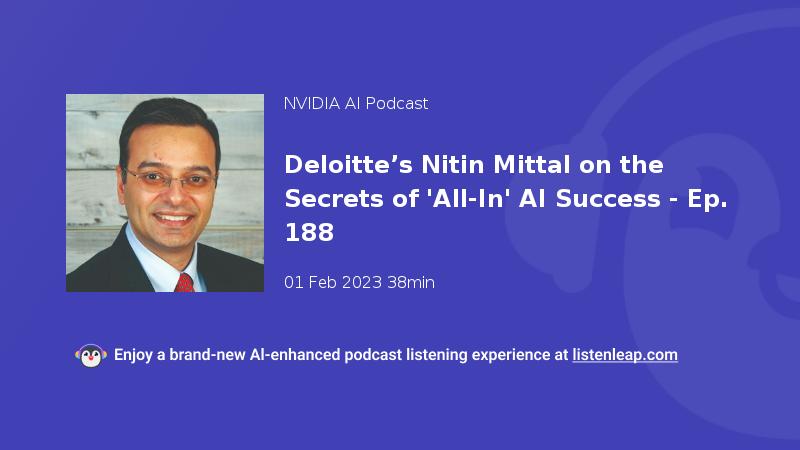
Here to tell us about it is Nitin Mittal.
Nitin is co-author of the book along with Tom Davenport, and Nitin is also a principal with Deloitte, where he leads the artificial intelligence growth platform.
Nitin, welcome and thanks so much for joining the NVIDIA AI podcast.
Thank you, Noah, and looking forward to the discussion and very happy to be on this podcast.
So congratulations on the book as we're taping this.
It's set to come out in a couple of weeks.
By the time people are listening to this, it should be available.
But why don't we start with you talking a bit about what led you to write the book, some of the ideas behind it, and then maybe getting into this broad idea of being all in on AI or what it means from a a business and organizational standpoint to truly be AI fueled.
Yeah, Noah, I've actually been in the field of data and analytics for over two decades.
And I've had the privilege to serve many of the clients that Deloitte has. and whom we work with across practically every industry in the marketplace.
And I have been able to, I would say, harness a lot of the knowledge that has been gained through working with these clients. serving the marketplace and specifically more and more being able to start helping these organizations around What does it mean to start becoming an insight-driven organization?
How to adopt artificial intelligence? how to apply it in the course of the day-to-day interactions with customers in the course of how they interact and collaborate with the broader ecosystem and the stakeholders whom they have, as well as what does it mean to really unleash the potential of AI, particularly as it comes to the growth aspirations that the enterprise may have. including how they compete in their own spheres.
And what I learned through all that is that there are many different facets of how AI can be applied.
There are many different benefits that an organization can accrue. as well as there are multiple pathways of how one can truly become an AI-fueled organization.
That led me to kind of the thinking as well as gave me the motivation that a lot of that knowledge that had been gained over the years could perhaps benefit society at large, could benefit a multitude of enterprises, and specifically could benefit many of the executives and managers in those organizations.
That was truly the inspiration and the motivation for me to write this book along with Tom Davenport so that it could be beneficial to the audience that I just mentioned.
So you mentioned you use the word insights and you mentioned your background in analytics.
I'm wondering, my understanding or when I think of AI in a kind of a traditional or perhaps legacy sort of the past, you know, 10 years over long business context.
There is a lot about analytics and insights, and I hear a lot about businesses leveraging AI to glean insights from their data.
So I'm wondering, is there kind of a through line from business analytics to what we think of as AI that maybe extends forward into some of the things that you talk about in the book, getting beyond that to looking at all aspects of an organization and not just not just crunching the numbers, so to speak, not just financial insights, but really using it to power all aspects of your ecosystem.
Absolutely. And frankly, that is one of the hypothesis of the book as well as what we see. with many of the enterprises out there.
You're absolutely right that The initial focus of artificial intelligence in many of these organizations was around the study of data and consequently generating insights that could then be woven into the business decision-making fabric of an organization and wherein executives and managers could make real-time decisions.
But the field of artificial intelligence has now progressed to a level wherein it's not just about generating insights it's also about generating experiences it's about executing in an autonomous fashion many of the interactions that take place with customers, suppliers, stakeholders, and participants in a broader ecosystem.
It is also about generating new content.
It is about fueling and enabling new pathways to grow or lighting up new business models that one can envision as it relates to those growth pathways.
So this field has, I would say, transcended just the ability to crunch numbers just the ability to study data and generate insights to truly becoming the means through which you are able to augment your employees, your workers, enhance experiences, with your customers and consequently figure out ways of actually competing in the marketplace in a much more effective manner. as well as having a growth trajectory that serves your enterprise in accordance to your vision and in accordance to your business strategy. dig into that a little bit with some specific examples?
And I don't mean, of course, to ask you to spoil the book, but you talk about some of the companies who are all in and have been kind of leading the charge, kind of taking a brave approach, if you will, and really going all in on AI as opposed to what a lot of companies, I think, or as you describe, are doing, which is sort of dabbling here and there and using a little bit in certain ways.
What are you seeing that is really exemplary to you in terms of the ways that successful organizations across all industries, as you said, are and should be using AI.
There are many, many different case studies and examples in the book, but to cite a few of them, There's the example of DBS Bank, which is headquartered in Singapore.
In terms of how they have gone all in with respect to AI and truly digitally transform their bank. every aspect of their business function, process, interactions, as well as the various products and services that they actually provide.
That goes beyond just the notion of generating insights.
There's also the example of Toyota. Toyota is figuring out how to transform their products And they have created something called the Guardian Project, which is essentially a vehicle that would ultimately and hopefully protect teens and bad drivers from making lethal driving mistakes.
There's also the example of Kroger, the efforts that they have launched through 84.51, which is a setup that Kroger has been instrumental in establishing to literally fuel their own ambition to be a digital powerhouse that is driven and fueled by artificial intelligence.
There's also examples of how Shell and Airbus and Loblaw in Canada as an example are proceeding.
There's many different case studies that you would actually find in this book and consistent with what I articulated earlier, they run across the gamut of how organizations are leveraging AI to study data, generate insights, figure out how to enhance experiences,
What type of business models could be developed?
What could be their growth pathway? How do they actually compete in the marketplace? many different use cases that are now more and more digitally powered, but reliant on artificial intelligence as the means to help these enterprises progress.
Another company that I should mention is in China, Ping An, in terms of how they have literally focused on artificial intelligence to not only imagine but execute on their business plan, new lines of business, new products to customers, new ways of generating revenue and new ways of looking into the market.
Those are some of the examples that frankly bring this book to life.
You mentioned digital transformation and this idea that's been around for a while of organizations literally moving from analog ways of doing things to digital ways.
And so it's not just taking things that might have been written on in ledgers or on the backs of napkins or typed out in memos and and moving them onto computers, but it's actually also changing the way that you do things, thinking digital first, leveraging, the additional power of a digital spreadsheet as opposed to writing things by hand in a ledger.
How is that perhaps the same and also different?
And correct me if I'm wrong, and I see it in my mind's eye as sort of residing on on a timeline of the evolution of the way businesses and organizations do things moving from analog to digital transformation and then forward to AI.
But maybe you can speak a little bit to what some of the similarities and differences are when you talk about an organization being digital, but then being AI fueled.
The way I would characterize it, I'm not sure that I would necessarily say that there's a linear progression from digital transformation to being AI fueled.
Rather, what we are seeing is that digital transformation itself is being powered and fueled by AI.
AI is becoming the new age electricity that literally powers digital transformation.
The fact of the matter is that we live in a digital economy where practically Every organization has to interact digitally with its customers and consequently aspires to be a digital enterprise.
And much of it is now being powered by artificial intelligence.
We at many times may not recognize it. All of us as individuals carry a AI assistant in our back pocket.
We just happen to call it an iPhone. or an android depending on what you kind of use as your device When we avail of ride sharing services, whether it happens to be Uber, whether it happens to be Lyft, et cetera,
If we just reflect on the interaction that we actually have, we go on to, let's say, the Uber platform and we get connected with a driver who could come and pick us up on demand.
That requires essentially matching that is done by AI algorithms.
We then get into the vehicle and we are driven to our destination.
And when we are driven to the destination, the Uber driver in most cases is using a map that allows them to navigate and consequently not only informs the driver but also the passenger as to the time it would take to get to the destination, that map service that is availed of is all AI powered. and AI generated.
And then, not only the interaction with the customer, but much of the back office functions that make any one of these functions ride sharing company successful is contingent on digital transformation powered by AI.
So we already live in a society where much of the interaction that we have amongst ourselves, with companies, with the macro environment in general is already digitally powered by AI. we may just not recognize it.
And that's what's happening in enterprises too.
AI has become mainstream. AI has become ubiquitous.
AI has become the means to differentiate themselves vis-a-vis their competition, whether those enterprises recognize it or not.
So when you speak and accurately, insightfully, I should say, about this notion of we have an AI assistant in our back pocket, whether we know it or not.
Digital transformation is AI powered, whether we realize it or not.
It made me think of the chapters, the second and third chapter in the book, which are titled The Human Side and Strategy, respectively.
And hitting right off the bat in the book in chapter two on this very important, it seems obvious to talk about it now, It's incredibly important, particularly in technology I think, which is that the human leadership factor is so important.
And whether you're talking about radically overhauling the way that an organization does business, or talking about a person who has the ability and understanding to choose the right tools. for their organization and maybe it's an AI powered tool that, you know, a lot of people using it might not be aware moment to moment that AI is actually making it easier for them to do things in a new and more efficient and more productive way, but there it is.
And it's happening because somebody had the foresight and the leadership position to choose the right tool or to invoke a new strategy.
And it's something that we talk about all the time on the podcast, human in the loop AI being widely regarded as more effective right now than just letting the machines run on their own, so to speak.
But can you speak a little bit in a business context, and especially maybe for people listening who are interested in a position in their own companies where they see the potential, they see the need to go more all in on AI, but it's not happening yet.
What does it take for a leader to lead that charge?
What have you seen that works as far as the human side of things?
And maybe that bleeds a bit into strategy.
I would definitely say that the human side of AI, frankly, in my view is far more important than the technology side of AI.
Technology is already progressing at a very significant rate, and it is absolutely going to keep evolving much faster than humans can even comprehend or perhaps an organization have the wherewithal to adopt it and embrace it.
But change is only going to happen when there is leadership in an organization There's a culture that has actually been established within that enterprise, and there's a focus on the skills and the talent that is required.
That is absolutely paramount in terms of the progress that is made and what it truly ends up becoming, wherein AI can be adopted in a manner where it's not just about a data science project.
It's not just about an activity or a R&D effort in the periphery, but rather it becomes the very essence of that organization.
If we take every aspect of this leadership, culture and the talent that is required, The leadership really needs to start from the top.
In my view, the CEO needs to help set the tone as well as the agenda for the company.
AI is not just yet another technology, It's not just an application.
It's not just a platform. It is a way of thinking.
It is a way of augmenting the workforce.
It is the way of approaching how decisions are made in an organization And it is the way of interacting with your customers and the type of experiences that you generate that ultimately lead to kind of increased brand value as well as loyalty from those customers.
It's an approach. It's a program. It is a way of proceeding and what your company stands for. that leadership can only come from the top and the message needs to be said.
The same way, frankly, that The CEO of a DBS bank, Piyush Gupta, said within his organization, And I would say the same way that leaders such as Jason Gersaras have been sitting in Deloitte as a company in the United States.
The other aspect of it is culture. When it comes to culture, Here is a key lesson that I have found myself learning over the past couple of years.
AI should not necessarily be viewed just as a technology.
AI should be viewed as the means to augment your workforce.
AI should be thought of as supplementing the cognitive abilities of your talented professionals of your workers and the intellect that you have within your organizations.
When you actually think of AI, as an inorganic augmented worker, it opens up. a completely different attitude in terms of how AI is embraced, how AI is adopted, and how AI becomes the means through which you are able to digitally transform yourself.
The third aspect of it is the skills and the talent that is required to make this a reality.
There is a lot of ink already on the hard skills, the computer programming skills, the data science skills, the deep learning skills, there's a lot of ink on it.
What I like to kind of stress on is the business skills. the ability of business managers, business professionals, business analysts to actually understand the application and the implication of AI.
They don't necessarily need to understand the nitty gritty technological aspects of AI or the science behind AI. but rather the application and the implication of AI, which then allows them to essentially make AI ubiquitous, make AI a mainstream effort within the organization and help propel the digital transformation efforts further.
I'm speaking with Nitin Mittal. Nitin is the co-author of a new book entitled All In on AI, How Smart Companies Win Big with Artificial Intelligence.
He co-wrote it with Tom Davenport. Nitin is also a principal with Deloitte, where he leads the AI growth platform.
And we've been talking about the book, which extends broadly to the ever ever-growing, ever-reaching role of AI in organizations of all sorts.
And then I want to go back to something you just said a moment ago about Well, it's kind of twofold.
One, it's about businesses needing to look at their employees, and I think the employees themselves needing to look at themselves as with these AI powered tools.
And in a certain way, that's no different than any piece of technology that anybody's ever learned to use and partner with, if you will, over time to get jobs done.
Pencil and paper, calculator, spreadsheets, the printing press, whatever it is.
But it seems that there's something about the name AI that strikes fear or maybe cast a bit of a dark cloud, for some people anyway, over this idea of humans learning to partner with AI tools to be more effective at what they're doing.
Because I think there's a lot of fear rightly so or not, a lot of fear from folks that actually the AI is going to replace them.
The robots are coming to take their jobs, so to speak.
And so I'm wondering if you can speak to some of your experiences regarding what that's really like inside some of these companies and is there a fear of AI replacing things?
Is it just adjusting to change? What's kind of the mentality on as sort of a partner to augment human skills and human abilities.
In the general popular imagination, I would agree there is an element of fear factor around AI, whether it is AI taking over our jobs, whether us being, quote unquote, subservient to AI in the future, and what does it mean for us to be human?
From my perspective, I think the fear comes down to one fundamental factor.
While humans have been partnering through the various, let's say, kind of augmented capabilities that you mentioned, whether it's been... pen and paper, whether it's a calculator, whether it's computers, and whether it's advancement in technologies that we have made. the fundamental difference with ai is the phrase intelligence we now have a inorganic means of something to think and act and make judgment the same way that we as human beings have been able to do so till the dawn of civilization.
That is a fundamental change. AI has been mechanizing the human cognitive ability the same way in a sense that the steam engine more than 200 years back mechanized the human energy production capability that we used to have.
Because AI has been mechanizing the human cognitive ability and has the means to infer has the means to think has the means to make a decision and consequently judge and in certain cases even initiate action the same way that humans do so, that has led to a lot of the fear that you kind of mentioned.
The way to think about AI, and what most successful companies who have gone all in on AI do, is to focus on AI in terms of how can it augment?
What is the type of workload it can take that elevates the pressure from the employee, that takes out the drudgery from the day-to-day work that is being performed by them?
And how can it actually aid that particular worker in terms of for the information that could be provided?
How could it aid that particular worker in terms of the experience that they're living?
How could it aid the interaction with the customer where it is actually seamless for that customer and they don't have to think twice as it relates to the actual underlying way of interacting with that customer itself.
So the focus has to be more on augmenting, more on aiding and leveraging the capabilities of this inorganic things, being able to think being able to judge, being able to infer.
If we put it to use for the right use cases, where it is augmenting the human being, it goes a long way in eliminating the fear factor.
Think of AI as an inorganic colleague of yours. we already as humans work in teams with other human colleagues.
Now we have the means for the first time in our progress as humanity to work in teams where our colleague is not only organic, aka a member of the homo sapien race, but is also inorganic, manifested as an AI system.
So to that point and kind of to sort of start to wrap up our conversation but with an eye out on the future, Deloitte obviously is a professional services company.
And so your focus is not on Well, the way that you grow your company is by helping clients to grow their companies.
And so you've been speaking about different different case studies and working across different industries.
So perhaps there are specific examples to this question I'm about to ask, or perhaps it's more of a broad view.
But where do you see the puck going and us all skating to catch up with it, if you will, or the winners getting ahead of where it's going?
Where do you see it headed over the next five to 10 years?
What should companies be looking forward to whether they're you know, already all in on AI or they're sort of racing to catch up, or perhaps it's a company in a field we don't think of as a tech field.
But they understand that there's this sea change happening and there's this ability to radically transform for the better the way they do things by using by augmenting their own capabilities, I should say, with these inorganic assistance.
Where do you see things headed in the next five to 10 years?
In my view, I would highlight three things.
And the way I would kind of categorize it is in the cloud, beyond the cloud and the ability to generate net new.
Here's kind of what I mean by these three categories.
More and more of the world's data and applications now reside on a cloud.
Cloud is no longer just the means to store and compute.
It is also the means to apply AI so that you could get a lot more value from all the data and the apps that have been moved. into the cloud.
That trend is going to keep moving ahead and frankly only accelerate.
Second, we are also going to see a society and a business environment where it's beyond the cloud. in the edge, the proliferation of devices in the edge, the proliferation of IoT, the proliferation of all the interconnected gadgets, interconnected systems, interconnected robots, interconnected machines. that are out there.
In those cases, you would have situations and circumstances where your AI models are trained on the Cloud using the data that is resident on the Cloud, but then productionalized in the Edge. we will actually see a lot of momentum as it relates to going beyond the Cloud into the Edge.
The third aspect of it is AI's ability to generate.
Generate net new content. generate images, generate experiences, generate new forms of helping to make money.
This is the field of generative AI that actually is now quite a bit in the press and is only going to accelerate.
And frankly, a company like Nvidia is right in the cusp of actually augmenting accelerating and amplifying these trends over the next decade and being the mainstay of how AI progresses in our society, in business, and for us as individuals.
Okay, so this may seem a little out of left field, hopefully not.
In my head, it fits in. But if it's not, I apologize.
You can take a pass on this. But I wanted to ask you, and particularly talking about the changing roles of Human beings in our in our jobs and our roles and the things we do in the workplace and in broader society and how to think about transforming that to leverage these AI. assistance that we have.
And then sort of the broader societal impact of what's going on And then also you just mentioned net new, the generative abilities that have been in the news lately.
So as you record this in early January, I saw just this morning, that new york city schools and and i don't want to be more specific than that because i don't know the details but new york city schools have apparently enacted some sort of a ban on chat gpt for teachers and students.
There's lots of concern from educators about students being able to use ChatGPT to write essays, do their homework for them kind of thing.
I fully understand from a short-term point of view, why someone would think, okay, we need to just ban this right now because it's turning everything upside down.
The teachers aren't prepared. to deal with this.
There's no easy way to know if an essay was written by a student, written by chat GPT, sourcing, lots of issues around that.
Long term, I personally think it would be incredibly harmful to ban tools like this from education.
But to me, it really marks kind of perhaps a milestone in terms of flipping our thinking around about the way that we use AI to teach, to learn, and then what the purpose of learning is going forward into when you leave. school and you go out into the workplace, what that's going to mean five, 10 years hence.
So I'm going to I'm going to pose to you, should you choose to be on the spot here, if you are advising the New York City schools or some other school district, and they came to you and said, we need a plan for how AI, how generative AI in particular, fits into this vision of what education should be over the next five to 10 years and what it means to prepare somebody to go out and be an adult citizen in society. putting you on the spot, but what would your response be?
What are the first things that come to mind as far as what educational organizations should be doing to better use AI to prepare our children for the future.
Here's what my advice would be. The fact that any ban is enacted by any entity is a recognition of the ubiquitousness and the mainstream of a particular technology.
We would not be banning anything if it was just in the periphery.
The fact that it's being more and more widely used is... manifesting itself as it relates to regulations being considered, as it relates to concern in society and as it relates to the implications to students in this case. without getting into the specifics of the ban and the merits or otherwise of CHAT-GBT,
My number one advice would be that schools in general need to essentially re-evaluate its and curriculum specific to how is the next generation growing up to be AI native.
We have heard the term being digital native.
We are now at a moment of time in society where the next generation is very likely going to be AI native.
Our children grew up with iPhones. Our children grew up with smartphones of any kind of any form, shape and from different companies out there.
Those individuals have got used to it. And for them, it is second nature to interact with an AI assistant.
And today, they've just been interacting with an AI assistant that's in the form of a smartphone.
They are next going to be interacting with an AI assistant, in this case, chat GPT for doing their homework. or supplementing their education or augmenting whatever activity that they are wishing to undertake.
And I think the role of the educator ought to be about how do we help this generation, the generation after that, and generally on a go forward basis to become more and more AI savvy more and more AI native so that When they enter the workforce, they are fluent in terms of the technology, the implications, the ethics, and the application of such type of advancements and what it does not only from a business perspective, but for society at large.
Well said, I agree. Are you optimistic? I am absolutely optimistic.
I am absolutely optimistic and my view tends to be based on this principle that the advance of science, the advance of technology is inevitably going to happen.
We as humans need to think through the implications of it, the ethical applications of it, and the considerations as it relates to society.
And over a period of time, our thinking adapts, our thinking evolves, and the forms of interacting with the advanced forms of technology undergoes a sea change with every generation.
That is what leads to my optimism. Couldn't agree more.
I'm optimistic as well, and you've buoyed my optimism here, so I appreciate that.
The book is called All In on AI, How Smart Companies Win Big with Artificial Intelligence.
By the time you're hearing this, it should be widely available.
Mitten, first of all, thank you so much for taking the time to come and chat with us.
This has been great. And we've only scratched the surface of what's in the book.
But for folks who would like to learn more about the work that you're doing, and there's much more in the book, drawing upon your decades of experience, in analytics and AI, working with all the clients that you work with at Deloitte.
Is there somewhere online you would direct listeners to go to dig in a little deeper to your work?
Yeah, I would definitely encourage the audience to go to the All In on AI.com website. you will be able to get a synopsis of the book and have the ability to actually place an order for that book so that hopefully you could read the book and get into some of these specifics, as well as the multitude of case studies that I was referring to and much of the conversation that we were having.
Again, that is the all in on AI.com website.
Perfect. Well, Nitin, again, thank you so much for taking the time to come on the podcast.
It was a pleasure chatting with you. Happy New Year, congratulations on the book and best of luck with its success and success in everything else you're undertaking this year.
Thank you. It was a pleasure to be on the podcast.
And thanks a lot, Noah. Thank you.