I'm Ayesha Roscoe, and this is The Sunday Story, where we go beyond the news of the day to bring you one big story.
Today we're going to talk about the crossroads of two worlds you might not normally think would intersect disability rights and the criminal justice system.
Joining us for this conversation is NPR criminal justice correspondent Meg Anderson.
Welcome to the podcast, Meg.
Hey, Aisha.
So tell me about what you've been reporting on when it comes to disabilities and crime.
So what I've learned is that many people who end up in the criminal justice system have a disability that affects their cognitive functioning.
That is the way they think, learn, remember, problem solve.
And unless they receive care, the problems that landed them in trouble with the law, they don't go away.
Yeah, I mean, I can see that.
But I did find some people trying to address this issue.
So let me take you to an office high above downtown Los Angeles.
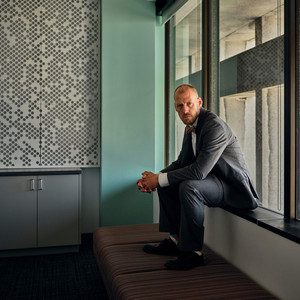
The office belongs to a guy named Noah Cox.
He's a lawyer in the L.A.
County Public Defender's Office.
I met him there at his office.
And on the walls, he has all these photos of people he has represented.
So this is a client of mine.
He'd had some really challenging experiences. periods of his life.
He pointed to a picture of some men in hard hats posing against the wall.
Cox's client is in the back.
He's leaning into the photo to make sure he's seen.
He's holding up a power tool like it's a prized possession.
And this is a photo of him at his first day at work.
And he's got a big grin on his face.
And you can't really tell which of the people in this photo is my client.
And I think that's part of the thing I love about this is that when he's successful, you wouldn't know him from anybody else.
So these photos are basically like little success stories tacked to his wall.
Cox says they motivate him to keep doing this work and meeting with clients where they're at and helping them get to a more stable place.
They're also evidence of the specific work Cox has focused on for the last few years.
It all started Aisha, after he noticed something unusual about many of the clients coming into his office.
They were accused of a crime and needing a lawyer.
I wanted to know their story. their account of what happened and I'd ask them questions.
And many of them would struggle with a basic explanation.
And it wouldn't even be on significant questions such as, did they do it or not?
It would just be like, where were you that day?
It seemed like they were having challenges related to some sort of intellectual ability.
So these clients were there for the same reason anyone comes into a public defender's office, right?
They had been charged with a crime and they couldn't pay for their own lawyer.
So I mean they're already in this position.
That's not great, because they're facing criminal charges and they don't have the money or the resources to get a private attorney.
Exactly.
And Cox realized that they needed interventions beyond legal representation.
It seemed clear that there was a tremendous number of these individuals, but it also became clear that not enough work had been done to identify these people, to recognize their problems.
So we set about to try and figure all this out.
What Noah Cox and his team figured out, it's pretty unusual.
They created a new unit at the Los Angeles County Public Defender's Office dedicated to representing people with cognitive disorders.
We'll be right back.
This message comes from BetterHelp.
President Fernando Madeira shares BetterHelp's commitment to expanding access to therapy.
Our State of Stigma report helped us understand that believing in mental health is easy, but asking for help is not.
Now, with the report on our hands, we can work to make mental health care more accessible to.
To get matched with a therapist, visit BetterHelpcom.
Slash NPR for 10 off your first month.
Support for NPR and the following message come from Warby Parker, the one-stop shop for all your vision needs.
They offer expertly crafted prescription eyewear plus contacts, eye exams and more, for everything you need to see.
Visit your nearest Warby Parker store or head to WarbyParker.com.
This message comes from Carvana.
Finance and buy your next vehicle with Carvana.
Shop a huge selection, customize terms to fit your budget and buy completely online.
No hassle, no pressure.
Get the car you love the easy way with Carvana.
This is a Sunday story.
I'm joined today by Meg Anderson, who covers criminal justice for NPR.
Meg is bringing us a story about this pioneering effort to address cognitive disabilities among people in the criminal justice system.
So Meg, before we get back to the public defender's office in Los Angeles County, I want to understand what Noah Cox was seeing in some of these people he was representing in court.
Like, what does it mean to have cognitive impairments?
Yeah, so the term can definitely feel a little squishy.
And actually Cox was seeing a pretty broad swath of conditions, because all kinds of things can cause an impairment to your cognition or your brain's ability to learn and understand.
You could have had a stroke or a traumatic brain injury or be suffering from dementia.
And then there are disabilities that start at birth or in childhood.
Those are called developmental disabilities, and some of them can affect your cognition too.
That would be things like fetal alcohol syndrome, Down syndrome or an intellectual disability which limits a person's intelligence or their ability to reason, problem solve, do everyday tasks.
Cox has seen pretty much all of these.
So for this story, we're talking about basically any condition that affects brain functioning, because those conditions are often the ones that make someone worse off when it comes to navigating the legal system.
You know, I've had some instances in my personal life where I could definitely see how having a cognitive impairment or having something going on with your brain could certainly put you in contact with the criminal justice system.
It seems like if you're not thinking clearly and maybe you don't have resources, you could easily come in contact with the police.
Am I right about that?
Totally.
And I want to point you to two statistics that I think are really illuminating on that point.
So first, according to a survey by the Federal Bureau of Justice Statistics, people in state and federal prisons are more than twice as likely to report having any disability compared to the general population.
But the most common disability they report is a cognitive one.
Other studies point to that overrepresentation, too.
And then the second one is that people with disabilities are also more than twice as likely to become the victims of violent crimes compared to the general population.
Again, people with cognitive disabilities are the most at risk there, too.
Those numbers also come from the federal government.
And that's really important to point out, because I think that's something that a lot of people don't realize is that people with cognitive disabilities
You're saying they're both convicted of crimes, but they are also the victims of crime.
Yeah.
And so I talked with Leanne McKinsley about that.
She works on criminal justice issues at The Arc.
That's a nonprofit that advocates specifically for people with intellectual and developmental disabilities.
And she says cognitive disabilities, you know, especially when they're not severe, can be invisible at first.
Often the disability goes unrecognized.
They could have gone through their school system, not ever really passing much, but it never got documented.
So it either goes unrecognized or even just kind of dismissed as irrelevant.
And so, without intervention and support, it can be easy for people with these invisible disabilities to fall through the cracks.
They might have trouble understanding who's a friend, who isn't using good judgment if they're in a bad situation.
They can be highly suggestible.
That makes them vulnerable to being taken advantage of, right, to becoming a victim of a crime.
And I would think that that also goes the other way as well, right?
Yeah, those same challenges can get a person in trouble.
They can fall in with the wrong crowd.
They might have trouble holding down a job.
And I should note that poverty can play a big role here too.
Diagnosing a disability can be time-consuming and costly and not everyone has the resources to navigate that or know how to advocate for someone who needs more support.
Here's McKinsley again.
There are intersections, of course, with poverty because when you're looking at...
A person with disabilities who may have not been able to have access to getting the services that they need early on.
That can just increase the situation with time.
So then that person grows up, right?
And then you know, if they do end up getting in trouble or going to jail or prison, even more issues can arise.
They go into a system that doesn't address their disability, they'll probably come out much worse and probably more likely to commit more crime or get involved with people that will.
I mean, it just sounds like a vicious cycle.
And I guess that brings us back to the public defender you talked to, Noah Cox.
Yeah, that's right.
So Cox was seeing this play out, right?
People coming in accused of a crime needing a lawyer and a lot more support than what they were getting right.
So what did he end up doing?
Well, after years of noticing this, he established a team in 2021 within the public defender's office.
It's set up specifically to work with people in need of a public defender who have some sort of cognitive impairment.
As far as Cox knows, and as far as I could find, it's the only team of its kind in the entire country.
Officially, it's made up of Cox and two social workers.
There are other lawyers who volunteer their time supporting the team unofficially.
And then there's also a rotating group of law clerks and interns.
Cox told me many of them are college age and unpaid doing what amounts to full time work.
I mean.
So I mean, it sounds like a scrappy team that's trying to to do a lot with not a whole lot.
You know, to do a lot with a little, I guess.
Yeah, that's exactly right.
Part of that is that they don't have a separate budget for this work.
So the team was created by reallocating resources and shifting priorities.
So they do get creative where they can and they rely on people who are willing to do more, like you said, with less.
So what do they actually do?
Yeah, so basically the team operates in two phases.
First, they have a referral system so that public defenders in LA who think their clients might have a cognitive impairment can alert them.
And then Cox and his team get these clients some initial testing, which is done also for free by local graduate students.
When we come back the story of one criminal defendant who went through that cognitive testing and what happened next.
I didn't realize what was wrong with me.
I wasn't a bad person.
I just made bad decisions.
This message comes from Lisa.
From night one, you'll feel the difference.
Premium materials that deliver serious comfort and full body support.
Go to Lisa.com for 25% off mattresses, plus get an extra $50 off with promo code NPR.
Support for this podcast and the following message come from Strawberry.me.
Be honest.
Are you happy with your job?
Are you stuck in a job you've outgrown or never wanted in the first place?
Are your reasons for staying really just excuses for not leaving?
Let a career coach from Strawberry.me help you get unstuck.
Discover the benefits of having a dedicated career coach in your corner and get 50 off your first coaching session at strawberryme slash, NPR.
This is Ira Glass.
On This American Life, one thing we like is a good mystery.
Sometimes about really big things, but most times, the little mysteries are the best.
Our Lost and Found is currently filled with pants.
I don't know.
I've never seen this happen.
This is true?
This is true.
Mysteries of every size, each week, This American Life, wherever you get your podcasts.
We're back with a Sunday story, hearing about an innovative program to try to identify and help criminal defendants with cognitive impairments.
So Meg, tell me what happens once a person is identified.
Yeah, so I think the best way to explain what happens next is to tell you about a man named Jimmy.
So first, we are not using his last name, because he and his family are worried about the stigma of his criminal record.
I met him in Ladera Park in Los Angeles this fall, and he was very energetic.
Almost right away, he wanted to show me his workout routine.
I do my push-ups right here.
Jimmy is 56 years old.
He was born and raised in East L.A.
So I got to work out, you know, because I got to focus my energy, because if not I go haywire, you know.
He's small and wiry, with tattoos on his neck, and he has glasses that are a little too big for his face.
And for as long as he can remember he's been getting in trouble right with his family, with his teachers, with the police.
I got arrested a lot.
I was constantly getting arrested since I was a little kid.
I wasn't a bad person.
I just made bad decisions, you know?
He has been homeless at times and struggled with drug abuse, and he has been in and out of prison most of his life, mostly for possessions of drugs and theft, but also for some really serious crimes, including sexual assault and robbery.
It was just, it was a revolving door, man.
I can't It's like I would take two steps forward and then back down another three steps, you know?
It was just a lot of problems with the way that I lived my life, you know?
The way that things went down in my life.
Noah Cox remembers the first time Jimmy came to his office in late 2021.
He was there on a residential burglary charge.
It was his third strike, meaning he already had two violent felonies on his record.
So now he could face a much harsher sentence, 25 years to life in prison.
So there was a lot on the line for him that day.
And Cox says he introduced himself to Jimmy the way he introduces himself to all his clients.
My name is Noah Cox.
I'm your lawyer.
And as your lawyer, I have two and only two responsibilities.
The first responsibility is to help you get the best possible outcome on your case.
And the second responsibility I have is to help you understand everything along the way.
And so the law sets up attorney-client confidentiality, so that You know everything you and I talk about is a secret and it's your secret.
It's not my secret.
So I can't tell anyone.
I can't tell the judge.
I can't tell the prosecutor.
I can't tell your mother and I can't tell my mother.
And that's set up, so that you can feel comfortable saying I did it and I need help, or I didn't do it and I need help.
And then Cox says Jimmy started talking about his case.
He was trying very hard to tell me something that was very important to him, but I could not understand what he was trying to say.
This sounds like what Cox was describing earlier, where he has this person in his office who he's supposed to be representing, but that person can't really express themselves.
Yeah, that's exactly right.
But by the time Jimmy came into his office, Cox had a plan.
Jimmy went through that initial testing, which did indicate a cognitive impairment.
And this is where things get a little more formal.
With that initial testing in hand, Cox asked the judge in Jimmy's burglary case to appoint a neuropsychologist to evaluate him.
Those tests indicated that Jimmy had weak memory skills and weak executive functioning skills.
Those help a person make plans, solve problems, manage time.
And his IQ score indicated a significant limitation in his intellectual functioning.
So he was ultimately diagnosed with an intellectual disability.
So once that happened, what happened to Jimmy's case?
What did Cox's team do?
So this is where phase two happens making the argument before a judge that Jimmy's crime, and really his life of crime, was related to his cognitive impairments and that, with the right support, he would be able to live a life where he follows the law.
In Jimmy's case, Cox and his team believed that an alternative to prison, sometimes known as diversion, would be a better fit.
And part of making that argument convincing to a judge is laying out a clear plan for what that support would look like.
Well, I mean, that makes sense.
I mean, I would think if you're a judge, it would be easier to agree to someone not going to prison if you have this alternative plan in place so that they don't commit any more crimes.
Yeah.
And so for Jimmy, the team wanted to show that he was eligible for California's regional centers.
Those are a network of support services specifically for people with developmental disabilities.
So when you say that with developmental disabilities, that means you've had that disability since childhood.
Yeah, that's right.
So basically the defense team wanted to show that Jimmy had always had his disability.
So they gathered as many records as they could and they interviewed Jimmy's family to get a sense of his childhood, including his older sister, Sylvia.
We're also not using her last name since it's the same as Jimmy's.
So Jimmy likes, he has a light personality where he loves to have fun.
He has a good sense of humor.
He jokes a lot.
That's him on a good day.
Sylvia has a strained relationship with her brother.
She and her sister help him where they can, but they don't always trust him.
She says they had a rough childhood.
We did grow up in an abusive household.
My father was very abusive.
It manifested in different ways in each one of us.
It's impossible to know how that abuse contributed to Jimmy's ability to function in the world or how it contributed to his serious mental health problems, which he also has.
But Sylvia says as long as she can remember, her brother has struggled.
Jimmy, he's 56 years old.
He's never held a job in his life, and he doesn't know how to function like a normal adult anymore.
She always knew something was different about her brother.
He was late to crawl, late to speak.
He couldn't do his paper route on his own.
He couldn't remember how to adjust the water temperature in the bathtub.
He struggled a lot in school.
And Sylvia says Jimmy started getting in trouble with the police before he even hit his teen years.
It makes me feel bad for him that he didn't get any extra support and he was labeled as bad and that's it.
I think it was a self-fulfilling prophecy for him.
The more he was labeled bad, I think the more he became bad.
Sylvia told all of this to Cox's team during the course of several interviews.
She spent hours talking on the phone with them, and so did her mother and sister.
And after all those interviews, Cox's team submitted an application to those regional centers in California.
They argued that Jimmy had had a disability since childhood and that he was in fact eligible for the state's services.
How important was this piece of it, like him getting accepted to those regional centers?
Being eligible would be a big deal.
These centers are taxpayer funded.
And once you're eligible, you're eligible for life.
The state eventually agreed.
And because of that the judge and prosecutor agreed as well to get him diversion in his burglary case.
And all of that took more than three years.
Jimmy was in jail that whole time.
It's very unusual for somebody who's 50 years old or older to be accepted by a regional center at that age, because we have to prove retrospectively that this condition existed 30 or more years ago.
But ultimately regional center, he said, yes.
Uh, I started crying.
I was so happy.
Um, Because here's a person who had been under-supported and not been given the things he needed to succeed for his whole life.
So what kind of support does Jimmy now have from the state?
The regional center found him a group home to live in where he has supervision all day long.
He's also now getting mental health treatment and substance abuse counseling.
And he goes to a behavior management day program five days a week.
All of this is happening in place of prison.
But he has to follow this plan going to that day program, going to his appointments, staying sober, not committing any new crimes and a whole slew of other commitments for two years.
Or he may face prosecution for his crimes and go to prison.
And again, he was facing 25 years to life because it was a third strike.
So he had been in some, you know, serious trouble before.
I would imagine that there are critics of these diversion programs who say look, if these people have committed real harm, you know they shouldn't be allowed to go to a diversion program.
They need to face punishment.
Yeah.
And it's true that Jimmy has done a lot of harm in his community.
I talked to Lisa Dugard about that.
She co-leads Purpose Dignity Action, or PDA, which designs community-based responses to public safety programs.
She's a leading thinker in the country in what makes diversion programs successful.
And she says they often operate on the premise that incarceration makes people worse than when they went in, but that that can seem to some people like leniency.
We have all been raised in an environment that teaches that negative consequences are what we do when we take a problem seriously.
That accountability means threatening someone with adverse consequences.
So doing it differently codes as minimizing the harm, right?
Minimizing the problem.
So she wasn't familiar with the L.A. program until I told her about it.
But her initial impression was that it sounds like good, thorough defense work.
But she says by the time someone needs a public defender, it's often too late, right?
The harm has already been done.
Dugard says the earlier someone can take an exit ramp off the road to prison, the better.
Well, so just thinking more broadly, what were her thoughts on what makes a diversion program successful?
So first, there are many different kinds of diversion programs around the country.
They all do things a little differently.
They serve different people veterans, people with mental illness, people with substance abuse issues.
There's good evidence that diversion programs can help people and can reduce the chances that someone commits a new crime, especially when they focus on young people.
But there are also stories of failure, where someone was given diversion but went on to commit a new crime.
So Dugard says doing these programs right is really hard work.
Often these efforts do fail and they're not designed really to catch the person in their real complexity and they don't reckon with the extent of the challenges that person is bringing.
And so they do fail.
You know, many skeptics become skeptics because they've seen these programs play out in ways that were really disappointing.
The person goes on to commit more crimes, for instance.
So then, like, how do you do it right?
Dugard says, the first thing that needs to happen is that whoever is experiencing the problem, the problematic behavior, right the victims or the witnesses of the assault, the robbery, whatever it may be they need to feel like there's no longer a threat.
That's what traditionally putting someone in jail does.
And so if you're not doing that, Dugard says the alternative has to be good.
It isn't better just because it's happening outside of the legal system.
And so if what we do is poor, then pretty soon society is just going to say well, that was a nice idea.
But actually it turns out that putting people in jail is the only thing that really quote unquote works.
It's important to note there are high rates of recidivism for those who receive routine prosecution and punishment.
Basically, jail is a very imperfect solution.
Still, Dugard says the alternative to prison has to actually help the person who committed the crime get to a place where they won't commit another one.
The design of the program really matters.
She says you have to get at underlying issues.
That could be drug use, mental illness, an undiagnosed disability, some combination or something else.
And in the case of Jimmy, it was all of those things.
Yeah, that's right.
And Dugard says to tackle that right, there are four main pillars to helping someone get to that better place.
You get them a safe place to live.
You get them access to health care.
You help them build connections to other people.
And you help them find hope or meaning in their lives.
I mean, all of that sounds like it takes a lot of time and money and resources to really do that.
It absolutely does.
Take this team in L.A., right?
They're operating on a shoestring budget and, in general, public defenders are already really overworked.
It can be hard for agencies for lawyers to make the case right.
Pun intended for all these resources.
But when a person is given support right and actually gets better, advocates of these programs say you can actually close that revolving prison door for good.
And they say in the long run, that's actually cheaper for society.
Dugard says, if you do all that, you can have unexpected allies right like police and prosecutors, even victims who often just don't want whatever happened to them to happen to anyone else.
So in Los Angeles, how do we know if the program there is working?
Well, so far we don't.
The team says that they have provided consultation and assessments in more than 500 legal cases.
And they have represented more than 30 people who were facing felony charges and who were granted diversion.
But it's hard to define what success would even be, right?
Is it that someone never commits another crime?
Do probation violations count as a failure?
How about misdemeanors?
And the team is also only a few years old, so it's too early to know if it will have lasting results for the people they've represented.
And that's true for Jimmy, too.
He's only about halfway through that two-year diversion.
Well, so how is Jimmy doing?
I checked in with him this fall.
Progress has not been linear.
The court has been monitoring Jimmy more closely in recent months because he wasn't regularly taking his medications.
But his days are looking a lot different than they used to.
He attends his day program.
He goes to therapy sessions.
He lives in a group home with other adults with disabilities.
I asked him what he thought would have happened had he not gotten diversion.
I would have went back to prison.
I would have been thrown away just like all the times.
You just feel useless like that.
He says these days he feels happy and calm.
All I can say is that it offers more than prison has to offer or the penitentiary has to offer me.
You know, because I've just changed my life completely.
It's impacted my life to the point where, you know what?
I don't even use drugs anymore.
I'm not homeless anymore.
I'm not frustrated anymore.
I'm just, I traded in my life for a new one.
So now, you know, with a lot of support, he's viewing his life as a clean slate.
Well, Meg, thank you so much for bringing us this reporting.
You're so welcome.
Thank you.
That was Meg Anderson, a criminal justice correspondent with NPR's National Desk.
This episode of the Sunday Story was produced by Andrew Mambo and edited by Jenny Schmidt.
It was fact-checked by Nicolette Kahn.
The engineer for this episode was Robert Rodriguez.
The rest of the Sunday Story team includes Justine Yan and Liana Simstrom.
Irene Noguchi is our executive producer.
I'm Aisha Roscoe.
Up First is back tomorrow with all the news you need to start your week.
Until then, have a great rest of your weekend.
This message comes from Betterment.
Their automated investing and saving tools give you the quiet confidence of someone who knows where to put their money, with tax smart tools that help grow your after-tax returns year-round.
Get started today at Betterment.com.
That's B-E-T-T-E-R-M-E-N-T dot com.
Investing involves risk.
Performance not guaranteed.
Betterment is not a tax advisor, nor should any information herein be considered tax advice.
Please consult a qualified tax professional.
This message comes from Odoo.
Some say Odoo business management software is like fertilizer for businesses because it promotes growth.
Others say Odoo is like a magic beanstalk because it scales with you and is magically affordable.
And some describe Odoo's programs as building blocks for creating a custom software suite.
But some say Odoo is fertilizer magic beanstalk building blocks for business.
Odoo, exactly what a business needs.
Sign up at Odoo.com.
That's O-D-O-O dot com.