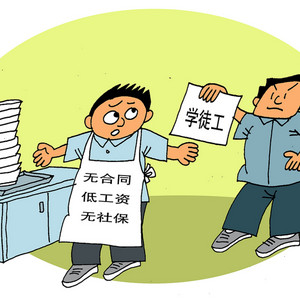
They call them apprentices, but are they trainees, workers, or something in between?
From busy milk tea shops to high-tech manufacturing, the line behind genuine training and cheap labor is sometimes blurred.
Join us as we expose the realities behind today's apprenticeships and ask, how can we protect the vital talent driving skilled labor in an economy hungry for a skill upgrade?
Coming to you live from Beijing, this is Roundtable.
I'm He Yang. For today's program, I'm joined by Steve Hatherley and Li Yi in the studio.
First on today's show, from the stages of Peking opera and crosstalk or Xiangsheng in Chinese to the delicate hands of embroidery and wood carving masters, traditional Chinese apprenticeships or Xue Tu Zhi were built on hierarchy, discipline, and at times, exploitation. fast forward to today apprenticeships have found new life in the hospitality and manufacturing industries from restaurants to hair salons to welding smart manufacturing and electric vehicle repair but here's the catch some employers are using the apprentice title to dodge labor contracts When does training cross the line into cheap labor?
And how can we make sure today's apprentices or 学徒 get the protection they deserve?
So let's go to you first, Li Yi. Please cite some notable legal cases recently that highlight the misuse or violation of apprenticeship arrangements in China.
Sure. There was this case that actually leads to some important discussions about apprenticeship and also their labor rights.
For example, there was this young job seeker surnamed Pan in eastern China's Jiangsu province.
In December 2023, she applied for a tea making position at a local chain milk tea shop.
And after the interview and also this trial shift, the shop owner just told her to officially start work the next day and also sent her a daily roaster.
And also Pan was added to a staff group chat where rules about attendance, checking, phone use, and also daily duties were posted and shared.
And from then on, she just followed the regular shifts and was paid monthly through WeChat.
But one problem is that the shop has never signed a labor contract with this girl Pan.
And in May 2024, so that's about five or six months later, after she resigned, she realized that her rights might have been violated because no labor contract was signed.
So she took the shop owner to court and also asked for double wage compensation for the lack of written contract.
And the funny thing is that in court, the shop owner argued that the pen wasn't really a formal employee and she was just an apprentice.
So the contract would only be signed after the apprentice passed the six-month training period.
And also the shop owner claimed that pen and also other apprentices were pretty flexible in terms of the way they work.
They don't really follow the rules of formal employees and they are not really paid for and they are paid based on their working hours.
But the thing is that the court, of course, reviewed all the details and also checked those WeChat group chats and found that Penn was actually a de facto employee, meaning that she was involved in key working tasks every day and she was paid regularly.
And she was also clearly under the management of the milk tea shop.
So that's why the court also ruled that this is a de facto employment relationship.
And this is where it gets... kind of into the gray area between employers and employees, right?
And that's why we need these types of clear regulations.
But if we look at the law specifically, this is from Article 82 of China's labor contract law.
If an employer fails to sign a labor contract after one month of employment, then it must pay double wages.
So in this particular case, the court ordered the milk tea shop to pay Ms.
Pan the wage difference for the period from January to May of that year.
And the court also clarified that even if someone is called an apprentice, even if that's their title officially, an employment relationship still exists as long as they are under the employer's management, as long as they are performing core business tasks, like in this case making milk tea, and also receiving regular pay.
If all those criteria are met, that constitutes that de facto employment relationship.
Exactly. And the Pence case is not really the only case in terms of how people maybe define the definition of apprenticeship in a different way.
For example, there's another girl named Xiaolan.
She joined a hair salon where she earned a base salary plus commission, and she worked nearly 11 hours daily and also used an attendance app.
And the company claimed she was a trainee and also gave her not only and gave her only a stipend, meaning that amount of money that is usually paid for those who work for training and that is usually unpaid, I guess.
So based on attendance and also leave records, her involvement in court attacks like dying and perming and regular payments, a local court in Shandong wrote that the labor relation existed in order the company to pay the double wage compensation.
And in another case, There was a girl surnamed Zhu who signed a training agreement with a nail salon.
The training period lasted for 90 days. And in reality, she reported to a manager and followed the assigned schedules and was paid monthly.
So a local court in Guangdong concluded that Zhu was under labor management and performed paid services and that these tasks were part of the business.
So the court ruled that the training of women did not really change the nature of the labor relation.
And also court ordered the salon to pay which differences?
Double compensation. Starting to sound like a court podcast all of a sudden.
But we see in all of these cases, I feel like the narrator on a court podcast.
We see in all of these cases that regardless of what the employer thought of the relationship, regardless of the... tag of apprentice, the court saw things differently because of the established relationship between the employee and the employer.
And there's also the construction industry that sees apprenticeship very common as well and there was this similar classic court case of a violation of labor rights basically and then without a labor contract the apprentice individual might have thought oh I might just have to walk away tail between legs and not receive the compensation when that is, in fact, their legal right to actually claim the money that they're entitled, regardless of the apprentice or trainee label that they hold for the beginning of their jobs.
And as we were doing research on this topic, it just made me realize that the apprentice slash trainee period, it actually, or actually this apprenticeship, it happens more prevalent in different industries than I assumed.
If we can really sort of broaden the discussion a little bit just for this moment.
I remember when we started out in the journalism job, we Well, you had to follow.
You'd be really lucky if you followed a veteran journalist who would show you the ropes.
I was very lucky to have followed the guidance of a fellow radio announcer.
And she helped me in understanding how to use the mic, how to write reports, etc.
How do you conduct your business with your interviewee and establish confidence when you're just a newbie in the field and you don't really know how things work?
So that was cool. Do you have her number?
I need one of those. Yeah, she no longer works here, unfortunately, but it's cool.
So the part that I didn't have to worry about, though, was because I signed a labor contract early on, and there was a trainee period, which I knew I would be paid less than a full-time regular employee, but this will... uh this situation will improve after x amount of months etc but when it comes to more like manual labor jobs and in different industries that involve working with your knowledge and hands this kind of apprenticeship is particularly important because in those industries as we've kind of insinuated here the written labor contract isn't always signed and also in those areas it's particularly important when you have a master or someone of a mentor who can actually teach you how to connect the dots connect the things um in this um on the job And when it's skilled labor involved.
So this is also, I think, a big piece of the labor market puzzle of China.
This type of conversation for us to have right now is an important one because I think it's an easy mistake.
I don't know if mistake is the right word, but when someone enters into the job market and they're offered an apprenticeship, And I think this is probably universal.
The last thing on their mind at that moment is, I better know what my rights are so that they're protected.
They're excited probably, right? They're entering into the market.
They're learning their new skills. And that's probably something that they're unaware of.
But a shout out to these people from these different cases that we were talking about because they stood up for themselves and they didn't do anything wrong there.
They were going after their legal rights and they were granted their legal rights.
So again, that's why it's important for, and it's important for employers obviously too, but for employees, for apprentices to know exactly what they are entitled to.
Yeah, I agree. I think young people are more vulnerable in terms of these scenarios, because as Steve said, many of them, they just received their first jobs and maybe first internships.
And I believe that most of them are pretty hesitant to speak up, even though they feel something is wrong, because they might fear that I might just lose this opportunity that I've strived for for a long time.
So do I really need to speak up? for those little details, maybe not.
So that's why I think this discussion is so important to inspire people that you can speak up if you feel like your rights have been violated.
And the most important thing is that I think here a very tricky question is that what's the difference between apprentice and employee, right?
Because it seems that in those previous cases, those employers claim that they just treat those young people as apprentices.
But in reality, they're doing the same role or they're doing the same work as a former employee.
So when you look at those court ruling, they're also looking at details.
I mean, what's the difference between apprentice and employee?
Because when you think about apprentice, it should be someone who has very limited responsibilities.
They might not really, you know, be handed with very important tasks because they're just under that whole training process, right?
That's interesting because I think, at least in Chinese, there could be two understandings to the idea of 学徒 or apprentice.
And I'm really curious, Steve, what you think about this in the English speaking context.
So what a lot of this, a lot of these legal cases, they're essentially talking about the treatment, the financial remuneration for an employee or not, but this in the trainee period.
So how long should the trainee period or apprentice period be?
The loss is a month. And anything after that, well, you need to look at the contract and pay double if you violated that employment relationship.
And So that's one thing. But there could be another understanding in Chinese when we look at this about 学徒, that is about this apprenticeship relationship that could go far longer.
You're learning from a mature employee or a master, and it takes maybe a year or longer to learn how exactly to repair this electric vehicle to understand smart manufacturing or let's say wielding or some of these parts of works in construction that takes more than a few months to really perfect the skills and you learn from one person or you learn from a group of people in that company so these are kind of two different ways of establishing what apprentice could be and you also said when we started today that the traditional Chinese apprenticeships were built on hierarchy and discipline and perhaps exploitation at the same time.
Right. But that implies to me that historically you have your master, right?
And that training, you know, labor laws, you know, thousands of years ago, but that relationship could exist for a very long time and you're handing down knowledge, right?
So there's that respect factor. But when it comes to 2025, then it doesn't matter about respect and hierarchy and those types of things.
The issue here is the nature of the work and how long the work goes on for, not the title that the employer uses to call it. blueberry tree if you wanted to.
And it makes absolutely no difference. I don't know where that came from, but it makes absolutely no difference.
My point is that it's in the work, it's not in the title or the relationship.
Yes, exactly. And I think when we look at this question, we can refer to some professional explanation, because according to a lawyer named Zhuang Yu from a legal aid center in Nanjing, there are actually several criteria or standards we can refer to when you try to identify whether this labor relation existed or not.
First one, whether the worker is under management and supervision, like whether they are involved in attendance checks and whether they are asked for leaves and whether there is a working schedule for them.
And the second one is whether the work the worker does is part of the business operations.
Like I said, maybe for apprentices, they might not really be involved in so many daily operations because they are learning, they are practicing.
But for an employee, obviously, they are being involved in daily working routines.
The last thing is that whether the worker relies on the employer for their main source of income.
So these are three major standards we try to refer to to identify labor relations.
So like Steve said, it does not really matter how employers claim or name their employee as long as their relation works in this ways.
And this is an official labor relation. That means a working contract need to be signed and the labor rights need to be protected.
And it makes things clear, doesn't it? Yeah, it makes things really clear.
And the cases that you talked about before, Lee, all of those things were met, weren't they?
All of those three stipulations that you met, and that's why they all won in their court cases.
Side note, blueberries grow on a bush, not a tree.
That just occurred to me before somebody emails our show and says, you're wrong, Steve.
Yeah, so having these types of definitions in place... is really great for employees and it's great for employers too.
And I don't know, I think we need to say this as well is that I think it's quite, um possible that employers might not understand the situation very clearly either right they might think that they're not doing anything wrong and then come to find out that that they were exactly and also yeah and also on the case we are referring to our i mean the majority of those shops are pretty small scale like milk tea shop paris salon which might just be private owned So for a lot of like small shop owners, they might not really be aware of these very clear legal conditions.
And they might think that I'm just giving this person an opportunity.
So it doesn't really matter whether I try to sign a labor contract with that person or not.
And they might think that. you know what apprenticeship or the labor contract these are only things of for big companies and another things that they might they might also try to save costs as well by you know bypassing this process because if you decide to sign labor contract with this person that means as a shop owner you have to cover the social insurance and medical insurance everything related so that could also be a reason for shop owners or business owners to bypass this process.
That's a very good point. And also we see that for employers, however big or small, often I think they're deciding the trainee period on very arbitrary terms.
It could be three months, it could be six months or nine months or whatever it is.
And now with the law on your side, trainee or apprentice.
Now, I guess the takeaway here is that we all need to understand the labor contract law a little bit better to protect our rights.
And modern apprenticeships could be a powerful tool for growing skilled talent. what China very much needs.
What would a truly effective apprenticeship system look like in today's China?
One that balances efficiency, innovation, and protection?
Well, we can have a look at how the apprentice system empowers skilled talent development.
Exactly. So recent years, there are more discussion about this whole apprenticeship system.
And when we talk about the modern apprenticeship system here in China, it's usually related to vocational education, because here in China, it's more like a talent program. cultivation model that actually combines traditional hands-on training with school education.
I think this policy or the system was first introduced in China in 2014 to really help young people to learn both theory in the classroom and then practical skills on the job.
And schools and companies, they just work together to train so young talents are better prepared for real-world careers.
And in recent years, national legislatures and policy advisors handed in motions and proposals in March 2025 on further improving this apprenticeship system at the two session meetings.
They propose to improve support and evaluation systems and establish a coordinated enterprise school training mechanism to really develop a better system.
And I think nowadays we have more examples of cooperation between schools and enterprises.
And we call it as a new type apprenticeship system, which includes two main models.
The first one is usually led by educational authorities.
But one thing is that it can also be constrained by poor communication and poor cooperation between schools and enterprises because schools, I mean, their main goal, of course, is to cultivate talents and they want to teach young people skills.
But meantime, enterprises, they value profits and interest or the process of making money more.
So that's why in reality, these kind of projects or policies are usually hindered.
And the second, there's another type of apprenticeship system, which is enterprise-based apprenticeship. which is usually led by the human resources and the social security departments.
It's an upgraded version of the traditional model with enterprises as the main body and public policy incentives, mobilizing various resources.
And particularly in 2021, I want to refer that Several departments here in China, they issued a policy to fully implement a model apprenticeship system.
The goal, of course, is to train more skilled workers.
And one thing that deserves to stand out is that there are subsidies being offered to those companies who offer those apprenticeship training systems.
So for each this apprentice, the company can receive an annual subsidy of up to 5,000 yuan, that's nearly 700 US dollars.
So I think it's really good to motivate this willingness to provide more this training programs coming from the enterprises as well.
Yeah, it's a new type of apprenticeship system, isn't it?
It's collaboration with enterprises and vocational schools and training institutions and apprentices and mentors, where, again, traditionally, you know, here in China, you might have had a master, like a mentor, and that relationship would be one-on-one, right?
And that really kind of simplifies things.
So when you have all of these institutions involved, it complicates things, but that's what makes the need... for an organized system all the more necessary, right?
So that's one of the big challenges there.
And then you have to have effective integration between the two training models that Lee just mentioned as well.
If you don't, then it's gonna lead to resource waste, it's gonna lead to some pretty inconsistent standards, I would think as well.
So this modern apprenticeship system, It has to be a big collaboration with everyone involved because you have to treat the schools and the enterprises like training grounds for these apprentices.
Yeah, and that's why establishing that partnership between the enterprises or companies or factories with the vocational trade schools can be quite important.
And a couple of weeks ago, we had this big discussion about how vocational education has evolved in China in 2025, and we saw that there were better programs, more targeted programs being offered to students who want to take up vocational skills as opposed to going the traditional maybe higher education route and even some college graduates decided after graduation to take up another year in vocational education, which really shocked a lot of people.
But this shows that in China, in our current workforce, there is a dire need, a gap to be fulfilled of skilled labor and those who have the ability to work the computers as well as working their hands.
And if you have the skill and knowledge in these both two areas, then I bet there's a pretty bright future for you.
When done right, apprenticeships can be a win-win, offering structured learning and also steady income.
Because when you're an apprentice, you're already on the job.
So although you might not be getting the full wage, but you're getting a you're getting money already.
You're on the path to the full wage. Absolutely.
And that is great for a young person. And of course, getting the industry recognized credentials is another plus, but low starting wages.
And I suppose sometimes the labor contract treatment remain barriers that need active support.
And guys, what lessons can China take from international models to make this apprenticeship system more protective professional and possibly appealing um i looked at the united states it's called the fitzgerald act and it goes back way way way back i think it was the 1930s when that was established it's also known as the national apprenticeship act and it's officially authorized and established um the national apprenticeship system And that act gave the U.S.
Secretary of Labor authority over apprenticeship programs.
And it also established an office of apprenticeship within the U.S.
Department of Labor. And it provided for the recognition of state agencies to register and administer apprenticeship programs.
There are a lot of states and districts that have recognized these apprenticeship operations.
And in the other states where it's not, that's where the Department of Labor administers apprenticeship.
And all that means is that there are a lot of occupations that are recognized as apprenticeable, if that's a word, and occupations that are continually being added to the list.
And it's things like construction and manufacturing and transportation and healthcare and finance and hospitality and all these different industries.
But the registered apprenticeship program, it allows and energizes, I think, more employers to participate and provide them access to a larger pool of talent that have been trained really well for entry-level to management positions.
And the programs include... industry vetted and an improvement to ensure alignment with industry standards, paid jobs, structured on the job learning and mentorship programs, supplemental education where they have classroom education, classroom hours based on the employer's training needs, whatever that company or industry happens to be.
And then there's credentials where you can earn kind of a portable nationally recognized credential within their industry.
And the programs are really popular. In May of this year, the registered apprenticeship programs enrolled about 940,000 people for the fiscal year 2024.
So it's a very well it's got a long history.
It's very well organized. It's very clearly laid out in terms of the agreements between industry and schools.
So it seems like a pretty, pretty solid system.
And also Germany is another country that we also refer to when it comes to vocational education or apprenticeship program because the country is often held up as the global golden standard for its vocational education because of its dual system combining classroom learning with apprenticeships in real workplaces.
And this close collaboration between industry and education has really helped the country maintain its highly skilled workforce and also low youth employment and strong manufacturing sectors.
And someone said, well, some experts said that China is also looking at similar industry education integration models of Germany when it comes to its own vocational education system.
And also we have to mention that actually traditionally those Germany companies in vehicle or manufacturing sectors, they can offer a long term apprenticeship system.
The reason is that they remain their high interest.
So that's why I think it's really important to see, you know, more policies like what we mentioned earlier, coming from the official side, that we are offering more incentives or subsidies for companies to encourage their willingness to provide such programs.
And in the meantime, I think especially in a time full of uncertainties, maybe there's a changing mindset or perception among young people.
They also want to learn a skill that they can rely on for a long time.
And maybe this, you know, a more well-established apprenticeship system can also help to maybe improve the need of China's need for skilled workforce as well.
Certainly. Around the world, apprenticeships serve as gateways to skilled careers.
But the best systems don't just teach skills, they safeguard legal rights.
As China builds its modern apprenticeship model, there's a valuable chance to learn from international successes and missteps alike.
Done right, it could become a powerful driver of talent development across manufacturing, construction, hospitality, and other industries.