It's the book club for kids.
The book club for kids.
It's the book club for kids.
It's the book club for kids podcast.
Hi, I'm Kitty Felde.
Today we consider what it takes to build a perfect community.
I think a perfect community would be houses that are well spread apart.
Because if houses are too close, then you're going to have neighbor problems.
Our readers are from Belvedere Elementary in Virginia and they have a long list of requirements for future developers.
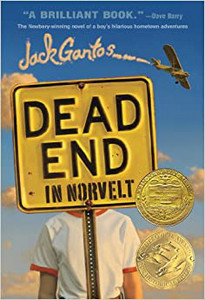
The book that inspired this conversation is called Dead End in Norvelt by Jack Gantos.
Gantos grew up in Norvelt, Pennsylvania, a town champion by no less than Eleanor Roosevelt.
I love Eleanor Roosevelt.
I admire Eleanor Roosevelt, and I wish there were more of her.
The town is so beloved, even the houses get an obituary in local paper.
An obit for a house, he questioned as he relit his pipe.
Has she lost her mind?
No, I said.
She just speaks her mind.
Well, amen to that, he remarked.
This is the Book Club for Kids, the show where kids talk about books.
We'll tell you how you can be on the show a little later on, but first let's meet this week's panel of readers.
Hello, my name is Alice.
Hello, my name is Deborah.
Hello, my name is Ava.
Hello, my name is Daniel.
Hello, my name is Liam.
And we're all fifth graders in Mr. Close's class at Belvedere in Fairfax County, Virginia.
So the book is about this boy named Jack who has great summer plans until he gets in trouble.
He gets grounded for the entire summer.
And then his mother decides to lend him out to write obituaries with Miss Volker, a possibly eccentric old lady.
Yeah, her hands have arthritis so she has to put wax on them and put them on the stove to make them heat up and so they can work again.
And she knew Miss Eleanor Roosevelt, who started the town Norvelt, and she promised to keep working in Norvelt until all the original Norvelters are dead.
Well, let's follow Jack as he pitches in to help Ms.
Volker as she composes her latest obituary.
Our celebrity reader is KPFK radio host Wenzel Jones.
This is not your normal obituary, she started, and I could hear the strength return to her voice.
Then she pulled herself up like a drum major about to march at the head of her words.
This is the obituary of a house, a house that was born of love and died by the hands of hatred.
The little house on parcel number 11, in section D, on Larkspur Circle, was born in 1935.
Mrs. Roosevelt was the godmother, and a great one she was.
When the government offered to help poor people build houses in Norvelt, the architect drew up plans to have entire families live like farm animals in one barn-like room with a bathroom, outhouse and a kitchen.
That was nothing but a wood-burning cook shed on the back of the property.
The government's idea of helping poor people was to give them some shelter to survive, but not allow them to live a life of pride.
But Godmother Roosevelt came to the rescue.
She made sure people had real homes little New England-style houses and they had bedrooms and a living room and a useful kitchen and a bathroom with a bathtub and even a laundry room with a washing machine.
The government called this luxury living, but Mrs. Roosevelt called it living with dignity.
And now the house has been burnt to the ground by a gang of hell's angels who have turned their obscene hatred toward our town.
They poured gasoline throughout the house and garage and lit them on fire and, like cowards, they fled into the night.
It is a sad death for a house to become nothing but ashes and dust and earth, but we in Norvelt will never forget every splinter of the life it lived.
I had tears in my eyes, but Miss Volker looked revived, as if a few hot embers of the house were glowing within her.
Boy, she said as she tried to close her hands into two bony fists and punch out of the air.
I love it when I get mad.
I feel like I'm ready to take on the world.
I'd like to show a few of those hell's angels a thing or two.
I hurried up and typed the obituary and ran it down to the Norvelt News.
Mr. Green took it from my hands and read it.
An obit for a house, he questioned as he relit his pipe.
Has she lost her mind?
Now I said, she just speaks her mind.
Well, amen to that, he remarked.
Jack isn't just there to help write obituaries.
He's like her maid, her cook, her getting rats out of her basement, errand boy babysitter, car driver, boyfriend and all of the above.
Miss Volker has an admirer.
And this admirer will not give up.
He wants her to marry him.
And she will not marry him, she says, until all the original Norvelters are dead.
And she did not willingly say that.
She just was caught in a weak spot because her admirer, which his name is Mr Spiz, would not stop nagging her.
So she was like really annoyed and gave up and said okay, I'll marry you when all the original Norvelters are dead.
Her admirer, Mr. Spiz, he works as a police officer for the town.
And he rides around on a man tricycle looking for people that have weeds in their gutters, that are too long and things like that.
There really is a Norvelt, Pennsylvania.
Why is this town different than other people's towns?
The town was founded so that people who didn't have a lot of money could live dignified.
Eleanor Roosevelt created it so that families with not a lot of money could live there and lead in life.
The other people said it was luxury living.
But Miss Eleanor said it's living with dignity, so she built it.
But because people aren't moving into the town, it's slowly dying out and there aren't a lot of young people who live there, unless they're children.
Like Jack's dad.
He says I want to leave to Florida because it's so run down here and the town is dying off and I have like nothing to do here.
Is it a kind of town you guys would want to live in?
No.
The reason that I wouldn't want to live there is because They have plenty of job opportunities, but none of them offer much.
And they're not like really nice jobs.
They're just like working in factories.
The laws in Norvelt seem very different from the laws that apply today.
Jack drives a car.
He buys poison.
He rides in an airplane with someone who I seriously doubt is registered to fly.
Well, he got the plane from a card game.
So does this alarm you or does it make it more enticing?
I mean, these jackets do a whole lot more stuff than you guys probably do.
The thing is, when you live in small towns, there aren't as much police, there's not a ton of watch and everyone knows each other, so the rules get cut down a little bit.
So I mean driving the car when you're 13.
In some areas you're allowed to operate farm equipment on your own property.
Would you like to do that?
I think driving a car might be fun, but it's also really dangerous when you're out on streets because you don't know what happens exactly.
You can't control it.
I think it would be fun to live in the town because there's stuff to do for the kids.
Like Jack's on a baseball team and Bunny takes him to her dad's workplace, or like the funeral parlor and takes him to watch dead people.
I think that's a little creepy.
I mean, it has tons of excitement.
People are playing stuff.
There's people that do all sorts of things building bomb shelters, building planes, building runways.
But also there's so much danger.
There's no, as Ava mentioned, there's no policemen, there's no...
There's no security.
There's no nothing.
And if someone comes into the town, they can pretty much destroy it.
It's fun, but it's not safe.
It's dangerous.
Well, I think that they don't really think they need this extra security, because some people love this town and they think it's completely pure.
But there are also other people who think, just let it crumble, because some people are just holding on to a town.
And in my opinion, they can build houses, but at the end of the day, they just need more people to come in.
Just let it.
And speaking of dangerous people coming into the town, there are appearances made by Hell's Angels.
If you don't know what they are.
They are bikers who are quite dangerous and scary, and well, you should probably try and stay away.
But anyway, they come into the town and they cause some damage.
They come in and burn people's houses down because one of their people died.
I get that someone died, but they shouldn't blame it on other people.
He's the one that's dancing on the road.
They also do kind of have a security system in a way.
It's just not strong enough to keep up with these people on motorcycles.
Because you're not going to catch a motorcycle with a tricycle.
I think it's either do you want more space or do you want more activities, friends and stuff like that.
For me it would be more friends and little space.
This is a town that's been run over and not many people live there.
Imagine how much space you could have for a house, or imagine how much field space or anything you could do there.
This kid literally has a horse pen in his backyard.
Imagine how much space you could have with that.
That's attractive to you.
I mean, it's one of the qualities if someone wants to live there, but for me I'd want more friends and little space.
I think the thing in Norvelt is you have to have a job that is independent of Norvelt.
You need to be like an artist or a writer or something that does not depend on the economy of wherever you live.
So if you guys were to, you know, here's a bunch of money, here's a bunch of land, build me a community.
I mean, what should a perfect community or an ideal community have?
I think a perfect community would be houses that are well spread apart, because if houses are too close, then you're going to have neighbor problems.
And Also I like how in Norvelt, like Daniel said, there's a lot of land.
And then the land is definitely going to help, but you're still going to need to get people in there.
So that's a main part of a community.
So you need to make it look good.
Another thing, I think I'd make sure there was security, maybe some police stations.
I'm drawing on some things I've lived in.
When I was in Maryland, I lived in a very close town.
It was...
There were tons of houses.
Everyone knew the mayor.
Everyone was very close, at least who I knew.
We were all very close.
We had a community market.
We had tons of events.
It was very connected, I think.
I think a perfect community would need to have resources like enough water, enough energy sources so lights don't go out and stuff.
Another really important thing is schools because having an education is really important.
In the book.
It doesn't mention schools at all because it all takes place during the summer, but it's still a very important part of a town.
Let's talk a little bit about the writing of this book.
Is it funny?
His writing is funny and it's based on himself.
Like in the back of the book.
It shows him the runway, his father and him with the runway and the bomb shelter.
So it's funny and it sprinkled in some facts about the real world in it.
I think that...
He made a very powerful way of showing the community and the whole geography because he explained all the different places very well where you could almost map out the entire town in your head and know where everything is.
So I thought that was cool.
Was this historical fiction or biography?
That's a really good question.
What do you think?
I think he threw in some historical fiction, because maybe he didn't play baseball, or maybe he didn't drop red balloons on the theater, or maybe these guys didn't really sneak in, or something like that.
I think it's probably more historical fiction, because I don't think that Hell's Angels would drive into a town, but I just think that some of this could actually have happened.
Like, there were people dying, the obituaries, writing, the just...
Some stuff that sounded realistic was in there, but I think that some of it was also not true.
So I think it's historical fiction because of what Ava said.
Not all of them might have happened, but it has facts and it's also based on himself.
So it has facts about him, but it's also fictional, because it might not have had every single thing he said.
Well, let's ask Jack Gantos.
The main character is named Jack Gantos.
So what are we supposed to make of this, fiction or fact?
Well, yes.
There's a lot of fact to it.
And there's just a tiny bit of fiction to it.
And the tiny bit of fiction is mostly the plot line.
But the facts are really pretty solid.
I am from Norvelt.
My grandfather was a coal miner and worked in the mines, double shifted.
One shift digging coal, one shift taking care of the mules.
My parents were married and we lived in Norvelt and I started school in Norvelt.
Norvelt was a town built and named after Eleanor Roosevelt for out-of-work farmers, miners and other people that, during the Depression, had lost their housing, had lost their jobs and were really at odds.
And so they needed a place to live.
Eleanor Roosevelt, who had the biggest heart of anybody in the country.
I love Eleanor Roosevelt, I admire Eleanor Roosevelt and I wish there were more of her.
But she looked out at the country when FDR came in and said we have to help people.
So they bought the Hearst Farm and they designed a community of 250 houses with a community chicken patchery, a community farm, a community factory and everybody could sign up and get a house and have it built.
On script.
They didn't even have money.
You worked for me for two hours doing electricity.
I worked for you for two hours doing plumbing.
And they built these houses, and they're still there.
And these communities grew.
They thrived.
They had a school, and people moved forward.
They did not sink below the poverty line and become a drag on the economy.
They became great citizens of the country thanks to Eleanor.
I grew up as a person that thought that community meant that one person helped another person, that helped another person, and that we all joined hands and joined forces to create a community and helped those people in the community that could not help themselves.
People in Norval who could not help themselves, never thought of themselves as a drag on the community, never thought of themselves as incomplete citizens.
They just thought they were there and surviving well and were part of the community as best they could do, and everybody helped them.
What else about the writing itself stuck out?
How does he write differently than other writers?
His perspective isn't too funny, but I think the way that he writes about it is...
I mean he has funny things happening to it, but his tone overall isn't too comedic as compared to some other writers that I've read.
I think he stays on track.
He makes it good for the reader.
He draws the reader in, and then he makes them learn stuff without them realizing it.
He tells them facts mixed in humor in it, and I think it was a very good way to capture the reader.
I think that With all these characters, he did a great way of describing them, and I think my favorite part where he showed a character was when he met the old lady in his Grim Reaper suit and then she was incredibly kind to him.
And if I were an old person, I would probably get a broom or something and chase this person out of here.
I like, like, at the end, he twisted, like, the story, like, connected with the beginning.
I really enjoyed the book.
Most of the time the dialogue wasn't very funny, but I feel like the thoughts that jack was having, sort of um, made it kind of funny.
Um, like a different perspective and way to interpret the way um, the things that people were saying.
If the whole thing it's funny, then you might lose readers, like you want.
Balance the scenes in total weren't that funny.
But for readers in the future that read this book, try to picture those scenes in your head and imagine how funny that would be to a grim reaper to appear in your house and an old lady is asking him for tea and he doesn't get in trouble at all.
I mean, I think you have to imagine some of these scenes in your own words, in your own head.
I think he sets the scenes and you add the final touch to make it funny.
I think that, yeah, it wasn't a completely overall hilarious book, but it's kind of like chocolate.
You don't want it to be like dark chocolate, where it's super bitter and not very funny, but you also don't want it to be like white chocolate, where it's just like super sweet.
You want to find a balance.
So you want to make it a little bit funny, if that's what you're going for, but not too much, so you can keep a historical look on it.
I thought that Jack's nose was kind of funny.
How whenever he got surprised, his nose would just burst out in blood.
But then some people would think that that is utterly disgusting and maybe put the book down and go hide in the corner.
I like that it's like a mix.
There's romance, there's mystery, there's some horror of the death.
That's the only part I didn't like, the death part.
And I like that he mixed it up together to give it a really good feel.
Though I usually don't read historical fiction that much, it's not my favorite genre.
I wasn't exactly like oh my gosh, I really really, really want to read this when we got the book.
But
It didn't turn out so bad.
Alright, well then let's talk about our favorite books.
Alice, what's your favorite book?
My favorite book is The Fault in Our Stars by John Green.
I just really liked the detail in it and sort of how they set the scene.
Leem, favorite book?
My favorite book is Candy Makers, which is about kids who make candy, but I also have a favorite series, which is Wereworld, because I think it portrays the characters very, very well.
Deborah, favorite book?
Mine is actually a series.
My favorite series is The Chronicles of Narnia by C.S.
Lewis.
My cousin recommended it to me and I like it because they created a really cool world and the kids find it by going through a closet.
And I like that in the first book, it showed how the world was created, and that's why I like it.
All right, Ava, favorite book?
I also really like The Fault in Our Stars, but I also like The Warrior Series by Aaron Hunter.
Wings of Fire by Tui Sutherland.
I like reading and sometimes writing fantasy.
I like the idea behind the story, and I like the way that the story, like how it's written.
Daniel, favorite book?
I don't have a favorite book.
I've read tons of different authors, tons of different books.
I've read The Hatchet, Hatchet 1 and 2.
I think I just like adventurous action survival books that just capture my interest.
Some people are like historical fiction people.
Some people like science books.
Some people like geography books.
I'm an action person.
What about you, Wenzel Jones?
What's your favorite book?
My favorite book that was not assigned to me is Onions in the Stew by Betty MacDonald, who got famous for writing The Egg and I, But it's a book that was on the bookshelf the whole time I was growing up.
And in high school, for whatever reason, I pulled it off the shelf and found this charming, captivating story about raising teenage girls on Vashon Island during World War II.
And I cannot tell you how many times I have reread that book.
What's your favorite book?
Well, tell us about it and we'll put you on the podcast.
Just record yourself on your smartphone telling us the name of your favorite book and why you love it, and email the voice memo to kitty at bookclubforkidsorg.
We'd love to hear from you.
And we have a list of everybody's favorite books from today at our website, bookclubforkids.org.
Book Club for Kids is funded in part by the D.C.
Commission on the Arts and Humanities, an agency supported in part by the National Endowment for the Arts and by listeners like you.
By the way, have you seen our cool retro watch?
I have one.
Bright orange with the book club logo.
Check it out at our excellent book club stuff store at our website, bookclubforkids.org.
And a portion of every purchase goes right back to the podcast.
That cool logo, by the way, is designed by Emma Steinkellner.
Jonathan Jensen composed and performed our music.
And thanks this week to Marcy Atkins at Belvedere Elementary and our crew of readers Deborah Leem Alice, Daniel and Ava.
And thanks as well to writer Jack Gantos and our celebrity reader, Wenzel Jones.
We have a free newsletter for teachers, parents and librarians full of free tips about how to turn kids into lifelong readers.
You can sign up at our website, bookclubforkids.org.
You can also follow us on Facebook, Twitter, Instagram, even Pinterest.
I'm Kitty Felde.
Thanks again for listening.