
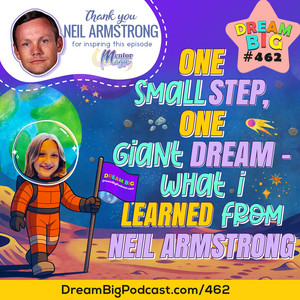
[Lessons from the Moon: How Neil Armstrong’s Journey Can Fuel Your Big Dreams]-[DBP 462: One Small Step, One Giant Dream – What I Learned from Neil Armstrong]
📋 Summary
Reaching for the Stars: Lessons from Neil Armstrong
In episode 462 of the Dream Big Podcast, host Sophia Cartman invites listeners to look beyond their immediate surroundings and toward the stars. By examining the life of Neil Armstrong, the first human to step onto the moon, Cartman extracts three fundamental lessons that can help anyone turn their aspirations into reality. While Armstrong is remembered for his legendary words, "That's one small step for man, one giant leap for mankind," his journey offers much more than just a historical milestone—it serves as a blueprint for personal growth.
Big Dreams Start Small
Cartman emphasizes that greatness is not an overnight occurrence. Armstrong did not begin his life as a rocket scientist; he was a "curious kid" who developed a passion for aviation at the age of six. He spent his childhood building model airplanes, drawing sketches, and reading books about aviation. By the time he was 15, he was already learning to fly real planes.
The core takeaway here is that "big dreams start small." Whether one aspires to be an astronaut, an inventor, or an artist, the journey begins with the tools immediately at hand—crayons, Legos, and a sense of wonder. Cartman encourages listeners not to be discouraged by their current circumstances, reminding them that the seeds of massive achievements are often planted in the simple, messy ideas of childhood.
Bravery Is Moving Forward While Scared
One of the most intense moments in space history occurred during the Apollo 11 landing. As the lunar module approached the moon, the onboard computer malfunctioned, and Armstrong faced a landscape filled with "big boulders." With only 20 seconds of fuel remaining, he had to take manual control of the spacecraft.
Cartman points out that Armstrong remained "calm" despite the immense pressure. This teaches us that "brave doesn't have to mean you're not scared." True courage is not the absence of fear, but the ability to "move forward even when you are scared." Whether a child is standing up to speak in front of a class or attempting something entirely new, the act of proceeding in the face of anxiety is what defines bravery.
Preparation Turns Dreams into Reality
Success is rarely the result of luck alone; it is the product of rigorous preparation. Armstrong spent years training, studying math, science, and engineering, and practicing survival in difficult conditions. He knew that when the opportunity to step onto the moon arrived, he would "only get one chance."
Cartman argues that "dreaming, plus preparing... that's what real success comes from." She challenges listeners to stop viewing preparation as boring and instead see it as the vital process of getting ready for their own "moon moment." Whether it is practicing an instrument or keeping a journal, these small, consistent actions build the foundation for future success.
The Mission: Taking Your First Step
To conclude the episode, Cartman issues a challenge to her "Big Dreamers." She asks listeners to identify one small step they can take this week toward their personal goals. By focusing on action—whether it is checking out a library book or asking a question—listeners can begin their own "space mission" from home.
Ultimately, the story of Neil Armstrong serves as a reminder that one does not need a literal rocket ship to make history. With "heart, courage, and your next step," any individual can unlock their unlimited potential. As Cartman reminds her audience, dreams are not optional; they are essential, and they require taking "massive action" to turn them into reality.
Deep Learning with ListenLeap


