We, as humans, are living longer than ever, and that's something worth celebrating.
But with more candles on the cake comes a big question.
As societies age faster than ever, who's going to help us when we're old and frail?
More and more, we're hearing robots to the rescue.
is the future here.
Coming to you live from Beijing, this is Roundtable.
I'm He Yang. For today's program, I'm joined by Steve Hadley and Yu Shan in the studio.
First on today's show.
With shrinking family size and a shortage of caregivers worldwide, the search for solutions has turned to technology.
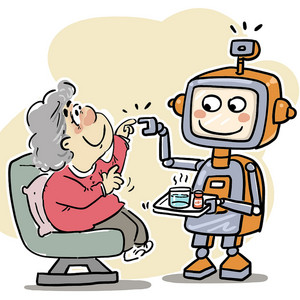
Enter elderly care robots, machines designed not just to lift and assist, But to remind, comfort and even connect from Japan, to the UK, to China, developers are racing to create robots that can meet the emotional and physical needs of older adults.
And just this past February, a major step forward, the release of international standards for elderly care robots.
These new guidelines aim to ensure safety, improve performance, and most importantly, center the needs of the aging population.
So are we finally on the path to aging with dignity assisted by smart machines?
Well there are definitely the gaps between what's promised and what's possible and we'll get into that as well.
So let's go to you Yushan first. When speaking of elderly care robots what are we referring to?
Well let's just hear the name elderly care robots.
I think that says it quite a bit and also sometimes that's also referred to as elderly companion robots.
These are a range of devices that's dedicated to support older adults in various aspects of their lives, including just daily living, health care, and overall well -being as well.
There is this paper from 2023 and is published on the US National Center of of biotechnology information.
So according to one paper is coined as a type of AAL robots.
The active assisted living robots.
And that refers to just various systems that's designed to improve the quality of life that has this function of aiding the independence in their daily lives and create healthier lifestyles for those who need assistance at any stage of their lives.
So basically, elderly care robots falls into this category but it's more just specifically targeting on elder care.
Yeah, they can come in different shapes and sizes and different things that they can do.
Some can be equipped with wheels or walking mechanisms, and those robots in particular can move freely within the home environment.
They provide assistance with mobility for the elderly or with the owner, including navigating complex environments.
They can avoid obstacles for the elders when walking, especially in outdoor scenarios.
So that's one thing they can do.
They can be programmed to monitor the person's health condition, they can detect emergencies, like if the person happened to fall down, that could be detected.
Health signs, vital health signs, heart rate, blood pressure, blood oxygen, and walking difficulties.
All of these things could trigger timely responses when an emergency like that occurs?
So my thinking is that for the elders who are using these robots, they ought to be wearing some sort of a wearable device, like a watch or something that's connected to the robots so that their health status can be monitored at any time.
So whenever there is an emergency, like a sudden race of heart beating rate, so, yeah, the robot is going to send alerts and there will be human aid at any time.
You know, on that point, can I just add something, please?
A couple of years ago, I believe, on our show, we did this interview with some researchers in Tsinghua University in this particular area, and I happened to have the chance to visit their lab, and they have, it's really fun, kind of interesting, in this really like a regular -looking neighborhood complex, the lab has rented this regular apartment and then they're doing experiments there by, instead of wearing the watch that Youshan, you mentioned, in that experimental apartment, the Tsinghua University researchers have layered this special carpet in that apartment.
So if a fall happens or abnormal activity happens, the fiber in the carpet sends data to the center, and then a reaction could happen, et cetera.
Through the sensors in the carpet.
Yes, that's cool. But the researchers did say this is very expensive because if this were to be used in an individual's home, then you'll need to have the special carpet refurbished in your apartment and that could be expensive.
That could be very, very expensive.
But all kinds of sensors and connectivity experiments are being conducted.
Yeah, and these robots, too, they're integrated with cameras and microphones and all different types of sensors and they can perceive their surroundings.
They can recognize voice commands and they use all of those things together to monitor the user's condition.
Yeah, and it's also reported that well, this is super fun that the robots they can automatically open the curtains When the elder are passing by or just adjust to room temperature for them and maybe lightings based on their schedule Maybe it's time to wake them up.
So the light is Slowly turning up a little bit to remind their body that it's time to wake up or vice versa when it when it's time to Go to bed.
That's really cool.
You're talking about the connectivity of things right the internet of things Yeah, the things that they can do door locks.
I read as well They can unlock doors or lock them when needed.
And of course these robots can be customizable to meet individual user needs.
For example, they could provide navigation assistance for visually impaired users, or help with object transport for those with limited mobility.
So, you can kind of customize the robot for the things that you need most in your life.
Currently, I think it's in southwestern China, the city of Chengdu.
In some southern cities as well, there are already such robots being applied in nursing homes or caregiving homes that they can just provide general information for you or entertainment services for you, like to play chess via some sort of digital devices or tell you how's the weather.
and you know just information on that and such. Playing music or movies or audio books.
Yeah, they can do that too.
Yeah, so when we're talking about the robots today, they're not necessarily the robots we have in our minds when like in movies and it's not like that machine with a head and a torso, sometimes with the limbs, not necessarily.
From the Spring Festival where they were, no, it's not those ones.
Not necessarily like that.
Yeah right. It could just be this, any kind of tools or systems out there that can aid elderly care?
It doesn't have to be humanoid, I guess.
Okay. I don't know whether it's an insuring or not, but that's an interesting thought.
And what do we know about this new international standards that's been released on elderly care robots?
Yeah, that's the main reason why we're mentioning this in the national context as well because China has taken the initiative in developing international standards for elderly care robots and that's officially released at the end of February just earlier this year.
And so, the new standards is titled functional performance criteria for AAL robots used in connected home environment.
So, these standards were led by China and it was recently published by an international organization, the IEC, the International Electron Technical Commission as well.
So, according to that report that I was checking out, this is the first standard of its kind globally and it's leading up a development for such a new track in the elderly care robots or rather elderly care robotics industry.
So it is designed to address the specific needs of elderly individuals in an interconnected home environment.
So even though it's led by China, it's meant for a global usage in developing such industry.
Yeah, and when we're talking about standards, these are a basis for things like product testing, things like certification, helping to promote the development, the healthy development of the market.
So manufacturers, they're expected to follow these standards in their production and in their sales, and this is all done to ensure a certain level of product quality, and also a certain level of product performance as well.
So ultimately, this is as a mean to benefit the silver -haired population.
As we know, it's more than just China.
A lot of the countries worldwide are facing the silver -haired population increasing in recent years.
And so by improving this functionality and quality of elderly care robots, we hope that this can help enhance consumer trust in elderly care robots and potentially expand market demand for this particular product?
I think consumer trust is really important here, right?
Because this is a relatively new thing.
So you are introducing these tools to people who need them, obviously, but maybe people who have never used anything like this before in their lives, right?
So convincing them that it's a tool that can really help them out.
Building that trust between the customer and the tool is probably going to take some time, but when you introduce standards like these, industry standards, it goes a long way in helping to create that trust. Yes, and in light of the new standard, what are the main roles robots are expected to play in the lives of elderly people?
Yeah, sorry. Actually, this is a new discovery.
And for me, that's a new discovery and is posted on Eld Expo official website.
And currently there are three main types of roles or rather three main types of services that these robots are dedicated to perform.
The first one, which is also the major one in China, is the rehabilitation robots.
And that's to assist with the rehabilitation training and supporting activities like walking, climbing stairs, fitness for disabled or mobility -impaired elders.
So some examples would include Something we've touched upon before like lower limb or upper limb exoskeletons and also walking assistant robots used in elder care Rehabilitation centers.
Yeah, this one is already being used in some higher -end Centers as such sure, you'll find these in hospitals and of course in rehabilitation centers.
And that's important because globally rehabilitation robots, they account for about 60 % of the elder care robotics market.
They're not the only types of robots in use, but there there are a large chunk of them and they are a key development focus here in China, too.
So you have the rehab robots and then you have the automated nursing robots.
And these are a little bit different.
These will provide daily caregiving services, including electric nursing beds and mobile care chairs, health monitoring, emergency assistance.
These are also designed to handle more delicate tasks for example, bathing.
That would usually require perhaps two to three nurses to complete that task, if you can call it a task together, because you're looking at things like full body wash and scrubbing and drying and that's suitable for disabled individuals, so having robots like that, these nursing robots, to be able to assist with bathing, even feeding, too.
They can use voice recognition and visual tracking technology to detect the eating needs of elderly individuals.
That can really help out with the risk of accidental injury.
And you're looking at people there in that task with limited hand mobility, unable to feed themselves.
These are different types of robots, but still providing absolutely essential services.
But are we actually there yet?
Just take the bathing scenario.
That's really, really hard. Yeah, exactly.
Like I said, these are more delicate tasks, aren't they, than simply a lower limb exoskeleton?
Which is impressive on its own, of course, but this is just a different more intricate style of care.
So, you see, one example would be last year, in November, I was in Shanghai for the CIIE, the Import Expo.
And I saw such a design of something that looks like an automated bathing electronic belt or some sort of bathing that looks like a mini bathtub, but it's designed for similar usage, but it's not fully automated yet, it still requires human aid.
And I would assume it's very pricey too, given the brand itself is a Japanese brand and it's being exhibited at the CIE as a model type.
It's more of an idea, let's say.
I will say we're not there yet to widely apply this product or products of such in every household just yet.
It's more like a nursing home facility tool for maybe lightening the nursing worker's workload, just to try to replace partially the human labor on helping out, like Steve mentioned.
Usually, taking a bath for an elder requires two to three people, if not more in some cases.
So, yeah, maybe in the future, in a few years' time, we will see this entering into real households.
But not right now, I'll say.
Certainly, not even to the real household, even for this to be widely used in professional elderly homes.
We're not really there yet.
Yeah what we're seeing more of now I think would be companionship robots and this is yet another type.
These are the ones that provide emotional interaction, entertainment, we mentioned before some robots can play music or movies or audio books.
They can also provide educational content.
They can teach things like computer skills or calligraphy if the customer is interested in that type of thing.
These are what I saw in use at elderly care homes in the United States and in the UK.
In the States, the robot's name from the report I saw, the name was Pepper, and it was a social interaction robot.
and it could do things like dance.
One of the dances it could do was the Macarena.
Da da da da da da da da da da da da, that one, right?
Now that sounds silly and useless, but the person from the center was there explaining what an impact that robot had on the community that lived there.
They loved it. And they were up dancing with the robot, trying to follow the robot, doing the steps to the dance, the Macarena, and it laughs and it tells jokes and this is the type of interaction that you would have in your quote unquote normal life.
So being able to provide that part of of something that might have been missing for people in the home is really important and really effective.
I think that's also why some of these robots are also referred to as elderly companion robots because at the certain development and staged their biggest, say, function would be there to stay with the elders, talk to them, provide information to them, have some sort of interaction with them in the place of maybe their children or other caregivers in their family?
Well, it can provide a therapeutic effect too.
The example in the UK that I'm talking about was actually a robot that was developed in Japan by the name of Paro and it's a robotic seal.
I'm not sure if you've seen this it looks like a seal that you'd find in the ocean.
It has white fur, it's very cute.
And what they found at that particular center was that around 2 .30 to 3 p .m. in the afternoon, the patients who suffered from dementia would find their anxiety levels spike at that time.
So they used this fluffy seal, it's really cute, to have this calming effect.
And they showed video footage of the people in the center.
They're petting it, talking to it, and they're completely calm.
It had a real calming effect.
So there's that therapeutic aspect of these robots, too.
When it's designed so well.
Yeah. Yeah. Also, we've talked so much about AI and large language models, and I don't think it surprises us anymore when the algorithm can churn out really well -suited responses.
So I think that can definitely be widely used in the future for all kinds of robots to offer this comfort and companionship verbally, you know?
Yeah, and not just that, but the report went on to talk about how having that kind of robot, doing that kind of thing can help decrease the need for certain medications that the elderly might need.
And it also is a big help with the strain on care workers, right, who if they don't have a tool like that to assist them, for example, when anxiety spikes in the middle of the day with dementia patients, then they have to come up with their own solutions, right?
So this is just a great resource for healthcare workers to have, too.
Yeah, that's lovely.
Yeah, that's wonderful.
And what's driving the growth of the elderly care robot market in China?
We know that we're turning gray rapidly in this country and we know that there's not enough healthcare workers and it's very expensive to employ people as time moves on.
So what are your thoughts on that?
Well, one biggest drive should be the aging population.
And at least here for the data shown in China, and that's from the National Bureau of Statistics, It suggests that by the end of 2024, there were over 300 million people aged 60 and above, and that accounts for 22 % of the total population here in China.
And then there are over 200 million people aged 65 and above.
And that represents over 15 % of the general population.
So this is a significant demographic shift that's creating the need or the very, say, big market for elderly care solutions and also products, and in the meantime, there's also the WHO, the World Health Organization estimation that shows by 2050, so just in a few decades time, the global population aged 60 and above will reach 2 .1 billion, and that represents, well, also a massive opportunity in international markets in receiving these new type of robots for elderly care.
Yeah, and it just makes sense, right?
When you have aging populations around the world, those people are going to need help with certain types of things.
In some nursing homes, almost 80 % of disabled elderly individuals need help with walking.
20 % require support with bathing.
And we've talked about it already.
Elderly care robots, they're seen as a potential solution.
If not a full solution, at least a major helped to alleviate the burden of care on society in general, but more specifically on families, right?
We know that the world has gotten smaller in many cases, but bigger in other cases where families sometimes live far apart.
They can't be there 24 hours a day, seven days a week, even though they want to be.
So this helps alleviate that burden.
Calling it a burden sounds like a terrible thing.
but that responsibility as well.
Apart from that, there's also, like you mentioned Ho Young, the vast developing, if not booming, of new technologies that could be applied in such products, such as AI.
Because progress has already shown that in domestic AI and robotic industries, it's making this huge development of more sophisticated and functional elderly care robots.
And it's making the quote unquote brain of the robots to become more mature in a way that is able to conduct interactive conversations with the elders in the future.
And also we see that, I think we mentioned earlier that how these robots can help avoid the elders from falling or help you to monitor if there are any obstacles.
these we have the advanced sensor and also the entire system of sensors that's integrated into the robots to thank because there according to Shing Hua news there are various sensors applied in such robots like visual sensors auditory sensors it can listen to your command and understand so all of these are technical advancements that has come to the mature stage to be applied in the elderly care robots to help.
And they'll only get better and better we have to assume, right?
It's on the government's radar, that's for sure.
It was during this year's national two sessions, they called it AI plus elder care.
It was a hot topic among MPC deputies and CPPCC members.
This year's government work report, they proposed establishing a mechanism for increasing investment in future industries, including embodied intelligence, and that encompasses advanced robotics.
The opinions on deepening the reform and development of Elderly care services also emphasize accelerating the application of elderly care technology.
And I think we'll see the advancements in the future because the global humanoid healthcare assistive robot market size is expected to be worth about 17 billion by 2034.
Now, when you compare that to 2024, which is a billion and a half dollars, that's a growth rate of almost 28 % from the years 2025 to 2034.
That's a pretty significant growth rate for a relatively short amount of time.
Yes and I think we feel like the pressure is on and the pace of development has to be accelerated or I don't know, maybe it's just because we're on this show and we're paying careful attention to all these different industries and aspects of our society.
And I really feel that in recent years that there's just so much discussion and so many inventions and much innovation that's going on in this field.
And we know that the demand is here and the standards are set, but what's this day of play for elderly care robots here in China?
Well currently, and this is, well according to a report from Shenzhen Industry Research Institute, the market size of elderly care robots in China has already reached 7 .9 billion yuan and that's roughly 1 .1 billion US dollars.
And that's the data from last year in 2024.
And in a few years' time, it is expected to grow to 15 .9 billion yuan and that is 2 .1 billion US dollars by 2029, which is a compound annual growth rate of 15%.
And also domestically, the number of enterprises that's joining the game is also showing an increase as well.
And that's according to the latest industry -wide papers and market research data as well.
So China currently has approximately 120 to 150 companies that's engaged in the research, in the development and also manufacturing of elderly care robots.
And that well includes related upstreams and downstream enterprises along the supply chain, so actually, not all of these 150 companies are fully dedicated to making these robots.
They are somehow related or at some part of the production or design of these products.
Yeah, certainly this seems like a field that's worth investment and research and development, but it's not going to pan out in terms of benefits super quickly.
So that's what investment is about, I suppose.
And what about the biggest limitations and challenges in this sector right now?
Yeah, there are a few, but I think the one that stands out the most to me is the high cost, right?
These are very, very expensive robots, and if you have — and I'm speaking from maybe a global standpoint here — if you have limited government funding and insurance coverage for robotic assistance, then it can restrict access to these solutions in cost -sensitive regions.
If we think too about smaller businesses, right, smaller manufacturers, they have scaling challenges, don't they?
And when you can't scale in a way that you want to, that's going to keep your unit price pretty high.
Then you have economic disparities between high income regions and low income regions, right?
So hopefully the cost can come down to a point in the future and there will be enough government funding globally, enough support that this can be affordable for everyone who needs it and not just those who can afford it.
Right. And another major limitation would be on the technological side because well right now some industry insiders also voice that there is a recognized need for collaborative efforts across the industry to achieve breakthroughs in core hardware and software technologies and I think by hardware it refers to again going back to the brain of such robots it has to have sophisticated enough a chip in order for it to be able to respond to some commands given to it and right now it's still making mistakes when playing with elders according to some reports like playing chess.
They still make mistakes and still respond slowly and there's a time lag of sort.
So yeah. That's not gonna help build that trust that we talked about before.
Yeah, so there's still a lot to improve.
Definitely, and some might see these robots as futuristic luxuries, but with caregiving resources stretched thin and life spans steadily rising, they may soon become necessities.
Here we're talking about, I suppose, recognizing the growing care gap before it becomes a chasm.
The real challenge ahead isn't just whether the tech can keep up with aging societies, but whether society can rise to the moral agency of investing in care, human, digital, and possibly everything in between.