Big news, we're going on tour.
Tickets are available now at planetmoneybook.com.
Our first ever book comes out in April and we're so excited to share it with you.
We are hitting the road about 12 cities starting Monday, April 6th in New York.
And if you buy tickets to these book events, you will get a limited edition tote bag while supplies last.
We'll sign your book, all that jazz.
Planetmoneybook.com.
Check out the show notes for tour and ticket info.
This is The Indicator from Planet Money.
I'm Darian Woods.
I'm Waylon Wong.
And connecting with The Indicator crew this week is the ever effervescent Mary Child from Planet Money.
Hi, I'm just so happy to be here.
And we are happy to have you.
Mary, I cheer that you're here because you've arrived just in time for Indicators of the Week.
That's right.
We are here to tell you about the most interesting numbers in the news this week on today's episode.
The dilettantes in Davos put on a show.
And just a thought experiment.
What if we did cap those credit card interest rates?
Plus, who's really footing the bill for all these tariffs?
Hint, it's who we told you it was.
That's going up after the break.
This message comes from Charles Schwab.
When it comes to managing your wealth.
Schwab gives you more choices, like full-service wealth management and advice when you need it.
You can also invest on your own and trade on Thinkorswim.
Visit Schwab.com to learn more.
This message comes from ServiceNow.
People should do the creative work they actually want to do, not boring busy work.
Now, with AI agents built into the ServiceNow platform, you can automate millions of repetitive tasks in every corner of your business IT, HR and more.
So your people can focus on the work that they want to do.
That's putting AI agents to work for people.
It's your turn.
Get started at servicenow.com slash AI dash agents.
All right, Indicators of the Week, Mary Childs, you're first.
My Indicator of the Week is one as in first.
As in, this is the first time that I wish I was at Davos.
Used to be so countercultural, now you're just old pearls and gold-plated bits of chocolate.
My initial theory Darian, thank you for bringing this up is that I thought that maybe I was just old and power-hungry.
And that's why I finally wanted to go to Davos.
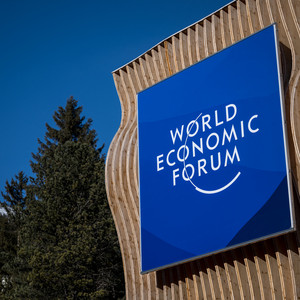
As you may know, Davos is the long-running conference hosted by the World Economic Forum in Davos, Switzerland.
And in my opinion, it has basically been an environmental nightmare.
It's notoriously difficult to access this little mountain.
So all these CEOs and bigwigs fly in on their own private jets and planes to this remote little mountain town.
And they have all these elaborate and expensive stands and booths that have been set up for this very brief occasion.
Yeah, I read a sci-fi book where everyone at Davos got held hostage by environmental eco-warriors.
Oh, was this Ministry of the Future by Kim Stanley Robinson?
Yeah.
That's a good one.
So normally also the content is not?
That revelatory.
It's usually, like you know, there's a lot of JPMorgan Chase's Jamie Dimon saying he's like worried about bond market liquidity or something.
And then they all do their little panels and their little CNBC interviews.
And then they all go to a piano bar together in like snow boots and blog about how hard it was to get dressed for this trip.
And that's generally the run of things.
And what's changed?
Okay.
Yes, I think to some extent I am older and whatever.
And craving power?
You know, aren't we all?
And I think it's also because, in part, our geopolitical and economic futures are so tied up in the whims and pet theories of some individuals more than usual,
And like they're all there.
But also the fact that it's any good at all this year is due to the personal efforts of a one, Larry Fink, the CEO of BlackRock.
The World Economic Forum has been recently plagued by scandals, and Davos was kind of becoming uncool.
And Larry said not on my watch, because he felt like in this increasingly polarized world it was more important than ever that all the bigwigs get to vibe.
This is really warming my heart, Mary.
Mine too.
So, thanks to Larry strong-arming, all of his friends and influential people, everyone who's anyone is there.
There is a group from the Trump administration, including Commerce Secretary Howard Lutnick, who gave a very fiery speech on Tuesday which Bloomberg reported made fun of European economies, saying they are not as competitive as the US, which is true, but you don't need to be mean about it.
And the FT reported that there was widespread jeering.
With Larry asking people to pipe down.
The president of the European Central Bank, Christine Lagarde, straight up walked out and Al Gore booed.
He booed Howard Letnick.
He booed Howard Letnick.
Wow, lively crowd.
I know.
There were also very serious historic feeling moments.
Mark Carney, the prime minister of Canada, gave a big speech in the strongest terms I think I've heard so far.
Let me be direct.
We are in the midst of a rupture, not a transition.
Carney described the old bargain of American hegemony as being kind of unfair.
Like we pretended to be totally rules-based and then we enforced those rules kind of whimsically.
But he said it was a bargain that non-US countries, including Canada accepted, because that structure meant open sea lanes and security.
It enabled prosperity.
But...
You cannot live within the lie of mutual benefit through integration when integration becomes the source of your subordination.
Carney said that it was time to build something new instead of just waiting for the old order to come back.
And also, just one little thing I'll leave you with.
Larry Fink might be trying to move Davos to Detroit.
And I just want to say here right now on the record that I fully support that move.
No need to take a private jet to Detroit either.
Plenty of commercial flights.
Exactly.
Let's move now to Waylon.
My indicator has to do with tariffs and specifically how much of these taxes are being paid by Americans versus other countries.
Right, because the Trump administration has repeatedly said that other countries pay the tariffs.
So we've covered on our show how the tax bill mostly hits business owners and people in the U.S.?
?
Exactly.
So we have this basic understanding that Americans bear the costs.
But how much?
Well, a German research institute has crunched the numbers and it says Americans pay 96 of the tariffs.
That is my indicator, 96%.
It comes from the Kiel Institute for the World Economy.
And when I say Americans, I'm talking mostly American importers.
That's like 100%.
Yes, the researchers described this as America's own goal, which was funny to me that they picked a metaphor from a sport that's not nearly as popular in the US as in the rest of the world.
But maybe it's a symbol of America's increasing isolation on the global stage.
That is a soccer reference where you make a goal on yourself.
That's exactly right, yes.
Thank you.
And now we have exhausted my knowledge of soccer.
So who pays the remaining 4%?
So the report says that foreign exporters absorb that small 4% of tariffs.
Basically, it means that they lower their prices in response to tariffs so they eat those costs.
Well, that makes sense.
But then back to the US.
We have not seen a huge spike in inflation, like some economists were warning about last year.
So what's the story there?
So, when it comes to the effect on consumer prices, it's important to think about what economists call pass-through, as in how much of that tariff is passed through to an everyday shopper buying you know that imported washing machine or a pair of Mary Janes.
Economists have also been trying to put some numbers around this.
So one estimate comes from research affiliated with Harvard Business School.
These researchers put the retail pass-through rate at 20%.
That means consumers aren't feeling the full impact of tariffs.
So maybe some businesses had like inventory stored up and didn't have to raise prices right away, or other businesses just decided to eat the cost.
Yeah.
And don't rule out businesses just doing nothing with their prices at the moment because things feel too uncertain.
And speaking of Americans shopping, it's time for my indicator, which is four out of five credit cards.
Four out of five credit cards will have their credit limits greatly reduced or closed entirely if interest rates are capped at 10 percent.
That is according to the American Bankers Association.
OK, so this is about that call to cap credit card interest rates that President Trump has been talking about.
Yeah.
So four out of five greatly reducing access to credit.
How do they get to that number?
So it's from a survey of banks that represents a majority of the credit card industry that There's this bill in Congress that seeks to enact that 10 interest cap.
It's being called the Hawley-Sanders bill.
It's after conservative Senator Josh Hawley and Democratic Socialist Senator Bernie Sanders.
Oh, strange bedfellows there.
Horseshoe theory.
And the American Bankers Association asked the banks what share of accounts would lose access to credit if that bill were to pass.
Okay, so it's what they say they would do.
Yeah, and so whether or not that would actually happen, we'll have to see.
But the banks are sending a pretty strong message.
They want higher interest rates to account for the risks of people defaulting.
I don't know.
Doesn't it feel like the companies are holding us hostage?
This is part of the debate.
Credit card interest rates shot up a few years ago and they've stayed really high, around 21, even as the Federal Reserve has been lowering interest rates.
And there's basically two schools of thought here.
One is that credit card companies are charging more to account for people missing their payments.
The other school of thought is basically there isn't enough competition in the credit card industry.
I really love this one because the banks are like, oh, no, this will hurt consumers.
And it's like, because we will hurt them.
So where are we at with the bipartisan bill?
So this bill has been around since last year.
It has stalled.
A lot of Congress people still aren't biting.
But banks are clearly concerned enough to be writing reports talking about all the possible negative unintended consequences of a cap.
And you've got the commander in chief, Donald Trump, championing action this week at Davos.
And Jamie Dimon saying don't do it.
Just think, Mary, if you had been at Davos, you might have heard some of this chatter in person.
I would have been the life of the party next year.
Mary Childs, it's been great having you on the show.
Thanks for having me as always.
This episode was produced by Angel Carreras with engineering by Kweisi Lee.
It was fact-checked by Sierra Juarez.
Julia Ritchie edited this episode and Kate Kincannon edits the show.
The Indicator is a production of NPR.