Welcome to Spotlight.
I'm Gillian Woodward.
And I'm Roger Bassack.
Spotlight uses a special English method of broadcasting.
It is easier for people to understand, no matter where in the world they live.
1977, Berlin.
A 31 year old David Bowie looks out of his window at the Berlin Wall.
For most of his life, the young music star had spent his time imagining he was other people.
He invented characters to perform as.
Ziggy Stardust, a rock star from another planet.
The Thin White Duke, English royalty.
Major Tom, someone who travelled to outer space.
These characters made Bowie different than other musicians.
The changes in the way he showed himself interested everyone.
But Bowie's fame and drug use were hurting him.
He felt lost.
His move to Berlin suggested another change.
But this time, Bowie would not invent another character.
Berlin was a way to discover who he was himself.
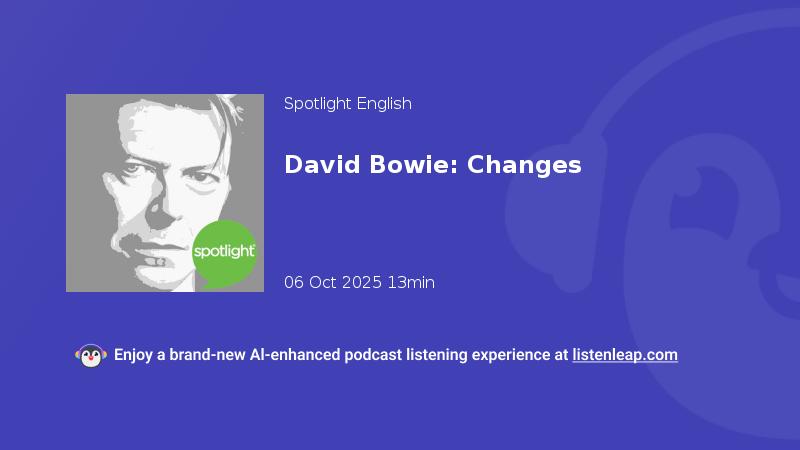
Today's Spotlight is on the English rock star David Bowie.
Most of Bowie's musical life was defined by the different characters he created.
They seemed to be part of an ever-changing person.
Some had their beginning in personal insecurity.
But Bowie's personalities were also a way of exploring the different parts of his life.
They were a way of showing that all of us change.
David Bowie was born in 1947 in London.
His full name was David Robert Jones.
Bowie became interested in music when he was very young.
He joined his first musical group when he was just 15.
They were called the Conrads.
Bowie was sure he would one day be a famous musician.
Bowie had a difficult beginning.
He recorded many of his songs on his own, but he did not find much success until releasing the song Space Oddity.
On the surface, Space Oddity was about a man named Major Tom.
The United States launches Major Tom into space, but something goes wrong with his ship.
Major Tom floats around in space speaking to people on Earth.
But he knows he will never be able to return to them.
Soon, he goes too far to speak to anyone.
He is alone.
Bowie would later say about the song.
When I originally wrote about Major Tom, I thought I knew all about the great American dream.
I knew where it started and where it should stop.
Here was the great rocket of American technology.
It pushed this man up into space.
But once he gets there, he is not sure why he is there.
And that is where I left him Space Oddity was also about Bowie's life.
Bowie was depressed about his lack of success.
He had recently left someone he loved.
He felt as if he were a man floating with nowhere to go.
Space Oddity was Bowie's first major success.
It was also his only one Struggling for recognition, Bowie began to try different musical styles.
He also tried different styles of art.
Lindsey Kemp was a theatre director and teacher.
He taught Bowie how to act.
His style was also a great influence on Bowie.
In a talk in 1974, Kemp said, My performance is exactly the same as my life.
But it is even more amazing because it has to be noticed from farther back.
My makeup, for example.
People talk about the actor covering his face.
But there is no covering.
It is just a way to make what already exists bigger.
Bowie would take Kemp's guidance very seriously for his first major recording.
The Rise and Fall of Ziggy Stardust and the Spiders from Mars.
Ziggy Stardust was about a being who came to Earth to play music.
But in his performances, Bowie would also play a character called Ziggy Stardust.
He called his group the Spiders from Mars.
The character Ziggy Stardust enlarged different parts of Bowie's personality.
Bowie had always felt strange among normal people.
Pretending as a person from another planet made this feeling solid.
It turned part of his life that he did not care for into something to be celebrated.
Bowie's music and persona got the public to notice him.
Almost everyone knew his name by the mid 1970s.
But Bowie's growing fame was beginning to be a problem.
He started using cocaine heavily.
This drug caused intense feelings of pleasure.
But Cocaine also made Bowie extremely fearful.
He continued to invent new characters for himself to play.
With each new record came a new character.
But Bowie began to lose himself in them.
He no longer knew who he was.
Bowie's move to Berlin in the late 70s came as a shock to many fans.
He was at the height of his popularity.
But to those who knew Bowie, it was a welcome change.
The star's health was very bad.
His cocaine use made it difficult for him to see reality.
He was emotionally and physically broken.
This move could have been the end for Bowie.
Fans wanted his show.
They loved his new characters and his music as it was.
But instead of continuing on with the same unhealthy path, Bowie did what he was best at.
He changed.
Bowie's next several records, Low and Heroes, were different than anything he had done before.
Instead of rock, he created electronic music.
And when he performed, it was not as someone else.
Bowie would continue to be interested in acting and theater, but it would no longer take him over.
From now on, Bowie would only be Bowie.
He said, I needed to discover for myself a new form of musical language.
I could not continue writing otherwise.
Lo and heroes are not complete on their own.
They are a process of discovery.
I am searching for a new artistic language so that I can go farther.
The rest of Bowie's life would be a process of self-discovery.
He experimented with musical styles to express what he thought and felt.
Music writers called each of his new records They thought that Bowie was creating himself anew.
But really, he was just exploring different parts of his music.
He changed, but he changed because we all do.
His popularity grew because of it.
Bowie's last recording was called Black Star.
It was recorded just before his death by cancer in 2016.
Bowie wrote the music knowing that he was dying.
But this did not stop him from learning and growing.
Released two days before his death, Black Star held some of the most interesting music Bowie ever made.
Even though they caused problems, Bowie's changes were a part of him.
He could have stayed with one kind of music.
He could have created different characters for his whole life.
But Bowie's art followed his life.
He was always finding out who he was.
Have you ever tried to start over like David Bowie?
Could you?
You can leave a comment on our website at spotlightenglish.com.
You can also find us on YouTube, Facebook, TikTok, and Instagram.
You can also get our programs delivered directly to your Android or Apple device through our free official Spotlight English app.
The writer and producer of this program was Dan Christman.
The voices you heard were from the United Kingdom and the United States.
All quotes were adapted for this program and voiced by Spotlight.
This program is called David Bowie Changes.
We hope you can join us again for the next Spotlight program.
Goodbye.