Discussion keeps the world turning.
This is Roundtable.
You're listening to Roundtable.
My name's Steve, and I'm joined today by Yuxun and Li Yi.
Coming up, building data centers on the moon could provide extreme cooling and cosmic isolation, but the astronomical costs and logistical hurdles raise doubts.
Is this visionary solution necessary or should we prioritize improving earth -based infrastructure first?
And then, the 15th Beijing International Film Festival or BJIFF, runs April 18th to 26th in 2025, bringing together filmmakers and cinephiles from around the world.
The festival showcases exceptional global cinema while promoting cultural exchange through its diverse program, and we'll take a look at one of the films being screened.
Our podcast listeners, that's you, can find us at Roundtable China on Apple podcasts, and don't forget as well that we love hearing from you.
You can send an e -mail, that's wonderful, but hearing your voice puts a smile on our faces.
So send those our way with your thoughts on any of the issues that we discuss here on the show.
Here's how you do it, roundtablepodcastatqq .com.
One more time, roundtablepodcastatqq .com.
And now, as demand for data storage explodes, one company thinks it has the answer, Luna Data Centers.
Lone Star Data Holdings claims its moon -based servers slated for a 2026 prototype will solve Earth's digital crunch, but is shooting servers into space really the best solution or just the tech world's latest overreach with energy -hungry AI and climate crisis straining grids Shouldn't we focus on better earthbound alternatives before turning to interplanetary outsourcing?
Or is this really a practical solution to an ever growing problem.
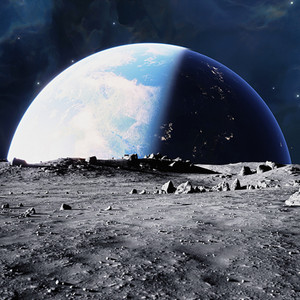
Data centers on the moon.
Every time we talk about AI or something related to storage, or I always feel like this is the future.
Why are we talking about this now?
But these things are happening as we speak.
So particularly here, Lee, What is going on?
Yeah, the company you just mentioned, Longstar Data Holdings, is actually a space startup based in St. Petersburg, Florida that was founded in 2018.
And the company is pioneering the concept of lunar data centers to address the growing demand for data storage.
And earlier this year, on the SpaceX Falcon 9 rocket, Intuitive Machines' Athena lunar Calendar was launched with a small data center from Lone Star company as the payload.
And it's really exciting because the launch of this data center was significant because it really marks a major step forward, establishing the first -ever commercial data center on the moon.
The objective of this data center was to test the viability, functionality, communication, and resilience of Lone Star's data center technology in a harsh environment of space, and eventually on the lunar surface.
Yeah, it was called FREEDOM, I think, right?
That's what the payload was called.
It was pretty small, though, right?
We should clarify that.
We say launching a data center into space.
People may think, oh my gosh, how did they do that?
Data centers are typically huge, huge structures, but that is not the case here.
It is actually just about the size of a hardcover book, weighing around one kilogram.
That sounds like a hard drive, though.
It actually had a storage capacity of 8 terabytes.
The long -term version includes scaling this up to petabyte -level storage in future missions, that's really incredible.
Yeah, I actually saw the news about this Intuitive Machines Athena project.
It's that the actually the project has failed because the lander could not stand straight right and it was landing on the moon yeah, however, you know the This this lender fell to land successfully that this lone star confirmed that the data center remained Intact on the lunar service making it the first company to have hardware for a data center on them It did it successfully and it completed a series of critical commercial operational tests including file uploads and downloads and data encryption and decryption and authentication, authentication and in -space data manipulation for its customers.
So it was considered to be a success.
Okay, why do we need to put data centers on the moon?
Well, just as you mentioned Steve, I think data centers are increasingly important especially we're having a lot of digital infrastructure They are the core of building this digital infrastructure and they are really developing like mushrooms all over the world.
But one thing is that data centers are really running out of spaces on earth.
The growth of data is really huge driven by factors such as the Internet of Things, AI and digitalization of industries.
and according to IDC, which is an analytics firms global data creation, will swell to a mind -blowing 175 zettabytes that's about 175 trillion gigabytes by 2025.
That's a zettabyte?
Goodness me, that's a that's a huge figure even if it doesn't make sense to us non -computer experts.
Data, right, it continues to churn out, not day after day, second, after second, after second, after second.
It's requiring more and more cloud computing and streaming services and data storage.
The demand for that is increasing.
That continues to skyrocket, and with this kind of exponential growth, what was that, 175 zettabytes?
These data centers are the backbone of the digital infrastructure.
we need we need them, right?
We need these data centers and the problem is we don't have enough space.
Is that kind of the main issue that we're talking about here, Yuxin?
Oh yeah, you know, as big as the world is actually, one of the primary challenges facing data center is a lack of space.
You know, constructing a data center is a massive undertaking requiring, you know, not only vast amounts of land but also significant investments in infrastructure, cooling system and security measures and on top of that many urban areas are already densely populated and leaving little room for the sprawling campuses that data centers require.
But, you know, space isn't the only issue because even when space available, there are, you know, regulatory hurdles, there are environmental concerns and also community opposition.
Any of these can thwart efforts to build new data centers or expand the existing ones.
Yeah, so even if there is this space, if it's going to be built near a residential area, well, these are not attractive -looking buildings, typically, right?
They look like warehouses a lot of the time, and people just tend to not want them occasionally built in their community.
And then, of course, yeah, they consume enormous amounts of energy, and they need these huge cooling systems to prevent them from overheating and that kind of further limits their potential locations.
It's been kind of widely known, I think, for a while, but I do think it's worth talking about for a minute or two the environmental impact of a data center because that's part of the reason that they're looking at the moon as a potential solution too.
Definitely. I think people are looking at this alternative solution.
One part of the reason is that they're looking at this environmental burden caused by those AI, especially data centers, because they are really demanding power.
Actually, check some specific data saying that how much power data centers could need.
Scientists estimated that the power requirements of data centers in North America increased from, again, some huge numbers that doesn't really make sense, but still 2688 megawatts at the end of 2022 to over 5 ,000 megawatts at the end of 2023.
Almost doubled. Yes, and globally the electricity consumption of data centers rose to 460 terawatts in 2022 and this would have made data centers the 11th largest electricity consumer in the world between the nations of Saudi Arabia and France.
So imagine they're consuming the same as countries.
A country exactly and by 2026 the electricity consumption of data centers will approach to over 1000 terawatts, in that case, they could be the fifth largest electricity consumer on the global list between Japan and Russia.
When we do our typical, you know, internet searches that we did 7 ,8 ,9 ,10 years ago, Googling something, for example, and then compare that you should, to conducting a search through Gemini or any other sort of large language model assistant, it uses more energy than your typical search, correct?
Yes, that's correct.
And that's probably even consuming a lot of drinkable water, to be honest. Google's environmental report saying that their data centers around the world consumed a total of 6 .1 billion gallons of drinkable water in 2023.
And Google calculated that its data centers used as much water as 40 .7 golf courses that's an interesting comparison like whenever you were asking questions to Jam and I would just google something yeah yeah you are drinking yeah yeah that's that's exactly true the I guess it's the computational complexity if we can call it that of AI right a google search relies on some pretty lightweight algorithms to search some web pages, but AI runs these massive neural networks to generate answers from scratch. This is kind of a shocking thing to hear.
The energy used every time you open, or sorry, every time you ask a question to AI, it's like running a light bulb for a few minutes.
That's shocking. Isn't it?
We don't pay attention to that.
But again, this is why we're looking for alternative solutions because the demand for energy, translates into carbon emissions and water use.
Yuxin you mentioned that and also puts a lot of stress on electricity grids and those electricity grids are already strained by climate change.
So there's a lot of issues here.
There was one estimate as well that says that the amount of computational power used for AI is doubling roughly every 100 days.
This is the alarm bell I think, isn't it?
because we're so, I feel like, this is how I feel, you know when a magician holds something in their right hand?
And they say, look at this, look at this, look at this shiny new toy.
And then over in their left hand, that's where the thing is actually happening.
And I feel like when we get introduced to all of these wonderful new AI creations, it's amazing, they really are wonderful technological advances.
But the thing that we should also be paying attention to is the drain on physical space on our planet that these data centers require and the drain on our environment too.
And it seems like now everybody is starting to pay attention to that.
When we look at certain parts of the world, though, are some areas of the world impacted, I guess, more than others on this topic?
I think in regions where climate change is increasingly water stressed, the water use of these data centers can become particularly concern.
The drought that happened in California where many tech companies are based has really led companies including Google, Amazon, and Metta to start water positive initiative.
And these of course, tech firms they have already announced commitments to really save more water than they consume and recycle more water than they consumed by 2030.
Their plans could include projects such as designing ecologically resilient watershed landscapes and improving community water conservation to improve water security, but still, people are questioning whether this efforts could really actually work considering how much huge amount of water, I mean those 47, is that the number, 40 .7 golf squares that they are referring to?
Golf courses, yeah.
Yes, exactly. and especially people are, there are research proving that AI and climate change is interchanging each other, especially in areas that suffer from high heat, I mean, high temperatures.
If you have more data centers built in those areas, they can actually spike those temperatures because they are, yeah.
Okay, so that's the problem with the environment.
So why then I mean all of this is why the moon has become a possible solution I guess to the world's data center problem, but why you should why is the moon a better choice?
Oh, yeah, this may sound a little bit hmm You know while we we are, you know running out of space on earth, then we're exploring spaces on the moon It feels like we're invading the moon.
Yeah, but there are some reasons that you know the advantages of of building or sending data centers on the moon.
Stable environment is one thing, the moon has no atmosphere, experiences few climate events, and it has stable radiation levels, and it is currently free from geopolitical conflicts, making it a safer location compared to Earth.
Makes sense. Also, energy efficiency is one thing of course before concerning, and that's why we've been talking a lot about it.
Certain areas on the moon are in permanent shadow and remain extremely cold, that's around minus 173 degrees Celsius.
That's eliminating the need for maybe additional cooling and enhancing the performance of electronic components.
Also, crater rims near the lunar poles are almost constantly exposed to sunlight, offering a very reliable source of solar power for data centers.
So there are advantages to putting it there, putting them there, but it's not easy to build a giant data center on the moon because the one that was just sent was the size of a small backpack, essentially.
It was done successfully.
Even smaller, the size of book.
Yeah it was done successfully, but we have to think about scalability here, right?
So what are some of the challenges that come with this?
I I would think they're pretty obvious challenges.
Yeah I think according to researchers the first major challenge would be the latency issues, because the moon is really far away, so that means data will take time to arrive, and the one -way latency is 1 .4 seconds, which actually you know means that you can't really guaranteed the data can be accessed in real time— Like live streaming?
Live streaming, and maybe autonomous vehicles or gaming, and even high -frequency trading.
They all require instant feedback, and then that can pose a major challenge for the industry who are using this data center on the moon.
1 .4 seconds? I think that's even a very optimistic estimation.
I mean, it's amazing, isn't it?
We can tolerate it.
we can get something sent from the moon in 1 .4 seconds.
That's amazing, but we're still complaining about it, it's too slow, oh, we're so spoiled.
I guess, another challenge you should, what if something breaks?
Yeah, maintenance difficulties, of course.
We got to keep a man or a woman up there as a maintenance staff.
Yeah, or I need to maybe constantly sending technicians to the moon to fix everything and maybe, and that's an even bigger challenge that human need to come over, right?
Overcome Amy. Because sending a human on to the Moon is basically, I think, the global challenge that we are all facing.
Yeah, I mean data centers here.
They have experts on site, right?
Operating those 24 hours a day, 7 days a week.
So that would be an issue.
Fixing things up there.
And then of course, this is going to cost a tremendous amount of money.
Yeah, definitely. And especially when there isn't really anything, I mean there isn't really any existing infrastructure on the Moon right now, so you have to bring everything to the Moon and you have to bring every component and that's really costly and especially we're talking about maintenance and repairment so it can really cost extra money and according to a professor from our university in the UK, each kilogram sent into space costs thousands of dollars and space -based data centers would require not only the data equipment but also the infrastructure to protect power and cool them and all
this will add up in weight and complexity.
Yeah I mean with all of the things that we just said you know why we're sending these that why we sent that many data we as if I were involved why they sent that many data center to space because we're dealing with a growing issue environmental issue, space issues here on earth.
But then when we talk about the cost and the feasibility, it just doesn't feel like something that's going to happen very soon.
But yet, companies are working on this right now.
So what what is going to happen next?
What can we expect?
At least this is a very critical and pivot step that people or human are stepping into, right?
Last summer, a European Commission funded feasibility studying to orbiting data centers published its result.
The Ascend report carried out by Talus Eliena Space, a joint venture between French and Italian aerospace groups published its result.
So these are the things that we can see, at least, we are having maybe more options in the future.
Yeah they deemed it more that from their report they deemed it more eco -friendly and they said that it could transform the European digital landscape so it seems like governments are starting to get on board with this decision.
Are we close? Probably not there's a lot of investment obviously that needs to decisions need to be made, that could be done by 2030 or 2035, but the next target is to put a small data center in orbit around the moon in 2027.
And there are other companies, the one company that we mentioned before isn't the only one.
There's another one in Washington called StarCloud they're due to launch a satellite based data center very very soon and start commercial operations in So, maybe on a small scale, we're close.
On a larger scale, that's going to take a lot more careful, careful planning, I would think.
But an interesting topic, nonetheless.
Stay with us. Coming up, we'll give you a film that maybe you can enjoy from the 15th Beijing International Film Festival.
Looking for passion?
How about fiery debate?
Wanna hear about current events in China from different perspectives then tune in to Roundtable where East meets West and understanding is the goal.
It's Roundtable time I'm Steve with Yesen and Li Yi today and the 15th Beijing International Film Festival or BJIFF is set to captivate global audiences with its celebration of cinematic excellence, cultural exchange, and innovative storytelling.
Running from April 18th to 26th, 2025, this prestigious event will showcase a diverse selection of films, from groundbreaking international features to compelling Chinese productions while hosting industry forms and so much more.
As one of Asia's most influential film festivals, BJIFF continues to bridge cultures, foster creativity and highlight emerging talent to reinforcing Beijing's status as a vibrant hub for the global film industry.
This year's edition promises to be a dynamic convergence of artistry and innovation, drawing filmmakers and critics and cinephiles from all around the world.
Today and for the next few days, we'll be introducing you to a film from the festival that's being screened that we hope that you'll enjoy.
So, Yuxin, what is today's film?
Yeah, so the film that I recommend is called Vetrivil of a triple the most beautiful village in the world and it is directed by two Belgian directors living in Brussels named Baptist Borat and Norwell, Boston if I am pronouncing them their names, right the film was nominated for best film in the tiger competition at the International Film Festival of Rotterdam and also this Beijing international film festival.
Already recognized as a good film then?
The story takes place in Vitrovol, a small village in the south central region of Belgium.
It's not a big place with just over a thousand residents.
And life there is usually quiet and uneventful.
But the peace doesn't last long.
Out of nowhere with weird graffiti all over the town.
Most shockingly, a series of suicides shatters the village's tranquility.
And a dual police officers trying to figure something out or figure everything out.
The two directors don't focus on solving the mystery instead they use the perspective this quirky police dual to immerse us in the rhythm of a village life and all the characters in the film are played by local residents.
Oh cool, that's fun.
including including you know some of the director's own relatives Oh really and this lands the film a very striking sense of authenticity making a feel as if you are truly there after watching the trailer I felt that you know the whole film or rather the town itself gives off a very relaxed and maybe laid -back vibe because of the name you know the most beautiful village in the world and initially I thought it would be you know poetic kind of film But the element of where we introduced mystery in the storyline seems to add a layer of intrigue Which makes me even you know more curious to see what actually
happened there There are elements of comedy in the film too, correct?
Correct. That's why I think you know the the atmosphere the environment of the film gives you a sense of Humorous, I think that's that's because you have this huge contrast and on the other hand is a comedy film meantime there's so suspense stories that's always making films or stories much more compelling and one example would be the white lotus the very popular tv drama i think it's also popular because on the one hand all the stories happen on the luxury resorts in very beautiful islands in meantime every there's always one person who would just die and every first episode would actually build
up the suspense and i think that's yeah a real gem thank you yu shen for recommending this film.
And it's got that small town element.
Everybody knows each other.
But then the actors are actually people from there and some relatives of the filmmakers.
I don't think I've heard of a project quite like this before.
Give us the name of this movie one more time, please.
Vitrival, the most beautiful village in the world.
Again, that's a film being screened at the 15th Beijing International Film Festival, and it certainly sounds like it's a film worth watching.
That brings us to the end of today's Roundtable.
Thanks Lee. It was great to see you again.
Thanks Yuxin for joining the show.
Thank you for your time.
You can find us at Roundtable China on Apple Podcasts.
My name's Steve, and we hope to see you again next time.