Welcome to Spotlight Advanced.
I'm Colin Lowther.
And I'm Alice Irizarry.
Spotlight uses a special English method of broadcasting.
It is easier for people to understand no matter where in the world they live.
A small craft flies through space.
Stars shine bright in the darkness.
Two large space rocks or asteroids float in the distance.
One asteroid slowly circles the other.
The spacecraft, called DART, rockets towards the smaller asteroid.
DART goes faster and faster.
Soon, it is traveling at over 22,000 kilometers an hour.
It crashes into the side of the asteroid.
DART blows apart.
A cloud of dust and metal flies up from the asteroid.
And slowly, this smaller asteroid begins to change direction.
On Earth, scientists watch the crash through the DART's cameras.
When the camera stops, they cheer.
Some hug each other.
It is the first time humans have tried to move a natural object in space.
And it has worked!
But the crash is much more important than this experiment.
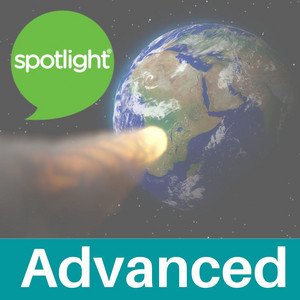
A spacecraft like the DART may one day save the planet from destruction.
Today's Spotlight is on the DART project and the future of planetary defense.
Asteroids are not usually a danger to the Earth.
Small asteroids enter the Earth's atmosphere every day.
Objects often hit the Earth, but they are not large enough to do any damage.
Or these asteroids fall in places where no one lives.
But asteroids come in many different sizes.
Some are only a meter across.
Some are larger than one kilometer.
If an asteroid this big were to hit the Earth, it would cause a lot of destruction.
Erik Kristiansen is a scientist at the Catalina Sky Survey.
He helps find asteroids and other objects that could be dangerous.
He spoke to the University of Arizona News about these large asteroids.
The force of an object that size would cause global problems.
It could cause plants and animals to die out.
It would lift a lot of dust and water into the atmosphere.
The effect would be like a nuclear winter.
Less sunlight would reach the ground for several years.
It would change the global food supply.
Even smaller asteroids are dangerous.
In 1908, an asteroid fell over an area in Russia called Tunguska.
Instead of hitting the ground, it exploded in the air.
Still, the asteroid did a lot of damage.
It destroyed over 2000 square kilometers of forest.
Scientists suggest the explosion was as powerful as the biggest nuclear bombs ever tested.
Chu Chen was a member of the Shanyagir tribe.
He was in the woods when the Tunguska asteroid fell.
He spoke to I.M.
Suslov about his experiences.
The earth began to move and shake.
The wind hit our house and pushed it over.
My body was pushed down by sticks, but my head was fine.
Then I saw a wonder.
Trees were falling.
The branches were on fire.
It became very bright.
How can I say this?
It was as if there were a second sun.
My eyes were hurting.
I even closed them.
It was like what the Russians call lightning.
This explosion is known as the Tunguska event.
It is the biggest asteroid to hit the Earth in recent history.
But the Tunguska asteroid was not extremely big.
Scientists believe it was about 65 meters across.
Even events like Tunguska do not happen very often.
But it is important to protect against them.
Over the years scientists have mapped many of the large asteroids.
They know where they are.
And they can guess where they are going.
But scientists did not know if they could change where an asteroid fell.
They did not know the best way to do it.
One method scientists have discovered is called kinetic impact.
A kinetic impact would mean pushing an asteroid.
Scientists would not have to push it much.
A small push in the right direction could make an asteroid avoid Earth.
The DART project was the world's first try at kinetic impact.
It did not target an asteroid coming toward Earth.
Instead, DART was a test.
In fact, the name DART itself stands for Double Asteroid Redirection Test.
The rocket would fly toward a large asteroid called Didymus.
Once it came close, it would fly toward a smaller asteroid called Dimorphos.
Dimorphos circles, or orbits, around Didymus.
It is the same way the Moon orbits the Earth.
Then, DART would crash into Dimorphos.
Scientists hoped the crash would move the asteroid.
They wanted to shorten its orbit.
By studying the orbit, they could see how much force DART had.
Then they could use that information when trying to push asteroids in the future.
Ed Lu is the director of the Asteroid Institute.
It is an organization that focuses on planetary defense.
He spoke to news organization NPR about the DART project's success.
The point is, this is a great thing.
Someday we are going to find an asteroid which has a high chance of hitting the Earth.
We are going to want to avoid it.
We should have some experience first.
We should know that this would work.
DART was a project started by NASA, or the National Aeronautics and Space Administration.
The United States provides the money for this government agency.
But many other countries came together to make the project possible.
The Japanese Aerospace Exploration Agency helped.
The Italian Space Agency helped monitor DART.
In several years, the European Space Agency will send a ship to Dimorphos.
They will study what changes DART made to the asteroid.
Defending the planet is important.
Asteroids are not an immediate danger to Earth, but in a hundred years we may need this technology.
But planetary defence is a very large job.
It requires many countries to work together.
Bill Nelson is the NASA administrator.
He spoke in a press release after the DART test.
As a whole, DART represents a great success for planetary defence.
But it is also a project of coming together.
It helps all humanity.
NASA studies space and our home planet.
But we are also working to protect that home.
This involved many countries working together.
It turned made-up science fiction stories into science facts.
And it demonstrated one way to protect Earth.
Have you heard of the DART project?
Do you think it is important?
What else could people do to protect the Earth?
You can leave a comment on our website or email us at radio at radioenglish dot net.
You can also comment on Facebook at facebook dot com slash spotlight radio.
The writer of this program was Dan Christman.
The producer was Michio Ozaki.
The voices you heard were from the United Kingdom and the United States.
All quotes were adapted for this program and voiced by Spotlight.
You can listen to this program again and read it on the internet at www.radioenglish.net.
This program is called DART.
You can also get our programs delivered directly to your Android or Apple device through our free official Spotlight English app.
We hope you can join us again for the next Spotlight program.
Goodbye.