Movement is so much more than just exercise or training or motion even.
Movement is a language.
It's a way of connecting body, mind, and environment.
Movement as a way of being.
A way of being that brings me close to myself, closer to other people and to what matters most in life.
And for me, what we wear in that pursuit plays a crucial role.
And that's what I appreciate about Onn.
They engineer apparel that supports and elevates the practice of movement itself.
From running shorts with built-in support to technical tees that cool you down right where it matters.
This is apparel born from precision and tested by elite athletes, but made for anyone committed to the path.
I've been with On since 2023 and I'm still just so impressed by how they continue to elevate and innovate in the name of purpose, not flash.
Head to On.com slash Rich Roll to explore gear that supports you every step of the way.
We're brought to you today by the wonderful folks at Go Brewing.
Let me tell you a story.
A few years ago, this guy, Joe Chura, rings me up out of the blue and he asked if I'll fly out to Illinois and speak at this event that he was hosting, called Go, which ended up being this really incredible weekend oriented around taking inspired action.
Joe and I hit it off, but, you know, That was kind of that.
And it wasn't until I ran into him a couple of years ago at Jesse Itzler's Running Man event that I realized that he had taken inspired action himself by creating this new enterprise that was also called Go.
Go Brewing, in fact, which from Go has grown into what it is today.
One of the most exciting revolutions in craft brewing.
One of the many things that makes Go Brewing extraordinary is that they don't outsource, like most companies.
They handcraft everything from scratch in small batches.
In fact, this commitment to quality has fueled their growth into one of America's fastest growing breweries, now in over 5000 locations across 20 states and available online.
The salty AF gelato earned the untapped number one non-alcoholic lager in the United States.
And they're constantly creating bold new flavors almost every month that push the boundaries of what non-alcoholic beer can be.
Double IPAs, mouthwatering sours, all with zero added sugars and none of the junk.
Hear that?
Incredible stuff.
The non-alcoholic revolution is here, people.
I am proud to help champion it alongside Joe.
So get on board by getting with Go, by going to gobrewingcom where you're going to use the code RICHROLL for 15 off your first purchase.
Go.
I'm so competitive once I'm in, like I'm all in and I'm going to do whatever I can to be the best I can be.
And the biggest thing that I learned just from my age and being in the sport for so long is listen to your body.
I think you always wish you can do what you wanted to do when you were younger.
And, you know, when your body needs a break, you need to take breaks.
I'm a big believer in learning from people.
I think researching and learning what's going to work best for you is really important.
The theme of age-defying athletic feats has been a pretty steady and recurring one here on this podcast and pretty much from the beginning and across the pages of Finding Ultra, and it's sort of part and parcel of what I talk about when I talk about what it means to transcend the limitations we impose and imagine in the world of athletics when it comes to what we are capable of doing with both our bodies and our minds.
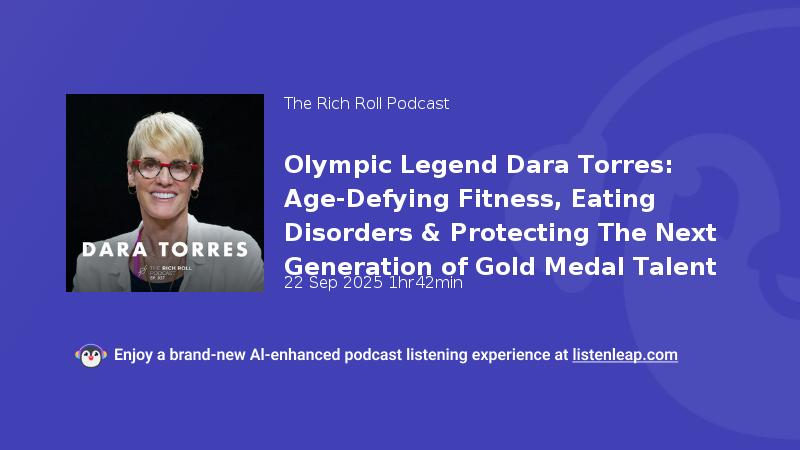
And, insofar as this idea goes, there is nobody more emblematic of it than today's guest, because Dara Torres is the complete, absolute embodiment and pinnacle of age-defying athletic excellence.
Exceeding all labels, every expectation, to essentially astonish the world by winning Olympic medals at an age that others presume to be just well past her expiration date.
As many of you know, I was a competitive swimmer myself.
And because Dara and I are basically the same age, she's somebody, this athlete that I first came across as a young teenager, and basically this person that I can't even remember not knowing about.
But for those who are not in the know, Dara is one of the most accomplished and decorated female athletes in Olympic history, a sprint, freestyle and relay specialist, with 12 Olympic medals and three world records to her name.
She's also the first swimmer to represent the US in an astonishing five Olympiads, her first being in Los Angeles in 1984, when she was just 17.
Then there was Seoul in 88, Barcelona in 92, Sydney in 2000, where she won five medals.
And finally, all the way to Beijing in 2008.
Well, it's worth noting missing out on a sixth Olympic Games in London in 2012 by only four one thousandths of a second.
Along the way, Dara has had many high highs, but also plenty of low lows, as well as a couple retirements and comebacks, each of which were more remarkable than the one before, for doing things people thought impossible, given the advancement of her age.
So to put things in context at the time, throughout Dara's career, it just wasn't a thing that a swimmer could be competitive on the world stage beyond a certain age.
And that age was somewhere in the mid-20s at best.
And yet, during her first comeback in Sydney, when she was 33, Dara became the oldest member of the USA team.
She became the oldest woman to medal in swimming and won more medals than any athlete on the team that year.
Then, after birthing a child in 2006, she returned for her second comeback to break the 50 freestyle American record in 2007.
And in 2008, at 41 years of age, broke it again in Beijing, where she took home three silvers and the distinction of having swum the fastest 100 freestyle split in the world ever, when she anchored the 4x100 medley relay.
And then again...
I should say, at the Olympic trials in 2012 at age 45, almost made, as I said earlier, her sixth Olympic team, narrowly missing it by only four one hundredths of a second.
So this is a person who has done it all, even in retirement, where she found a different kind of success as a sports broadcaster, as a fitness influencer.
Before that was even a thing.
She sold something like 10 million Tybo DVDs with Billy Blanks back in the day all the way to today where she is in her second year as the head swimming coach, her first coaching post at Boston College.
Dara is one of the most fiercely competitive people on the planet, probably the fittest 58-year-old on Earth.
And still getting after it.
So how did she do what she did?
How does she continue to do what she does, which is to defy gender and age expectations, to essentially excel in life, in so many different ways?
So that's what today is about.
It's a conversation about self-belief and self-sacrifice, determination and dedication, resilience and motivation, perseverance and parenting, including parenting herself, her daughter and now the next generation of aquatic talent.
So buckle up people, because Dara is a true force of nature.
Dara, so nice to meet you and have you here.
I think you, did you just arrive from Singapore?
I did.
I was out there for World Aquatics so I was pretty busy out there and got in last night and my first stop is you.
How did the U.S. team do?
Like I admit, I didn't really follow the meet.
You know, they're doing okay.
I think that when they had their, from what I understand, they had their training camp in Thailand and a lot of them got sick.
So, like some kind of bug or whatever.
So, some had to scratch some events.
Like Gretchen Walsh, she scratched 100 freestyle even though she won the 105.
And there's a lot of something going on.
So, I don't know the exact amount of swimmers who got affected by it.
But I think a good majority of the team did.
Well, I think it's a really interesting time for USA Swimming.
Like we can no longer just expect to dominate at every meet.
I think Paris, you know, is kind of a referendum on that.
And perhaps, like my sense of the team in paris was that it's sort of in transition, like there were a lot of very, you know uh, accomplished swimmers with storied careers at the very end of their career trying to hang on, and then this new crop of young talent um, that is sort of just beginning their olympic journey, and so there wasn't anyone really who was right in the pocket of that sweet spot where you know we we tend to like always have, you know, these standout performances from from our country.
Yeah.
You know, it's tough also because the year after Olympic games is always a rough year.
You know you're really gearing towards the Olympic games and considering that, you know it was just a year ago that they had them to be able to come back and swim at worlds.
We probably don't have our deepest talents.
Um, I mean, we have a lot of great swimmers there, but uh, you know, some people are taking off and taking a break and some people don't train as hard.
You know, this past year.
So um, it's not uh, a great um sort of uh environment to see where our really our best swimmers are.
And you look at australia too, like they don't have their.
A lot of their top swimmers aren't there either.
So Well, I was trying to think if we'd actually ever met, and I don't think we ever had.
But we're about the same age, almost exactly the same age, and have been in sport for a long time.
And you were on this incredible trajectory.
My trajectory was less interesting.
But you're somebody who I have, despite not having met, you have, of course, known of, since I was probably 14 or 15 years old.
So it's really fun to have a legend sitting across from me.
And you're story is super fascinating.
And I think people who follow swimming or know who you are are familiar with the two comebacks and kind of doing something that no one had ever done before by winning these medals in your fifth Olympics at age 41, which is just an incredible story.
But I think what gets lost in the sort of narrative here is that, for somebody who isn't like really familiar with what swimming was like during our time, like when we were in high school yeah, like there was no money in swimming and there was this idea that like basically, like nobody was extending their career past 21 and i, and part of that was because there was no money so no one was even trying to uh, but that idea was that like well, that's your peak, you know, maybe there's a few people who could extend it to 24 or so, but like nobody was going into their 30s, let alone like, oh my god, the fourth decade, like that was just absolutely unheard of, even though We kind of see that stuff now happening all – kind of all over the place.
And I think you broke a barrier there.
And especially with women athletes, like I think we both know of many, many – young female swimmers who you know would make this huge splash at between 14 and 16 and go to the Olympics, but then could never kind of repeat those performances.
So I feel like it was even more outrageous that that a woman athlete could could like do this thing, you know, and I think people who don't know swimming, like kind of don't don't get that aspect of it.
Well, you know, I think you did nail, nail the nail on the head when you said that you know, you didn't, you peaked at an early age, or that there wasn't money in the sport.
And I think that was the biggest thing is there wasn't money in the sport.
So when you got done with college, that was it.
You move on to the next chapter in your life.
And that's what I did.
I mean, I graduated college and I went to New York and was doing sports modeling and some TV work.
And working behind the scenes at NBC Sports and being like really busy.
But you know, I think for me I was lucky that I was able to save some money.
Come back and swim again.
And, you know, then money started being the sports.
I started paying athletes.
You know, at the Olympic Games, if you want to gold, silver or bronze.
And you start to see that more and more.
And then, you know, Michael Phelps came onto the scene and it sort of just, you know, pushed swimming into a different level where people were excited about it and wanted to sponsor athletes.
And there's a lot more money in the sport than there was back in the day, you know, when we were swimming in our early 20s or late teens and stuff.
So I think that they had that myth.
And you're right too, that you know women tend to peak, or I guess they think they peak when they're like teenagers.
But you have to remember that a woman's body changes in a different way than a man's body does.
And so it's a little tougher for women when you get, like you know, go from like you know a girl to you know a woman.
It's not easy.
I mean I went through lots of ups and downs which I know people in the swimming world probably remember, like in college at a really tough time.
And then I got an eating disorder.
And, you know, it was just a, it was a rough time for me.
But then my body got to the point where, I don't know, it got better and better and better.
And I was able to do what I did.
But, you know, I also took care of myself.
I worked out all the time.
And, you know, not knowing I would in between my long breaks that I'd be making a comeback.
But I think the fact that I stayed active really helped also.
Right.
The idea that you were never really out of shape even though you were taking these you know multi-year breaks.
But you know, the other thing is, until you and Pablo did it, you know both of you you, Nobody at the highest level of swimming had ever like, taken a year off, let alone a couple of years, and come back at all.
Like, I don't even know if that had ever even been tried, let alone tried successfully.
Yeah, I think, I didn't know how it was going to be.
I remember when I made a comeback after having my daughter, I went to the doctor, my orthopedic surgeon.
I'm like, hey, I said, can you just like x-ray my body and make sure like everything's okay?
Because I don't know like if I can do this or not.
And he's like, what, do what?
And I said, I want to make a comeback.
And he's like, oh, and he's like, so you want me to x-ray like your body parts?
I'm like, yeah, just make sure like everything's, he's like, okay.
I don't even know if he did it.
He just like all of a sudden he comes back in the room.
I don't know what an x-ray is going to reveal unless your bones are broken.
Yeah.
I don't know.
And he's like, yeah, everything's great.
Just go for it.
I'm like OK, you know and, and like I had no idea how I was going to do and what was going to happen, and if my body could, could handle all the training.
And, you know, I realized really quickly that, you know.
I had to add recovery in there.
And when I look back on my career and people are like, oh, you took so many years off.
How'd you do that?
I think my body was recovering that whole entire time.
Because, as you know, in the old days they used to just pound the yardage all the time and you didn't really have time to recover, except when you tapered which, for your audience, that's when you start resting for a meet.
Um, you know, that was really the only rest you had and you had maybe one or two weeks off a year.
It was a year round sport.
And so I think uh, in reality uh, my body was allowed to rest and be able to come back after all those years of training.
So I think it was a blessing in disguise.
You spared yourself, like.
You know what so many swimmers had to endure.
You know which is just basically decades of walking around like a zombie.
Yes, exactly.
Yesterday I had Andy Galpin in here, who's a strength coach.
I don't know if you ever heard of him, but this guy is, like you know, just a font of incredible knowledge.
And he was talking about when it comes to fitness, like you always have to start with efficiency first, you know, and kind of build on that.
Right.
And we were talking about all the facets of what goes into, you know, fitness from a holistic perspective.
But I was sharing with him, like, you know, what swimming was like.
Back in the day where it was just like no periodization, not a single thought for recovery, like sleep is optional.
Like it's like it's you just sleep deprived the entire time.
So of course you're not.
I mean, you can get away with it when you're young, but you're not really giving yourself the opportunity to recover, which is how you actually get better.
Right.
And that was just the way that it was, like volume, yardage.
And on top of that, like you're at Mission Viejo, which is like the birthplace of that whole kind of like training philosophy.
So you grew up in Beverly Hills.
You're this standout kind of from the get-go.
You break your first world record at like 14 or 15, which is insane.
Yeah.
And then you decide to go down to Orange County and train with this guy, Mark Schubert, at this program called Mission Viejo, which was just like that, was like the Mecca.
You know, in the in the early 80s, like during that period of time, it was almost like there was a whole mythology around what was going on there.
Well, you know, it's funny because you made this big thing about Mission Viejo and Mark Schubert.
And obviously, you know, and I know that he was known for distance swimming.
And like, why are you going to this guy was given more yards than anyone.
I know.
You know, why don't you just stay local?
And I was like, you know, there's I just need to be on a bigger team.
And because I was on the team that I had, I didn't have a lot of competition to be able to to like race and practice.
And that's why I was looking for a team in Fort Lauderdale was the team I was looking at.
And he convinced me to stay and said, Oh no, like I have these male sprinters coming in.
They're going to be great.
And you know, my training for sprinters is much different.
And I'm like, Hmm, you know, do I believe this?
And so when I went there, sure enough, like we got in after everyone, we got out before everyone our, our training wasn't like long distance training.
Like he really catered to, yeah, he was very true to his words and catered to the sprinters.
So yeah, It wasn't as bad as what someone from the outside looking in would think.
Sort of imagining you at like 16, you know, just doing like you know.
Like you know, 18000 meters a day, you know, for a 20 second race.
I'll tell you like at University of Florida with Randy Reese, he would have us on Fridays do a 6000 per time.
And I'm thinking, what is this?
I mean, I can't even count to a 500 being a sprinter.
So to do a 6,000 per time, that was a little bit brutal.
Yeah.
Like a 50 meter or like a 50, a hundred meter dash runner.
You know like doing, you know like 20 mile long runs or whatever.
Yeah.
That's changed a lot.
And I think you've played like a vital role in like re-imagining what swim training could be.
So you have all of this success, 1984 and 1988, but like all of your medals are in relays.
You still have that elusive, like sort of Olympic, you know, like individual Olympic medal.
What was the thought process in making this comeback in the first place?
Was it just unfinished business or just feeling like you had more to express here?
Or, you know, like you were it's not as if you were navel gazing and had nothing to do, like you had this career as a broadcast.
You had a very flashy, like you had made this transition into this very public facing kind of glamorous career.
You know, it's funny because I think a lot of the times when athletes make comebacks is because that's what they're used to and what they've done their whole lives and they miss it like that.
And the world is just confusing without it.
Like a veteran coming back from you know an overseas conflict, and like doesn't really know how to function in the normal world.
Exactly.
And I wasn't like that.
I had a lot of stuff going on.
And when I made my first big comeback for 2000, I had been off seven years like I didn't touch the water.
And I was like 32 at the time.
Like, there's no way.
Like, I haven't swum in seven years.
And I don't know.
Once the thought was in my head.
I'm really the type of person that loves challenges and loves trying to do something someone else hasn't done.
Clearly.
And so trying for a fourth Olympics after taking seven years off, I'm like, oh, that'd be cool.
Let me see if I can do this.
And Richard Quick at Stanford decided to take me on.
And you know it was a very successful Olympics at 2000, won five medals, finally medaled in individual events, which was great.
And, you know, that was that one.
And then when, like fast forward six years and I got pregnant with my daughter you know I was I was like hey, I'm going to go to the gym.
I have to work out.
And it just wasn't working out because I kept getting sick every time I went to the gym.
And so I thought well, you know, if I go to a pool, I can get sick in the gutter, and I can keep swimming.
It's not a big deal, you know.
So I ended up going to a pool and started swimming a little bit while I was pregnant and then ended up joining a master's team at Coral Springs.
And then, about a week before I was supposed to deliver, the coach was like hey, we have a master's nationals here in like three weeks.
Can you swim in it?
And I'm like, I think I'm delivering in like a week.
So I highly doubt my doctor's gonna let me swim three weeks after I deliver.
And he's like well, just ask.
And I'm like okay, and I don't know.
One thing led to another and I convinced my doctor.
So three weeks after I had my daughter I swam at Masters Nationals and you know, did okay.
And then after that I got convinced to go to Masters Worlds, which was like two and a half months later it's at Stanford, and I somehow made qualified for Olympic trials.
I didn't mean to, but I did.
And then all these old people kept coming up to me and saying hey, you should train for the Olympics and represent us middle-aged people.
And I don't know, after a lot of nagging, I'm like, all right, I'll do it.
You know, not really thinking.
And that's when I got the x-rays.
And he's like, oh, yeah, you can swim.
Right.
I decided to swim.
A couple of things.
First of all, is it true that you worked out every day for all nine months of your pregnancy?
I tried to.
I mean, I literally was nauseous every day my whole entire pregnancy.
So when I did try to go to the gym, I kept getting sick to my stomach.
So the swimming really helped.
It helped me with my nausea and it helped me feel good about myself actually working out.
And getting up on starting blocks like three weeks after giving birth and like doing fine.
Not a pretty sight.
And then like two and a half months later, actually making Olympic trials like that is insane.
You know, like setting aside the age aspect of it, you know, to begin with.
But I think I want to start with the first comeback.
You know the lead up to 2000 where you competed and you were 33 at that time.
And that was like that was like, oh, my God, 33.
Like, how could you do that?
Like, you know, let alone like, oh, my God, 41 later.
But I just remember, because you arrived at Stanford to train with Richard Quick who, for people who don't know, is just an absolute, like you know, legend in the sport and beloved by, like anybody who had the the good fortune to train underneath him.
And he was new at the time as the women's coach at Stanford.
And so you kind of showed up right a little bit after I had left.
But our alumni network, there's gossip and like, what's going on?
Dara's training with Richard, and we're hearing stories about like weird training protocols and you know you're doing things like no one had ever done before and we're like wow, what's?
You know what is happening over there right, so that it seems to me there was like there was some, there was some mythology around that too, because you were experimenting, there's a, there's a very kind of locked in, standard way of how to train, right and and you don't really challenge that dogma too much.
But you came in clearly like asking questions and had found like a, A partner in Richard who you know I can only assume was like really game for this challenge of like approaching what you do through a completely new and different lens.
Well, you know he was actually like that too, because you know, for me, I actually love training with coaches who like to think outside the box.
Uh, and so when the minute I went to him um, you know I remember first of all he changed my stroke completely.
Like it was, he's like, we don't swim like that anymore.
And I'm like, wait, what?
You know?
And so he had a completely changed my stroke.
And then after like the first week, he's like, Hey, you know, I want you to go talk to this person.
I'm like, who?
And he's like, well, he's in Washington, um, state and his name is Richard Diana.
And uh, you know, when i was coaching in 96 and i had to coach the women's relay like he was the woman's coach and he was going to be the woman's coach in 2000 um, he's like every personality on that relay was different.
So if you tell them something, one person may be able to take it in, but the other three may not understand it the way the other person.
Does he go?
He said so i want you to go see this this person and he's going to evaluate you and let me know the best way to coach you.
And I was like okay, this guy had me doing like crazy stuff, you know, and I get back and the outcome was that I'm a very visual learner.
So if you try to tell me something on how to do it, I don't take it in.
Like you have to physically show me how to do it and then I have it like right away.
Or you'd videotape something I was doing wrong.
I need to look at it and then I can figure it out.
Instead of him saying hey, your elbow's not high enough when you do this.
I still won't do it right, unless I see it.
Mm-hmm.
And so he was the one who actually would think outside the box.
But then he wanted us to go to Pilates.
And I'm like, okay, I'll go to Pilates or whatever.
And I'd never done it before.
And I went to Pilates and I found it was like making me tighter, not looser.
And the third time that I had gone, there was a guy in the corner who was like stretching someone, like doing these crazy, like pretzel stretches and stuff.
And I said to my Pilates instructor, what's that guy doing?
He said, oh, it's stretching.
He goes, actually, this might be better for you than Pilates.
So I met this guy and he has a partner that he worked with and they do resistive stretching, working like the different Chinese meridians in your body.
And...
I was like, great, I'll try it.
And so I also like to feel what it does for you, not just hear.
And so after he worked on one side of my body and it was such a difference compared to the other side of my body that he had worked on, I was like this is amazing.
And so I introduced him to Richard and Richard.
He worked on Richard and Richard's, like that's it, hire.
Like, you know, once he worked on him, he's like, I want you to work with him.
So That really helped a lot with my recovery after my practices.
Going and getting the stretching done and taking them to the swim meets with me and taking the Olympics with me.
It was huge.
But yeah, I really loved working with Richard because he would do things that a lot of coaches wouldn't do or weren't up to date with.
Mm-hmm.
Instead of just pounding the yardage, which was huge.
And he's the one who actually taught me about recovery, because there was one time when we got in the pool and started swimming.
I guess he could tell I was like exhausted.
And I was always the type that would do my practices and then go run like five miles after.
I always want to do more because, in my head, if I'm doing more, I'm going to be faster than everyone else.
And so it was like a Friday morning and we got him warmed up and he's like Daria, I want you to stand up and do an all out 25.
I'm like, okay.
So I get up and he timed me.
He's like, all right, you're getting out.
I'm like, what?
And he's like, you're out.
And I said, why?
And he said, because you're exhausted.
You look exhausted.
He goes, I want you going home, sitting on your couch, watching movies.
You're not doing anything all weekend.
If I see you running, like, you know, you're going to get in trouble.
Like, I don't want you lifting, doing anything.
I came back Monday morning, had like the best practice in my life.
And I'm like, oh, okay, this is what recovery is.
Rather than just being exhausted for, you know, five to eight months and rolling the dice on a taper.
Yeah.
So this guy, Andy Galpin, yesterday he framed that as the difference between what he calls like functional overreaching, which are periods where you're purposely beating yourself up and you know when you get up and try to do a 25 for time from the blocks that it's not going to be great.
But when you get those two days of rest or whatever, you're going to bounce back and have this super adaptation versus Like non-functional overreaching, which is you're just beating yourself up and like digging this hole.
You know, it's funny because I'm now a year into coaching at Boston College.
And one of the reasons why I didn't want to coach like a long time ago is because I didn't want to ruin someone's taper.
You know like tapering and resting for each swimmer is so individualized.
You know, compared to just tapering as a group.
And that was like a big fear of mine is like what if I ruin someone's taper and they swim horrible?
And then it's like on me and making sure they get the right amount of rest and stuff and making sure that you know when you're doing practices that if they need a recovery day, you give them a recovery day.
And so that was something I was very fearful of when I took this job.
Yeah, because you can only give, when you're coaching a team, you can only give so much individual attention to each person and they all have those different needs.
Yeah, but i like what you shared about about richard uh, approaching you initially from the perspective of, like i don't know how to help this person until i first learn how they, how they learn you know what i mean.
Like that's a very cool um, you know, kind of glimpse into somebody who is thinking different and thinking in the right way.
Yeah, because there are a lot of people that are analytical and they and they take things in a lot differently than someone who's visual.
Yeah.
To me, when I think about your career, that seems to be like the first instance in where you're not just necessarily thinking outside the box, but you're starting to get the idea of building a team around yourself that extends beyond just your swim coach.
And then you really kind of like push the envelope with that for the next go around.
I did.
I realized that I couldn't do it by myself.
I was going to be 41 years old.
I started at 39 training for 08 and I had a little less than two years and I felt like there's no way I could do this by myself.
So I had to find someone who would think outside the box with strength training that You know, it's like what your Andy said that you talked to yesterday.
It's about figuring out how to be efficient in the pool, and not necessarily be the strongest in the pool, you know, or efficient in the weight room equates to being efficient in the pool, rather.
And I had like a massage person.
I had my stretching trainers.
I had, like everyone who could help me.
And so my role in that was the one who was doing the training, and that was standing up on the blocks and swimming.
So we each had a role and I really surrounded myself with people who had no egos.
So we were all in it together and it was just an awesome feeling to have this team that would work with me, because there was no way I would have been able to do it by myself.
Yeah, it's an interesting equation to solve.
On the one hand, like you're older than everyone else.
You're training in the pool with like teenagers, you know, and you're mature enough to know like hey, I'm not gonna be able to like do the double workout thing and kind of do it the way.
This kind of goes down.
Over here.
I've gotta figure out a different way, but I also have this maturity and all of this experience and I know how my body works and I'm going to explore, you know, how to get the most of it, given like the fact that I'm older and like what does that look like and what will that require?
Yeah, it was a little bit of a process and at least I had a couple years to sort of like figure it out.
But I think what really surprised me after going through all that is that, you know, considering what I was able to do at 41, why weren't there more people asking me like hey, what did you do?
What like, you know, what were these trainers for?
What, you know, and I really didn't have a lot of people ask me.
Like I had a few coaches here and there.
But you'd think, if something works for someone like, why aren't you trying to figure out what it is that worked for them?
So you can do that too.
And so what were the key elements like looking back on that that you think were the biggest differentiators in how you were training that led to your success.
I think.
Well, in 2000 I worked with a strength coach who was all about being the strongest because it would equate in the water.
But I also felt so heavy in the water when I was swimming because I was probably 10 pounds 12 pounds heavier than I was in 08.
So finding the right strength coach that would really, like I said, was about efficiency and about using body weight and using your core in every exercise.
Also, what was really important to him was using a lot of different muscles at once as you're doing an exercise, because that's what you're doing in the pool.
That's what you're doing when you're on a track.
You're not using just one muscle.
You're not just doing a bicep.
Right, these functional exercises.
Very functional, yes.
So that was one thing.
Dynamic.
Yeah.
Yeah.
I learned that there was no way I can do double workouts.
Like my body just was not going to do that.
So in my head, though I was so used to old school of the more you do, the better, the heavier you lift, the better.
So the hardest thing for me was not physically trying to do that, but wrapping my head around, sort of mentally that okay, I'm not doing as much as the kids and I'm only going five workouts a week instead of nine, like is that going to be enough for me?
You know, when I go to Olympic trials and Olympic games, and so the mental aspect of it was probably the biggest obstacle for me.
To get over and know that no, that's what your body can do and you know it's okay if you're not doing what everyone else is doing.
Sometimes the things we think are good enough suddenly get better in ways we did not expect.
And that's what happened when AG1 launched three new flavors.
Look, I was perfectly happy with the original.
I've been drinking it every morning for ages.
It does its job.
But then I tried tropical, which tastes like papaya and passion fruit.
There's berry, with these blueberry strawberry notes, and citrus, with this lemon orange thing going on.
This isn't about chasing novelty.
It's about recognizing when something great becomes even better.
The nutritional foundation of AG1 is exactly the same and remains solid.
Multivitamin, prebiotics, probiotics, and superfoods all in one scoop.
I still feel that sustained energy, digestive support, all with the same confidence I'm covering all my nutritional bases.
But now there's variety baked into my morning routine.
All plant-based, no added sugar, no shortcuts taken.
So if you've been on the fence about AG1, hung up about the taste, consider that fence officially removed.
Give the new AG1 flavors a try today.
If you head to drinkag1com slash richroll, you'll also get a free welcome kit worth 76 bucks when you subscribe, including five AG1 travel packs a shaker, a canister and a scoop.
That's drinkag1.com slash richroll to get started.
This show is sponsored by BetterHelp.
So I just read this book called Dealing with Feeling.
That's right.
Dealing with Feeling.
It's by this Yale psychology professor called Dr. Mark Brackett.
And it's all about emotional intelligence and why learning to understand and regulate our emotions is like the most important skill you can learn to live a better life, but also to better help others with their emotions.
He calls it co-regulation, which in some sense kind of means that we can all act as therapists for each other in some way, which is an amazing thing, very cool, but and this is a big but it's not a replacement for talking with someone who's actually trained to help you.
Therapists are not just good listeners.
They're clinically trained professionals.
They understand patterns.
They identify underlying issues.
And obviously they're well equipped unlike your barber or your bartender or your best friend to provide you with tools that actually help.
BetterHelp has been helping people find their therapeutic match for over 10 years.
They have a 4.9 rating from 1.7 million client reviews.
They do the matching work for you, and if it's not the right fit, you can switch therapists anytime at no extra cost.
It's completely online.
It's flexible.
It fits into your life.
As the largest online therapy provider in the world, BetterHelp can provide access to mental health professionals with a diverse variety of expertise.
Find the one with BetterHelp.
Our listeners get 10% off their first month at betterhelp.com slash richroll.
That's betterhelp.com slash richroll.
It's still crazy when you think about the fact that your race is like.
Compare it to how, like 100 meter track and field runners train.
Right.
Like it still feels like there's a lot to be learned about how to coach sprinting for swimming.
I think it's you know a lot of the mid-distance and distance.
Kids will tease the sprinters because we don't swim as long and our races are so short.
But I honestly think swimming the 50 freestyle is probably the hardest race to swim.
Not from a physical aspect, because obviously 400 IM, 200 fly, those are really hard races.
But mentally, your start has to be on.
Your race has to be on.
Your finish has to be on.
You can't make one mistake.
It's not like swimming a 200 where you can fix something really quick and be able to keep going.
I mean you have 23, 24 seconds, and that's it, to be able to swim your race and you have to be on with everything that you swim.
So for me, I'm really as a coach.
I'm really enjoying coaching the sprinters and sort of teaching them a lot of the things that I learned not just from the physical side of it but also the mental side of it.
The other thing that I think might not be fully appreciated by people who aren't like steeped in swimming is that in 2008 you go to Beijing.
You're 41 years old, it's your second comeback and you end up getting silver in the 50 free style, narrowly missing the gold.
But you break the American record, like you go 24-0, right?
And in like one year prior you had broken the American record in the 50 free by going like 24-5 or something like that right.
So it's not just that you're making this comeback at 41 like you're breaking American records by wide margins.
I mean, to go from 24-5 to 24-0 is like a massive leap.
Yeah, you know, I just think because I had another year after that first year to be able to get more training.
And I think that, you know, really had an effect on me.
I mean, in 2000, I had a year and that was it.
And I remember getting out of the pool in 2000, my last medal.
And Richard saying you know, it's really too bad that you're retiring because you still haven't reached your peak yet.
I was like, what is he talking about?
I'm 33 years old, you know.
And I think I just everything was right for me.
You know, you do mention me getting the silver medal, though.
I remember watching Phelps tonight before I swam the Hunter Fly.
And everyone knows that race because it was all over the press and on the cover of Sports, Illustrated like that touch that he was losing the whole entire way.
And I remember him touching and beating the other kid, Kavish.
And yeah.
Thinking to myself oh my God, that poor guy that lost by a hundredth of a second.
That's gotta be like the worst feeling in the world.
And then fast forward the next day and I swim the 50 and I lose by a hundredth of a second.
And I'm like, okay, now I know what it feels like.
But for me, being such a competitive person, it was mentally getting over that hump also, like do I have to come back at 45?
Like I'm gonna be in menopause by then, probably like how am I gonna swim at 45 and try to go for that?
You know, individual gold medal.
That keeps eluding me and I think mentally it was just you have to give yourself a break.
Like I felt like I did everything I could up to that point.
I left no stones unturned.
I had the best people I was working with to make this comeback and That if silver medal was what I won that day, that was the best that I can do.
And that was a mature process I had to go through to be able to come to that conclusion, you know.
Because the silver medal is the rough one for a lot of people, right?
It is.
Like the silver medal is the like, oh my God, I almost.
And, you know, people who win bronze are actually like happier than me.
Yeah.
Well, especially losing by 100 of a second.
I mean, you can't even blink that fast.
I know.
But then you are 45, four years later, and you almost do it again.
I mean, you miss your Olympic berth by like less than a tenth of a second, like 0.09, right?
Like that is crazy. crazy that that almost happened.
That was rough.
I made a comeback for that.
I took a year off.
I had major reconstructive knee surgery with cartilage transplant and then I had to rehab that for a year.
So when I came back I didn't even really want to, but my coach, who was very sick, um was dealing with a rare blood disorder, aplastic anemia.
And, um, he was like, Hey, we need to finish this chapter of our book.
I'm like, what book?
And he's like the book that we've been writing.
I'm like, Oh, we've been writing a book.
And he's like, yeah, I know.
I was like, I wasn't aware.
And I said, I already wrote two books.
And he said, uh, no, like, um, you know, we, can you imagine like coming back and doing this at 45?
And I just, I felt so bad because he was so sick.
I'm like well, maybe he'll hang on to life, if I, you know, it gives him something to look forward to, to coach and stuff.
And so I made this comeback and about, I don't know, maybe six months in, he ended up passing away.
And I'm like, ah, I guess I'll just keep doing this.
And so I did go for it.
But it was so hard because You know we talk about recovery but as you get older especially for a woman your hormones start to go.
And so for me it was about when I'd go to any meet, a prelim finals meet.
I'd always swim faster in prelims at that age.
Like I could not go faster because my body was still recovering from the race in the morning.
So for me, like Rowdy would make comments, you know, Rowdy.
Yeah.
He would make comments like, why aren't you swimming 100?
You have a better chance at making a relay than you would in an individual race.
But there's no way my body could swim 100 three times for prelim, semifinals and finals.
So that was the hardest thing.
And I was at least able at Olympic trials to go the same time in prelim, semifinals and finals, like within a couple of tenths of a second.
So I was actually really happy with that.
It's kind of amazing.
And you know, even in Beijing your 100 free split on the medley relay was like the fastest of all time, you know.
And yet you didn't compete in the 100 free.
No, I scratched it.
You didn't even swim that race at the Olympics.
You know why?
Because it's an eight-day meet and if I'd swum...
The hunter freestyle, I would have swum almost every single, I would have swum eight times in eight days.
You're relentless.
Like, you know, when people ask you, like, what is the secret here?
Or like how do you make sense of how you were able to, you know, do this thing that nobody had ever done before?
How do you answer that?
How do you make sense of what the differentiator was for you?
Genetics.
Yeah.
Well, I broke world record at 15.
I've been at this for a long time.
I think actually having a love of something like my love of swimming, I think was a great encouragement or motivator.
Most people fall out of love, though, with swimming.
And I did for many years.
Because it's so monastic and brutal.
Like you'll see...
Tour de France riders like continuing to ride bikes the rest of their life because they love it, even though that's an insanely hard sport.
But something about swimmers, they're like, I'm done with the pool.
Like, you know, like, I can't even think about that.
I was there.
I mean, I was every time I retired, I was there.
I'm like, I'm done.
I can't do this.
And then. you know, a couple of years go by, you're like, God, actually, I really miss it, you know?
And so, and I think, like I said, my personality type is a challenge of something.
I don't like things handed to me.
And so every time there was like a challenge at 33, no one's done that.
Going to four Olympics, that's great.
Oh my gosh, having a kid and going at 41, no one's done, you know?
And so there was always a motivating factor for me, but the biggest motivator is the love of the sport.
So we're talking about, Five Olympics, five-time Olympian.
You're the first swimmer to represent the USA in that many Olympic games.
12-time Olympic medalist.
Tied for women's most with Jenny Thompson.
Is that still the case?
No, Katie Ledecky broke it last year.
Oh, Katie, of course.
Yeah yeah yeah, um.
Oldest swimmer to make a us olympic team, oldest swimmer to win an olympic medal?
Uh yeah, and again, first us swimmer to make five olympic teams.
I mean it's just like it's.
It's crazy, like now that you know there is a lot more kind of like time and space between that and where you're at now.
Like What is your frame on that?
Has it evolved or changed?
Like, how do you think about that?
Because I imagine, like everybody wants to be inspired by you and you do these keynotes and you get up and you try to motivate people.
Like, has that message evolved in how you communicate the meaning of this to to the public?
Yeah, I mean, it definitely has evolved.
And I think I'm more appreciative of everything.
I think when you're younger.
I remember my first Olympics being 17 and just taking it for granted and just in awe of everyone else that was there.
And there's Mary Lou Retton and Michael Jordan and Patrick Ewing and all these, like Carl Lewis, these great athletes forgetting that you're there.
And then as I got older, you become more appreciative, you're more mature about it.
And I think my speeches have evolved over the years.
I think, now that I'm coaching, there's like a different aspect of it too that I add into my speeches.
But, you know, I only talk about it when I have to.
Like, I don't really think about what I did.
Like, I'm more of a person like, OK, I'm done.
What's next?
You know like yeah, I don't think about what I've done unless someone talks to me about it or brings it up.
So, yeah, I just I don't know.
It's just not me.
Yeah.
Genetics aside though, you have a predisposition to be good at this sport, and specifically as a sprinter, but you did do a lot of things that no one had ever done before.
What is the message that you have for the athletes out there about taking responsibility for their own careers and thinking about performance in the sunset of those careers?
You know, I think it's the biggest thing that I learned, just from my age and being in the sport for so long, is listen to your body.
I think you always wish you can do what you wanted to do when you were younger.
And, you know, when your body needs a break, you need to take breaks.
You know, I...
I'm a big believer in learning from people.
You know, when I started hiring these people to work with me, I did a lot of research on them.
I tried to, you know, see what worked for them and what they've been doing with other people.
And I think researching and learning what's going to work best for you is really important.
And I think just you know, loving the sport, like if you don't love it you're not going to do well, you know.
And believing in what your coach, the story that your coach has said for you.
And I think I'm learning that with my kids now as a coach.
You know letting them learn how to believe in you and what your story is for them.
I want to.
I have a lot of questions about the coaching part, but I want to kind of put a pin in that for now.
I'm still thinking about you.
I don't know.
I know you want to know like how I did it.
I, you know, honestly, I just, it's, it's hard to explain.
Like I just, I, so competitive.
And once I'm in, like I'm all in and I'm going to do whatever I can to be the best I can be.
And, you know, I mean, it was rough for me because I had people making accusations and insinuations.
Oh, she must be like taking drugs.
There's no way a 41 year old can be doing this.
And you know my philosophy is if Jack Nicklaus can win a master's at 46 and Nolan Ryan can hit a no hitter at 44, why can't a 41 year old mom make an Olympic team?
And so you, you know I immediately, when that talk started to happen, I went to USADA, the US antidote agency like look, what can I do?
Like, how can I prove to people that I'm doing this the right way?
And you know it was hard hearing, like all the whispers and stuff.
But they came up with in January of 08, so six months before trials they came up with a sort of very intricate drug testing program.
And They took about two athletes from each sport.
So it was me and Phelps who And they didn't really talk about it either, but they took 38 vials of blood from us within a couple of weeks and got a baseline and started testing us randomly and doing drug tests.
Right, like a biological passport.
Exactly.
And people don't know that I did that, but I wanted to be a part of something, so...
I can just prove that I was doing this the right way.
And I can't give an exact answer of how I did it, but it's just a passion and love for the sport and trying to do things the right way and hiring the right people to be able to work with me so I can recover and be able to swim fast.
When you're 41 and you're at the Olympics in Beijing and you're in the village.
Yeah.
I mean, did you have to, like, room with teenagers and do that deal?
Or, like, how did that go down?
Well, you know Beisel.
You didn't hear the story?
No, I didn't know.
Oh, my gosh.
Was she your roommate?
Well, so we get to the village and, you know, I just assume they're going to put me by myself because I'm, you know, 41 years old.
And so they gave me a card said, okay, you're rooming with Elizabeth Beisel and, um, Alison Schmidt.
I'm like, okay, whatever, you know, they're young kids.
Maybe they want me to mentor them or anything.
And so I get to the bottom of the dorm and I start to walk up to like the third or fourth floor.
And I hear this like screaming and laughing.
I'm like there and there's Elizabeth and Alice and I'm like oh, I am out.
You know I can't room with like teenagers, like 15 and 17 year old, like I just can't.
And I said I'm like no offense to you guys, you guys are like my kids, but there's, you know, you guys are in a different like headspace than I am and this is your first Olympic Games and I need to have a room by myself.
So they ended up giving me a room to myself.
But yeah, initially they had me with a 15 and 17 year old.
Yeah, And how did that work?
Like being that much older, like it's almost like a you know weird museum curiosity, you know, for these young kids.
But you have all this wisdom, you know, I'm sure, like they're all like you know.
Tell us, you know, what you've learned and discovered.
Or are they you know, or is that?
Was that not what it was?
You know, I mean it was, there were definitely times that they'd come up to, but I'll never forget.
Specifically in 2000, we were at our training camp and I think okay, I'm 33.
Like hopefully the young kids want to come up to me and ask me stuff.
And I get this like knock on my door.
I'm like, Hey, what's up?
Like, you know, Daryl, I want to ask you some questions.
I'm like great, come in, you know, and they, the girls, come in and they have this like cosmopolitan magazine and they're like Hey, and here it says that you know they give condoms out at the Olympic village.
Is that true?
I'm like, that's what you guys want to know if they give like condoms out the Olympic village.
Of course that's what they want to know.
And I'm like, yeah, they do.
Okay, get out, you know, or whatever.
It was just you know.
But you know, you have to remember that when you get to the Olympic Games you're that great of an athlete that you sort of know what to do if you're there.
You know, there are definitely some younger kids on the team that I try to mentor a little bit.
And, you know, I really enjoy that.
Even if they're not...
I'd have other like other athletes come up to me and say, how did you do this?
And like, what did you do for your weight training?
And, you know, which was really cool.
A few athletes would do that.
But, you know, it's you're already there and you kind of know what you're doing.
You don't want to mess with what you already have done, I guess.
I think the biggest thing is just like what to expect when you get to the Olympic Village and get to the Olympic Games.
Being this insanely competitive person like a plus plus, you know, sort of like type a plus plus uh, is that like?
Does that make it like?
Are you competing at everything all the time with everybody?
Like, is that like a challenge for your friendships?
Yeah.
It's like, how does that work?
I I'm a lot more like mellow about it, but inside it just boils and say, what is the motivation?
Is it like to be the best?
Is it to beat other people?
Is it just like, I want to master all things.
Where is that coming from?
I think it's in my blood.
You have nothing to prove.
No, I don't.
But here's a perfect example.
So one of the things I like to do with my college teams, I like to take each class out.
And so I took the freshmen out to do something fun.
And I'm like, hey, we're going to go go-karting.
They're like, awesome.
So the freshmen were talking smack in the car, as I was, you know, driving them.
They're like oh, this is going to be great.
We're going to like haul ass and this and that.
I'm like, okay, you know, I'm just like sitting there driving the car, you know, whatever.
And we get there and the minute my helmet's on and the goggles are on, I get in that car.
I'm like screw everyone.
And I'm like you know, and I and these poor little freshmen, like I'm just like whipping them in the wall and you hear no bumping on the thing.
I'm like, I don't care, you know, in every lap, like I had to win.
And I and it was like you know, they're 18, who cares?
You know?
But it's like this blood boils in me where I.
You can't help it.
No, I can't help it.
And I felt and they were like walking with their, especially the boys, they were kind of walking with their tail between their legs.
I'm like, I'm sorry, you know.
Did they know that you had won the Long Beach Grand Prix?
I think they looked it up afterwards.
But you know what you're doing behind the wheel.
Well, like you were in a race, so that's not fair, you know?
And I'm like, okay.
Oh my God.
Yeah, I'm very competitive.
There's no off switch, is there?
No, there really isn't.
So here you are, we're the same age.
And you know, on top of, like you know, the comeback story and all the Olympic stuff and the medals and blah blah, blah.
Um, you just might be like the the fittest 57, 58 year old.
I don't know how old you hit with, like yeah, 58 year old, like not woman, but like person in the world.
Like you're insanely fit in these videos that you share on Instagram with your workouts, and like the focus and the dedication and the consistency that like setting aside, like intentional recovery, like there's no days off.
Um, I don't know.
Like I flew from Singapore last night, so I had to take that day off.
But are you the person who's like on the plane?
You know getting up every 20 minutes to like do burpees and stuff.
Let me tell you, I do lunges down the... It's funny, I just posted something about that.
Like I said, there's no way I'm going to last 13 and a half hours from Boston to Japan, you know, without doing some kind of lunges or something in the aisle.
No, I think I was like that a lot younger.
I don't think I'm like that as much anymore.
You have to remember, we trained, what, like four to six hours a day.
It was insane.
So to do a workout every day that's like 45 minutes long, I don't think that that's that bad.
So I'm going from something where it was my whole entire life to something where it's just like 45 minutes to an hour out of my day.
Um, but there's something about like this morning I was up at 6am and I went to the hotel gym to work out, just because it wakes me up.
It, you know, sort of, um, releases like any kind of tension I have.
Um, it just starts my day off where I just feel great the rest of the day if I get a workout in.
Is there a strict regimen or routine like setting aside travel, like when you're just at home?
Um, that uh are what are, like the non-negotiables and what are the the kind of things that that you mix in some flexibility.
Um, because you're like a group fitness person also, like you do all kinds of stuff.
You know, i do, i like to do stuff on my own, but i, you gotta remember like i've been coached my whole life, so to have someone tell me what to do is much easier than for me to go to the gym and get in a habit of doing the same things over and over, which i think a lot of people do.
You know, like they'll do a workout like oh, this is great.
And they'll just keep doing it and do it.
And you get to a point where you're plateau and you're not going to see changes in your body anymore.
And so you know, for me I like someone like getting on my ass and saying hey, like you're not doing this right or you're not.
You know, I thrive on that kind of stuff, rather than just going to the gym by myself and doing something.
And what is?
What are the differences now versus like 41, like setting aside, like being you know.
Like, like competitive at the elite level, like in terms of how you have to approach your recovery, your body, your strength training.
Like what is what have you discovered like works and what have you had to let go of?
Like I'm looking for like I want to know, you know, this is.
This is for the fellow Gen Xers out there.
Like I, you know, like I'm coming off spinal fusion surgery.
So I'm really like I can't do anything, you know, and I'm just looking at my body decompose in real time and just and and thinking about like the road back to some degree of you know, some modicum of fitness.
And I know how difficult, you know, how that's harder now than it used to be.
Like you can't just bounce, bounce back in the way.
It's brutal.
Yeah.
It really is brutal.
And um, you have to know that, like I feel like, when you have to take time off or you have a surgery, like you had, you lose muscle a lot quicker than you used to.
And it takes a lot longer to be able to put it back on again.
And I think that's the biggest obstacle I think I've seen as I've gotten older.
You know I have starting a little loose skin in places and stuff that you know there's nothing you can do about.
You're aging.
So after I'd have a surgery, like if I had knee surgery, I would, you know, put one foot on top of the other and do pushups where I wasn't using that leg.
You know like there was always things I would try to do to take place of not being able to do something because of an injury or something else that happened.
So I always find that there's no excuses.
I mean, I had pneumonia for like two and a half weeks.
So I had to take like a week off because I was literally like on my ass.
But there was a week and a half of having pneumonia.
Yeah, I was like, I think my head was like spinning.
But, you know, you have to listen to your body.
But a lot of people will make excuses because something's hurt or you know you don't have enough time, but you can always make time to work out.
It's easier to stay in shape than to get in shape. that you've ever been in?
What's the most that you've ever let it go?
It's like almost nothing probably.
Well, I'll let you know when I get to that.
See, that's what I was looking for.
Today's episode is brought to you by...
You know, it's funny.
We don't often think of eyewear as performance gear until it starts to get in the way.
And if you're like me, somebody who has contended with eyesight impairment my entire life, it's a very real thing without a real solution for athletes.
I cannot tell you how many times I've been mid-run constantly shoving my glasses back up my nose, tripping on roots and rocks, because I couldn't see them or my glasses had fogged up.
Or what about out on the bike where the treachery is obviously far more intense?
Well, this is why Roka has been a godsend for me.
Approaching prescription eyewear from a performance perspective first, but not at the cost of fashion, I should say.
Helping not only people like me, but all kinds of athletes, including Tour de France cyclists and Ironman champions, with everyday frames designed for movement.
Their secret is their proprietary gecko technology patented nose and temple pads that grip even more securely when you sweat.
No slipping, no distractions, and they're insanely lightweight.
Most frames weigh less than a pencil, super light, even with prescription lenses.
Beyond the function, the craftsmanship is next level.
Razor, sharp optics, durable construction and a design that actually is beautiful and keeps up with you.
So put them on, feel the difference, and wear without limits.
Unlock 20% off your order with the code RICHROLL at ROKA.com.
That's R-O-K-A dot com.
I want you to pause for a moment because I want to tell you about my friend, RJ.
Now, you might know this guy as the founder and CEO of Rivian.
He's certainly that, but he's really so much more.
He's one of those rare people who actually walks the walk.
I've watched him over many years and I know him to be this incredibly deeply committed person committed to preserving wild spaces while also inspiring people to explore responsibly.
And that's basically Rivian in a nutshell.
Their mission keep the world adventurous forever comes from this understanding that adventure and a healthy planet, these are not separate things, they're the same thing.
Here's what gets me.
Every generation deserves wild places to roam, to climb higher, to run farther, to be changed by the journey.
But obviously that's only possible if we're not destroying those places in the process of getting there.
So yeah, Rivian builds electric vehicles.
But really, they're building something bigger.
Momentum toward a future where exploration does not come at the expense of nature, but actually inspires us to protect it.
It's like...
Why create the ultimate adventure vehicle if we're not protecting the adventures themselves?
And that's why I'm so proud to align forces in partnership with Rivian.
This isn't just about transportation.
It's about building a world worth exploring for our kids, for their kids and for generations to come.
You strike me as a very devoted parent.
How old is your daughter?
She's 19.
19.
Like extremely attentive, caring and loving parent.
But how does the whole competitive thing work with raising a child?
Like how does that not spill over in sort of toxic ways?
Well, the minute she turned 18, then it was anyone's game.
OK, like are you competing with her, you mean?
Or what does that mean?
She would like race me to the kitchen.
I'm like, oh, my God, she's me.
You know, she started to like be like that a little bit, you know.
But the thing is, is that like I know exactly what she's thinking because I was there.
And so, like even going to the elevator, we were in Singapore and we're We're both kind of walking and then all of a sudden, like we race, to touch the button, you know.
And I knew she was going to do that.
So, like we definitely have like competitive moments, but that's sort of also you have to take a step back and you know.
But, like I said, it's a free-for-all once you turn 18.
It's like, I'll compete with her in anything.
Is she an athlete?
She used to play lacrosse and then was diagnosed with Crohn's disease, had part of her small intestine taken out, so then she stopped playing lacrosse.
So now she is, like, a sports fanatic nut that – knows every sport, every stat.
Like she goes to Penn State.
She does photography at their online publication for ice hockey and, you know, wrestling.
And I think she just got assigned football this next year.
So she's a sports nut, but in a different way now.
Yeah, that's cool.
Yeah.
So walk me through this decision to get into coaching.
You're an athlete, a competitor your whole life.
And then, and never, you know, have kind of showed any interest really in getting involved in coaching.
So I think the swimming community was like, what?
Oh, wow.
Like out of the blue, like... Some weren't excited about it either.
Oh, really?
Why is that?
I think there was just like... jealousy.
Well, she's not a USA swimming coach.
You didn't pay your dues because you just went right to a head coaching job instead of working your way up.
A lot of people that weren't thrilled with it.
That's interesting.
Which, you know, is fine.
Everyone's entitled to their opinion.
You know, I think being coached by some of the best coaches in the world that have a combined total of 18 NCAA titles they've coached over 50 Olympians and been to over 15 Olympic games gives me a little bit of credibility.
You know, I had a little issue and people really took, like, when I did a Swim Swam interview and said, I didn't even know how to use a stopwatch except when I was younger.
I saw that, yeah.
Yeah, and I got such negative like feedback from that.
But it was a joke, because my and I didn't explain that that my associate head coach Bruno, had given me, like the Rolls Royces of stopwatches.
It wasn't just start, stop and reset.
It was, and split, it was like three buttons and it took like four times to get to a certain thing.
And I'm like, oh my God, like it was just so confusing.
But people i was just joking around and people like took it the wrong way, but um it, i love it.
Like one of the reasons why i took it is because um, i really want to give back to the sport, i want to teach these kids stuff that i learned not just in the pool or in the gym, but also, like mentally, how to deal with something.
And i think um, the most rewarding part of it is, um knowing that you've made a difference in someone's life.
And like, the perfect example is I had a kid who was a senior this past year who really struggled at our mid-season meet.
And he was leading the lanes and everything and decided like okay, I didn't do well here and I'm just not going to lead the lane anymore.
And I came up to him after a week, I said, what are you doing?
And he said well, I've come to the conclusion that you know we had this past year off and you know coming back.
Like you know, I just know I'm not going to make the ACC team.
They only let 18 of each gender go.
And he said, so I'm just going to enjoy, you know, my last year.
And I'm like, no, I go, why do you, why are you saying you're not going to make the ACC team?
He said, I just know I'm not, it's not fast enough after that meet.
I'm like, you have three more months to train.
I said, it's not in my head.
You're not making it.
And so then he started to get back into it.
And then after he made the team, did his best times, best splits ever.
And he came up to me after him and thanked me so much and for believing him.
But his mom came up to me and said you know, he's worked with so many coaches and the fact that you can get through to him mentally was like the happiest thing moment for a mom to be able to see that with their child and that, just that was like, oh my god, this is why i'm doing it.
You know just, and you're not going to reach everyone, you're not going to be able to help everyone, but if there's some kids that you can help and you know, you're gonna like, you know, leave a lasting imprint on you know, that's the most satisfying thing to me ever.
And I think the one.
It's funny because when I got interviewed to coach at Boston College, you know I went through the whole process.
You know three interviews.
And one of the questions they asked me was if there was one word that can describe what you want your kids to, to come out of your program, going into the next chapter in their lives, like what would it be?
And I say confidence.
Like.
That's really.
What I want to teach my kids is to have the confidence you know in the pool that we'll be able to trickle out into other aspects of their lives.
Translate over the remainder of their life.
Yeah.
What was it about Boston College?
Like it's a very interesting choice.
Like I think one would expect or imagine that if you were to become interested in coaching that you would go to Florida or Texas or maybe Stanford or these places where you had trained in the past.
You know real like kind of legacy, you know swimming programs.
I reached out to a couple of teams and there wasn't really anything available.
And I was like, you know what?
Like as I've talked throughout this interview with you is like I love challenges and the fact that they had an off year the year before.
Um, they're at the bottom of the ACC.
Uh, their kids that I hadn't recruited, you know, there was just so and there's no scholarships.
So I'm like, well, you can't get any better.
Like you have nowhere to go but up with that, you know?
And so I wanted to be able to come in and make a difference with these kids, but also somehow start trying to inch up towards the bottom of the ACC.
I didn't realize they didn't have scholarships.
Yeah.
So it's really hard to, But that's not.
That doesn't apply to football and hockey, or There's a few sports that don't have scholarships at Boston College.
It's just a funding... It's a funding issue?
Yeah.
Title IX funding, like a lot of stuff.
Uh-huh.
Boston College is a very interesting place.
I think I I had I texted you as much, but like I was just there, I was in Boston for a week, I had some work stuff.
But also I had my daughter and she's going into her senior year and it's like let's let's, let's go.
She's a California kid, she's never seen the East Coast, you know kind of college thing.
And I was like, all right well, we'll just, We'll go, we'll go like do some tours.
Right.
And the first one was Boston College, which was kind of like a mind blower, you know, because it's just nothing like you would imagine.
Like growing up in Los Angeles.
It's sort of like you know the everything you imagine, kind of like an upper tier, like really good, you know east, like northeast, you know kind of college university would look like.
With the, with the impeccably manicured lawns and and the.
You know all the Harry Potter, the Harry Potter, you know?
Library Yeah, but it's.
It's curious because it's kind of a small college but it's also kind of a University and it has these amazing sports facilities and and sports programs like it's, isn't it?
Like it?
The women's hockey team, like there?
Yeah, they're lacrosse right and like I.
You know, we were old enough to remember Doug Flutie.
Right, right.
All of that.
Right.
Right there in front.
Yeah.
And the whole kind of like Jesuit thing, which is a very interesting, you know, kind of philosophical approach to education that I quite like.
It was funny because my daughter was like, you know, like, what is happening here?
Yeah.
Anyway, she's got like a punk rock T-shirt on and Doc Martens or whatever.
And there's like a lot of guys with like pop collars and, you know, lacrosse sticks or whatever.
But it was cool.
And I had completely spaced that you were the coach there for some reason.
Otherwise I would have definitely you know kind of like pinged you and would have loved to have, like you know, seen you and gotten like an insider's view of what's going on over there.
But in terms of its swimming program, it's not like we're not talking about, like Auburn or like these other places that you hear about when you hear about NCAA swimming.
Yeah, like I said, I think it's just, it was the challenge of it.
And you know they took a chance on me to come in and make a change with this program, change the team culture.
We ended up having 100 best times ever last year.
So we did really well.
And now you get to recruit.
Yeah, I have my first recruiting class coming in in a few weeks.
And, you know, I'm going out to junior nationals to do some recruiting.
And, yeah, it's a lot.
But, you know, it's funny because...
I dropped my daughter off at Penn State last August on a Friday.
And I'm like, oh, empty nester, you know, it's going to be so quiet.
And then like three days later on a Monday, school starts, I inherit 54 kids.
So it was, I had a three-day empty nester.
Yeah, empty nester.
I had three days of empty nesting.
That it was like.
Is it like Friday night lights, Coach Taylor, where they're like knocking on your door, you know, with some like crisis in the middle of the night because something happened?
I do leave my phone on, my school phone, work phone on in case there's an emergency.
But you know we have our little ups and downs and stuff typical, like you know, college stuff that happens, but nothing outrageous or crazy.
You know, you have to remember, I'm dealing with 54 different personalities.
That's what Richard Quick comes into my head.
Like, OK, like, how do you think this person deals with this?
And, you know, so there were it was definitely a little bit to get used to.
And also just knowing who these kids were because I didn't recruit them.
So I took screenshots of all their Instagram like profiles.
So I knew who was who when I got there because I.
I didn't know names and you know, with the caps they didn't have the names on the caps and they're swimming.
And I'm looking at my associate head coach Bruno.
I'm like, do you know who this is?
Like, I have no idea, you know?
And so we're like, Hey, you like your elbow has to do this.
So, you know, we didn't know names for like two, three weeks.
So that was hard too.
You have worked with so many of the world's greatest coaches over the years.
So obviously, you have an appreciation for great coaching.
But what is it about coaching that maybe you failed to appreciate before having to actually do it yourself?
I'm sure there's a lot of things that you discovered and learned about this world that maybe you took for granted or didn't quite fully understand.
Um, I think there's a couple of things.
Number one, on the college level, um, I didn't know how much administrative work you had to do.
I don't have assistants or, I mean, like, like, um, administrative assistants.
Like I have coach Bruno and coach Chris and that's it.
And Chris is a volunteer assistant.
And so, and we have now this year, now we have like 48 kids.
Um, and so after like two weeks, my sports administrator comes up to me.
He's like you know, when I hired you, I really underestimated how little you know about administrative work.
I'm like i had an agent.
Like i don't know what you want from me, like i don't know anything.
And so there's all these different platforms you have to log, like every phone call, every email that you make with a recruit.
Um, you have to put on a week ahead of time what the schedule is for the kids and if you change it the day before, you're not allowed to do that.
Like you have to give them 25.
I'm not.
There are so many things like you are Only allowed to coach 20 hours a week.
Which God, I wish we had that when we were swimming in college.
There's just so many different things that I didn't know about.
I think from a different perspective, aside from the administrative stuff being able to watch – all your like.
If you're having a dual meet, obviously it's an eight lane pool, you have four swimmers you're watching and you have to be able to watch like everything that's going on.
And maybe one's so far ahead than the other and you're trying to, so they come up to you afterwards you're like okay, what did I do wrong or what do I need to work on?
And that's a lot to be able to try to.
You know, watch everyone and put into words what maybe someone needs to improve on in their races and stuff.
So I was, I think, very appreciative of how my coaches handled that out of all the years that I swam.
And then also just, I guess, figuring out what works for everyone.
As we've talked about, everyone's built differently.
And what may work for one sprinter may not work for another sprinter.
And so you have to really listen, watch and learn um what works for everyone and, um you know, make some switches as you're going and not just go off.
You know your workout.
Like, you know, once your workout's up, that's not just it.
You may have to make changes in it.
And I'm usually like creature of habit.
Okay.
It's up.
That's what you're doing, but you have to go with the flow.
Hmm.
It's a challenging equation to solve when there's so many people.
I mean, you have to be on some level a psychologist.
You have to understand who these people are, what makes them tick, how to communicate with them, how to really connect with them in a meaningful way.
You have to be... kind of a preacher, a cheerleader to get them riled up and excited.
And then in the college context, you also have to be a politician.
I'm sure there's lots of personalities that you have to navigate and everybody has different agendas and stuff like that, which makes it all the more delicate.
My sports administrator, my boss, has sat me down numerous times and said OK, maybe you can approach this like a little bit differently when you do this.
And I'm like, you know, thank God for you, because you could just yell at me, you know.
But you sit me down and talk very calmly to me.
Strategies for effective.
Yes.
Of how to approach different, because you know swimming is, you know, just as a sport, has kind of been at the bottom at.
You know Boston college.
And now, you know, I think there's a lot of enthusiasm and um, you know, I don't want to say it's been in the bottom, you know all the time, but it's just, you know, it's a sport that we have to sort of fight for a little bit.
Um, I remember when we first got there um, The trainer was like hey, you guys, we have the training room.
The kids didn't even go in the training room before.
I'm like, you never use a training room?
We have recovery and massages and cupping and kneeling.
Because they're like second class citizens or something like that compared to the other sports.
No, but it's not Boston College's fault.
I think maybe the coaches didn't. know that it was there.
I'm always fighting for them and making sure that they're getting everything that everyone else is getting.
And I think it was a process, but it wasn't necessarily Boston College.
It was that the kids didn't know.
And so I had to say hey listen, you have all these, you know, availabilities for you to be able to like, use a training room, or go, you know, to the sports psychologist or do you know.
Whatever you guys need, you know, you need to take advantage of it.
And so that's something that's a little bit new, I think, for the swimmers.
They didn't really realize or know that they can go in there and do that.
But it's got to be exciting for Boston College to have.
I mean, you have to be the most decorated coach, you know, at the university by by a long shot.
Right.
So there has to, there has to be some buzz and some, at a minimum, like curiosity around.
You know, you just finish.
You finish your first year.
You're about to start your second year there.
Like.
When it came to the dual meets, just like, oh, we need to go see what's going on over here.
Like, you know, we have Dara Torres now.
What's happening?
Well, you know, it's funny because our first season, we didn't have a schedule when I got hired.
And I got hired like maybe a month and a half before school started.
And I was and so.
When I got the job, I'm like, hey, what should I do first?
He's like, get a schedule.
I'm like, okay, so do you have someone who has, like, numbers or, like, the teams?
He's like, nope, it's all you.
And I'm like, oh, my God.
So I was, like, cold calling, like, coaches.
And I'm like, hey, can you put us on your schedule?
What am I supposed to do?
Yeah.
I didn't know what to do.
And so our first year, like— Scheduling mean, like, dual meet schedule?
Yeah.
Like, there weren't any scheduled meets?
There was nothing.
And—
Like it's the coach's responsibility to set that up?
Yeah.
Oh, that's weird.
I would have never thought that.
I had to do that.
And I'm like you know, so I'm reaching out to all these schools and they already had their schedule, like a year in advance.
So we only had one home meet last year against BU and that was it.
Um, so this year we have a couple more and we're adding more as we go, go along, and we're adding a lot tougher teams too as, as our schedule progresses in our year, the years progress.
But, um, yeah, so I don't really know.
I mean, there were a lot of people that showed up for that first meet uh, which was great but um, hopefully we'll get more buzz and, and you know, get sort of get it going.
But I'm super excited about our incoming classes coming.
I think it's going to be great, like great meshing with the team now.
And, and just the attitude of these kids, they're young, they, they're hungry.
They want us from fast.
They want to train hard.
So I think it's going to really just, you know, make it sort of like a domino effect on my team.
How many uh nc2a division one head swimming coaches are there that are women right now?
You know what?
It's funny because i, i reached out to mel before i got hired so i could throw that in there in my interview.
You know and um, he wasn't 100 sure, but i i yeah, mel stewart, because he has all the stats on everything you know.
And so um, you know, i reached out to him and and he gave me a few names, but there's definitely under 10.
Like I can't think of like 10 head coach.
I mean, the one that sticks out in my mind, what's her name?
Tara, Terry McKeever.
She's the legend, but she's not, she's no longer coaching.
Right.
Yeah.
She's not a cow.
So there are female coaches that coach women.
Um, but I don't know.
Yeah.
But not full programs.
Like you're coaching the men and the women.
Yeah.
Yeah.
Um, well hopefully this is, you're disrupting things again.
You can't help it.
Um, There is, I'm curious around a sensitive issue.
As we both know, USA Swimming has a little bit of a checkered past when it comes to coaching abuse.
And I feel like you're somebody with a very strong parental instinct.
How do you think about you know, that checkered past, what's being done to course correct it.
Like, I don't even know, like, what the changes are, what that looks like right now.
I just know like there was a lot of bad stuff for a while and maybe not the best strategy in like dealing with it and resolving it and creating kind of a safer system.
Oh, USA Swimming is doing an awesome job now of creating a safer system.
They have for coaches online, you have to pass their safe sport, you know, tests.
You're not allowed on deck unless you have that and you pass and done background checks and stuff.
So, you know, it's it's a lot more intricate than it was back.
They didn't really have, I think, a system back when we were swimming.
Um, but I mean, I've gotten calls about coaches from like way back when.
Um Hey, did this ever happen to you?
And this, you know, and so they're, they're, they're doing their due diligence and doing what they're supposed to do to try to keep the sport safe.
So it's a lot different now than it was back in the day.
And you know, if my daughter was a swimmer, I'd feel very comfortable with her being on a team.
Yeah.
But meaning like they're still sort of investigating things that happened a very, very long time ago.
Yeah.
Yeah.
Wow.
Um, that's good to hear.
Yeah.
Uh, yeah.
Cause it, you know, there was a period there where it wasn't so great.
No, it wasn't.
And it's a lot different now.
Things are changing for sure for the better.
I want to get back to, uh, like Gen X fitness.
I'm going to show you my abs already.
I mean, yeah, like they're, well, they're like, they're like, you know, they're all time.
We all know what you're doing, Dara.
Uh, and I'm thinking of the person you know who's kind of in our general age range, who you know maybe has had a history with fitness and has let it go a little bit.
Um, what in your experience have you know cause you you do all these different?
You know, you know you have, aren't you like a co-owner in some bars, bar studios and stuff like that and like Pilates and like all these bands and all kinds of stuff?
Like what have you found?
And, and these things are always changing, you know what I mean?
Um, What have you found like effective or like a kind of, oh, like maybe you should try this.
This is like really cool and people aren't talking about it.
Or is it just basic foundational boring stuff?
You know, we teased about me taking group classes and stuff, but.
There's something about having people next to you to be motivating but also not feel intimidated.
Like a lot of times you go to these classes and, you know, you may not have never tried it before.
But, you know, it's not about what someone else thinks.
It's about you and doing the workout.
And so what motivates me is having someone tell me what to do.
Um, you know, I like, I like to mix it up.
I think doing you know people get in a rut.
We talked about earlier of doing the same thing over and over again, or they like that.
But you need to mix up a little bit, even mix up what you're doing.
So for example, like I'll do solid core three days a week, which is amazing.
Pilates on steroids, basically.
It's like a crazy workout, but they start with beginner classes if you want to learn how to do it.
But it works your overall body, especially your core.
Like it's crazy how much it works your core.
But they do different muscle groups each day.
It varies what they want to do.
Um, that's a great 45, 50, actually a 50 minute workout.
Um, I take boxing classes at rumble boxing, which is a lot of fun.
Um, I actually have my kids, we go um my team and we'll do rumble boxing workouts instead of dry land, just to mix it up a little bit.
Um, it's great.
That has to be the only collegiate swimming program that is, that is like going to a boxing class.
It's fun.
Like you have to mix it up with the kids.
You know it's it's it's really about.
You know you have your academics Boston College is 12 acceptance rate to get in.
You have your training.
You have to mix it up a little bit and, as you know, like it gets very boring and monotonous and you know, I think it's just fun to to do some different things.
So yeah, so rumble boxing is a lot of fun.
It's bags on one side, a bench with weights on the other side and you keep switching, doing rounds and switching and stuff, and they play loud music and I love that.
I'll go and work out at our facility at Boston College.
I take spin classes.
You know, I just to me.
It's again about mixing it up to make it fun, because it gets really boring after a while.
But you know, you talk about a lot of Gen Xers, like how you know we might have already worked out, but now we've kind of like slacking a little bit.
There's also people that haven't really worked out a lot at all in their lives.
And it's that intimidation practice, the intimidation you know, notion of like I'm too intimidated to go to a gym.
I've never done this.
But you know, hire a trainer just for once, learn how to do the moves, or you know there's so many like group classes that are less expensive than going and trying to do private lessons if you can't afford it, or whatever, to have the money.
There's different ways you can work out.
If you work in a building that has stairs, take stairs.
That would be great to do when you're coming in and out of the building.
If you're at home or a stay-at-home mom, take cans of food and do biceps, do triceps, do arm lifts.
There's so many things that you can do to work out, but don't worry about other people like, Don't worry about how someone else looks or whatever.
It's about yourself and being in the zone and doing what's best for you, because eventually you will get there.
You know, but there is always that intimidating factor that you know people is a lot of reason why people don't want to go to the gym.
Yeah, it's it's scary to go to the gym when you're out of shape.
Right.
And even scarier, to put yourself in a group fitness class where you know kind of there's, there's a everybody's measuring themselves against each other.
Like it just that that like that's a dial click.
But everyone started once at some point.
So it's hard.
It's hard to like get out of that, you know, that that kind of thing.
When was the last time?
You got up on the blocks and timed yourself for a 50 freestyle.
I think when I... Like three days ago?
No, no, no.
Probably when I did master's at Harvard, when I lived there from 2012 to 2016, probably.
But... Oh, really?
So it had... Oh, come on.
You don't like every once in a while be like, let's see what I can throw down?
Never.
You never have your kids like, here, you take the stopwatch.
I don't know how to work and like time me.
They want to.
They want me to go out there and sit, you know?
And it's funny because there's some times when...
They'll be doing something.
I'm like, God, I can even do that.
And they're like, no, you can't coach.
And then like, they'll all leave.
And then I'll get in the pool and I'll say okay, like I'll say to the lifeguard hey, you got to film this.
After they're gone.
You don't want them to see.
No.
Well, they're going to listen to this.
So now they know.
So you guys next, you're going to be, by the time you hear this, you're probably back in school.
Like, you know, maybe like hide in the corners or whatever after practice.
Oh my gosh.
I don't know.
So you do.
So you quietly, secretly.
I do secretly.
All right.
Yeah.
Like I knew it.
You're too competitive not to.
I am too competitive.
So here's the thing.
Like, when are you going to go back to Masters Nationals and like just wipe the record books clean for your age group, or is that not interesting because it's not hard enough for you?
No, it's not that, it's just that i well, you should know, like most swimmers and you talked about this earlier like once you're done swimming, like that's it, like you really have no desire to do it again.
Yeah, but that's not you, i know.
But i haven't gotten to that point yet where i mean, i started to get in a little bit this year after, like once the kids were out of the pool.
I'm like okay, I'm going to get in, like you know, swim a little bit.
But I don't know.
Like, I mean, if it was an outdoor pool and 80 degrees out, that might be a little bit different.
But, you know, being indoors and it's cold and, you know, I don't know.
Here's the thing.
Here's what I think you should do.
What should I do, Rich?
Work out like a maniac, but like never get in the pool.
Like do all your Pilates and core and spin and like boxing and whatever.
And like just don't even get wet once.
And then just show up at Masters Nationals and get up on the blocks and swim a 50 freestyle and see what happens.
Oh, my gosh.
I think you would be just fine.
Yeah, I don't know.
That would even make it more fun.
Well, we'll see.
The challenge is there, I guess.
We'll see.
Our culture right now is obsessed with longevity.
Like there's all these breakthroughs in longevity science.
And there's a lot of galaxy brains out there talking about, you know, lifespan extension and reaching escape velocity and we're going to be able to, you know, repair ourselves and live forever and all this sort of stuff.
And you know, these are people who are, who are kind of out of the box thinkers and disruptors, like yourself, but also like it's like all right, is this like how much of this is coming from a place of fear rather than like really kind of like engaging with life?
And, you know, are those 100 supplements that you're taking every day really doing anything?
And when I try to make sense of of of this conversation and like what's real and what's kind of like projection, I look to the people who are actually thriving and vital in their later years.
And you're certainly one example of that.
So, in this conversation around longevity and health span extension, like what?
Setting aside, like fitness routines, like what are your other practices that you believe have been important in contributing to, like remaining vital and young and energetic?
I don't know, I guess I take care of myself.
Like I take care of my skin, I take care of my hair, like all that stuff.
But honestly, I... eat just normally.
Like you guys gave me a menu before we started taping and they're like, oh, here's some stuff.
It's all vegan.
It's all this.
I'm like, oh, this is so healthy.
And I eat healthy stuff, but I also don't deprive myself of things.
So I think that's where I got in trouble when I had an eating disorder is depriving myself of food to the point where then you want it so badly after a while that you eat a lot more than you should.
So, you know, I just I eat my fruits and vegetables.
I, you know, try to eat healthy, but I also have my snacks that I eat sometimes, and we'll have dessert every now and then.
And like last night I had two scoops of ice cream.
You know, I just I don't know.
I just try to enjoy life, you know, and you know do the things I need to do to make myself healthy, but also not deprive so much, where you're just always in a state of wanting something and you know, just being calm about it.
Having a balanced, healthy approach to things amidst your very out of balance competitiveness that keeps you on the edge.
That makes up for it.
The eating disorder thing I mean that was, was that back like during the University of Florida days or like, but it spanned.
It went on for a while though, right.
Like what was happening there?
So my freshman year, weight was a big issue.
As you know, like coaches were, very much into being lean and fit.
And my body was changing.
I was becoming a woman, and it just wasn't where I think my coach wanted it to be.
And you know he was a little bit of a stickler for weighing us every week and seeing you know if we He wants us at a certain weight and every week we have to lose a couple pounds and it just wasn't happening.
And someone introduced me to binging and purging and one thing led to another and it became like an addictive thing.
And so I had it for about five years.
But then you don't just get over.
You get over the physical part of it, but then there's the mental aspect of, you know, still having some cravings for stuff.
And like, do I do this or don't?
Or how do I you know?
Or being intimidated of certain foods, because that's what you are binging and purging and you don't want to get heavy if you do that.
And so really, I've struggled for years with that.
And then, I mean, I had my disorder in, started in 85.
And then it went through until about like 91.
And then after that I didn't do the physical part of it, but I was still mentally sort of dealing with it.
And when I got to swim with Richard Quick, he was like, listen, I know you had an eating disorder.
I want you to learn about the Atkins diet and the protein and how you can like mix things and maybe you know, not have as much bread, but you have more protein.
And, you know, so he kind of taught me how to re-eat again.
And I finally got over my fear of foods, which took a thing is trickier to understand with the elite athlete, because there is that, like hey, I have to be at a certain weight, you know, to perform at my best.
And oftentimes there's a coach who's like reinforcing that.
But fundamentally like and for the average person who suffers for that, it's an affliction of trying to exert control over your life when your life feels out of control.
Like this is something that makes me feel like I have agency or whatever.
And I'm just curious, like, How does, you know, how did that work with you?
Like when you try to make sense of like why you were doing this to yourself.
Like because you were young, you were like, very successful at a young age.
You kind of moved away from home.
Like there is.
I would imagine there's some disorientation, you know, with trying to make sense of that world and kind of being young.
This person who was shouldering a lot of expectations and trying to live up to those expectations.
Yeah, well, I think for me, I felt more out of control because I didn't have control out of it.
Like it became sort of an addiction and it just like just kept doing and doing.
The point was almost like a chemical thing that I couldn't stop.
But, you know.
I think the hardest thing is for my coach and I don't blame him because he didn't force me to do anything, you know, but his philosophy is the more intimidating you look on the starting blocks, the more intimidated your competitors will feel.
And so he just wanted us to look lean and strong.
And there's no rhyme or reason about how much weight we should lose or what we should weigh, but it –.
For me, it was, I didn't have control over it.
I mean some people is a control thing, feeling they're in control of their body, but I was like out of control with it.
And it was a really dark time for me and a rough number of years that I went through.
And it's very secretive and you don't want people to know about it because then they'll think badly of you.
And there were just so many components to it that really put me in a I wanna say almost like a depression.
Um and it.
It took a while to come out of it and I learned a lot from it, from it, and have been able to talk to younger kids and even like women and men who are going through it, and try to help them a little bit.
But, um, for me it was about how I looked and wanting to, you know, look a certain way.
So I looked intimidating on the starting blocks.
How did you get out of it?
So what happened was, is I moved to New York after I was done with college.
And my mom kept saying, oh, you haven't had a physical in a while.
I think she knew for sure something was going on.
And so I think she wanted me to just go talk to this doctor.
So I went and got a physical.
And at the end, she's like, oh, I want to ask you like... a bunch of questions.
We always do this with all the patients.
And I'm like, okay.
And which I've never had done after that, but, um, yes.
And so she asked me a whole bunch of questions, and one of them was like have you ever binged and purged?
I'm like, no, you know?
And so then I left the office and I felt so bad for lying.
I called her back.
I said, Hey, like I do binge and purge.
And you know, I don't know what to do about it or whatever.
And so she set me up with a psychiatrist to go talk to about it.
And slowly I started to like I mean there, I guess there are other factors that you know with um having low self-esteem about certain situations that might've happened in my life and stuff.
Um, you know, it, it really helps me sort of dig myself out of it and not become so addictive.
I may get the point where I've walked by a window and see something in a New York city window and be like, Oh God, it looks so good.
And go in and then binge and purge because I ate too much of it, you know?
And so it was a very long process to get over.
But I think initially going to you know, talk to the psychiatrist and sort of get me on the right track to deal with the emotional part of it really helped.
Yeah.
I mean, it's good.
You like called yourself out.
You were like, it's so funny.
We want to lie to ourselves. therapists and our psychologists.
It's like, these are the people that are here to help us.
Yeah.
And then I'm like, well, it's not going to help if I don't.
Yeah, I know.
I know.
But still, it's like, yeah, I want them to think well of us.
Yeah, exactly.
You know, it's crazy.
Yeah.
Your big thing is, is that like, nobody should put an age limit on their dreams.
This is part of like out of the box thinking or just kind of like reframing.
You know how we approach our lives.
And I wanted to kind of maybe end this with some thoughts about how we think about our dreams, our innate potential that is, you know, remains untapped and how to break through these, you know, kind of barriers that we erect, especially as we get older.
It's like, this is my life and this is what I do.
And like, oh well, maybe I'll do that in the next life, or you know all of the kind of just calcification that happens when we get older.
And then we kind of dismiss dreams that maybe were important to us when we're younger.
I think one of the things that really motivated me, besides the challenge of making a comeback in 08, was the fact that I had so many middle-aged people relying on me to make the Olympic team.
And I didn't realize until I got to Olympic trials and everyone was making such a big deal about what I was doing that I feel like for me the most rewarding part was being able to make the Olympic team, to be able to let middle-aged people know that you don't have to put an age limit on your dreams.
You don't have to not do something because you're a parent.
You know.
There are so many things that you know.
I think we are stigmatized because of our age and you never know if you can do it unless you try.
You know is the biggest thing.
And I think that it was so rewarding for me because I had so many people come up to me afterwards and say oh, like I never thought I'd be able to do something.
And you really motivated me to do that.
And that's just, it's not the medals that are rewarding.
It's the, it's how you touch people's lives.
That's so rewarding.
And so do you think about legacy in that regard, or you're just you're you're, uh.
I'm on to the next thing.
Yeah yeah, i don't think about what's in front of me.
If there was something that i'd want people to remember me by, you know down the road, is probably being able to stay in the sport for so many years.
I think that and and And.
Yeah, I guess I think that's probably.
It is just is is.
If I were to have a legacy would be the longevity of being in the sport and doing it at a later age.
But I really don't I don't really think about that.
I feel like you're a really important person, um figure and piece in this evolving story around performance in in our later years, and i think we're in this really remarkable era where we are seeing people, you know, just defying all these stereotypes of what's possible and and that goes for, like all different kinds of sports, like i think it's it's, i love it, it's super cool right, it's totally different than and women who and women who are having kids also like who they think oh, you wouldn't see that a lot like 20 years ago, you know, I think it's fantastic.
And you're a legend.
I really appreciate you coming here to share with me today.
So nice to chat with you and meet you.
I know.
It's super cool.
And for any of you...
BC swimmers who are watching and listening, and you're still with us.
Like you know, it's like don't let her off the hook.
Oh my gosh.
I don't think anyone wants to see me in a swimsuit, honestly.
I think they would very much like to see, you know, what you're capable of.
I think you're afraid that you're going to be faster than all of them and what that might do to their psyche.
I don't think so.
Yeah.
So what can we expect for the BC team in this upcoming year?
Um, you know, uh, more than a couple of dual meets, maybe more than a couple of dual meets.
I think we're going to have some, some good showings.
Like I said, we have some great kids coming in.
We have our returning kids who are training hard this summer.
And, um, you know, it's just all about rebuilding the program and it's going to take a little while.
So this is one thing I don't have as patients.
So this is something I'm really gonna have to test my patience with is just give it time.
Well, it's exciting.
I think it's super fun.
So I appreciate you sharing.
Thank you.
It was nice to meet you.
Yeah.
Cheers.
That's it for today.
Thank you for listening.
I truly hope you enjoyed the conversation.
To learn more about today's guests, including links and resources related to everything discussed today, visit the episode page at richrollcom, where you can find the entire podcast archive.
My books Finding Ultra Voicing Change in the Plant Power Way.
If you'd like to support the podcast, the easiest and most impactful thing you can do is to subscribe to the show on Apple Podcasts, on Spotify and on YouTube and leave a review and or comment, and sharing the show or your favorite episode with friends or on social media is, of course, awesome and very helpful.
This show just wouldn't be possible without the help of our amazing sponsors, who keep this podcast running wild and free.
To check out all their amazing offers, head to richroll.com sponsors.
And finally, for podcast updates, special offers on books and other subjects, please subscribe to our newsletter, which you can find on the footer of any page at richrollcom.
Today's show was produced and engineered by Jason Camiolo.
The video edition of the podcast was created by Blake Curtis and Morgan McRae with assistance from our creative director, Dan Drake.
Content management by Shana Savoy.
Copywriting by Ben Pryor.
And, of course, our theme music was created all the way back in 2012 by Tyler Pyatt, Trapper Pyatt and Harry Mathis.
Appreciate the love.
Love the support.
See you back here soon.
Peace.
Plants.
I love that.