How could your favorite NPR podcast get any better?
Well, what if it had bonus features such as extended interviews and zero sponsor breaks?
There is a remarkably easy way to turn that fantasy into reality.
It's called NPR+.
You get perks across more than 25 NPR podcasts while supporting the teams that make them.
Make great podcasts even greater by visiting plus.npr.org.
You're listening to Shortwave. from NPR.
Hey, shortwavers, Emily Kwong here.
Quick reminder, Shortwave comes out four days a week, Monday through Wednesday and Friday.
So to make sure you never miss an episode, look for the follow button on your podcast app and give it a little boop.
Thank you kindly.
All right.
Now.
It's my great pleasure to welcome shortwave producer Burleigh McCoy.
Hey, Burleigh.
Hey, Emily.
So, as you know, winter is my jam.
I ice fish all winter on a frozen lake in northwest Montana, where I live.
Yes, you are our resident shortwave ice queen.
Thank you.
And I'm not the only one who takes ice seriously.
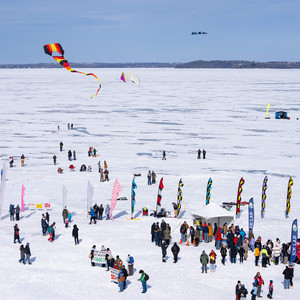
Almost every year since 2011, a huge lake in Madison Wisconsin, has frozen over enough to support an entire festival.
It's called Frozen Assets, and that's where I headed to report this story.
Ooh, this sounds fun.
What happens at Frozen Assets?
So on and near the ice of Lake Mendota, there is ice hockey, curling, ice skating.
People are flying these giant, colorful kites on the ice.
A skydiver is landing on the ice right now.
That's incredible.
And they did this warm-up for a 5K where more than a thousand people jump up and down on the ice to make it shake.
What?
Why would you do that?
I don't know.
I did not like it.
This lake is over 14 inches, so it's safe.
But can it shake?
So this is James Tai, the executive director and founder of Clean Lakes Alliance, which puts on the festival.
But Emily, this lake, which freezes every year this year with ice thick enough that it could have held an entire fleet of trucks, might one day not freeze at all.
And thousands of others may stop too, like soon.
I could foresee in my lifetime certainly a winter when Mendota doesn't freeze.
Today on the show, how changing lake ice is altering culture, community, and safety on the ice.
Plus, I go out with Madison's lake rescue team to see how they train for emergencies when someone falls through.
You're listening to Shortwave, the science podcast from NPR.
Greenland has said it is not for sale.
Denmark has said it can't even legally sell Greenland.
And whether Trump can or will or should try to control or purchase a territory that does not want to be sold is one question.
But on Planet Money, we are more interested in how we even got to this moment and how we might gracefully get out of it.
Listen to Planet Money on the NPR app or wherever you get your podcasts.
This week on the NPR Politics Podcast, the CBS Stephen Colbert dustup is part of a pattern.
Corporations are changing to avoid angering President Trump and his administration.
It's really the first time I can remember so many of these organizations have bent because of their own business interests.
This week on the NPR Politics Podcast.
Listen on the NPR app or wherever you get your podcasts.
All right, Burleigh.
So we are talking about lake ice, which remind me when is it safe to walk on lake ice?
Yeah, so I double-checked this with Hilary Dugan at the festival.
She's a scientist who studies inland lakes and she says it's safe for a person to walk on ice when there is four inches of black ice.
Black ice is really strong and it's what freezes in the lake water itself.
So it's what's freezing downward.
So black ice, which is called that because it's clear and appears black, is strongest.
But it's not the only type of ice.
White ice is what's forming when you freeze snow or slush.
And that white ice has a lot more air in it, just weaker in general.
Because of all the air, white ice scatters more light, isn't clear, and it looks white.
It's less strong, and so it's less safe.
And, unlike black ice, it's tricky to say how much white ice is safe to walk on, because the amount of air in it can be variable and it's often mixed with black ice.
Okay.
So you went to this festival on a frozen lake with clearly enough black ice for you to stand on.
And it sounds true to the spirit of northern communities.
I mean, celebrating winter and making it a part of the culture there.
Absolutely.
That's very true in Madison.
In many places downtown, people can always see one of the two lakes surrounding the city.
It's just part of everyday life there.
And a lot of people take advantage of that.
In one of the lakes, there's this bay where, in the winter dozens, if not hundreds of people are ice fishing every day.
I mean, this is a place that embraces winter.
When I was at the Frozen Assets Festival, we walked by people eating snow cones.
It was 10 degrees outside.
I spent some years in Maine and in Alaska and it reminds me of lacing up my skates on the weekend just to go out on the lake and have fun.
Though it also reminds me of how nervous I was every time to step on it.
I could not imagine going out to a whole festival on a lake.
That's a lot of weight on that body of water.
Though at Lake Mendota, it's not every year anymore.
Hillary told me that Lake Mendota does freeze over every year.
There's even a contest where people guess what day that'll happen.
But two years ago, the ice didn't form thick enough in time for the festival.
So the festival on the ice was canceled and it was sort of moved to the shore, which is really unfortunate.
It was still fun.
You know we still had a lot of the same things, but you know it takes away the spirit of what this festival is about.
But at the same time, better for people to be on solid ground, you know?
Yeah, and that made me wonder about safety on Lake Ice and how it might be changing.
So I went to another expert.
I'll let him introduce himself.
Justin Tooze.
I'm a firefighter down at Station 1, Madison, Wisconsin Fire Department.
Justin is part of the Lake Rescue Team, a group of firefighters who, among other things, are professionally trained to dive and rescue people who have fallen through the ice.
I joined them on one of their training exercises.
Nice.
So we went to Lake Monona, which is also right in town, to a spot where a river flows into the lake, which basically means there's always open water in that area.
Ooh, sounds like the perfect place for practicing rescues, if you're the Madison Wisconsin Fire Department.
I think that's exactly the thought.
So I put on this giant yellow immersion suit.
On it goes.
They call it a Gumby suit because you basically walk like the green claymation character Gumby, if you try to move.
One size fits all usually means men's size.
So I followed a couple of firefighters also wearing these suits onto the ice, including Justin.
We walked parallel to the river at first and started moving toward it.
We stepped over this huge ice crack where you could see the water.
And they told me it's features like these.
They can form from warmer water flowing into a lake or from, like natural ice, expansions and contractions.
These are the places weaker ice can exist and are often where people fall in.
So we cleared the crack, walked right to the edge of where the ice stops and the lake water starts.
Justin got in first.
Yeah, whenever you're ready to try it, we can throw you in.
I'm ready.
All right.
Hey, Lou, Burley's going to go in.
They didn't throw me in.
I kind of got down on the ice, then went in backwards off the edge.
All right, so it's actually only like four feet here, so you can't touch it.
You'll feel a little pressure on your legs.
All right.
Oh, this is nice.
Yeah.
If you want to lean back, I can hold on to you.
You can kind of feel how it is.
Whoa.
So it's super buoyant.
Yeah.
Yeah.
It'll keep you warm.
Actually, like, the longer you're in it, the warmer you get.
And I just floated there. while holding onto the ice for a few minutes.
Was it cold?
No, I was in this suit that made it kind of comfortable.
And I had the lake rescue team around, so it wasn't scary or anything.
It was pretty much the safest situation I could ever be in, going into a frozen lake.
Ready to get rescued?
I'm ready to get rescued.
So another team member brought over this bright yellow rescue sled and attached my arms into a thick loop.
Then he flagged the shore team to start pulling on this ice anchored rope that was attached to the sled.
Get her out, gentlemen.
It was all pretty quick.
Cool to hear how they practice.
How often are they doing it in reality?
Like how often are they rescuing people?
Yeah, this year, not a lot because the ice has been super thick.
But that's not always the case.
Last year was definitely our busiest year just because of the mild winter.
Justin said that's because there were multiple freezes and thaws which led to a particular kind of ice shelf.
That's super dangerous.
When there's solid ice and then there's water on top of it and then another ice formation forms on top of that water, so it looks like solid ice.
But it's not solid ice at all, and a person who was walking on the ice at night fell through.
Oh, gosh.
It wasn't deep water, but the ice shelf made it, so he couldn't get out of the water.
So he would.
He would have been gone if we wouldn't have been able to find him.
Was he okay?
So they got him out?
They got him out.
And in drone footage from the rescue you can see that the ice just keeps breaking up when the rescuers are trying to get to them.
And when they all get pulled off the ice like it just keeps breaking up because of this false ice shelf that Justin was talking about.
And Justin said the person was probably in the water for around 25 minutes trying to get out of the water before they called for help.
But they were okay.
I'm so glad to hear they were okay, because it is incredibly dangerous.
I mean, falling into cold water can kill you in less than a minute.
Many people die within just minutes from cold shock, so not every rescue has a good outcome.
Yeah, unfortunately they don't.
And the frequency of both people going through the ice and people drowning from ice breakthroughs are increasing globally as climate change drives up the average temperature.
We've documented over 4,000 fatal drownings through ice.
This is Sapna Sharma.
She's a global change biologist at York University in Canada.
The drownings she's talking about were from 1991 to 2017, and they happened across 10 countries.
She says 50% of those drownings are related to air temperature.
So basically what that means is that Half of those drownings can be explained by winter air temperatures such that in warmer winters more people drown.
When temperatures are hovering right around freezing and freezing unfreezing freezing, unfreezing.
That leads to more of that weak white ice that we talked about earlier.
And it's harder to tell just how safe the ice is.
And not to mention riskier for people who can't Judge whether they'll fall through it or not.
Right, going out on the ice.
And another thing that makes ice safety trickier to predict is something Hillary calls winter weirding.
We'll just have these really cold polar vortex events followed by heat waves.
And so winter is no longer this duration of cold weather.
It kind of bounces around all over the place.
So throughout the winter, lake ice is getting more unstable, less safe.
Plus, ice is forming later and disappearing earlier.
Depending upon the extent of greenhouse gas warming, you might expect 10 to 28 days less ice cover by the end of the century.
And at current greenhouse gas emission scenarios, we forecast about 5700 lakes may permanently become ice-free within this century.
Over 5,000 lakes permanently ice-free within the century.
That is so many!
It changes winter as we know it in the north.
I guess if there is an upside, it's that if they don't freeze over, it definitely reduces the chances of people falling through.
But what is at stake for the environment if all that ice is lost?
Well, for starters, Sapna says, when you have less lake ice cover, you have less ice.
Ice fishing opportunities, recreation opportunities, it matters for winter ice roads.
So many northern communities, especially remote communities and many indigenous communities, actually require the use of winter ice roads to access food fuel, medical supplies and even social connections.
In the winter?
Yeah.
Ice is an invaluable resource, actually, in a lot of places.
And it is being threatened by climate change.
As is lake ice culture, which is less tangible in some ways, but comes with a lot of sorrow.
Yeah, I bet.
It's like a way of life you practice, Burleigh.
Yeah.
And James Tai, the festival organizer, who we met earlier, hopes that it's also a call to action for change.
Once people care about something, then they're going to want to protect it.
You know, things are changing.
And if there's a year that you can't be on the ice, then people are going to sort of wonder why.
And maybe they'll ask for a change.
Burleigh, thank you so much for bringing us this reporting on changing lake ice from your neck of the woods.
You're welcome.
To see pictures of Burley during the Lake Ice rescue training or at that really cool festival, check out our show notes.
Also, there's so much more reporting to come.
We will have another episode on changing Lake Ice coming out next week.
Also, follow us on the app you are listening to.
Please, whether that's the NPR app or another one, it really helps us out and means you won't miss out on cool new episodes.
This episode was produced by Hannah Chin.
It was edited by our showrunner Rebecca Ramirez and fact-checked by Tyler Jones.
Jimmy Keeley was the audio engineer.
I'm Emily Kwong.
Thank you for listening to Shortwave, the science podcast from NPR.
Is there an acquaintance in your life that you'd love to turn into an actual friend?
And have you thought about saying, hey, we should hang out sometime?
Maybe think again.
The more specific you are, the more likely it is that you're actually going to get together.
You know, pull out your calendar, pick a time, pick a thing to do together and actually follow through.
Listen to the Life Kit podcast in the NPR app or wherever you get your podcasts.
On.
Wait, Wait.
Don't Tell Me, it's not so much we get to talk to celebrities, it's that we get to talk to celebrities about other celebrities, like we did with actor Nathan Lane.
I remember having to tell George C Scott that I was leaving the show to do this musical and he said to me you're leaving me to do a fing magic show.
Listen to Wait, Wait in the NPR app or wherever you get your podcasts.