Hi everyone.
Let me ask you something.
Has anyone ever asked you, how was your weekend, and suddenly your mind goes blank?
You had two full days of life food people, maybe even a little drama, and all you can say is it was good.
Exactly.
Today, we are going to change that.
In this episode, we will show you how to turn a simple weekend into an interesting English conversation.
You'll learn how to add details, tell short stories, and speak with more confidence.
So if you want to stop giving short, boring answers, Stay with us, because by the end of this episode you'll know exactly what to say next Monday.
Let's get started.
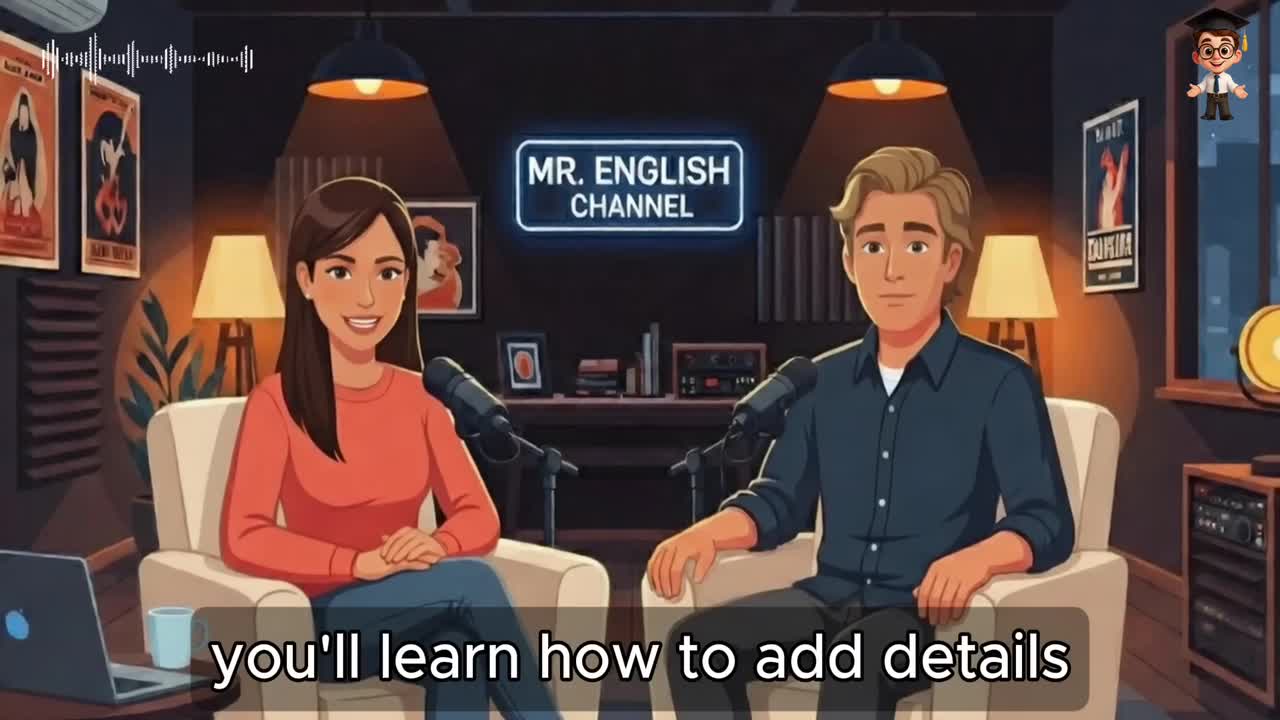
Hello, everyone, and welcome back to Mr. English Channel where learning English is easy and fun.
I'm Emily.
Hello, Emily, and hello to all our friends listening at home or in their cars.
It is so good to be back here with you today.
It is.
I am very happy today, Paul.
The weather is so nice.
Yes, it is a beautiful day.
I love the sun.
It makes me want to go outside.
Me too.
But first, we have a very special episode for everyone.
That's right.
Today we are talking about a very common question.
It is a question people ask every Monday.
Exactly.
We are talking about the weekend.
How was your weekend?
I love that topic.
It is a great way to practice English and talk about our lives.
It really is.
But before we start our chat, we have a small favor to ask our wonderful listeners.
Oh, yes.
Everyone, if you like our stories and our English tips, please click that like button right now.
It is a big help for our channel.
Yes, thank you.
And please subscribe to Mr. English channel.
We want you to see every new video we make.
And one more thing.
If you have a friend who is learning English, please share this video with them.
Learning is better with friends.
I agree.
Okay, Paul, are you ready to talk about the weekend?
I am ready.
I have my tea, I am relaxed, and I have a lot to tell you.
Good.
So, Paul, how was your weekend?
Did you do anything fun?
Wow, Emily.
My weekend was, well, it was very interesting.
It was not quiet.
Oh, really?
Tell me more.
What did you do on Saturday?
Well, on Saturday morning, the sun was shining.
I decided to go for a long walk in the big park near my house.
Ah, I know that park.
It has the beautiful lake and the tall trees.
Yes, that's the one.
I put on my blue walking shoes, I took a bottle of water, and I also made a sandwich.
A sandwich?
What kind of sandwich?
A simple one.
Bread, cheese, and some fresh tomatoes.
I was very hungry.
Yum.
I love cheese and tomato.
So you went to the park for a picnic?
Yes, exactly.
I walked for one hour.
I saw many people.
I saw children playing football, and I saw people walking their dogs.
It was very peaceful.
That sounds lovely.
Did you eat your sandwich by the lake?
Well, that is the story.
I found a nice bench under a big tree.
I sat down.
I took out my sandwich.
I was ready to eat.
And what happened?
I looked at my phone for one second, just one second, and suddenly, whoosh!
Whoosh?
What was it?
A squirrel.
A small brown squirrel jumped from the tree, grabbed my sandwich, and ran away.
Oh, Paul, a squirrel stole your sandwich?
Yes, it happened so fast.
One second the sandwich was in my hand, and the next second the squirrel was high in the tree with my lunch.
That is so funny.
Was it a big sandwich?
It was a perfect sandwich, Emily.
And that squirrel looked very happy.
He sat on a branch and looked down at me.
I think he was laughing.
Oh, Paul, I'm so sorry, but that is a great story.
What did you do?
Were you still hungry?
I was very hungry.
I didn't have any more food.
So I had to walk out of the park and find a small cafe.
Did you find one?
Yes.
I found a little place called the Sunny Spoon.
I bought a piece of chocolate cake instead of a sandwich.
Well, that is a good happy ending.
Chocolate cake is better than a sandwich.
You are right.
It was delicious.
So that was my Saturday morning surprise, a thief in the park.
A very cute thief.
Wow.
Well, my Saturday was also a bit of a surprise, Paul, but a different kind of surprise.
Oh?
What happened with you, Emily?
Well, on Saturday afternoon, I wanted to go to the cinema.
There's a new movie, a romantic comedy.
I love funny movies.
Me too.
They make me feel good.
So, did you go alone?
No, I went with my sister.
We bought our tickets and we bought a very big bucket of popcorn.
Popcorn is the best part of the cinema.
Did you get the salty popcorn or the sweet popcorn?
We got both.
Mixed popcorn.
It is the best.
I agree.
So, you had your popcorn and your tickets.
What was the problem?
Well, we went into the room.
It was very dark.
We found our seats.
The movie started.
Okay.
But the movie was not funny.
It was very dark.
And suddenly there was a loud, scary noise.
And then a monster appeared on the screen.
A monster?
In a romantic comedy?
No.
We were in the wrong room.
We were watching a horror movie.
Oh, no, Emily.
That is scary.
It was very scary.
My sister screamed and I dropped half of the popcorn on the floor.
Oh, what a mess.
Did you stay and watch the monster?
No way.
We ran out of the room.
We were so embarrassed.
We looked at our tickets again.
We were in room four, but our movie was in room six.
That is a classic mistake.
Did you find the right movie eventually?
Yes, we found Room 6.
The romantic comedy was very sweet and very funny, but I was still a little bit nervous because of the monster in the other room.
I understand.
That is a very funny weekend story.
So you had a scary start and a happy ending.
Yes, exactly.
It was a popcorn disaster.
Mmm, a popcorn disaster and a sandwich thief.
Our Saturday was very busy.
It really was.
But what about Sunday, Paul?
Was Sunday more relaxed?
Sunday was much better.
It was very quiet.
In the morning, I went to the library.
Oh, I love the library.
It is so quiet and smells like books.
Yes, I went there to find a new book about history.
I love learning about the past.
Did you find a good book?
I did, but something amazing happened.
I was looking at the books and I saw a man.
He looked very familiar.
Familiar?
Like a friend?
Yes, it was my old friend from school, David.
I didn't see him for ten years.
Ten years!
Wow, Paul, that is a long time.
It is.
We were best friends when we were ten years old.
And there he was, in the library, looking at the same history books.
That is incredible.
Did he recognize you?
He did.
He looked at me and said, Paul, is that you?
I was so happy.
We talked for two hours.
Two hours in the library?
Did the librarian tell you to be quiet?
Yes, a lady came and said, shh, this is a library.
So we went to a coffee shop nearby.
That is so nice.
What is David doing now?
He is a teacher.
He teaches history to children.
It makes sense because he always loved history.
That is a wonderful surprise.
It is so good to see old friends.
It really is.
It made my Sunday very special.
We exchanged phone numbers and we're going to play football next weekend.
That is great.
I am so happy for you, Paul.
Thanks, Emily.
What about you?
How was your Sunday?
My Sunday was very productive.
I spent the morning in my garden.
Oh, you have a garden?
I didn't know that.
It is a very small garden, but I have some flowers and some herbs.
I have basil and mint.
Hmm, fresh mint is great for tea.
It is.
I was helping my neighbor, Mrs. Miller.
She's very old, and she needed help with her roses.
That is very kind of you, Emily.
I like helping her.
She has a lot of stories.
But while I was digging in the dirt, I saw something shiny.
Something shiny?
Like a coin?
I thought it was a coin, but I picked it up and cleaned the dirt away.
And Paul, it was a ring.
A ring?
A gold ring with a little blue stone?
Yes, a small gold ring with a little blue stone.
I showed it to Mrs. Miller.
And?
Was it hers?
Paul, she started to cry.
Not sad tears, but happy tears.
She lost that ring in the garden twenty years ago.
Twenty years!
Wow, Emily!
That is like a movie!
I know.
She said it was her grandmother's ring.
She was so sad when she lost it.
She thought it was gone forever.
And you found it.
You're like a detective, Emily.
I was just lucky.
But seeing her face so happy was the best part of my weekend.
She gave me a big hug and some homemade cookies.
Wow.
Your weekend was full of surprises, too.
A horror movie, a lost ring, and cookies?
Yes, it was a very emotional weekend.
I can see that.
You know, Emily, listening to your stories makes me realize how much we can say about just two days.
You are right, Paul.
Even a normal weekend has so many stories.
If you are still listening to us, friends, we want to hear from you.
Comment chocolate below if you like chocolate cake as much as I do.
Yes, please comment chocolate.
We want to know you're there.
So, Emily, we talked about a lot of things today.
We used many words to describe our weekend.
We did.
It is fun to remember everything.
It is.
I am thinking about the squirrel again.
I hope he enjoyed that sandwich.
I'm sure he did.
He's probably the strongest squirrel in the park now.
Probably.
And I'm thinking about Mrs. Miller.
I'm so glad she has her ring back.
Me too.
It's a very beautiful story and it shows that even small things like helping a neighbor can lead to big surprises.
Exactly.
So, Paul, let's quickly think about what we talked about today.
Good idea.
We started with my Saturday morning walk.
I talked about the park, the weather, and my sandwich thief squirrel.
Yes.
And then I told you about my cinema trip the popcorn, the horror movie mistake and the funny movie with my sister.
That was so funny.
And then we talked about Sunday.
I saw my old friend David in the library after 10 years.
And I helped my neighbor in the garden and found her lost gold ring.
We also talked about food, cheese sandwiches, chocolate cake, popcorn, and homemade cookies.
We are always talking about food, Paul.
Well, food is important, especially when a squirrel steals yours.
True.
Very true.
This was a great chat, Emily.
I feel like my English is getting better just by talking to you.
I feel the same way.
It is so natural to talk about our days.
I hope our listeners feel the same.
It's not about being perfect.
It's about telling your story.
Yes.
Communication, not perfection.
We say that a lot, don't we?
We do, because it's true.
Well, I think that's all for today's episode.
Time really flies when we're talking.
It does.
Before we go, everyone, please don't forget to subscribe to Mr. English channel.
Yes, and if you liked our weekend stories, give us a like and share this video.
And our question for you today is, how was your weekend?
Tell us one thing you did on Saturday or Sunday.
Did you see a friend?
Did you eat something delicious?
Did a squirrel steal your food?
We hope not, but please write your comment in English below.
We love reading them.
We really do.
It's our favorite part of the day.
Thank you so much for listening, everyone.
You are all amazing students.
Yes, keep practicing.
You're doing a great job.
See you in the next episode.
Bye for now.
Bye-bye.