Have you ever been so close to finishing something and suddenly felt like quitting?
That happens to me all the time.
I start excited and then I get tired and want to stop.
Not sleepy tired.
That inside tired.
The kind that says, you can finish tomorrow.
But tomorrow comes and the goal is still there.
So here's the question.
When you feel tired, should you stop?
Or does tired actually mean you're almost done?
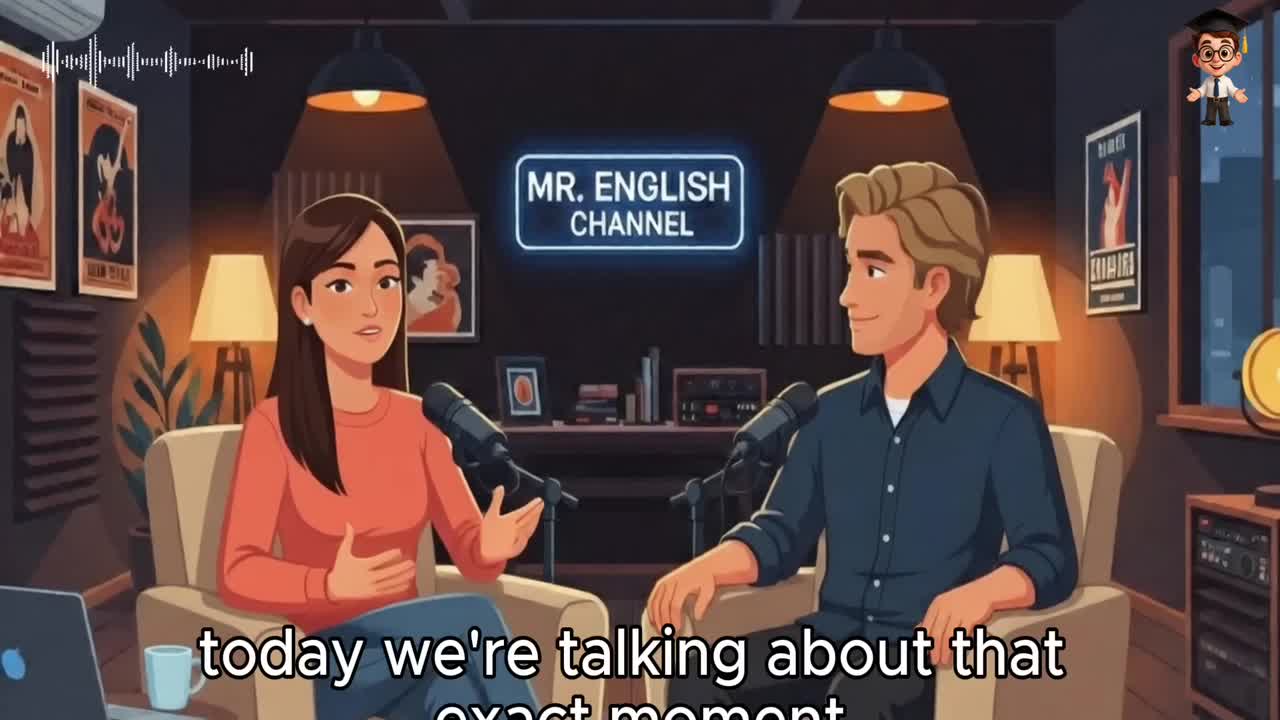
Today, we're talking about that exact moment, the moment most people give up.
Stay with us.
Let's begin.
Hello everyone and welcome back to Mr. English channel, where learning English is easy and fun.
I'm Emily.
Hello, Emily, and hello to all our amazing listeners.
I am so happy to be here today.
I am feeling very, hmm, inspired.
Inspired.
That is a great word, Paul.
Why are you feeling inspired today?
Well, I saw a quote this morning.
It was on a big sign near the gym.
It said, don't stop when you're tired.
Stop when you're done.
Wow!
That is a powerful sentence.
Don't stop when you're tired.
Stop when you're done.
I love it.
Me too.
But it is also very difficult, right?
When I am tired, I really want to stop.
Haha.
I know what you mean.
We all want to sit down and relax when we are tired.
But today we are going to talk about exactly that, how to keep going and finish what we start.
This is a perfect topic for English learners.
Sometimes learning a language is tiring, right?
Absolutely.
But before we dive into our big conversation, we have a quick request for our friends listening.
Yes.
If you like our podcast, please give this video a like.
It really helps us.
And don't forget to subscribe to Mr. English channel.
We want you to be part of our family and learn with us every week.
Share this with your friends too.
If someone you know is feeling tired or wants to give up, send them this episode.
That is a wonderful idea, Paul.
Okay, let's talk about this quote, don't stop when you're tired.
Paul, tell me, have you ever wanted to stop something because you were tired?
Oh, Emily, every single day.
But I have a story, a real story from last weekend.
Oh, I love stories.
What happened last weekend?
Well, I decided to fix my bookshelf.
You know, the big one in my living room.
It was very shaky.
Ah, yes.
I remember that bookshelf.
It looks a bit dangerous.
It was.
So I went to the store and bought tools.
I started working on Saturday morning.
I thought, this is easy.
I can finish this in one hour.
One hour?
Paul, you are very optimistic.
I was.
But after two hours, I was still working.
My back was hurting, my hands were dirty, and it was very hot in my apartment.
Oh no.
So did you feel tired?
I was exhausted.
I sat on the floor and looked at the bookshelf.
It was in many pieces.
I thought, I want to stop.
I want to watch a movie and eat pizza.
I am tired.
And did you stop?
I almost did.
I looked at my phone to order pizza.
But then I thought about my books.
They were all on the floor.
If I stopped then, my living room would be a mess all week.
That's true.
Sometimes we want to stop, but the job is not done.
Exactly.
So I said to myself, Paul, don't stop because you are tired.
Stop when the bookshelf is strong.
And is it strong now?
Well, I finished it at 10 pm.
It took all day, but when I put the last book on the shelf I felt amazing.
I was still tired, but I was happy because I was done.
That is a perfect example, Paul.
Finishing a task gives us a special kind of energy, even when we are physically tired, really does.
What about you, Emily?
Do you have a story like that?
Mmm, let me think.
Oh, I have a story about running, running.
But you were very fast, Emily.
You were like a rabbit, not always.
Last month, I decided to run five kilometers.
For many people that is short, but for me it is a long way.
Five kilometers is a lot.
I get tired just walking to the kitchen.
Well, I started running in the park.
The first two kilometers were great.
I felt strong.
I was listening to music.
And then?
At kilometer number four, my legs felt like lead.
You know, very heavy.
I was breathing hard.
My face was very red.
Oh, I know that feeling.
Your body says, stop, please, Emily, stop.
Exactly.
My brain was saying, Emily, go home.
You can try again tomorrow.
You are tired.
So why didn't you stop?
Because I saw the finish line.
It was far away, but I could see it.
I remembered that if I stopped then, I would feel disappointed later.
That is a very important point.
The tired feeling goes away, but the done feeling stays.
Yes.
So I kept moving.
I was very slow.
Maybe a turtle was faster than me, but I didn't stop.
And when I crossed that line, wow.
You were done.
I was done.
I sat on the grass and I couldn't move for 20 minutes, but I was smiling.
That is so inspiring.
You know, I think many English learners feel like kilometer number four.
I agree.
They study and study.
They learn many words, but then it gets difficult.
They feel tired of practicing yes, they think i can't remember these verbs i am tired of making mistakes.
I want to stop, but that is the most important moment right, that is the moment to keep going, exactly.
If you stop when you are tired, you don't reach the goal.
If you stop when you are done, you are a speaker, speaker.
I like that.
Oh, I just remembered something funny that happened while I was running.
Tell me, was it a happy accident?
Well, not really.
While I was running and feeling very tired, I saw a small dog, a very cute, fluffy dog.
Oh, did the dog run with you?
No, the dog had a ball in its mouth.
It ran in front of me, and it dropped the ball right under my feet.
Oh no!
Emily, did you fall?
I didn't fall, but I did a very strange dance to avoid the ball.
I looked like a crazy person.
People in the park were looking at me and laughing.
So the dog was trying to play while you were trying to survive kilometer four?
Yes, it was so funny.
I started laughing, and that laughter gave me a little bit more energy to finish.
Laughter is a great medicine for tiredness.
It really is.
Paul, what do you do when you feel tired of a project?
Do you have a trick to keep going?
Hmm.
I have a small trick.
I call it the five-minute rule.
The five-minute rule?
How does it work?
When I'm very tired and I want to stop, I say to myself, Paul, just do five more minutes.
Only five.
That sounds easy.
It is.
Usually after five minutes, I feel a little better.
And then I say, OK, maybe five more.
And slowly, I finish the job.
That is a very smart way to trick your brain.
My phone.
I am so sorry.
Is it your bookshelf calling you?
No, it's my mom.
She always calls at the most interesting times.
Let me just turn it off.
Sorry, everyone.
No problem, Paul.
Say hello to your mom for us.
I will.
OK, phone is off.
We are back.
Great.
So we are talking about persistence.
Don't stop when you're tired.
Paul, do you think it's OK to take a break?
Oh, that is a very good question.
I think a break is different from stopping.
I agree.
A break is like a pit stop for a car.
Yes.
You stop to get more fuel, but you don't stay at the gas station forever.
You get back on the road.
Exactly.
If you are learning English and you are tired, you can take a break for one day, but the next day you must continue.
That is the difference between stopping and resting.
Rest if you are tired, but don't quit.
Yes.
If you are still listening to our conversation and you are not going to quit, comment finish below.
Oh, I love that.
Comment finish to show us you are a champion.
You know, Paul, I once tried to learn how to play the guitar.
The guitar?
Wow, Emily, you were full of surprises.
Are you a rock star now?
No, definitely not.
That is my story of almost stopping.
What happened?
I bought a guitar.
I was very excited.
But my fingers, oh, Paul, my fingers hurt so much.
Yes, the strings are very hard.
I practiced every day for a week.
I was tired of the pain.
I was tired of the strange sounds I was making.
It didn't sound like music.
It sounded like a cat in trouble.
A cat in trouble.
I can imagine that.
I wanted to stop.
I put the guitar in the closet.
I thought, I am done with this.
But you weren't done.
You were just tired.
Exactly.
Then I saw a video of a girl playing a beautiful song.
I realized that she probably had hurting fingers too.
She didn't stop when she was tired.
So did you take the guitar out of the closet?
I did.
I started again.
I practiced for only 10 minutes a day, and slowly the pain stopped.
My fingers became stronger.
And can you play a song now?
I can play Twinkle Twinkle Little Star.
It is a simple song, but for me it is a done project.
I didn't stop.
Good job, Emily.
That is a victory.
From a troubled cat to a little star.
Thank you, Paul.
It feels good to finish even a small thing.
I agree.
I think done is a very beautiful word.
It is.
Paul, do you think people are born with this persistence, or can we learn it?
I think we can learn it.
It's like a muscle.
A muscle?
Like in our arms?
Yes.
The more you finish things, the easier it becomes to finish the next thing.
That makes a lot of sense.
If you finish a small bookshelf, maybe next you can finish a big table.
Exactly.
And if you learn 10 new English words today, maybe tomorrow you can learn a whole sentence.
This is very motivating.
I feel like I want to go do something big now.
Wait, we need to finish the podcast first.
Don't stop now.
You are right.
I am not done yet.
Oh, listen, a little bird is cheering for us.
Everyone wants us to finish today.
You know, sometimes done doesn't mean perfect.
Oh, that is a very important point, Paul.
Tell us more.
Well, back to my bookshelf.
Is it perfect?
No.
There's a small scratch on the side, and one shelf is a little bit crooked.
But it holds the books, right?
It holds all my books.
If I wanted it to be perfect, I would still be working on it today.
I see.
So stop when you're done means finishing the goal you set, even if there are small mistakes.
Yes, especially with English.
If you wait until your English is perfect to speak, you will never speak.
Wow, that is so true.
Speak even if your grammar is a bit shaky, like Paul's bookshelf.
Hey, my bookshelf is strong now.
But yes, speak.
If you communicate your idea, you are done with that conversation.
I love that.
Communication, not perfection.
Exactly.
So don't stop because you are tired of making mistakes.
Stop when you have finished talking to your friend.
We are learning so many good things today.
Paul, I feel like we are reaching our own finish line for this episode.
We are, but I don't feel tired.
I feel happy.
Me too.
Let's do a quick recap for our friends.
Okay, so we talked about that amazing quote, don't stop when you're tired, stop when you're done.
We heard about Paul's shaky bookshelf and how he worked all day to finish it.
And we heard about Emily's 5K run and the dog that wanted to play with a ball.
Yes, and we learned about the five-minute rule to help us when we feel like quitting.
We also talked about the difference between resting and stopping.
It is okay to rest, but don't stop the journey.
And most importantly, we learned that done is better than perfect.
Especially when learning a language.
Keep going, keep practicing, and don't let the tired feeling win.
You are all doing a great job just by listening to this.
You are practicing your English right now.
Yes, you are not stopping.
You are moving toward the finish line.
Well, Paul, I think we are officially done for today.
Yes, mission accomplished.
Thank you so much for this conversation, Paul.
It was very inspiring.
Thank you, Emily.
I always feel more motivated after we talk.
And thank you to our wonderful listeners.
Remember, we believe in you.
Yes, we do.
Before you go, please subscribe to Mr. English channel.
And give this video a like if you are going to finish your goals this week.
Leave a comment for us.
Tell us, what is one thing you are going to finish today?
We love reading your stories.
They give us energy to make more podcasts.
Keep practicing, keep speaking, and keep smiling.
We will see you in the next episode.
Don't stop when you're tired.
Stop when you're done.
Exactly.
See you soon.
Bye bye.
Bye everyone.