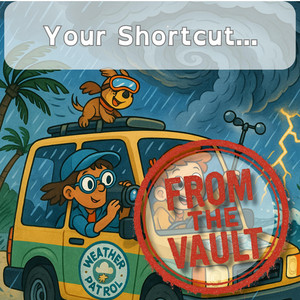
It's Sunday again.
Welcome to the vault, people.
And with a huge hurricane over Jamaica dominating the headlines this week, it's the perfect time to revisit one of our most popular shortcuts.
All about the giant swirling storms that can stretch for hundreds of kilometres and pack winds strong enough to lift rooftops.
In this episode, Bryce and I dive into what cyclones, hurricanes and typhoons actually are, why we're hearing more about them lately, and how we can all prepare when one's headed our way.
So, whether you call them cyclones in Australia, hurricanes in the Americas or typhoons in Asia, they're all powerful reminders of nature's force.
Get ready to head into the eye of the storm.
This is a Squiz Kids podcast.
Your fresh take on what's happening in the world around you.
They form way out over the ocean near the equator.
They can travel thousands of kilometres to reach our shore.
And there are lots of things we can do to prepare for when they get here.
This is your Squiz Kids shortcut to cyclones, hurricanes and typhoons.
The podcast where we dive into the who, what, when, where, why and how of the big news stories.
I'm Christy Kidgerina.
And I'm Bryce Corbett.
Music Bryce.
If you've been anywhere near the news or social media lately, you will have heard about the damaging tropical cyclones that have been blasting coastal regions of northern Australia recently.
And if you're inland or a bit further south, you might have felt the after effects of heavy rainfall and flooding.
But tropical cyclones, hurricanes and typhoons don't just occur in Australia.
Today we're diving into the eye of the storm to take you through what cyclones, hurricanes and typhoons are, why we're hearing so much about them lately, and how we can prepare if one is headed our way.
So grab your raincoats and hold on to your hats because here we go.
Listen carefully.
There's a squeeze at the end.
What?
Alright Bryce, let's start with the basics.
Whether it's called a cyclone, a hurricane or a typhoon, it's all about location location, location.
Here in Australia, we're familiar with cyclones.
They occur in the South Pacific and Indian Oceans along the northern coast of Australia.
If you're in the United States, Mexico or the Caribbean, they're known as hurricanes.
And if you're in China, Japan or the Philippines, you'd be calling them typhoons.
But no matter the name, they're just the same.
They're all giant swirling storms.
They sure are, Christy, but they aren't just any old storms.
They start over warm ocean waters near the equator.
So, picture this.
Warm, moist air rises and leaves underneath it an area of lower air pressure.
Now, because the pressure is lower, cooler air then rushes in to replace it.
This cool air then warms up and it rises too, creating something of a spiral.
And the spiralling air then churns up massive storm clouds.
That's right, Bryce.
And the Earth's rotation gives these storms their signature spin.
That's why in the southern hemisphere they spin in a clockwise direction and they go anti-clockwise in the northern hemisphere.
Fascinating.
Now imagine a giant spiralling storm forming above the ocean.
Now that's what we're talking about.
Oh, wow.
The centre of the storm, the eye, is eerily quiet and calm.
But the eye is surrounded by a wall of cloud with the strongest wind and rain.
Did you know that winds here can get up to 360 kilometres an hour?
Whoa, that is fast.
Now, the size of these storms can be massive too, covering hundreds of kilometres.
And they can last for days, or sometimes even weeks, travelling thousands of kilometres across the ocean.
And in Australia, the Bureau of Meteorology you might have heard them called the BOM categorises cyclones from Category 1, which is the mildest, to Category 5 storms, which are extremely dangerous.
These categories are based on the wind speed.
But it's not just the wind that's the problem.
No, you're right there.
Because when these storms get close to land, they also bring heavy rains with them.
Now these are rains that can cause flooding, landslides and even create what's called storm surges, which are huge waves that can cause flooding inland around coastal areas.
That is a lot of wind and water, Bryce.
It sure is, Christy.
But let's look at why we seem to be hearing more about cyclones and other tropical storms recently.
Why?
Here's that swirling question again.
Why do we seem to be hearing more about cyclones, hurricanes and typhoons lately?
You might think it's just because there are more of them.
But hold on to your hats because the answer is a little bit more complicated.
Yeah, it sure is.
Now Christy, do you remember that I said that warm water is like a party invitation for these storms?
I do.
So as the Earth's temperature rises, so does the temperature of our oceans.
Warmer water means more fuel for the storms to form and to become more intense.
So the number of these storms is increasing because of climate change, right?
Well, while that's certainly a factor, Bryce, here's a twist.
Okay.
In 2023, the number of cyclones, hurricanes and typhoons was actually lower than the global average.
Surprised?
Oh, yeah, I am.
So it goes to show that, while climate change is a critical factor in the impact of these storms, it's not the only factor.
So Chrissy, what else is happening here then?
Because I know that there's been a lot of cyclone news lately.
There sure has.
So, even though there have been fewer storms overall, the intensity, meaning the wind speeds and the amount of rain these storms are dropping, has actually increased.
The percentage of cyclones that are reaching category four and five is going up.
So there are fewer storms, but the ones that we're getting are more dangerous and are causing more damage.
That's right.
And we also need to consider where these storms are coming into contact with land.
Good point, because they form in the ocean, so I'm guessing that they come into contact with land on the coast.
And I know that in Australia, some 85% of people live pretty close to the coast.
So that means when a cyclone hits, lots of people are affected.
And that means that it's big news.
It certainly is.
And these days, news travels fast, faster than the cyclone, thanks to the internet, social media and 24 hour news channels.
We hear about storms almost as soon as they form.
Every twist and turn of these storms is reported in real time, giving us the impression that they're happening more frequently.
So it's a combination of factors at play.
More media coverage, growing coastal populations and the impacts of climate change have all contributed to why we're hearing more about these powerful storms and why they're happening perhaps a little more regularly.
It sounds like it's important to stay informed so we can better prepare.
But Christy, how can we be prepared for a cyclone?
All right, Bryce.
So you can see a big storm on the horizon.
What do you do?
I don't know.
Panic?
No.
Preparation is the key.
Here's how you can do it.
Firstly, stay informed.
Keep an eye on the bomb for the latest weather updates.
Okay.
They'll let you know if a cyclone's brewing and how severe it might be.
Knowledge is power, especially when it comes to the weather.
Ah, yes.
And let's talk about your all-important emergency kit.
This should include things like water, non-perishable food like muesli bars and tinned food, a first aid kit, a torch and a radio that runs on batteries in case the internet goes down. so you can still get important news updates.
Good point.
You should also have some extra batteries.
Pop any important documents or medicines into waterproof bags.
And let's not forget our furry friends.
Make sure you have supplies for them too.
Oh, absolutely.
Now there might be some really strong winds on the way, so secure any loose items around the yard, like garden furniture or trampolines, because these can become dangerous in high winds.
And Listen, Christy, I don't want your trampoline landing on my roof.
Fair enough.
If there's time and someone's able, you should also get your parents to trim any tree branches that could fall on your house.
And people who live in cyclone prone areas.
They might consider installing shutters or stronger roofing.
But sometimes, even with the best plans and preparation, leaving the area for a little bit might be the best option.
And so it's really good to have an evacuation plan.
Know your local evacuation routes and have a plan for where you'll go if you need to leave.
And remember, your safety is more important than your possessions.
Yeah, and never ever drive through floodwaters.
Absolutely.
So even if you think the water doesn't look too high, if it's flooded, forget it.
You'll never know what's happening beneath the surface of the water, and water is much more powerful than you think.
And of course, don't forget to think about your community.
Check on your neighbours, especially the elderly or those who might need a little bit of extra help.
It's about looking out for each other in true Aussie spirit.
So there you have it, folks.
Be prepared, not scared.
That's it.
It's the way to go when dealing with cyclones, hurricanes and typhoons.
Time for the quiz.
This is the part of the podcast where you get to test how well you've been listening.
Question number one.
Where in the world do cyclones, hurricanes and typhoons begin forming?
I bet you said oceans, didn't you?
Well, that's correct, but the actual technical answer is the equator.
Question number two.
What percentage of the Australian population lives close to the coast?
Good work if you said a whopping 85%.
Whoa.
Question number three.
What's the name of the plan you should have if you're going to leave your home while a cyclone happens?
Yeah, that's right.
It's called an evacuation plan.
Well, that's all we have time for today.
Thanks for joining us as we explored the who what how when, where and why of cyclones, hurricanes and typhoons.
And teachers.
There are a whole heap of excellent classroom resources related to this topic on the Squiz Kids website and there's a link to them in the episode notes or just go to squizkidscomau.
In the meantime, get out there and have a most excellent day.
Over and out.