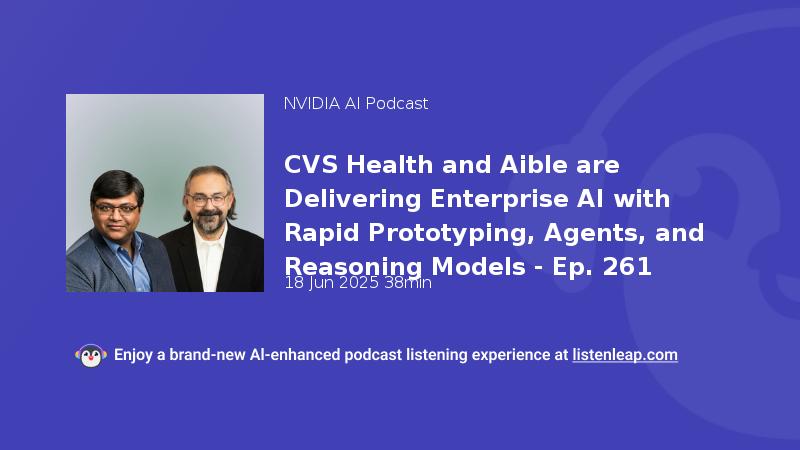
I'm your host, Noah Kravitz.
Our guests today have known and worked with one another for years and can speak to the ins and outs of enterprise technology, including developing AI applications, from the perspective of brands, vendors, developers, customers, and probably most anyone else you can think Tony Ambrosi is Senior Vice President and Chief Digital and Technology Officer of Pharmacy & Consumer Wellness for CVS Health.
And Aurijit Sengupta is Founder & CEO of Abl.
Tony and Aurijit are here to talk about developing AI apps at a massive scale, using DGX Cloud to do it, and the current and future of generative AI, agintec AI frameworks, and so much more.
So I'm going to get out of the way and introduce these two gentlemen to share some tales and drop some knowledge on us in the next half an hour.
Tony or thank you so much for joining The AI Podcast. Thank you for inviting us.
So if you would, maybe we can start a little bit with your backgrounds and how you've been working together forever.
So I'll let you start at the point that seems apt to get us into what CVS and ABLE are doing now.
So I'll start. I've been doing this for technology and digital, and then at some point data, machine learning for quite a while trying to be at forefront of technology to support customers and employees and colleagues and wherever else there.
I've spent my last five years in healthcare, three years in a hospital system in South Florida, obviously focused on patients and patients' well -being.
I've been with CVS for almost two years now, the same type of focus, and I think Arjit and I kind of bumped into each other, And then we saw that that it would be cool to do interesting things with this machine learning thing, because we can transform a lot of make a lot of things there.
At that time, I was with Disney and make a lot of things much better for consumers and guests.
And so Origi, where were you when you guys met?
So I had right before that sold my previous AI company to Salesforce where it became Salesforce So I started some book, Beautiful Core, which was one of the first augmented analytics companies on the planet, and ended up having a crisis of faith.
I was like, did I create value or did I just make some money?
Right. So I ended up writing a book called AI is A Waste of Money, where I've taken a thousand projects and laid out why these projects fail.
And one of the most common reasons was disconnect between the business user and data scientists.
And this is where Tony and I always had this one thing which was like, it doesn't matter what you build unless the business stakeholders adopt it, right?
So that's how our partnership actually started.
In fact, the first time I was actually trying to sell to him, I came to him and said, Tony, keep me honest here.
Something like, we'll do this prototype in 30 days so that your business users can see.
And he said something like, do it in five days or something.
And then we did it in two, three days.
Tony, am I remembering this ballpark correct?
like it was something absurd like that?
I think so. So some of the folks who are listening to this find that they can do it less than, you know, in a week and five days.
You're absolutely right!
It's come of frame, yeah.
Yeah, you and I talked a lot, Arjut.
And I think you guys are very, very good at that.
Which is a new experiment.
You try things, that's what the discussion really is.
If you have cycles of okay, we talked for a week about what we want to do.
And then we go and do it for two weeks or even more than we come back for another week and evaluate that it's not what we wanted or not, but the business wanted or the outcomes are not met, and then so you have the cycle that takes months.
Everybody will forget about what they wanted to do in the first place.
and then that's how things just go into the grave gut, those things that never go anywhere.
So being able to slice things and then do something in five days, and how many of us remember what we did on a Thursday a few months ago?
We do remember what we talked about it on Monday.
I'm just trying to remember if today is Thursday.
Yes. I'm going to take that as a chance to segue and getting under the hood here, so to speak, with you guys.
How do you approach that now, Let's say you're starting an AI project or further along in the cycle as well when you're kind of iterating.
How do you approach that now working together on projects for CVS?
And I would imagine at that scale and all the other considerations, but how do you get started?
So there's two key parts to it.
One is for any use case we go after, 48 -hour rapid prototype, no longer than that, which means from when we first start.
And we're already implemented inside CVS of data protection and all that is very crucial to CVS. This is all happening within CVS system now.
That's why you can kind of get going that fast, but Tony's team blesses a project within 48 hours, a product has to be done.
And that has to go in front of business for feedback.
It's not just IT or analytics, just thinking about it.
If business is not involved, doesn't matter.
Separately, his teams are building their own products.
So my team will do sound describes when Tony blesses it, but the teams have been allowed to build whatever agents they want to build.
And then once business blesses it, then you gotta build it within 30 days.
Meaning something real has to be in the hands of business at scale in 30 days.
In 30 days. When you set those kinds of expectations, AI is exciting.
So people will sign up for projects, but then never finished it off.
Sure. You've gotta have this kind of, and sometimes they want an AI, they don't really know what they mean and they don't really know what they want, right?
Absolutely. When you get a prototype in front of them, they either like it or dislike it and then they can tell you what they disliked about it.
Then you iterate and improve it until you get to an element.
Right, you give somebody something to react to.
It's so different from even a blank check, you know, and they'll, well, what do I write?
So you mentioned Tony's team and your teams and I think in the beginning, talking about your origin stories so to speak with Tony, I might have glossed over a little bit.
Abel is providing the development platform services, what is Abel providing kind of, how did Tony's team and your team fit together?
We have an agent development platform, but it's a no code, low code.
In fact, that most of the time, it's like no code at all, kind of a platform.
So, we have the software that runs on top of NVDS.
So for example, we are using things like NIMS and NIMOS and all that good stuff.
But Tony's team doesn't have to worry about that, right?
So we leverage all of NVIDIA's capabilities within that, and then when his team comes in and says, hey, I want to look at WhatsApp, actually I can't mention specific use cases, but let's say I want to understand what's going on with this data, the software does it, presents it back for feedback.
Yeah, and I would add, that's accurate.
So we do a lot of work.
Some of it, thank you, Aravind, for helping other things, some of the bigger things.
There's a lot of work.
What I would say is, this is my boss always emphasizes, given the domain where patients, consumers, we all have a particular focus on what we call responsible AI and maybe others call it the AI.
So that is the fact there.
Before you delve into that, and apologies, but just in case I'm thinking I grew up with CVS, but I think of it as the pharmacy of the store.
CVS Health is the second largest healthcare provider are in the United States, under its full umbrella, but you're focusing on the stores in the pharmacy?
Correct, correct, and obviously within that because we have all the retail customers, my focus with technology, with digital product is how do we make that experience for customers better.
And of course constantly innovating on how to make it, improve the safety.
Right, so the responsible AI you started.
That's where these, exactly, and also how do we help our colleagues with things that probably I can do in terms of automation, uh, while also also always keeping the human in the loop and in control.
So obviously we do some things that are pretty, pretty non, you know, uh, non health, healthcare, a bunch of other things, you know, my finance partners and my procurement partners say, they are, can you write the agent for me?
Whatever. You know, summarize all the invoices.
Perfect. Sure, of course.
But the others that were extraordinary.
Careful. Right. Are there any specific applications that CVS has implemented that you can talk about?
There are quite a few, I think some of them probably will not go into, but others.
What we're doing is and it's part of the progress of being implemented is and that's where NVIDIA that plays a big part is what we call the conversation AI.
The way I look at it from a digital perspective is, we want to help customers with whatever they need.
Of course, we're not talking about dispensing medication and what the pharmacist does, putting things on a bowl and making sure everything is right.
But everything else, we want to make sure that customers can have access to us in all channels.
So maybe reordering or refilling the prescription.
Absolutely, you know, if somebody needs a more of a pharmacological key or medical advice that's for pharmacists and doctors.
But things like that, I call an assembled procedural, yes, you like the way has my my prescription ready, those will try to if they choose to go into the voice channel, we have a, you know, AI being able to provide that with precision.
And that's a big thing because it's a huge shell.
So Tony, you mentioned AI agents, building an agent.
I think the off -the -cuff example was to summarize receipts.
I'm going to put you on the spot here.
Can you first talk about what an AI agent is?
It's sort of one of those things that, building the definition as we fly the plane, maybe that kind of thing, and then get into, you know, in your experience and, and Orjit as well, obviously some of the key considerations that go into thinking about, you know, and then designing and developing, I guess agents with different use cases.
So, it's, it's interesting.
And, and we talked earlier about how fast things move.
All right. So some of us got some inkling probably or dude, more than I, you know, in 2018, 2019 about kind of what's happening with these large models, right?
And the transform, Google's transform in 2017 kind of opened up the avenue.
And then well obviously we got the chat GPT in 2022 and everything coming from there but it was an interesting thing that because these chat bots, and obviously there were the API, they were the API behind them, they could tell things, tell us things, they could think somehow somewhat, but they couldn't do anything, right.
You know, you have the womb, but the, the human going in and asking a question, and then taking that in some shape or fashion and doing something in some workflow.
And then some people that said, well, wait a minute, we're kind of like the plumbers for AI, you know, they're thinking AI is stinking and we're doing.
So agents came in the, and clearly this has been a topic in the sci -fi for 50 years agents came at the intersection really of intelligent machines through large language models and the let's say process automation and you know we've done LLMs for for a few years now a couple of years at least and I've done RPA for 10 years and then this is where we kind of bring them together and say this these things called AI agents and agenty AI by don't you like how we geeks in technology come up with all these fancy terms and cloud and all the stuff?
You know, I'm a writer at heart.
So that maybe that's what actually drew me to technology.
I just didn't realize.
So that's kind of remarried.
That was where the intelligence behind the LLMs now drives through the use of tools process automation and process execution.
Because we had that gap of execution gap where those things were disconnected.
Of course, I've seen researchers talk about different level of maturity like everything else.
You know, I think you're starting with zero, basically it's manual work, going through all the way to some size, which is completely autonomous, where basically every AI is doing everything the agents are doing everything there's no human in the loop but five yeah i don't know what kind of world that would be in but let's not go there right but i think most of us are somewhere in the two two three you know some level of uh some level of intelligence coupled with some level of doing through tools and in and within workflows when you mention tools and we talk about the agents being able to go and take
within CVS or perhaps, Arjit, that Abel has implemented, and you've been thinking about, just for folks who maybe understand this idea of agents more in an abstract level and haven't gone hands -on, what are some of these actions that we're talking about?
Sure. So the tools enabled the LLM to actually take their insight or their decision to us, to operate the task and actually do it.
Right. And I think there are plenty already out in the market where an agent can basically do whatever a user in front of a computer do so they can control the screen, they can navigate a browser.
They can fill in forms, uh, figuring out what the page is about.
And that's kind of a little bit between the difference between RPA, where we would have to code all that in and say, Hey, you know, look into the HTML source.
And then whenever you find the label name, you put the name and then so on so forth, the agents who that intelligence could be what they do, they take a picture and the analyze and say, yeah, I think I know what they mean is referring to that.
And then before I know what I figure out what to do with it, those would be, you know, one tool accessing out the other resources, like API's is another tool and accessing databases, whether internal or external it's another tool to bring all that together in order to execute, to get the goal that's given to that agent.
One way to think about tools for me at least is think of the things that Generative AI doesn't do a good job of, right?
It actually despite most of the research being focused on math, it actually can't guarantee you is that the math is correct.
So that's where like in able for example, we do a lot of augmented analytics.
So we'll go in and look at a data set and look at a million variable combinations.
Think of every possible group by and drilldown chart, but you're just doing the math in a span of one or two minutes.
So your Snowflake, your BigQuery, your data warehouse just charges you for one or two minutes.
Then you're combining that information with the language model to present it to the user.
The math is not being done by the generative AI.
The math is being done by a deterministic system, backed up.
So if an auditor shows up and says, how did you get to that number?
or you can point out precisely to deterministic stuff but you present it.
So, anything the AI isn't good at, that would be a truly calling piece.
But one of the things Tony was talking about how we shift it from chat to something autonomous.
To me, our motto from the beginning has been this idea of I am able.
And what we felt was it has to be, AI has to empower the human, right?
Now think about what happens when you are doing a chat interface.
You're taking the entire power of AI and putting it behind the human ability to ask questions.
That makes no sense, right?
You take this incredibly powerful thing and you say, I'm only going to sit from it every time a human asks a question.
What agents start doing is like can I do things continuously?
Can I look out for stuff?
Can I be an advocate for the human?
Can I give the human superpowers so that we can do humanly impossible things?
And I think that shift is beginning to happen where the first phase of a lot of the use cases was how can I automate the human?
Wrong mindset. Think how can I give every human a superpower.
And then you can do crazy things.
You said humans can do crazy things.
Let's focus on the good crazy things because there are humans now.
But I think, you're absolutely right, if you look at it a bit back a long time ago, like basically back to 2022, a long time ago in AI history.
What happened was, or even a bit earlier than that, so folks figure out that, hey when they ingest more data and some of the models get bigger, because they were relatively small.
in the days of ML as maybe hundreds of parameters, not more.
The more you scale, the better the output is.
Frankly, when we started with transformers, that's basically how do you predict probabilistically, I didn't mention this versus the thematically what do where next word should be.
But so we ingested all this data.
The thing is a lot of the chatbots are also optimize things in just this, And they optimize to basically provide the simplest responses for efficiency reasons.
Right? We're going to maybe talk about that and our reasoning because that's important.
So that's kind of where we were in terms of history.
Interviewer You both talked about probabilistic versus deterministic, and, Arjit, when you were talking about it and this is in the context of the agentic systems and sort of sounded like you were talking about using the deterministic, other deterministic systems to do what the AI's not so good at?
When we're talking about agents and thinking about that one -to -five scale, and a goal, not necessarily going all the way to five, right?
But a goal being to get the system to do more and more of the work, to free the human up, to go faster for a multitude of reasons.
How do you go about designing?
I'm trying to even wrap my head around that.
How do you go about designing and sort of knowing what needs to be built deterministically to, and I don't know if that's the right way to say it, but, to kind of nudge the probabilistic system under the right path.
So think of it as math and words.
So when I was in business school, what our teachers, there's a person named Das Narayan Das who used to teach this and say that what a student needs to do, I'm going to misquote him pretty badly, is they have to understand the math and do the analysis, and they have to be able to tell the story.
Genia is brilliant at telling the story and for assimilating information together and present it in a very coherent way.
What it's not very good at is doing the math.
And this is something like people are kind of hand -waving it saying no, no, no, we can do it.
What you're actually going to find is if you want to be absolutely sure that the map is correct, at some point they're doing tool calling.
They're going into a deterministic system.
Now, what we did is we said, look, our underlying platform actually has all kinds of AI.
We don't just do gen.
You want to go in and understand what's happening in your data, like what's driving my revenue, what's driving my patient?
No shows, what's driving my customer churn?
Guess what? Have a deterministic system, ask millions of questions.
Don't have the generativity.
But then, if I give you a bunch of dashboards and bunch of charts, you won't consume it that easy.
How can I take all that and say, hey, here are five things you need to know.
And now you ask a followup and give you something more.
Now, one of the important parts, You ask, how do you decide what becomes a tool, what becomes an agent?
But on an ongoing basis, though, one really important thing of the reasoning model that Tony just mentioned a few minutes back is you can almost build humility into the AI.
With the AI, when it explains its reasoning, it says, I did this, I did this, I'm a third step, I calculated gross margin this way, it actually allows the human to then say, hey, you know what?
Your definition of gross margin was wrong.
Now, here, thumbs down.
The AI says, what did I get wrong?
And this person says, you've got a cross margin definition.
That is where the market is going.
Up to now, it was like you're training an AI like a pet.
Good job, bad job, but that's not very high resolution feedback.
Now the AI couldn't explain itself to the human and the human couldn't explain the feedback to AI.
When you make that reasoning model and the feedback on the reasoning model happen, you close that loop.
And actually, I'm gonna put Tony on the spot, But Tony was one of the advisors when we were doing this with NVIDIA, this reasoning model and the feedback cycle of that, which we did on DGX cloud, with a bunch of customers help, one of them was Tony.
And Tony, is this anything you want to add about the reasoning model and that feedback that teaching it as an intern, if you feel comfortable saying change?
Yeah, no, absolutely.
I will say this, I think we all like the humility in AI.
Or I hope that that's gonna continue.
But I think, You know, reasoning is a big thing.
So back to what I was saying earlier, a bit earlier about yes.
Um, everybody in just a huge kind of quantities of data, but frankly, at the beginning of years ago, I mean, a lifetime ago, three years ago, it was a relatively simple, you know, regurgitating of things, right, right.
If you think about the way everybody was going into Chad JPD and asking simple questions, and we then started having these conversations about hallucinations, which most people think it's, they're a bug, but they're not a bug.
They're actually a feature.
And we figured out that, if we forge the models to explain what they do and how they think through things, they get to better outcomes that are resolved.
And plus it allows us as humans to identify this, as Arjit said, where do they go wrong?
And it's the difference, let me put it very simply because, uh, let's Let's say you have a child, you know, young child who is learning math, I don't know, five, six years old.
OK. And you say, OK, how much is one plus two?
And they would say, five.
Why five? Well, it's interesting because the brain...
his brain probably likes the number five for whatever reason or they heard the number five and then said that's how they wrote in it.
However, now if you say, here, let's do this exercise, you know, in both hands and, you know, in a fist. and then each hand you raise one finger for the number you want to add yeah one on one hand and two on the other now count your number your raise fingers then you get the right answer, but also now the child understands better how that worked right another thing is through reasoning over time and maybe we're going to talk about memory they learn how to do it better themselves my kids are We're a little older, but it's funny.
I'm always trying to think of a metaphor as I'm listening to guests talk to, I don't know, to prove that I understand you, hopefully to explain it for the listener.
But I was thinking about debugging coding at first, but then when you get to the thing about the example with the fingers, I thought, oh, my kids are a little older now, but showing your work, right?
And math class, that's always like, well, why do we have to show our work?
And I think you just explained it really well.
Yeah. And if we never challenge or never go back to them, they will never understand the mistake.
Now, I would say one thing that I probably should have started with.
The number one is we need to start thinking about AI and AI agency agents, not us tools.
Now, AI agents use tools like the one we described, but they're not tools themselves.
So let's think about them as well, obviously as a alternative intelligence, just like humans, yes, they're Silicon, they have different architecture, they have different capabilities, obviously they're fast, but sometimes their, their behaviors are surprisingly human, surprisingly human.
And, you know, Arjun was talking about humidity, guess what?
They're very, they're kind of hallucinating with a plum, which is like absolutely accurate.
Right. So that's one thing that sometimes we have to apply human psychology to what they do and how they do it.
That's number one. Now the number two would sound completely contrary, after all these things are still machines at least from an implementation perspective, we need to make sure how we implement them is well engineered.
Yes they're intelligent machines, but at the end things like scalability, things like monitoring, Things like error detection, and so on and so forth, that we have learned over the last 30 years.
Resiliency, you know, hallucination detection, or error detection, those are still very important.
But in truth, if we think of them as humans, then maybe we understand them a little bit better.
You know, I use this, symbolistically, just think about it as an intern.
You get a new agent, you know, you got a new intern.
They have some training, just like the models have from training, and they have some experience, the interns, just like the models have the memory, long -term memory if they have it, right?
So, but there's still a lot to be done.
You can't bring in that intern, even if they went to do the MBA and say, okay, go and ramp up the company and you'll figure out how to do the best thing.
You still don't do that.
It almost sounds, Origen, like Abel's business in a metaphorical sense, is building a school, or a development, I mean, development literally, right, but an environment for a precocious, but sometimes mercurial or unpredictable intern to grow and thrive in.
And the important thing to think about is how they evolve, right, so what would happen is let's say I start with an image intern, and by the way, that's what we call our initial models.
Before they get specialized, we just call them interns.
You call them interns, okay.
because the idea is I hate using the term specialised agent and the darn thing doesn't know my data, it doesn't know my terminology, doesn't know my way of doing things, that ain't our specialised agent there.
So you might start off with just an image one, and then the user comes in and says, I'm going to do a lost baggage deduction use case.
Another person says, I'm going to do a personal protective equipment use case.
Third person says, I'm going to do a stock art use case.
They're just providing feedback and it became different, right?
But then a farmer comes to a personal productive equipment one and gives very different feedback than a construction company does, right?
So what happens is these interns evolve into many, many specialized agents, so over time you might end up with thousands of AI agents.
And by the way, Jensen has been talking about this that how companies would have many, many agents, But this is the only way to build many, many agents through this kind of human feedback and evolution where you have an automated system change based on that feedback.
One tactical thing, by the way, what we found, which was really interesting, when you give feedback on the reasoning steps, you need a lot less feedback to make the model much better.
And conceptually, that should make sense.
If you took the kid who gave the math wrong and he said, you got it wrong.
Well, he doesn't know how he got it wrong.
When you walk then through it and say, on this step you got that wrong, it is easier for you to generalize.
So not less feedback gets them better.
Secondly, users still have incentive to give feedback.
If you're a business user, while I'm giving feedback, I'm not getting any feedback from it, right?
Maybe three months from now, the model gets better.
In reasoning model, when you give feedback, we immediately need the AI update itself with that feedback.
We do that work. So now you're getting immediate payoff, which is the AI got it wrong.
I gave it feedback.
It got it right. just like you do with an intern and that's what we have to figure out.
As Tony was saying, he's talking about thinking of AI as a human.
I actually am thinking about how do I think of the human incentives in this world where humans and AI have to work together because if you don't figure out the human incentive it's not gonna matter.
So it's a fine balance here with reasoning and what we're trying I don't know necessarily that at least in a foreseeable future of course AGI, whenever that comes, who knows?
So we have to, I believe to understand that these things yes, they learn, but they still have a large amount of variability.
And the balance or the paradox is we do want them, you know you want an intern or a new employee to have ideas, interesting ideas, but we don't want them to be damaging.
So that's in this thing called stochasticity for agents, which is the amount of randomness, not in just generating responses.
Because these agents, especially the reasoning agents, what they'll do, they'll create the plan.
You give them a goal.
Go and book a vacation for me, that's the goal.
They're going to create a plan, and that's what the reasoning comes because you're forcing them to create a plan, and then they execute, then they figure out what tools to use, and so on and so forth.
you want to control for bad things but also you want that agent to have the creativity to try different things okay that airline is booked therefore let me try a different airline versus coming in the back out they're booked and like okay I need to give another goal try the other airline and so on and so forth that's that's the interesting thing and it's not just at the model level store with models we can adjust the temperature of them all which is how wild I would be, obviously from between zero and one, how wild they are in terms of responses, which is the predictive of the next token.
But it's also is how do we design the workflows that they follow in a way that they don't go off the rails?
And this is back to, I think, Orygen said something earlier, which is at some point, humans are going to be the problem.
Do you know why? Because we're going to give confusing or overlapping goals.
Alright, so let's assume an agent has two ways to accomplish a task.
You say, I want you to be resilient, and that the agent will figure out, because it is learning, over time, the first way is probably not as available in terms of does it get the answer back.
This is a external API or whatever it is.
And then stars learning that if it goes to the other one, it gets responses right away and systematically, and it will, because the goal was, you know, be resilient, it will go to the second resource, but guess what, the second resource may be a lot more expensive.
But, we humans didn't tell it that, so now you get a huge bill from wherever for that second resource, so that's kind of like, We need to think through these implementations very well.
Just as it would if you brought in a human and say go and do this.
They'll go for the most expensive thing because they want the job done.
Right. Thinking about all that and thinking about the importance of thinking these things through carefully from the design stage, implementation stage, the feedback stage, all of it, as you've both alluded to in different context during this conversation, things are moving incredibly quickly right now in the world of AI, in the world in general.
What are the implications for AI?
We sometimes phrase this as, what do you see happening in the next, you know, one to three years, three to five years, whatever time frame you like, in your industry?
But we've been talking about AI and agentic AI and intelligence kind of writ large here as much as about, Tony, your work at CVS Health.
So I'll kind of leave it open -ended in that way.
Kind of, as we wrap up, what are the implications you see, given how quickly the world's moving?
Oh, I would say that given the investments, everybody across the world is making in AI.
I don't think, I don't see this slowing down.
No. You heard Sam Aldman of the AI saying, every six months ago saying, we're running out of the data to ingest where our models are not gonna evolve.
And then we said, wait a minute, if we're forcing these models to reason, they're actually getting more intelligent even if they don't have extra data because they probably have enough data somewhere that when we force them to put it all together, they are more intelligent.
There's a lot of investment.
Obviously, NVIDIA is helping power these things.
I think now that is, I don't see another winter, in AI winter in the past. I think that's now back to us to say, how do we use these things in the most logical way?
You know, we were talking about which, which, uh, how do we decide what to do with these things?
We were talking about prototypes.
Well, you need to figure out what brings the most value, what is most cost efficient and what's doable at any one time we need to, we're, you know, we have intelligent things now, but we still need to put all that good thinking through the, that humans are good when they want to, to make the best of it.
version, so first, let's take AI in general because when market conditions are constantly changing, all predictive models fail.
The reason is predictive models are based on the future looking like the past. So if your past and future are completely...
and we saw this during COVID times, for example, another rapidly changing world, all your models actually fail.
Now second thing is what happens to things like natural language querying, they also fail because we know what questions to ask for our data, when the data matches our past experience.
When things are constantly changing, how would we ever know to ask the right questions?
So you really need to flip the file, shift from a human initiating a question to a world where automated systems are looking out for you, acting as your advocates, doing millions of things for you.
If you're not starting from that mindset, if your frame of reference is just, I'm going to ask a chat, you're going to fall behind because you will never find the unknown unknowns.
Think of a metal detector.
That's what an AI should be.
It should find the metal for you.
You shouldn't be hunting manually through stuff, right?
The other part of this, the reason I'm very excited about the reasoning model and the feedback cycle because as we found that the cost of that feedback fine tuning was very low and there's a really cool NEMO customizer and evaluator stuff that Nvidia's come up with that we were launch partners for, but essentially, how can we constantly do feedback?
Every hundred observations, every hundred feedback, we're going and doing fine -tuning.
So that model is, and by the way, then we test it because, just because you fine -tuned it doesn't mean the model is better.
Maybe there was bad feedback, maybe the model is worse.
You gotta constantly test. You move to a world where your models are constantly changing, constantly specializing, is constantly evolving but under those kind of controls, don't let them go all over the place, it's still being monitored, everything is still getting logged, you're still looking for anomalous behavior all automatically, that's where this market is going.
Not one big model to rule it all but each user benefiting from hundreds and thousands of autonomous agents, assisting them almost unseen, that's how we give people superpowers, that's how you end up with the, I am evil mindset.
We humans in the last 300 years in the industrial revolution, we evolved faster than ever before when we figure out how to make components, in this case, specialized agents, and bring them all together and build up in multiple ways, and in a way that obviously using the integrations, that's where the power be.
I don't know if with that, You, it's very even hard to predict because it's not going to be linear.
The more intelligence, which, by the way, it's interesting, the more, um, people have served in studies that the more, uh, intelligent agents you have in the mix, the better the entire result is.
It's not a sum of intelligence because it's interesting.
Sometimes the, the, the agents themselves, uh, negotiate with each other and each other's reasoning, and that's an emergent capability that nobody can predict, so who knows what's in the future in terms of emergent capabilities.
And interestingly enough, they don't do it in English quite often, they just make up their own language when they talk to each other.
It's kind of fun. For listeners who want to know more about what Able has been doing, where online can they go?
Before us, if they just go to able .com, we have a bunch of blogs there including a bunch of stuff we have done with NVIDIA.
Perfect. AI BLE. AI BLE .com.
Fantastic. Tony Ambrosi, Rajat Sengupta, thank you so much for joining the podcast. Fascinating conversation, to say the least. Not just about what businesses can do right now for their employees, developers, for their customers with AI, but where all of this is headed, and how quickly it's evolving.
So thank you again for joining the podcast. Thank you.