Today, I'm excited to welcome Ryo Liu.
He's the head of design at Cursor, the leading AI coding tool used by more than a million people worldwide.
Before that, he was a founding designer at Notion and a product designer at Stripe and Asana.
Today we're going to review a bunch of user-submitted websites, all built in Cursor, and Rio is not gonna hold back.
Oh, we got the purple gradients.
They're here.
Scary.
What is this?
What is that?
Oh wow, this chart's sad.
Oh, whoa, whoa, whoa, whoa.
It's like distracting.
Oh yeah, it is very jargony.
Let's kill all of this.
Welcome to another episode of Design Review.
Rio, welcome to Design Review.
Thank you.
Yeah, thanks so much for joining.
These are all user-submitted websites from YC founders in the YC community.
And they were all at least fully or partially built with Cursor.
Nice.
So let's take a look.
First one we've got is Crunched.
Mm logo looks like a replica.
It does yeah okay, so ai reimagined for excel, yet started enterprise.
Why is there like a new york city thingy, i don't know.
I guess there's a lot of finance people in new york, i see.
I see oh, maybe that's why i set the scene for the finance people.
Yeah oh, some buttons jumped out.
Oh, maybe you should do that after these things go go over.
Yeah yeah, too too early for that too early.
It got my attention, though.
It does, but not that not in the right time.
Yes, but it is interesting.
Like that's a good use case for motion is it can steal your attention yeah, and it can be either distracting or it can be helpful.
Yeah, not sure what i'm getting from the hero at all.
Yeah, and there's tiny text here that says excel native ai analyst.
Not sure what it means.
Okay, used by professionals at um.
Okay, recognize bcg.
There was a harvard there in sead.
Okay, so it's like consulting and universities.
Did you notice?
Like, when you hover, the logos are not like showing the right highlight and then when it goes to like 100, it snaps like the right way to do it.
It's like you, you're like slotting more things up right right, it should just be a continuous stream, right?
Okay, so they're trying to build some credibility around.
Who uses it?
Does your work?
What's the work?
Transform your workflow with autonomous excel.
What does it mean?
What is the workflow?
What is this?
I guess something financial analysts do.
This is moving too fast.
I can't tell what's happening here.
Okay, it can build anything.
DCFs, discounted cash flows, market models, and more.
Wow, I didn't know what DCF means.
Well, these are things where they're probably speaking to their user.
And here you see it again, build a full DCF.
So their users will probably understand that we are not their target.
There's tabs here that, just because we happen to be here, I notice them.
Otherwise, I don't think I would have even noticed.
Yeah, I have not noticed them at all.
Okay, let's see.
They had a question that they sent in.
So they said looking for input on overall quality of messaging, and core sections should appeal to high-end investment banks, investors and consultants.
And the site was built using Cursor and vibe coded by the non-tech parts of the team.
Oh, interesting.
Maybe that's why the hovers didn't work.
Ah.
So messaging wise, I'm just not getting the message.
And maybe that's just because we're not the target.
They should talk to the target more and not less like in this vague high level.
Yeah, I mean a common pattern is like a sub headline under here.
That you know, sometimes people have like a cute kind of marketing headline.
But then if you do that, you should have like a literal sub headline that explains exactly what the thing is.
And you should talk to the people you want to talk to.
Yes.
Yeah.
Otherwise, like, I don't know, it seems professional enough.
It's not that horrible.
Yeah.
I would say, say, like, the styles and stuff is a little off sometimes.
Say, like, you see, like, here versus here.
Mm-hmm.
And they all they do still feel a little sloppy.
Yeah.
Like the icons are used to be like this is like the what what is it?
Like one of the most popular like AI like AI will just pick that one.
Yeah, yeah.
Tide Helvetica.
How do you break out of that?
You know, the AI has a lot of default styles that it likes to go to, and especially for people that are, you know, not as well versed in design.
How do they create something that doesn't feel like it's been vibe coded?
I think one of the key things is to avoid using sloppy styles or the core tokens of your designs.
You should probably think about it a little bit.
If you're not sure, actually go safe.
Say you just use system fonts, you let others decide for you instead of you deciding.
You want to avoid say, all the typical AI slop.
Say like massive shadows, purple gradients.
Purple gradients, yeah.
Purple buttons.
Bad typography.
Yeah. um just clean the the basics up then with like a really robust like foundational set of tokens and components ai is able to compose them pretty well cool well thank you crunch all right next up we've got velvet velvet.video creating detailed brand videos with ai interesting logo choice it's like a little face you can't really see it from here yeah so obviously like the model changing here gets my attention which i guess makes me think like oh this must be made with ai what do you think about like what do brand video mean i just assume like brand marketing type videos that are not trying to like convert you like buy now but more trying to like set a tone establish a brand feeling maybe you know some of what you were going for with the cursor website like i'm not sure what i'm looking at what is this for is it for like a e-commerce thing is it for like a ad And the guy changes his face as the head lifts up.
Kind of weird.
Yeah, this one's being choppy for some reason.
But yeah, it seems like either people are changing or a background is changing.
Yeah.
Seems to be the common pattern.
Like different variants of the same thing.
Yeah, here the clothes are changing.
Right, right, right, right.
What is this?
How is it different from other video models?
Yeah, i'm not sure.
It is true like they don't give a lot of information up here.
Um, they try to let the videos do the talking.
The videos are striking.
Yes, they seem like high quality, pretty good yeah, but it's not clear what's exactly happening and like what.
What if this is their product and what if this is?
Somebody shot a video?
Yeah like, i want to know like what's special about it, what's different from your video thing versus say, like sora, like what kind of brand videos can i do just here, versus other places.
Yeah, and then their their book.
A demo uh button, which i assume is the main call to action, is below the fold here.
Click on it, see what happens.
Let's see.
I don't hate it.
It's like kind of cute yeah, but even here, you know no, no detail.
Yeah, there's no information about, like what's going to happen or who you're going to talk to or anything like that.
Right, it's very like obscure.
Yeah okay, and now you're asking for money?
Yeah, and i'm not even sure what it is yet.
Yeah, so i think my biggest takeaway here is there's not enough information here to understand what this is.
Yeah, i almost thought like this was yc, because that's the more prominent logo than than their logo, which is tiny and off.
Yeah yeah yeah, they should probably like Make a better logo.
Slash, just use like a word mark.
Yeah.
Or at least make it bigger.
Make the logo bigger.
Nobody's ever heard that.
Oh, yeah.
All right.
So main takeaways.
What is this?
What is it?
Do a better job of explaining what it is.
Yes.
More content.
Why is it different from the other AI?
Why is it different?
And be a little more clear around who is it for.
A lot of times when people hit a site, they're asking themselves the question, what is this?
Is it for me?
Does it work?
Is it credible?
And I have to work pretty hard to figure out the answers to those questions.
Yes.
And don't scare them with money too quickly.
Yeah, let's go to their question here.
Let's see what they have to say.
I would like to make sure that the words put on the website correctly emphasize the value of the product.
I'm not sure.
I'm sorry.
Yeah, seems like that was our main focus.
Is that is that now?
I guess the keywords are detailed brand videos.
What is brand videos?
What is detailed?
What is it?
And There's literally only six words on the page that describe what they do.
Everything else is about sign up.
There are some hints in the quotes.
Yeah, exactly.
But yeah, you don't want people to have to work that hard to figure it out.
Actually, those quotes are from artists.
Awesome.
Add more content, Velvet, and that will improve.
More words.
Next up, we've got...
Clavis AI.
Why is it introducing Strada?
Yeah, I thought this was Clavis.
Why is there two names when you're just starting?
Like, why?
OK, so my first impression here is that this looks like a template.
Yes.
It almost looks like old school Bootstrap or something like that.
True.
And then there's a lot of things.
Yeah, join our discord.
Check out github back by yc.
Product of the day start, free documentation, sign up button up here.
There's a lot of things yeah, so kill all the distractions.
Make sure that, like every single scroll, there is only one main cta.
There's always like a priority, your main message what the hell is it?
The ctis?
And then it's like the proof or like i want to see what the hell is this like gray box here.
Right, it's just a great box.
I'm not sure what it is.
What?
Why is there a gray box and i can't see it?
Yeah, what's going to happen?
Right okay, so one mcp server for ai agents to use tools reliably at any scale, And it seems like maybe this started as an open source project and now this is their productized version of it.
I have seen that sometimes where The open source thing is maybe called Clavis AI.
And then their productized version that they're trying to get people to pay for.
They give it a different name.
So I'm kind of curious.
Maybe, maybe.
I'm going to click through here and see.
It is called Clavis.
Oh man.
So I've seen this before and I think it just probably adds confusion.
Yeah.
They should probably just call it the same.
Just Clavis.
Okay.
And so here we've got a video.
Oh, it doesn't autoplay.
Tells us tap to play.
AI agents struggle with too many tools, leading to wrong API calls, context overload, higher costs and limited tool coverage.
Meet Strata by Clavis AI.
This music gives me like an old TV highlight.
Yeah, it's like we just watched an 80s sitcom.
Yeah okay, so powering experiences from next-gen startups i actually don't know any of these companies.
Connect any ai tools on modern mcp infra?
Okay, so they integrate with a bunch of these.
Maybe this is more important.
Yeah, maybe just show all of them like up there's cursor.
Yeah, i feel like you might actually want like a more stable way to see these things.
Yeah, maybe you just show them all and then there's like quick filters.
Maybe you actually show them all like here here you know.
Yeah, then you can get a sense of what you can do how strata works progressive discovery, smart navigation, precise execution not sure what they mean.
That explains it all.
Right what, what are the problems?
I don't know, but here's why strata is better.
Better than what?
Like using individual MCPs.
Maybe show that, like the old world, the new world.
What are the problems?
How do you solve the problems?
The thing i hate for, like a lot of companies, what they do is like they love talking in their own words and with their own concepts that they came up that nobody else understands.
Right, like you, just throw these like big words there, but then they don't really mean anything to me.
Yeah, the best way is to talk to your users and use the words that they understand.
Yeah, you talk in their language, in their problems.
The world they are used to now and the new thing, how is it different?
What are the problems that you solved?
So if users are like, I need a tool for progressive discovery, then great.
But nobody's going to say that.
I've never heard anybody say that.
Because we're like, I have so many MCPs, I don't know how to manage them.
We're like, I don't even know what's there that can help me integrate my agent to other things.
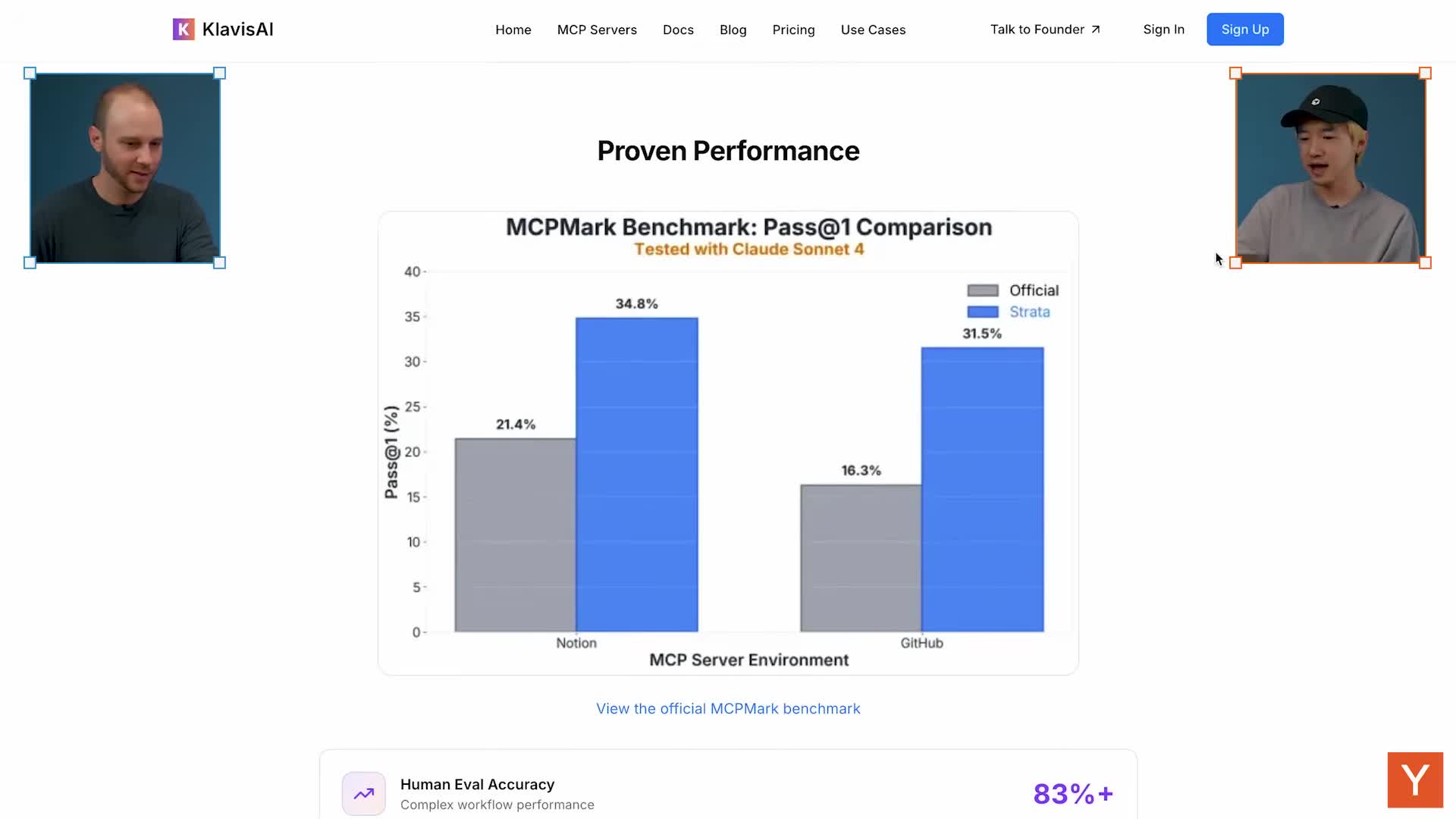
Oh, wow, there's charts.
This looks like a screenshot from Excel or something like that.
Yeah.
Sad.
Some dashboard.
Whoa, whoa, whoa.
Whoa, whoa, whoa.
Everything's kind of moving.
Yeah.
I don't like moving things when I'm not moving.
And when you're trying to read.
Yeah.
It's like distracting.
Mm-hmm.
I also don't like lines when you don't need lines like this one.
Yeah.
And, you know, headlines...
What most people do is they come down and they're going to read the headlines.
They're going to say, okay, what our customers say, compliance, investors, choose your plan.
You've got to be explicit and assume people are not going to read the sub-headline.
They're only going to read the sub-headline if they're intrigued by the headline.
Why is that even there?
Doesn't make sense.
Trying to build credibility, I assume.
But yeah, it's not clear what you're saying.
More like us money upfront patterns.
Is it too early for that?
Probably.
Yeah.
You should get them to sign up and start trialing.
Don't scare people.
Let's see what their question was.
Does our homepage, above the full hero section headline sub-headline, clearly explain our value proposition in five seconds.
We're worried it's too jargony.
Oh yeah, it is very jargony.
Let's kill all of this, kill the video.
Just show all the mcps.
You can connect that.
Uh, it's just one thing yeah, and that's probably pretty easy to show that visually right.
Just kind of all of them coming into like one strata logo or something yep, And then maybe, like you can actually like keep the little filters there and then you can filter between different set of tools.
Then you can kind of find the thing.
Yep.
But I think this sub headline helped.
I think we read this and we understood what they do.
Yeah.
Maybe make this the only headline.
Yeah.
Then kill your naming confusion, just pick one.
Pick one name, that's it.
Yeah.
Thank you, Clavis.
All right code crafters.
Oh, we got the purple gradients.
They're here, scary.
Become a better software engineer.
Stop following tutorials designed for beginners.
Start working on projects that actually challenge you.
Become a better engineer through deliberate practice.
Interesting, They don't have the name of the company up here.
And I said it, but then I forgot it already.
And I was looking for like, what is the name of this company again?
And I couldn't find it anywhere on the page.
Yeah.
Logo's also very generic.
Mm-hmm.
Doesn't tell me anything.
Yeah, this was a lot to get through here and it was it started out with the negative stop doing this thing.
So, instead of saying what they do in the positive, it started out with don't do this.
Yeah, which is not informative for for what they actually.
Yeah, i do like keeping things a little like aspirational, but you do want to communicate clearly.
What the hell is this?
Yeah, i still don't get it.
Yeah, it seems like learning.
It's a bunch of practice projects to become a better engineer.
Ah, i see.
So i guess, if you don't have side projects you want to work on, you would use this and this gives you a bunch of projects to build.
I see, i see, that's my guess here.
Maybe There's a pick, a challenge.
Let's see what happens.
Pick a challenge.
Oh, I see.
Build your own.
That's cool.
The whole website changed when we clicked through to this too.
There's like no continuity from the marketing page to those things.
Yeah.
And like if I get a pricing, if I get a roadmap.
Like even all the colors.
Yeah.
Like the green, yeah.
And then the other one is what?
Like purple purpley, purple everywhere, do they actually work with these companies?
Uh, enjoyed by developers, oh really, is that true?
I don't know, i guess we'll take their word for it.
Oh wow, this clipping thing is kind of crazy, backed by incredible engineers.
Okay, so i guess these are some of their investors.
Wait wait wait, wait.
These are actual, well, he's at Anthropic now, right?
Yeah.
Yeah.
Right.
So that is not a date.
I would not like modify other people's pictures like this.
It feels like kind of intrusive.
Yeah.
Yeah.
And they're all kind of a different style.
Right.
This one's like a professional headshot.
This one's like a phone photo or something like that probably.
One trick you can do is like maybe like knock down all their backgrounds but keep them like white.
Maybe you add a filter so that they're all like black and white.
Then it kind of standardized the thing without like butchering the picture too much.
Yeah, hear it from our members engineers and top teams love this.
Okay okay, right now, Projects that go way beyond the basics.
Be in the company of prolific developers.
Use your favorite tools to code.
No limits.
The world's best got better by doing.
Okay.
And try now.
Okay.
I'm curious if I click on other links through here, does it go, that goes to the YC site.
Okay.
Change log.
Whoa.
Okay, it goes to their... Look, they don't use their name.
Yeah, build your own X. Why is that?
I don't know.
I guess because people can make a Twitter X kind of thing.
The X means, like, anything.
I think the X means, like, build your own, like, X. Like, build your own Twitter.
Your own Redis.
Your own good.
Yeah, I was wondering if they're saying build your own X, because it's people on X and maybe I don't know.
Maybe, maybe.
Maybe one of the projects is rebuild X. Okay, so here perks looks like the homepage.
How about about?
Wait, what is perks?
Is that like another product or something?
Their members get priority access and preferential pricing on learning.
Interesting.
So this is like a learning subscription rather than a tool.
Maybe it makes me think it's more like a community or something.
Where's the community.
How do I talk to this pricing?
One takes me to this page, like in this design.
Oh, and this just changed too.
Now we're in like black and white.
What is this?
Are they like doing their own like expense card?
Yeah, is this a credit card company?
Wow.
I think it's some kind of learning thing to do projects.
That's what I've come up with after spending a few minutes looking at all of this.
And I can't tell what it is beyond that.
But there's the perks thing.
Yeah, that makes me think it's a community to do something.
OK, so be more clear around literally what this is, because it's not clear right now.
Yeah.
Less purple gradient.
Yes.
This looks vibe-coded.
It's got all the hallmarks of it.
So something that feels a little more custom, I think, would be great.
Yeah. we somehow kept getting to different versions of the site that all looked wildly different.
So I think consolidating all of that would be good.
And then you know, like a main thing is like the about page and it links off to their YC launch, which is a little bit jarring.
It feels like you know talking about who's behind this product is something you should have a dedicated page on your site about, right.
Otherwise it makes me seem like this company is so early.
They haven't even had time to like build their own.
Yeah, one thing i noticed is like i think a lot of them pride on being backed on yc, but that is actually not the main thing you're doing.
Yeah, like make people focus on what the hell is the thing.
Yes yeah, Yep.
That's about the backing end.
Right.
Number one is, what is this?
Number two is, is it for me?
Three, you can focus on the social proof and credibility and things like that.
But yeah, a lot of people are kind of putting it right in front, to the point where you look at it quickly and the YC logo looks like their logo.
Yeah.
Thanks, CodeCrafters.
Okay.
For this next one, let's do more of a lightning round and do some initial impressions.
Let's do it.
When we first pull it up here.
Slashy.
So this is Slashy.
It's so slow.
Also, it looks like Notion Mail.
Yeah.
Okay.
You obviously have a lot of experience with Notion and Cursor.
What's your initial impression here?
A lot of details are not there.
What's missing?
So if you look at this part, it almost feels like it's the raw Markdown output.
The UI doesn't really fit with the rest of the thing.
The video is like clipped wrongly.
There's like an extra yeah, it's like a white border.
I think the first impression really matters and anything above the fold.
Just make them as good as you can like.
No, you know obvious detail bugs, power of chat, gpt inside your email, I would say the messaging and stuff is pretty clear.
Actually not bad.
It's more like how you present it.
Like say this thing is not aligned in the same spot.
These images and the previews all have different sizes.
Some of them have shadows, some of them don't.
Yeah, this one's got a border.
There's a screenshot with a border in the window and then a border around the screenshot.
There's a lot of boxes and boxes and boxes.
It seems like there's some inspiration taken from the latest cursor site as well, showing some of these screenshots and calling out.
It's like the structure is fine, lacking some details.
Um, yeah.
Oh wow.
They're actually stealing like a notion picture here.
Yeah.
Another thing that resonates with me immediately is like they're using cursor to describe what they do.
So cursor for email.
Yeah.
And then power of chat GPT.
And then you come best of superhuman.
So they keep calling out all these other products that people may know to describe what they do, rather than just really explaining what they do.
True, and owning it themselves.
Yeah, they almost look like notion uh, agent and cursor in one, but lacking all the details.
Yeah, the details are what matters, and it's interesting you can pick that out from the screenshot too because you've used those products so much.
Right yes cool, thank you, slashy.
All right.
Next up we've got freya.
Oh,
Voice AI that sounds human for enterprise.
How can I hear it?
It has a start call.
What does it do?
Is it a phone number?
I'd say Freya safely handles inbound and outbound calls from support and service to sales and beyond, fluently in dozens of languages, 24-7.
Should we talk to Freya?
Yeah, let's try it.
All right.
Hi there, I'm Freya, the voice of Freya Voice.
We're an AI platform that helps businesses automate voice-based customer service.
Our AI agents handle full conversations end-to-end and sound completely natural.
Freya Voice is perfect for tasks like scheduling, answering common questions, or managing claims.
Available 24, 7, and over 40 languages.
你会讲中文吗?
It sounds like my response may have seemed unclear or cut off.
Let me try that again.
Freya Voice is a platform that automates voice-based customer service with AI agents.
What did you say?
I said, like, do you speak Chinese?
Because it says fluently in dozens of languages.
I was going to tell you to try speaking Chinese.
And I think my expectation would be that she would respond back in Chinese.
Exactly.
This is actually probably the best one we've seen today.
It's very clear.
Yeah.
Oh, they're kind of hijacking the scroll.
Not sure.
Yeah.
Okay.
Minus five points.
Yeah.
Don't hijack the scroll.
But the communication- Messaging, pretty good.
Yeah.
Demo, really accessible.
Pretty good.
Yeah.
Replace entire call center operations.
Custom use cases end to end.
Lead qualification.
Turn every lead into revenue opportunity.
Okay.
Resolve customer issues before they escalate.
Built for accuracy you can trust.
Results that speak for themselves.
Okay.
Whoa.
Yeah.
I mean, it seems like overall the messaging here is very clear.
Yeah.
And I think we understand what they do.
And I think if we ran a call center, an enterprise call center, we'd probably consider this and we know that this is for us.
Yeah.
All right, let's see what their question is.
Pretty good.
Curious how to very clearly convey the information of what we should focus on and give a smooth and simple experience.
I felt like they did that.
Yeah.
I don't think that's the thing to change.
It's not bad.
I would wonder how to make the demo even more obvious.
Maybe you can just start right here.
Right.
Yeah.
That's a question, right?
Is like, do you want to talk to Freya or meet the team?
What's the main CTA you want to drive people to?
It seems like meet the team because that's a button up here and that's the blue button here.
But meet the team is kind of weird too.
Like, do I want to demo?
Yeah.
Like who is the team?
Yeah.
And then what does this take us?
There we go.
Calendly.
Calendly again.
Yep.
Brea team meeting.
Okay.
Yeah.
Maybe like book a demo.
Yeah.
Book a demo would be better.
That's the main thing.
Awesome.
Not bad.
Nice job, bro.
Okay.
Finta.
Magically simplify accounting and taxes.
Automate bookkeeping, effortless tax filing, real-time insights set up in 10 minutes, back to building by 512 PM.
Very detailed.
Not sure what's the reference.
I don't understand the 5.12 PM either.
Wait, is it like...
Oh, okay.
That's just the time.
10 minutes from now.
That's cool.
That's cute.
But you know, now it's 513.
Took a little bit too good.
Yeah.
Okay.
All right.
That was clever.
Very cool.
Okay, so pricing gets started.
Yeah, it's something around simplifying accounting and taxes.
For like individuals who are... Yeah, so this was not clear to me.
And then when I go a little bit deeper, it's like automate bookkeeping.
Right.
And so that makes me think more businesses.
Maybe for companies, startups.
Oh, here we go.
Right down here.
What do you really think? for U.S.-based C-Corps, LLCs, and PBCs.
Maybe kind of fold that with the primary messaging.
Yeah.
And then maybe kill the time thing.
Yeah.
And I think we're seeing a lot of consistent patterns as we've gone through a few of these, which makes me feel like a lot of these are building effectively the same template, right.
We got the little thing up here.
Some people put the back by YC here.
Some people put we're hiring.
We got the blue buttons.
We got two buttons next to each other.
We got a headline.
We got something else here.
We got a logo here.
We got a screenshot here.
And so sometimes for a lot of businesses, that might be good enough.
You know, just clearly it's like a pattern that users are used to.
They know where to go.
But you know, sometimes it's helpful if you want to build your own brand and identity and be different and memorable is to break out of that box and come up with something that's like really unique and focused to what you're trying to communicate and get across around how you're different.
I actually don't mind keeping things simple and plain.
Just let people scroll.
Have the messaging be the primary thing.
Have the product be the primary thing.
As you scroll, there's little punch points.
Boom, boom, boom.
Maybe you're just scrolling and seeing some pictures that vibe with that idea.
So it's not that bad.
Yeah.
And I like this too, like tax season with zero stress you know that probably appeals to the type of person that would be their customer and to filed our taxes and claim 17000 in credits process was easy.
Cool.
Not bad.
Yeah.
I got live chat.
How the sections break is a little weird to me.
Like, I kind of want these things to be, like, more under the text thing.
Yeah.
Like you get this like white section and then some grays and then some whites and then some cars on top.
It kind of fucks up the hierarchy.
Yeah.
Yeah, it seems like the full width is like a headlight.
Right, it's like a boom.
Yeah.
But then the line that goes across makes it feel like it's breaking up the section.
Like why is this card like slightly on top?
Yeah, it looks like it's supposed to be a card sticking out.
It's like there's some cool visual treatments, but they actually cause some confusion.
Yeah.
But generally, like visually, it looks nice.
It looks well organized.
Yeah.
It's like if you look at each of the pieces, it's actually pretty well built.
Yeah.
Like there's a lot of little details in there.
Right.
Yeah.
The temptation is to show a big screenshot from far away and you can't tell what's going on.
Instead, they're honing in on the very specific thing.
Like if I were to do this, it's almost like I want to...
Just make these like maybe shrink them and make them more cardi, make them more like parts of the same whole.
Instead of, like, there's, like, a lot of things in, like, flat.
That's all, like, kind of moving and doing stuff.
Yeah.
All right, let's see what their question is.
Does it convert?
They're going to have to answer that for us, but I don't know.
I think it communicates what it does.
My sense is, if I were in the market for a product like this, this would appeal to me and I would probably want to check it out.
So my hunch is probably yes, maybe just making this more prominent, the who is for, and making that like ram that home a little bit more.
I think would be good.
I would steal the little trick to hide this button until, say, you're here.
And then it kind of animates in, then you know where it is.
Right, you pay attention to it.
Because, like, I feel like the main issue with, like, say, I think Hero's pretty good.
Once you pass here, it's like little disorienting, not sure what to do now.
Yeah cool, thank you, finta.
Last one, all right, last one.
Vibe flow, vibe flow.
Let's check it out prompt.
Oh, visually okay nice.
Where's the visuals?
Um Projects.
Explore your projects.
Sign in to see projects.
All right.
Well, clearly they want us to engage with the prop box.
Why don't you give it a shot?
Okay.
Okay.
A spinner.
It's thinking.
Okay.
Oh, wow.
Showing us something.
It's charging the electrons.
What is this?
Is that some kind of preview?
What is that?
Is it like a mini map of a whole page or something?
Maybe.
It's like the canvas.
Yeah.
This is one of the core.
I'm curious how you think about this, Cursor.
So many products that use LLMs today have this weight.
What do you do when the user has to wait to keep it engaging or make it feel like it's going faster?
I think you want to almost show every single state that's happening.
So I thought for 29 minutes, what did it do?
And if it does tool calls, just show them.
Um, but you do want to control, like you don't want to show too many things at once where like, it just becomes like a wall of text.
You want to control like ah, the things that are running.
You show them in a more like focusable spot And as it progresses it kind of shows you like ah, these are the things that are running.
These maybe are the actions I need to confirm.
This is my input.
You kind of shift people's focus.
And I don't want these like random empty states with spinners everywhere or like.
Ah, in the preview you saw like it was like looping some random messages, but they weren't really helpful, right.
They were actually cute messages, kind of distracting, right.
So you need to figure out like, when things are happening, where do i want people to focus their eyes on?
Yeah, it's hard too, because you don't know is it going to come back in five seconds or is it going to come back in 10 minutes?
Yeah okay, so this one we hit an error.
Let's see, feels very like vibe coded the whole thing.
What gives it that impression for you?
If you look at all the little details, they don't know together.
So everything feels kind of disjointed.
Yeah.
Like there's like weird hover states, like with little radius on top, but not on the bottom.
If you look at all these different views, like some of them are like I don't know portals into, like iframes of something
This is almost like a vibe code, a VS code.
This is pure AI generated.
You know, there's not even like a, like not even say you're not using chassis or whatever.
Yeah.
Like it's just raw AI.
Right.
Yeah.
What do you think this toggle button does in the top?
No idea.
The mystery toggle button.
No tooltip either.
Ah.
What does it do?
It looks like it goes full screen, and I assume that's the preview.
I guess we can't really see much.
Is it still working, or where is it at?
I think it failed.
Failed again.
Okay.
No luck.
Sad.
This is what I do.
Mm-hmm.
Ah, that's cool, like a little like suggestions.
I might still do this.
Why is there two spinners, right?
Why can't i open the thinking?
Huh, why is there's just spinning and not telling me what is thinking?
Yeah Also, the suggestions came before I did anything.
Yeah.
Okay, so it looks like the core issue is we don't have 3d libraries.
So it's gonna try to Do a CSS base.
Whoa.
That's a very interesting attempt.
Yeah.
It's creative.
Black Earth will be happy.
All right.
Let's see what their question is.
General advice on how to improve the design.
I think we touched on that.
I guess the problem was, before I came in, I couldn't even do anything or see anything.
You remember like there was the prompt box and then, when you scroll down, it's like all your projects sign in.
Right, why not just show people like other people's projects?
Yeah.
And then we tried to make something and we got hit with a sign up wall.
Yeah, just give them like.
Even in real os you can send three free messages before you sign in.
That just let people play.
Yeah, and maybe make sure that maybe the initial demo is more constrained so that it gives you better output.
Awesome.
Thank you, Vibeflow.
Rio, that does it for the reviews.
Thank you.
Thank you so much for joining.
This was incredible, really great feedback, and really appreciate you joining us today.
Great.