Grownups, Wondery Plus subscribers can listen to Wow in the World early and ad-free right now.
Join Wondery Plus in the Wondery app or Wondery Kids Plus on Apple Podcasts.
Hey, Wowzer fans, Mindy here.
And before we start the show, I gotta let you know that this November, with a special new episode featuring our friends at Circle Round and Terrestrials on Radiolab for Kids,
And don't miss when Elmo from Sesame Street stops by Wow in the World to make us all belly laugh on November 24th.
Oh, but that's not all, Reg.
On December 1st, we are sharing our 250th episode of Wow in the World with all of you.
We think this one is going to be music to your ears.
Literally.
Did I mention it's a musical?
And if you're a member of the World Organization of Wowzers...
Oh boy, do I have a surprise for you.
You can listen to our 250th episode early with me and other members from around the world on Saturday, November 22nd, at 7 pm.
Eastern.
That's right, we are throwing another listening party.
Join us as we dance along to our new songs.
React to the episode with other members in the chat and more.
Grownups.
If you want your wowzer to join this members-only listening party, you can sign up to become a member today at Tinkercastcom.
Slash wow.
Already a member?
Well, you can find the link and password to join the event when you sign in at Tinkercastcom.
Slash wow.
That's it.
It's going to be a November to remember.
But for now, let's get on with the show.
Woo!
It's okay.
It's okay.
Nothing to worry about.
You are safe under this blanket.
Okay, don't panic.
Nothing to be afraid of.
It's just a little thunder.
Hello?
Is anyone there?
Hey, guys.
Mindy?
What are you doing hiding underneath this bed sheet?
You're going to miss the whole light show under there.
Mindy, you scared me half to death.
I'm sorry.
I was just coming over to see if you wanted to watch the thunderstorm with me.
Watch the thunderstorm?
Yep.
I've got everything set up.
You see here, I've got an Oklahoma City fan.
Thunder jersey for you.
Oh, thanks.
And a Tampa Bay Lightning jersey for me.
Mindy, this jersey is like three sizes too big for me.
Eh, you'll grow into it.
What else do I have?
Let me see here.
Oh, I made us some Storm on the Cobs to snack on while we watch.
Storm on the Cobs?
Yeah, it's corn on the cob.
Uh-huh.
Melted butter.
Okay.
And rolled in Pop Rocks.
Huh?
Check this out.
Ooh.
Oh.
Uh...
It's an invention of my own creation.
I see.
So what are we waiting for, Guy Raz?
We're going to miss all the action sitting in here.
Well, actually, Mindy, um... What?
Well, it's a little embarrassing, but... But what?
I'm actually a little afraid of lightning.
It's okay, Guy Raz.
Don't feel embarrassed.
We all have fears of redonkulous things.
Even me.
You mean like your fear of sock puppets?
What?
Where?
Where?
No, no, no, Mindy, there aren't actually any sock puppets here.
Don't do that to me!
Sorry.
So is it lightning or thunder you're not a fan of?
Um... Because those are actually two completely separate things.
Well, I know that, but they always seem to go together, like... Like corn on the cob and pop rocks?
Uh no, I was gonna say Okay.
So lightning is that bright streak of electricity that you see dart across the sky.
And thunder is... That.
That.
Sound that follows it.
Uh-huh.
Oh, you know what might calm you down, Guy Raz?
What?
A little cold, hard science.
What do you mean?
Well, if you understand the science behind lightning and thunder, you'll realize that they're not really that scary at all.
Well, okay, okay.
Yes, but I'm waiting for this.
Okay, you wait right here.
I'll be right back.
Mindy, where are you going?
Be right back.
One, one, one.
I'm back.
Mindy, what on earth do you have in your hand?
This is my laptop.
I have a lightning PowerPoint slide presentation that I want to show you.
That is your laptop?
Yeah.
I built it myself.
All right.
Let me just fill it up with some gas here.
What in the... And boot it up.
This might take a few tries.
Uh...
Okay, let me just see here.
PowerPoints.
Double click.
Hmm.
Top tips for looking after your weasel.
No.
Reggie and Mindy, a guide to best friendship.
No, not that either.
Oh, here it is.
The shocking science of lightning.
Get it?
Shocking lightning.
Never mind.
Okay. there are these tiny little bits of ice that bump into each other as they move around.
And presumably, those small bits of ice are just frozen raindrops.
Exactoritos.
So as these small bits of ice collide with each other, they build an electrical charge.
The electric charge is then stored inside the cloud.
Kind of like a battery.
Yep. but much, much more powerful.
Well, how much?
So the battery in the remote control for your TV might store, like, 9 volts of electricity.
And to be clear, a volt is just a measurement of electricity.
Yeah, so while a normal battery might hold about 9 volts of electricity, an active storm cloud can hold around 100 million volts.
Whoa, 100 million volts?!
!
That's enough energy to power about, let me see, carry the wand, 30,000 homes.
I know, bonker balls, right?
So these thunderclouds are roaming around with all of this electrical energy thanks to little bits of ice mashing together inside the cloud.
Okay, I think I'm with you.
So this electricity then separates into two parts.
The positively charged electricity, which are called protons, float up to the top of the cloud, and the negatively charged electricity, called electrons, settles at the bottom of the cloud.
Right, kind of like how all the sand settles to the bottom of a glass when you make me one of your signature sand smoothies.
Yeah, exactly like that.
So after a little bit of time, some of the negatively charged electrons Jump across the cloud to where those positive protons are hanging out.
Because opposites attract.
You know it, Guy Raz.
And that jump across the cloud is, I guess, what we see as lightning.
You're picking up what I'm putting down.
Okay Mindy, I think I got this, but what about the lightning that comes out of the cloud and strikes the ground?
Like, like that.
Ah, well, that's where this PowerPoint presentation goes from good...
To great.
You see, the ground underneath a thundercloud is also positively charged.
And those positive charges kind of tend to bunch up in stuff that sticks up out of the ground high up like trees or tall buildings.
Right.
And so the negatively charged electrons jump from the bottom of the cloud to the positively charged ground.
I see.
I think you got it.
Hang on a minute, Mindy.
It looks like you still have one slide left.
What?
Oh, yeah.
How could I forget?
Lightning Fun Facts.
You ready for the lightning round?
Let's see here.
Lightning is approximately 54,000 degrees Fahrenheit.
Whoa.
Mindy, is that true?
Yep.
Almost 30,000 degrees Celsius and six times hotter than the surface of the sun.
That's incredible, Mindy.
Yeah, it is.
And that's not all.
Let me see here.
Oh yeah, this one is so cool.
It turns out that lightning doesn't just happen in thunderstorms.
Whoa, what do you mean?
Well, you know how the electric charge in the cloud was generated by little bits of Ice clashing together.
Yeah.
So the same thing can happen in a dust storm or a forest fire or even during a volcanic eruption.
You mean those tiny pieces of dust and ash can build up an electrical charge in the smoke cloud, just like how bits of ice do in thunderclouds.
You know it.
Whoa.
Okay, Mindy, I think I'm all caught up on lightning, but what about...
Why does that keep happening?
But what about thunder?
Let me tell you, Guy Raz, thunder is even cooler.
Cooler?
Didn't you just say that lightning is hotter than the surface of the sun?
What?
No, I meant, like, poodle wearing sunglasses kind of cool, not temperature cool.
Oh, got it.
So when lightning strikes, the bolt actually cuts through the air, opening up a little hole called a channel.
And once the lightning is over, the air collapses back in on itself, which creates a shockwave which we then hear as thunder.
Ah, right.
So when the lightning cuts through the air, it creates a pocket.
And then once the lightning disappears, it pops, just like a balloon.
You got it.
Huh.
You know what, Mindy?
That really did help me.
You mean?
Is there anything science can't do, Guy Raz?
Well, if there is, I haven't found it.
Okay, so now that we've got your fear taken care of, you're ready to go watch the storm now?
Yes, but not this storm.
Not this storm?
What?
Okay, Roz, are you talking about the Melbourne Storm rugby match in Australia?
I'm not talking about a sports team, Mindy.
I'm talking about one of the greatest mysteries in meteorology.
Meteorology.
Ah, you mean the science of weather.
Yep.
Cool.
So where's this wonder of the weathering world?
Well, it's located just off the coast of Venezuela.
Ah, Venezuela, huh?
Hang on, one second.
Uh.
Dial, dial, dial, dial, dial, dial.
Hey, Reg.
Buddy.
How you doing?
Ooh, new beak polish.
Nice.
Well, I thought you looked great already.
Mindy.
Oh, right, sorry.
Hey, Reg, we need a favor.
Yeah, Venezuela.
Really?
Not bad, huh?
No, no, it's fine.
All good.
Yep, nope, nope.
Have fun at dodgeball.
Dodgeball?
Sorry, Guy Raz.
Reggie is a no-can-do on the flying us to Venezuela.
He says it's too risky to fly in these conditions.
Yeah, well, that's fair enough.
Plus, he's got a dodgeball game in, like, 30 mins.
Of course he does.
So, looks like we'll be busting out the old time machine for this one.
Okay, but only if you take it easy with the takeoff and landing.
Cross my heart.
And my fingers.
Okay, well then, let's go.
Where did I park it again?
Uh, wouldn't it just be in your garage?
No, I just turned that into a slam ball court.
A slam ball court?
Yeah, you know, basketball, but with trampolines.
Oh, right.
Now, where did I park it?
Come on, think, Mindy, think.
Oh!
Did you remember?
What?
No.
But I did remember that I put a buzzer on it so that I wouldn't lose it.
All I have to do is press this button here and we'll be able to hear exactly where I left it.
Would you care to do the honors?
Sure, thanks.
Okay.
Found it!
Mindy, why is the time machine in the kitchen?
Well, I used it the other day because I ate my last fish taco and it was so good that I had to use the time machine to go back in time and then eat it again.
Uh, isn't that a Paradox?
Well, if paradox is a word that means all you can eat last fish taco, then yes.
You want to go back for it one more time?
Uh, no, I don't really think we have time for fish tacos.
We have to go to Venezuela, remember?
Okay, fine.
Let me just open up the hatch here.
There we go.
Are you Guyron?
Okay, strapping in.
Time to punch in the coordinates.
Where are we going again?
Catatumbo Bay, just off the coast of Venezuela.
Catatumbo Bay, Venezuela, South America, present day.
All right.
Now, if I just press this button that says go!
Man, this thing has a lot more than I remember it having.
You OK there, little buddy?
No.
No time for groaning, Guy Raz.
You're going to have to save it for later.
We've got a lightning storm to watch.
Guy Raz, what is that?
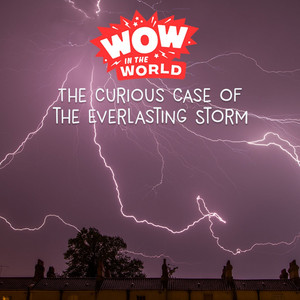
That, Mindy, is Relampago del Catatumbo, or in English, the Everlasting Storm.
The Everlasting Storm.
Lightning storm?
That's right, Mindy.
This storm rages for almost 260 nights of the year every year.
260 nights?
That's what?
One, two, three.
That's almost 10 months a year.
Yeah.
So you're telling me that for all but two months of the year, this lightning storm is just doing this?
That's exactly right, Mindy.
Every night for about 10 hours at a time with as many as 280 lightning strikes per hour.
Whoa, that's almost five volts of lightning every minute.
And a record-breaking 1.2 million lightning strikes every year.
Well, you know what this must mean, Guy Raz.
Yep.
Welcome to the most electric place on Earth.
Whoa!
This is so wow!
In fact, these bolts of lightning are so bright and so frequent that they can be seen from almost 250 miles away.
Which is what?
400 kilometers?
Yeah.
In fact, in olden times, sailors who were trying to navigate around the Caribbean island well, they would use this storm to guide them.
And they actually gave it a nickname, the Lighthouse of Catatumbo.
Whoa.
So how does it work?
Well Mindy, a lot of people have hypothesized or made scientific guesses as to why they think this part of the world is so electrifying.
But as it turns out, nobody is 100% sure.
Ooh, mystery.
But that's... could soon change.
What do you mean?
Well, scientists at NASA have been tracking lightning storms all around the world for the past 17 years as part of a program called the Tropical Rainfall Measuring Mission, or TRMM for short.
Catchy name.
So what these scientists did is team up with Japanese scientists from the Japan Aerospace Exploration Agency.
Which is like the Japanese version of our NASA, right?
Exactly.
And they teamed up to collect a bunch of data from weather satellites that were orbiting or floating above and circling the Earth.
That must have taken forever.
Last time we went stargazing I tried counting all of the satellites overhead and I lost track after like 10 minutes.
Well, that's hardly surprising.
Surprising, Mindy.
There are around 1,100 active satellites floating above Earth right now.
And about 13 of them are used exclusively for looking at the weather from really high up.
Wait, so you're saying that they used these weather satellites to spy on the lightning?
Well, sort of.
Some of the weather satellites were fitted with a device called a lightning image sensor.
A lightning image sensor?
Yep.
It's a tiny little device in the satellite that records flashes of light in the sky.
And with that information these researchers were able to create a map of the world's lightning hotspots.
Oh, so what were these researchers able to find?
Well.
Using this information, they were able to figure out that Catatumbo was, in fact, the most electric place on Earth.
Before 2014... there were two places that were competing to be the electric capital of the world.
Hello, ladies and gentlemen, and welcome to this electrifying showdown of meteorological might.
I'm your host, Will Wilson, and with me is Harry H. Harrison.
Harry, why don't you tell us a little bit about tonight's competitors?
Thanks, Willie.
What a showdown tonight, folks.
Over in the village of Kifuka in Central Africa, we have the longtime reigning champ, thought to be the most electrifying place on Earth for the past four decades.
Look at this.
158 lightning flashes per square kilometer per year.
And boom goes the thunder.
And the Brahmaputra Valley of eastern India, newly scouted this season by NASA, is a contender for the most electric.
Hey, I was watching that.
Anyway, as I was saying, these satellites that used this lightning image sensor...
Well, they helped scientists determine that neither of these places were the most electric places on Earth.
In fact, the most electric place on Earth was... At Atumbo Bay!
That's right!
I know!
So did this satellite help us get any closer to unraveling the mystery of why this storm keeps raging on?
Well, not yet.
Oh, man!
But the same scientists are hoping that a new satellite that was launched earlier in 2018 will be able to shed some light on the mystery.
Yeah, how?
Well, unlike the data that's been collected from those other satellites, this new satellite called GEOS-17 will sit in one place above North and South America and continually monitor those areas without going anywhere else.
Okay, so let me get this straight.
Instead of having satellites collect this lightning data when they just happen to be flying overhead, this satellite will stay in one spot and just constantly watch that one spot.
Exactly.
Which will hopefully give these researchers some new insights into how this natural phenomenon keeps on wowing our world.
That's so wow.
It sure is, isn't it, Mindy?
But you know what?
What?
For now, hi.
I'm just happy to sit back, relax and enjoy a storm on the cobs while watching this everlasting lightning storm do its thing.
You know, Mindy, that actually sounds like a pretty great idea.
Do you have a spare one of those storm on the cobs?
You know I do, Guy Raz.
Whew, just for you.
Hey, grown-ups.
It's Mindy and Guy Raz here from wow in the world.
Mindy and I have some brand new wow in the world toys out in the world, just in time for the holidays, made for the kids who love science and for the ones who don't.
Yeah, From our 100 experiments that wow kit to the telescope and astronomy kit, our wow in the world toys help your wowzer learn about their world through play.
Plus, you can hear exclusive audio content from me and Guy Raz to help your wowzer discover even more wows.
Grownups.
Give the gift of wow and wonder this holiday season with our latest wow in the world toys designed with your curious wowzer in mind.
You can shop our wow in the world toys at That's Tinkercast.com slash toys.
That's Tinkercast.com slash toys.
That's it.
Back to the show.
Wow in the World.
Hi, thanks for calling Wow in the World.
After the beep, get ready to record.
Hi, this is Will.
And this is Patrick in Gloucester Massachusetts, and our wow is we were playing basketball in the driveway and we found a giant fuzzy caterpillar.
Bye.
We love your show.
Bye-bye.
And we'll date and I'm four.
Yeah, four.
Yeah.
Hi, Mindy, Guy, Roz, and Reggie.
I'm Cora and I'm nine years old.
I'm from Washington, D.C. and my wow in the world is is that bell peppers are actually fruit.
And so are cucumbers, green beans, red chilies, eggplants, and avocados.
So if you have green beans for dinner tonight, you added some fruit to your meal.
Bye!
Love your show!
Hi, Mindy and Gerard.
My name is Charlie, and I'm six years old, and I live in Dallas, Texas.
And my wow in the world is that horned lizards can shoot blood out of their eyes to protect, to protect herself.
I'm mandine guy ross, my name is cameron and i'm six years old and i live in real estate california, and my wow is is that a blue whale's blood veins are so big that a small child could swim inside of them?
Bye hey, mandine guy ross.
My name is reina and i'm from kenosha wisconsin, and my wow in the world is that a killer whale is actually a type of dolphin.
How cool is that.
I love your show.
Hi, my name is Quinn.
I'm seven.
I live in Carthage, North Carolina.
My wow in the world is it takes 18 months to walk the wall of China.
I love your podcast.
Hi, my name is Ross.
I'm Ella.
And I'm Aiden.
We are nine years old and we live on a farm in Caledonia, Illinois.
And our wow in the world is cows don't have top front teeth.
Hi, Mindy and Guy Raz.
We love your show.
Hi, Mindy and Guy Raz.
My name is Zeke and I am six from Los Angeles.
My wow is that sperm whales can dive underwater for 100 minutes.
Bye.
I love your show.
It's my turn.
What?
Okay.
Although he got cut off a little bit in the beginning.
No, it's my turn.
End of messages.
Hey, everyone.
And if you want to keep the conversation going, check out some of the questions we posted on this episode at our website, wowintheworldcom.
And grownups.
There you can find more details on how your kids can become part of the World Organization of Wowzers.
Lots of cool perks, exclusive t-shirts, autographed pictures of us and a bunch of other cool stuff wowintheworldcom.
Our show is produced by Jed Anderson.
Say hello, Jed!
Yo!
With help from Thomas Van Kalken, Chelsea Erson, and Jessica Bode.
Meredith Halpern-Ranzer is the big boss.
Our theme song was composed and performed by The Pop-Ups.
You can find more of their awesome all-ages music at thepopups.com.
And parents and teachers.
If you want to send us an email, our address is hello at wowintheworldcom.
Grownups, you can also find us on Facebook, Twitter, and Instagram at Wow in the World.
And if you want to be featured at the end of the show, call us up and tell us your Wow in the World.
Our phone number is 1-888-7-WOW-WOW.
That's 1-888-7-WOW-WOW.
And parents.
If you want to upload any photos or videos or messages to us, please visit wowintheworldcom and find a link where you can do just that.
And if you haven't already done so, please subscribe on Apple Podcasts, or however you get your podcasts.
Leave us a few stars and a review and be sure to tell a friend about the show.
Until next time, keep on wowing.
Wowing.
Made by Tinkercast.
Grownups, if you like Wow in the World, you can listen early and ad-free right now on Wondery+.
Join Wondery Plus in the Wondery app or on Wondery Kids Plus on Apple Podcasts.
Prime members can listen ad-free on Amazon Music.
And before you go, tell us about yourself by filling out a short survey at wondery.com slash survey.