Discussion keeps the world turning.
This is Round Table.
You're listening to Round Table, I'm Steve Hatherly today with Niu Honglin and Lai Ming.
Coming up, snooker, a game of ball, cue, and table is one stereotypically reserved for older folks.
But wait, recently a young Chinese snooker star took the sport by storm, we'll talk Cue sports in just a moment.
And then, when you step onto an escalator, either going up or down, I'm guessing that you almost instinctively move to the right side.
It happens here in China and almost everywhere around the world to be fair, but are we actually using the escalator correctly?
Huh? Our podcast listeners can find us at Roundtable China on Apple Podcast. Don't forget we love hearing from you as well.
But yes, you can send an email and we enjoy that, but we love to hear your voice.
So send those voice notes our way with your thoughts on any of the issues that we discuss here on the program!
Roundtable podcast at QQ .com, that's roundtable podcast at QQ .com.
And now, have you heard his name yet?
If not, you're about to.
Zhao Jintong, his historic victory as the first Asian player to win the World Snooker Championships has reignited China's passion for billiards.
Once a wildly popular pastime, about three decades ago or so, the sport is now experiencing a remarkable resurgence among younger generations.
Industry analysts project China's billiards market will exceed 100 billion yuan, that's about 14 billion dollars, by 2025, with fans surpassing 210 million nationwide.
What is behind the revival of the game?
Well the answer lies in a mix of star power, changing lifestyles, and smart commercialization.
Niu Honglin -Or and Lai Ming.
Are you snooker players or fans?
Definitely not snooker players.
Snooker is too hard for me, but I do occasionally play a little Chinese billiards it's fun.
Chinese billiards. That's what we call it, but I think it's really close to the pocket billiards, the easier version with 16 balls, 1 cueball, and 15 other ones, object balls, and for me it's easier.
you break, and then whichever one goes into the pocket first would be yours, and then you only hit yours and you finish, and that's the black 8.
The black 8 -Ball, yeah.
Some of the balls are solid colors, some are stripes.
That's pocketball, I guess.
8 -Ball or 9 -Ball depending on the game.
But yeah, it's a different game from billiards.
And I only have experience of that.
From Snoker, excuse me.
Leeming, were you a player?
I can count with the fingers on my left hand the amount of times I played cue ball.
Check your notebook.
When was the last time you...
Yeah, I may be able to find out about that if I paid for them.
My friends usually pay for them.
So what's going on here?
I mean, this is big news in the sporting world, right?
There's a new superstar in town.
Yes. as in this year May 5th, millions of snooker fans in China witnessed history as 28 year old Zhao Xintong became the first Chinese player, actually the first Asian player to win the World snooker champion final.
It was a very exciting moment for snooker fans.
I actually, I didn't watch the whole entire match. Snooker matches can go on for quite a long time, but I watched the final 10 or 11 minutes.
This happened at the Crucible Theater in Sheffield in the UK.
And I must admit, before I watched, I had never heard of Xiao Xintong.
I wasn't a big snooker fan, to be honest with you.
In Canada, in America, we're familiar with the sport.
It's often televised, right, on ESPN Two or Three or something like that.
It's a very quiet game to be broadcast on TV.
Yeah, but for fans, I mean they really love it.
So, because Xiao Xintong won the World Championships, I tuned into the final 10 minutes or so.
This guy is phenomenal.
I can tell you that.
He doesn't miss, and he's really calm, but he's not just calm.
He's confident, but there's a swag in his, in his play, and he plays without hesitation.
If you watch other players play, they'll kind of slowly move around the table a little bit.
They'll, they'll look at the shot first. you can tell he knows exactly what he's going to do before he does it so he plays with a without hesitation as well so I was impressed obviously by his play he won the World Championships but I was more impressed with the interview that he did after he won the semi -final match not the final but the semi final and I was impressed by that because in the semi final he was playing his idol this This is a man by the name of Ronnie O 'Sullivan.
And Ronnie had been helping him out with his career.
He's much older than Zhao Xintong.
And so Zhao Xintong was playing against his idol in the semi -final.
And after the match, they asked him how, you know, congratulations, how did you feel about beating him?
And he said, well, I felt bad because I wanted him to win his eighth World Championship.
Ronnie O 'Sullivan is a seven -time World Championship.
So the humility in his answer, and he was so sweet and kind and I looked at the comments online, because this is from a foreign media outlet, and everybody was saying how impressed they were.
Not only with his play, but just with the kind of character and that kind of person that he was presenting himself to be as well.
It was a really great moment.
Billiard is a… On top of that, he's being very sportsman kind of way, because even though he wanted his mentor to win the eighth world title, he still played his best and still grabbed the title.
And he won, yeah. And I think billiard is that kind of sports.
You can have your own style and you show your personality, you show your strategic thinking, you even show a little bit of whether or not you are someone who can control your temper through the playing of game not only these kind of competition that we can enjoy to watch but also in one well in the everyday game well maybe not every day in the game that you play with your friends you get to see another side of them.
Yeah and Snooker has a reputation of being kind of a classy sport anyway and Zhaojin Tong he just looks like he fits in perfectly with his character but he also just looks like he's about 30 years younger than the average snooker player.
Again, I'm not an expert, I could be very wrong about that.
Just to go over quickly for our listeners who might have no clue about what these tables look like or what these different games are.
Billiards, and by the way, these terms can sometimes be used interchangeably and even native English speakers who aren't experts on the game, we don't exactly know what we're supposed to be calling these but I looked it up.
Billiards has no pockets and it has three balls, one white, one yellow, one red.
Pool which is what Nhong Lim was talking about before it's on a smaller table and it's usually about seven to nine feet long with with six pockets.
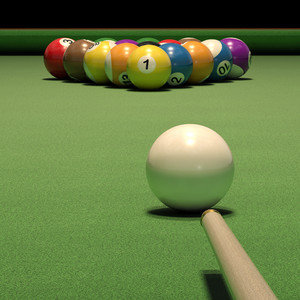
There are 16 balls you've got the colored ones and the striped ones.
This is what we call um eight ball or nine ball or pocket ball and this is really popular in Canada and the US and and you were saying this is this is kind of a popular game in China too.
As well. Yes. And then you've got snooker.
And snooker is the largest table.
It's 12 by 6 feet and the reason that they say snooker is the hardest of all three that I just mentioned is because the pockets are smaller.
And you take the balls out from the pocket.
I don't get it. I've done my job.
In this one you've got a lot of red balls.
15 red balls. Then you've got six colored balls, all different colors and then you've got the one white cue ball.
So the way that this goes is you have to hit one red ball into the pocket and then one colored ball.
The red balls stay in the pocket, but when you hit the colored ball it comes out.
It comes out. It goes back on to the table.
What? Why? Well because...
It's the rules. You have to get rid of all the red balls.
Listen, I watched so much snooker yesterday afternoon.
I was working, quote -unquote, working getting ready for this topic today.
But this makes Xiao Zhentong all the more impressive because this is the game that even professionals say is the most skillful of all the ones that I just mentioned.
So, let's talk about the market here in China.
What does it look like?
A report from industry research company China IRN estimated that China's billiards market is expected to exceed 100 billion yuan or 14 billion US dollars by 2025 which is this year with over 210 million billiards enthusiasts and an annual growth rate of one hundred and eighty, well one hundred and eighty percent.
I bet that number is about to go up.
Yes. There's a new Chinese world champion in in the snooker in the snooker realm.
Definitely and data from business registration tracker, I've heard Chi Cha Cha review that there are 100, more than 160 ,000 domestic enterprises related to billiards halls and they have shown a significant growth trend in post -pandemic era.
The number of newly added billiards halls from 2021 to 2024 is 20 ,000, 31 ,000, 41 ,000, and 55 ,000 respectively.
Wow, and the biggest jump was the most recent jump, as a matter of fact.
So when did, I mean this has been around in China for a little while, it's obviously growing in popularity, has this, I mentioned when we were starting the show today, is that maybe around 30 years ago or so, this was a really hot sport, this is a hot thing for people to do?
Here in China I think it's around 2000 or early 2000 it started to be really really popular or already being really popular because of the development of this pool game.
Not snooker. Snooker is still a bit too hard for regular players.
If you play snooker it takes longer time and it takes time to find your component to play with you But the pool game is easier and it's not that time -consuming and in different billiards halls, there are different ways you can pay for each game.
You can pay for the amount of time you're gonna use the facilities in the halls.
Like a bowling alley, like a bowling I don't know.
It really depends on the difficulty of the game.
If it's something as difficult and complicated as snooker, as you guys mentioned earlier, then I believe for anything to be popular, it has to be easy.
And I can see how the easier version of the Belial balls can be more popular across the country than snooker.
I don't recall ever seeing a snooker table in my life.
Really, but there was a report from People's Daily in 1988 that said 1988 that said that there were over 200 billiard halls within a 10 kilometer stretch of road and I was chatting with a co -worker who told me that sometimes businesses would even put the billiards table outside of the business, literally on the street, and I guess people would come and play so I mean, that's a bit of evidence right there.
And this is a long time ago.
This report is from 1988, right?
So the evidence that there was a time when this was quite the hobby for people.
But back then, I don't think these billiards halls are the places where I would encourage, for instance, for me to, well, I would encourage my kids, for example, to go.
Because back then, you would see people smoking because smoking was still allowed in indoor area back then in china and maybe a bit of gambling that shouldn't be happening at the time as well that happened in Canada in those types of establishments.
I also remember in those billiards halls it's usually a little too dingy and fishy the atmosphere was not as today's.
That's interesting because that's how I would describe pool halls of the past in Canada too.
Now this might be a stereotype, but it's just the image that comes to mind for me, a very kind of brightly lit space with some perhaps less than friendly characters hanging out there.
But what happened in Canada, at least when I was in my university years, this would have been around the late 1990s, is that there was a complete overhaul in the image of what a pool hall was.
all of a sudden these upscale pool halls started to appear.
Now, what's an upscale pool hall?
They completely cleaned up their image.
They made the interiors really, really nice.
Really, really fancy.
They started selling alcohol, but not at such a cheap rate that it would encourage everyone to come.
They made it more expensive to keep with that upscale image.
And then they started playing like really cool music too.
So it became a place where young people would go and just hang out, not necessarily because they love pools so much, but just as a cool, fun place to socialize.
The first part I can agree with my experience growing up in a small county in China, because back in the days, I think New Orleans would agree that little children and little kids and even youngsters weren't encouraged to show up at those places.
It's almost on par with arcades.
You know, arcades, they will usually hang a curtain and in front of the gate.
And they want to invite people around but they don't want people to see who's in there, especially parents.
You know? Right, mainly parents.
And so Billier Halls was kind of like that.
You could often see people riding their motorcycles there and they have very strange hair and they sometimes fail their chest in summertime.
They're just, they seem to be having a good time but there's not, you know.
I know what you mean.
So then, so then, so then if that was the case, then what happened?
Why has it become popular again?
To start with, the recent billiard halls I have visited, I didn't actually go play in those billiard halls.
It just happened to be in the area I want to visit with some other indoor sports.
There are archery...
virtual archery and actual archery items or runs that I can play in these Because in these almost integrated area there are other kind of VR and AR games, I can play in these areas.
And in this very venue, you get to play billiards as well.
So it has evolved in some of the billiards halls, it has evolved into this integrated entertainment area or venue or shop that you can do a lot of things together.
with also Bali. Yeah, so it's not just a pool hall unto itself, it's part of a larger venue.
Yes, and the technology is catching up as well.
Sometimes you can scan the QR code to active the table, you can use facial recognition, you can remotely control the lighting, air conditioning with a mobile phone app, and check out immediately after competition without the need for staff intervention it's getting friendly to those with social phobia and it's getting the youngsters very happy and in some of the billiards halls you can also if you're playing by yourself you can have the staff working in the place playing with you and based on your past records and how well you play the game they would even recommend certain courses based on your
data with yes artificial intelligence analysis.
Oh my gosh! It's like your health app on your phone telling you that you're not exercising enough, but this time with snooker or billiards or pool, whatever.
I think media and social media coverage really helped because the less you know about something, the more likely you are to hold some stigma or garage about something.
But media coverage and the change of lifestyle and also the introduction of more discipline of rules on the grounds really helped the business.
when you have new superstars who are humble and kind like Xiao Xintong, then that will never hurt a rising industry as well.
Coming up, airports, shopping malls, some hotels and many large office buildings...
Escalators are all around us, and if I asked you, do you know how to properly ride an escalator, you would probably reply Steve I'm not an idiot.
But what if I told you you were wrong?
Looking for passion?
How about fiery debate?
Wanna hear about current events in China from different perspectives?
Then tune in to Round Table, where East meets West and understanding is the goal.
It's round table time and you're joined by me, Steve, with Nghong Lin and Lai Ming.
Have Have you ever found yourself riding an escalator stuck behind someone, just standing still when you're in a rush?
Frustrating. Or maybe you're that person standing to the side, following what feels like an unwritten rule.
Stand right, walk left. Well, it turns out that rule isn't just common courtesy.
It's a global phenomenon.
Washington, D .C., London, Tokyo, Beijing, you name it, escalator users instinctively follow this two -lane etiquette.
Standers on one side, walkers on the other.
But here's the twist — this might not actually be the most efficient way to move people.
So what's changing when taking escalators here in China?
Here in China, we are now talking about, if you are on an escalator and you feel the need to run, then maybe just pause a little bit because it's not safe to walk on a moving escalator.
It increases the chance of slips, missteps, and falls, especially on faster subway escalators and it might cause long -term problems for the equipment because of the wear and tear of the escalator and it decreases escalator capacity.
So, now a lot of cities here in China are talking to people saying that you should be stand side -by -side and Stand still instead of walking or running on the escalator.
Hold the handrail face forward, mind your step and avoid using escalators with strollers or cards and to follow visual and audio prompts.
The concept of stand on the right and leave the left lane?
Is that the right word?
Open, for oncoming traffic, seems to be one that's global but yet not efficient.
The London Underground as well is exploring whether encouraging passengers to stand on both sides of the escalator rather than keeping one side open for walking can improve efficiency at deep and busy stations.
The reasoning is that during peak hours most commuters prefer to just stand anyway.
So using both lanes for standing could actually reduce congestion and move people faster.
This a quote from Marc Evers, customer strategy director.
He said the vast majority of people don't walk up the escalator.
What we end up doing is half the escalator is utilized and the other half of the escalator is only carrying fresh oxygen.
I don't know. I think maybe from the standpoint of overall efficiency, it maybe makes sense to have people stand on both sides of the steps because there's less waste of space, that's for sure.
But then why do people use emergency lanes when they drive?
Why do people cut off other people?
Why do people violate traffic laws when they're driving on the road?
Just because some people are more easy to get anxious than others.
For individuals, if they feel like there's space for them to move up, then for that particular individual they'll find themselves travelling much faster much more efficient I mean that's for sure so I'm saying is of course if we all rely on ration or you know or rules then I'm sure there's an ideal way to arrange the workings of the escalators or the ways people operate on the roads but people are not always rational people are not always obeying the traffic rules, and just there's just no perfect solution so I'll just let the issue drop, you know.
But I don't know if it's fair to compare it to traffic on the roads though because yeah in Canada on the highways we do have this kind of unwritten rule, the left lane is for passing and the right lane is for people who are maybe traveling at speed limit or slightly below, but I'm not sure if that's an apples Apple's comparison.
If you think about how crowded subways, especially Beijing subways, how crowded they can get in the morning, and the lines to even just go down or come up the escalators.
It can get really crowded, and it can lead to increased wait times, perhaps?
Is it? It sounds like the theory makes sense, for us to try to get people in a different mindset to use both sides.
It's not being rude if you're using both sides.
I know, but it's not easy to convince everybody to get on board. To agree that it's efficient overall for everybody, to use this way as compared to the other way.
You can't convince everybody to get on board. Well, just put a sign up in the subway stations and people will follow that.
And when we put that sign up.
I hope we can put a sign, we can change the sign occasionally.
like for the next three months maybe you stand on the right side and having people walk on the left side and for the next three months maybe you can stand on the left side, just because.
Now you're just toying with people?
Because I am thinking… There's more confusion.
You might as well change the direction of the elevator.
The escalator. When the day is going up and the other way is going down.
Oh, that's smart. We can do that.
Because I am thinking about standing always on one side and having people walking on the other side might cause some problems with the facility and making it less safe.
So my concern was towards directed towards that that area.
Yeah, and I do know what you mean, because if you're going down, then standing on if you're going to stand standing on the right side and leaving that left lane open, it does make sense.
It is polite because some people do rush down the stairs.
But conversely, when people are up, people tend not to run up an escalator, right, so it wouldn't make as much sense to have that need.
But then one policy for the escalator that's going up and another policy for the escalator that's going down, that's confusing too.
Too confusing. Yet in society we see these kind of common sense or common understanding about things all the time.
Like turning off your light for one hour every year.
Some people say it saves electricity.
Some people say it does not, and it even causes problems to the entire electricity system, and here's the elevator.
So I guess sometimes we just need to talk more about these so -called common sense.
Yeah, yeah. It's funny though, isn't it?
That it's that it's a worldwide thing.
Should we finish with a little escalator humor.
Sure. What do you call a broken escalator?
Stairs. Yeah. Rest in peace Mitch Hedberg.
I stole that joke. That's it for today's Roundtable.
Thank you to Lai Ming and Yong Lin and thank you as always for your time as well.
My name's Steve and please do join us again next time!