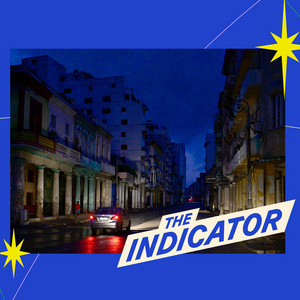
On Wednesday, a powerful hurricane hit Cuba.
The Caribbean nation was pummeled with wind and rain.
Electricity was cut off nationwide, bringing up memories of a string of recent power failures that had been plaguing the country even without hurricanes.
Cuba's dramatic power outages mark a low point in the country's sharp economic decline.
Food shortages are rife and inflation is running at 30 percent.
So what's going wrong?
This is The Indicator from Planet Money.
I'm Adrian Ma. And I'm Darien Woods.
Today on the show, why Cuba is struggling to keep the lights on.
The answer gives us insight into this age -old question of whether Cuba's woes are driven by its communist leadership or U .S.
sanctions. Professor Michael Lewis is looking at what the rise of sports betting is doing to America's teams and fans.
Listen wherever you get your podcasts.
Donald Trump has won the 2024 election.
How did it happen? And what are his plans for a second term?
Find out by listening to the NPR Politics Podcast.
We'll keep you informed every weekday with the latest news from the presidential transition.
Listen to the NPR Politics Podcast.
Marcos is an academic who lives in Havana with his mother.
Yeah, yeah, yeah. Did you hear me right now?
We're only using his first name to protect his safety.
And Marcos says the power going off briefly in certain areas is not especially remarkable.
It's a normal thing here.
We are not new in this kind of situation, you know?
What felt new has been the power shutting off without warning nationally.
Electricity is fundamental for modern life, even here in the Third Wall.
OK, if you don't have electricity, you don't have modern society.
So to understand what's been going wrong in Cuba in recent months, we called William Leo Grand.
William is a professor of government at the American University.
He's written several books on the country and he travels there at least once a year.
He keeps in touch with US and Cuban officials.
And William explains that Cuba's recent big blackouts were caused by an old oil burning power plant and a decrepit grid.
It's not being well -maintained.
The Cubans don't have the money to import spare parts.
Means that there's just a constant problem of breakdowns.
And as a result of that, you get these unscheduled blackouts.
Yeah, as opposed to scheduled blackouts.
That has actually been common over the last couple of years as the Cuban government has not been able to afford enough oil for the generators.
He says Cuba is caught in a vicious cycle.
Because if you don't have enough fuel to keep your domestic industry going, and you have to periodically shut down domestic manufacturing, for example, you have fewer exports, that means you need to import more things at a time when you have even less in the way of foreign exchange currency.
So it just, it's a crisis that builds upon itself.
So why doesn't Cuba have enough foreign currency?
Is it Cuba's communist policies?
Or is it the US embargo on Cuba, blocking the island nation off from the global economy?
Well, it's obviously both factors and it's really impossible to disentangle the two of them.
And in some ways they interact upon one another.
But let's see if we can disentangle these, starting with Cuba's economic policies.
So following the 1959 revolution, Cuba brought in a new era of authoritarian communist leadership.
That meant ration cards and redistribution and many other characteristics of a communist economy.
Cuba and the Soviet Union were strong allies, basically from the start of the revolution.
The Soviet Union gave Cuba a ton of aid over the years, keeping its economy afloat.
But that didn't last.
After the collapse of the Soviet Union, gross domestic product fell by 35%.
The economy had not evolved over time.
The vast majority of its export earnings were reliant on sugar, followed by some nickel mining, just like it was back in the 1950s.
This stagnation caused enormous hardship in the early 1990s once Soviet aid disappeared.
Cuba's system, where the government decides who makes what, had sheltered the country's industries.
William Leo Grand says that even Raul Castro, who was president from 2008 to 2018, admitted some failures.
Raul Castro acknowledged that the old system of central planning that they adopted from the Soviet Union really wasn't working and needed to be, in his words, updated.
And while newly legal private businesses have been growing over the last few years, that updating towards a market socialism model like China or Vietnam has been slow.
There's no doubt that the Cuban government has made a lot of economic policy mistakes.
And my judgment is continuing to make a number of policy mistakes today.
Cuba is prone to storms, both literally like hurricanes, but also metaphorical ones like the COVID pandemic that shut down tourism to the island nation.
That was a strong source of foreign currency.
Category four political storms have been US sanctions.
This is another big competing theory for why the economy in Cuba has struggled so much.
Yeah, from the moment Cuba became a communist country, it has been at loggerheads with the United States.
In the revolution, the Cuban government seized assets, including taking over factories and oil refineries owned by Americans.
Cuba also sent out armed forces and funding to rebel groups throughout the Americas.
In response, the U .S.
banned most exports to Cuba.
And when the Soviet Union shipped nuclear weapons to Cuba in 1962, the U .S.
government scaled up to a full -on blockade against the country that has sort of waxed and waned ever since.
This isolated Cuba from much of the rest of the world.
Yeah, so because so many global companies trade with the U .S.
or use the dollar system, U .S.
sanctions don't just cut off the U .S.
from Cuba. William points out a couple of examples like that any U .S.
citizen who's had their property taken can sue anybody around the world who does business with Cuba that uses that nationalized property.
And so, of course, this discourages direct foreign investment from any place going into Cuba for fear of litigation.
Also, companies that make certain goods with more than 10 percent U .S.
input serve barred from exporting to Cuba.
So there's a whole series of elements of the U .S.
embargo that are actually designed to, in a sense, recruit other countries unwillingly into the embargo restrictions.
This tension between Cuba and the U .S.
did ease under Obama, but it ratcheted way higher again in 2021 when the Trump administration tightened sanctions.
Cuba was put on the State Department's list of state sponsors of international terrorism, which is unfounded by the way.
Being on the list of state sponsors of international terrorism had enormous implications for Cuba's economy.
Remittances from Cubans overseas froze up.
Even Europeans who visited Cuba were barred from the U .S.'s visa waiver program, discouraging visiting tourists.
So it's difficult to say what's more to blame for Cuba's woes, Communist economic policy or the U .S.
embargo. But there is no doubt which one Cuba's government blames.
When their government points to the fact that the United States has been waging economic warfare against them for more than 60 years, it's a fact that the United States has in fact been doing that.
And so they have a degree of credibility when they make that claim.
With Donald Trump bound for the White House once again, William doesn't think Cuba will be a particularly high priority.
But he thinks Trump might reverse some of the slight easing of sanctions that happened under Biden.
By stemming remittances and foreign investment, that would likely make the situation in Cuba even worse.
And over the last few years, around one in ten Cubans have had enough and they've left.
That's one million Cubans leaving.
Marcos in Havana says this has hit him personally.
All my lifelong friends, friends from high school leave the country.
All of them. Marcos stays in Havana with his mother who has an autoimmune disease.
The main thing that why I don't leave the country is about my mom, okay?
I am the person who takes care of them, not only physically, not only economically.
Marcos says that everyone in Cuba is debating whether this economic crisis is worse than the big one in the 1990s.
You know, the one after the fall of the Soviet Union.
He doesn't have a strong view, but he thinks one thing is different.
In that time, the people got a hold.
Right now, people doesn't have hold.
Ironically, this pressure campaign from the last Trump administration drove a lot more migration to the U .S., both authorized and unauthorized, something Trump is trying to avoid.
This episode was produced by Corey Bridges with engineering by Neil Rausch, who's fact -checked by Sierra Juarez.
Patty Hirsh edited this episode and Kaken Cannon edits the show.
The indicator is a production of NPR.
Who's claiming power this election?
What's happening in battleground states?
And why do we still have the electoral college?
All this month, the Throughline Podcast is asking big questions about our democracy and going back in time to answer them.
Listen now to the Throughline Podcast from NPR.
Okay, so does this sound like you?
You love NPR's podcasts, you wish you could get more of all your favorite shows, and you want to support NPR's mission to create a more informed public.
If all that sounds appealing, then it is time to sign up for the NPR Plus bundle.
Learn more at plus .npr .org.
Do you feel like there's more on your to -do list than you can accomplish?
Or maybe the world's problems feel extra heavy these days.
We can't eliminate stress, but we can manage it.
It's almost like I have a new operating system now.
Like I tend to live more in this light.
Stressless, a quest to reclaim your calm.
A new series from NPR's LifeKit Podcast.