This message comes from Memorial Sloan Kettering Cancer Center.
With nearly 2,000 clinical trials underway, the next cancer breakthrough is just around the corner.
Make your triple matched gift at msk.org slash holiday match.
Hey, short wavers, Emily Kwong here.
Real quick before the show, let's talk about public media.
Public media has been in the news a lot this year, and public media is what makes NPR shows like Shortwave special.
It's made for you.
When you listen to an NPR podcast, the people who make it aren't thinking about shareholders or advertisers.
We're thinking about you and delivering on a promise to help you understand the world a little better.
From its very founding in the US, public media was also meant to tell stories from underrepresented communities, providing cultural insight that expands your perspective.
At NPR, we still believe in all of that.
We always will.
But, as of this fall, federal funding for public media, including NPR and local NPR stations, has been eliminated.
And now we're heading into an uncharted future.
But we know you won't let public media go away.
We rely on your support to bring you shortwave now more than ever.
We'll see you next time.
Thank you if you already go the extra mile as an NPR Plus supporter.
If not, you can join the Plus community now.
There has never been a better time.
You get a bunch of perks like bonus episodes and more from across NPR's podcasts.
Support public media by signing up for NPR Plus today at plus.npr.org.
Thank you so much.
You're listening to Shortwave from NPR.
Hey Shore Wavers, Regina Barber here.
And Emily Kwong.
With our bi-weekly science news roundup featuring the hosts of All Things Considered.
And today we have the legendary Elsa Chang from LA.
Thank you for having me yet again.
So what are we learning about today?
So Elsa, we're giving you an update on the chances of life on an Earth-sized planet that orbits another star will complicate the saga of the Black Death with a story of how it may have been driven by volcanoes.
What?
And why sick ants let nest mates destroy them.
Dark.
Okay.
All of that on this episode of Shortwave, the science podcast from NPR.
This message comes from AT&T.
America's first network is also its fastest and most reliable.
Based on RootMetrics, United States Root Score Report 1H2025, tested with best commercially available smartphones on three national mobile networks across all available network types.
Your experiences may vary.
RootMetrics rankings are not an endorsement of AT&T.
When you compare, there's no comparison.
ATT.
This message comes from Memorial Sloan Kettering Cancer Center.
At Memorial Sloan Kettering Cancer Center, they know that a cancer diagnosis touches more than one life.
It touches entire families.
Make a gift to MSK in honor or in memory of someone you love.
Donate now at mskorg slash honor dash 2x.
All right, Elsa, where do you want to start?
Let's start with the Earth-sized planet around another star.
Gina, go.
Okay, so astronomers have already discovered more than 6000 exoplanets, and those are planets that are orbiting other stars, not our sun.
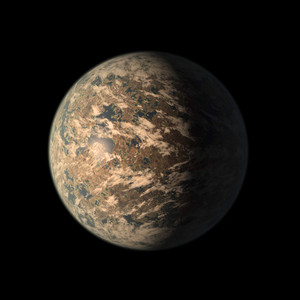
And some of them are more promising spots to look for life than others, like this exoplanet called TRAPPIST-1e.
And this planet is rocky like Earth.
It's the same size.
It's orbiting at a distance that's smack dab in the habitable zone of the star, sometimes called the Goldilocks zone.
Yes, it's at this really interesting distance from its host star.
It gets a little bit less light than Earth does, but way more than Mars does.
If there's life on it, we have the best chances of detecting it if it's present on TRAPPIST-1e.
That's Sukrit Ranjan, the lead author of a recent study about TRAPPIST-1e published in the journal Astrophysical Journal Letters.
Now what Sukrit is saying is that we have the best chances of finding life there, in the Goldilocks zone, as opposed to some of these other exoplanet systems.
This is so fascinating.
Wait, just remind me what are like, the ingredients that scientists look for when deciding whether there can be life on a planet.
Well, the reason this zone is important is because it's not too hot, such that water evaporates off the surface, and not too cold such that the planet would be covered in ice.
Another key ingredient for life on a planet is having an atmosphere.
It turns out to be really hard if it has an atmosphere for it not to be habitable.
That atmosphere allows liquid water to stick around, which is definitely good for life.
But Elsa, there are other places in our solar system that scientists are looking at for possible life that also have atmospheres like Earth, places like Saturn's moon, Titan.
So this study looked at TRAPPIST-1e and the potential existence of Titan-like exoplanets.
Wow.
OK, so how did they go about doing that?
So when TRAPPIST-1e orbits its star it occasionally passes between the star and us viewing it, sort of eclipsing the star.
So when that happens, the starlight goes through the exoplanet's atmosphere, if it has one, and studying that light can show if the atmosphere has certain molecules like CO2 or methane.
And CO2 and methane could be, but don't have to be, signs of life.
Oh, so wait, does this exoplanet have CO2 and methane?
I hope.
Drumroll.
Sadly, no.
A more in-depth investigation of TRAPPIST-1e revealed no CO2 and found that there may be no methane either.
Oh and, by the way, the study also noted that the majority of these Titan-like exoplanets, called exotitans, most likely lack an atmosphere entirely.
The answer we came out to was, man, exotitans, great idea, not looking super good.
Okay, so is he saying habitable planets might actually be rarer than scientists previously thought?
Well, at least these kinds of habitable exoplanets.
And these scientists said that we really just need, like better telescopes to get to the bottom of this.
All right.
Okay, well, this next study is a bit closer to home, planet Earth.
But we're going to time travel for this one, right, to the Middle Ages.
Yes.
Yeah, yes.
And to one of the most defining events of that time, the Black Death, which killed one third to one half of the population of Europe.
And we have a pretty good understanding of what caused the Black Death.
It was rats, wasn't it?
That's what I always thought.
Close, Elsa.
It was a bacterium from Central Asia, spread by fleas on rodents, that hitched a ride from the shores of the Black Sea to what is now Italy in 1347.
And the reason Elsa, that scholars think so many rats were hitching a ride to Italy that year had to do with food.
Hannah Barker, a historian at Arizona State University, discovered there was a reopening of the grain trade between the Mongol Empire and Genoa in 1347.
They thought they were doing a good thing, bringing food to hungry people.
They didn't realize that they were also carrying bacteria.
And this raised a question, like why were Italian states worried about famine that year?
Martin Bauch, a historian in Germany, has a really cool hypothesis.
He thinks it might have to do with volcanoes that erupted a few years prior.
There must have been a major volcanic eruption.
When sulfate is put into the higher strata of the atmosphere up to the stratosphere, then circling the globe for up to three years and then at some point coming down,
His team hypothesized that volcanic activity in 1345 led to extreme rainfall.
It also led to widespread flooding and ultimately crop failure throughout Europe.
This is quite a story.
Okay, so what evidence do they have?
Like, how do you prove volcanic activity from...
Seven centuries ago.
Totally.
It's really interesting.
So Martin and his colleague Ulf Bündgen looked at ancient tree ring samples, which found bad growth conditions.
In the years leading up to the plague, they looked at ice cores containing unusually high deposits of sulfate aerosols, which suggests volcano.
And they published their findings in the journal Communications Earth and Environment.
This is amazing.
OK, let me just make sure I understand this.
Volcanic activity led to some sort of climate downturn, which led to crop failure.
Yep.
Which led to grain imports coming in that brought all these rats carrying the bacteria to Italy.
And then a bunch of people died.
Yep.
Beautifully summarized.
Now, this is just a hypothesis, of course.
But it suggests that one of the biggest pandemics in human history could have been connected to the climate.
That is so interesting.
Okay.
Moving on to our very last topic.
Sick ants calling for their own extermination.
What?
What?
Yeah, it's like that's sick.
Yeah.
Yeah.
It's a gory tale.
But for the common good.
OK.
So a recent study in the journal Nature Communications found that sick ants send chemical messages to their nest mates signaling that they're sick.
Then worker ants pick up those signals and destroy the sick ants before they infect the others.
Because, you know, like a fungal infection could take out the whole colony.
Wait, so these ants are like self-sacrificing?
Yeah.
That is dark.
OK, how does this happen exactly?
Yeah.
Okay.
So it turns out worker ants are paying close attention to the pupae.
That's the stage when juvenile ants are still in their little cocoons.
And it appears that when pupae have an infection like a fungus, they send out a chemical message calling for those worker ants to destroy them.
Whew.
One of the study authors, Erica Dawson, explained the process to us.
She says first, the worker ants peel off the cocoon.
And then they bite holes in the pupae.
And then they spray in formic acid.
And this basically serves to disinfect the infected pupa because it kills off the fungus.
And while the acid kills off the fungus, it also kills the pupae.
So in effect, the pupae is essentially calling for its own death.
Saying, hey, I'm sick.
Kill me now before I get you sick too?
Yes, that is the dramatic monologue of these infected ants.
Though there is a plot twist.
Huh.
The team looked at pupae that would eventually become queens, like ants that start their own colonies, and they found out two things.
First, that these queen pupae didn't release the signal even when they were infected.
Why not?
Future queens, they don't signal when they're sick.
They're above the self-sacrifice.
Yes, they are.
And also, the infected future queens could fight off the infection on their own.
Bam!
True queens, just like Emily Kwong and Regina Barber from NPR Science Podcast Shortwave.
Thanks, Elsa.
Elsa, thank you so much for coming to talk with us about science and calling us queens, because we are news queens.
You guys are queens.
Podcast queen recognizes news queen.
Your Highnesses, it has been an honor to join you.
You are always welcome in our realm.
Deeply vows.
Yes.
You can hear more of Elsa on Consider This NPR's afternoon podcast about what the news means for you.
And for more science stories just like this one, follow Shortwave on whatever app you're listening to.
This episode was produced by Rachel Carlson and Jordan Marie Smith.
It was edited by Rebecca Ramirez and Christopher Intagliata.
Tyler Jones checked the facts.
Maggie Luthar was the audio engineer.
I'm Emily Kwong.
And I'm Regina Barber.
Thank you for listening to Shortwave, the science podcast from NPR.
This message comes from Capital One with the VentureX business card.
Earn unlimited double miles on every purchase and enjoy purchasing power to spend more and earn more.
What's in your wallet?
Terms apply.
See CapitalOne.com for details.
This message comes from BetterHelp.
The holidays bring traditions and joy, but they can be tough, too.
Therapy helps you care for yourself so you can truly show up for what matters most.
Visit BetterHelp.com for 10% off.
The First Amendment protecting the right to free speech and a free press in the US came first for a reason.
It was a bold declaration that set the young republic apart.
Today, we ask you to make your own declaration.
Stand up for NPR and a free press by giving now at donate.npr.org.
Thank you.