It's a bonus edition of the Book Club for Kids.
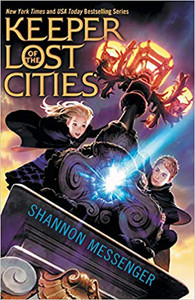
I am Kitty Felde. This week we continue our conversation with writer Shannon Messinger. creator of the Keeper of the Lost Cities series.
We wanted to know how Shannon keeps a long series organized.
I mean, do you plot everything ahead of time?
What happens when new ideas suddenly crop up in later books?
And by the way, Shannon Messenger, how did you know that The Keeper of the Lost Cities was a series and not just a long book?
I actually knew that Keeper was a series from the moment I had the idea, because I knew that the problem that Sophie was facing was huge. not a story where it's just Sophie up against a villain or a team of villains.
It is, A story where Sophie is dealing with a situation that exists because her world has deep fundamental problems.
And so those are not things that can be fixed in just a single book or even in just a couple of books.
I knew I was looking at a massive series and.
Keeping it organized has definitely been a challenge in some ways.
I started out taking notes and then sort of realized, wow, that doesn't keep me as organized as I need to because I – would have to wade through pages and pages and pages of notes.
And then I would find sometimes that I wouldn't update those notes. as well as I thought I had because things change every revision.
And so every book goes through multiple revisions changes each time.
And so it was quite a daunting process. And honestly, a lot of what I do now is as I'm writing, I keep PDFs of the previous books constantly open.
And I'll keyword search things and sort of look up, okay, what actually made it into the previous books?
What have I said already? What have I done already? and kind of go from there.
And so some of it is ideas that I had from the very beginning.
But I have also definitely left myself room to discover new things along the way, because I always firmly believe that your best ideas are not usually your first ideas.
So I had a ton of ideas in the beginning, and a lot of them, as I've gone along, I've come up with things that are way better than the stuff that I had originally planned and so I have Changed course in small ways.
I mean the ultimate problem is the same so That doesn't change, but sometimes the ways the villains go about things or. knowing new things about my characters, new talents, or just having more characters than I originally planned or what have you. has shaped the story in ways that I hadn't originally anticipated, but has made it so much better doing it that way.
Well, Shannon, you started out in a completely different genre, movies.
So how did you make the transition from film school to children's book author?
It was actually something that kind of snuck up on me.
I chose to be a film major because I had discovered that I absolutely loved writing and Hollywood sounded so glamorous.
And then I got there and I realized that Hollywood isn't nearly as glamorous as everybody thinks, but more than that, that what I thought of as screenwriting and what is actually the way that Hollywood works are two very different things.
And that real screenwriting and TV writing is very collaborative.
And I'm kind of a control freak and I did not enjoy writing that way.
And so by the time I graduated film school, I had kind of shifted my emphasis away from writing and had really been focusing on producing because it turned out to be something I was pretty good at.
But the thing about being a producer is that a lot of your job is being the person that other people go to when there are problems.
So it's very very very stressful. And it's a very long workday and it just wasn't really something that I enjoyed to the point that I sort of had this moment. where it was kind of like, how did I get here?
I hate this job so much. How did I end up in this mess?
And I realized that it was because I had loved to write and That was when I kind of realized, you know, there are lots of other things that I could write besides screenplays.
And so I decided that I wanted to try writing a book.
And it took me a little while longer to realize that the stories that I wanted to tell really gravitated toward the.
12-year-old version of myself rather than the adult version of myself.
And so that I wanted to write for kids. And then It was like that moment where the sky parts and the angels sing and it was just like, this is what I should have been doing all along.
This is the perfect fit for me. But it wasn't necessarily something that I set out to do.
I kind of discovered it along the way through trying a bunch of other things that just weren't the right fit.
Was there anything you learned in film school that helped you write for kids?
Oh, there were tons of things. Writing is writing.
Obviously, screenplays and books are different, but there definitely is a lot of overlap, especially when it comes to dialogue. because scripts are very, very heavily reliant on dialogue.
So a lot of the techniques that our professors had us use when we were learning how to sort of have natural dialogue and Dialogue that doesn't feel like exposition and dialogue that feels unique to a character.
All of that really has helped me. writing books as well.
And another thing that has been a big help is that screenplays are a very short format.
And I know that's going to sound a little hard to believe that that has been helpful to me given the fact that my books are very, very long, but...
It is still something that I feel like as much as my books are long, I constantly hear the feedback that they don't read like they're very long.
They read quite quick. And that goes back to my screenwriting training because it was sort of drilled into us because are such a short form compared to books that you couldn't have a scene unless you really needed it because you just didn't have the space. to have wasted scenes.
And so we sort of had these criteria that we had to use to decide if a scene needed to be there.
And I still kind of subconsciously use that same criteria.
And so every scene in my books, really does need to be there which I think helps make it feel like a faster story even though it's such a long complicated story everything that's in there really does need to be there for lots of reasons.
It may not be obvious to you what those reasons are when you're reading it the first time through, but Trust me, everything that's in there is there for a reason.
Thanks for the conversation, Shannon Messenger.
And by the way, we have conversations with lots of other wonderful writers at our website, bookclubforkids.org. just click on the Writers on Writing tab.
And in case you missed it, we'll also have our episode of Keeper of Lost Cities at the website as well.
And we will be back again next week with another brand new full-length episode.
I'm Kitty Felde. Thanks again for listening.
And with the State of the Union Address scheduled for March 1st this year, have you been thinking about ways to talk about civics education with your child or with your students?
Do check out the middle great mystery called State of the Union.
It's about a mysterious bird that poops on the president's head during the speech. but it's also an introduction to civics education.
We've just published a 56-page teacher's guide to State of the Union written by the former head of the Hawaii Library Association, Linda Marks.
It's available on Amazon or as a free download at the Fina Mendoza Mysteries website.
We'll also include a link in the show notes.
Thank you. Thank you.