This message comes from WaterAid.
Imagine having no clean water to drink, cook, or clean.
That's the reality for one in four people worldwide.
You can change that.
Donate now and your gift will be matched at wateraid.org slash podcast.
This is Planet Money from NPR.
Consumer sentiment is not doing great right now.
It is close to its lowest point in half a century.
Americans are... on average, not optimistic about the health of the economy.
They don't feel great about their jobs, their personal finances.
And when consumers don't feel hopeful about the economy, we usually do this one thing.
We save more and stop spending as much.
You can see it in the data.
When consumer sentiment is low, consumer spending slows down.
Consumer spending and consumer sentiment are like buddies that go everywhere together.
Yes, but, Sarah, these buddies...
Something strange is happening to their friendship.
They're drifting apart.
Yeah, consumer sentiment is like sad, in his sweats, on the couch, doing nothing.
Well okay, yeah.
But consumer spending is out there, living it up, spending untold amounts of money out all hours of the night at the club.
She sure is.
And when Dieran Patkey, an economist at the Boston Fed, saw this rift, I mean it's mostly bafflement right.
We see these two numbers, which are significant measures of barometers of economic activity, moving in ways that look discordant with each other.
That gives rise to a question about why that might be happening.
For some reason, despite many not-so-great economic factors, not just the low consumer sentiment, consumer spending is strong.
And it's making the economy look pretty good, resilient, actually.
But is it?
Hello and welcome to Planet Money.
I'm Sarah Gonzalez.
And I'm Kenny Malone.
Consumer spending is a significant barometer of our economic health.
Consumers buying groceries, going out to eat, going to the club, buying a new car, a plane ticket.
Buying goods and services makes up more than two thirds of U.S. economic activity.
It is 70 percent of our GDP.
So if consumer spending is strong, it's usually a sign that our economy is healthy.
But today on the show, is that still true, though?
Or is something going on with consumer spending that is distorting our view of the economy?
It's not just bottle service, everybody.
It might be.
It actually might be.
This message comes from AT&T.
America's first network is also its fastest and most reliable.
Based on Root Metrics United States Root Score Report 1H2025.
Tested with best commercially available smartphones on three national mobile networks across all available network types.
Your experiences may vary.
RootMetrics rankings are not an endorsement of AT&T.
When you compare, there's no comparison.
AT&T.
This message comes from Babson College.
Ever notice how one idea can change an entire market?
At Babson College, graduate students learn to turn bold ideas into real-world impact, whether launching a startup or rethinking business as usual.
In Babson's MBA and specialized master's programs, you'll gain the skills and experience to lead change.
Ranked number one in entrepreneurship.
Babson is shaping leaders who don't just study the economy, they build it.
More at babson.edu slash grad school.
The first thing you should know about the data we have on consumer sentiment, and even much of the data on consumer spending, is Babson.
They're based on surveys.
We survey people to get all kinds of information, including how they feel about the economy and about their recent purchases.
And listen, Dieran Patke, senior economist at the Boston Fed, loves a good survey.
Loves a good survey.
I'm extremely compliant when it comes to surveys because I use the data.
So I'm very, I do always participate.
I have never been a selected candidate. participant in any of the consumer surveys.
Are you dying to get a call?
You know, I would be very happy to participate.
That's how I feel about jury duty.
But that's the nature of random selection.
You really want to be on jury duty.
That is what's happening?
I was summoned once and dismissed immediately.
Like, no one even asked me questions.
Like, I just waited in the room and then I left.
Thank you for your service, Sarah.
Okay, now, the Consumer Sentiment Survey and the Consumer Expenditure Survey...
They have their flaws, of course, because, well, they're surveys.
So it's someone just asking you about your feelings and about your purchases.
So people can say they feel great about the economy right now, but actually in their spending habits it might not seem like they're actually feeling that good.
And also the consumer expenditure survey partly relies on what people like remember that they spent money on.
That works pretty well for many consumers.
It doesn't work well for all consumers.
So at the very high end of the income distribution, consumers may not report all of their spending.
Sometimes it's hard to track.
You know you might have bought flights on a private jet, a yacht yeah, those kinds of things.
You're probably not going to report or you may not be thinking about them quite as much as people who are buying groceries.
Oh, it's so hard to remember all of your purchases when you're rich.
Yes, how many $2,000 Hermes things throw blankets did we buy?
I can't remember.
Who can say?
They don't even fit in my house anymore.
Ah, yes.
Well, you forgot that you bought a bigger house.
That's the thing that happened, yes.
The house!
I forgot about that extra house.
So listen, the surveys aren't perfect, we acknowledge, but they do clearly show this mismatch that even though consumer sentiment is declining, consumer spending remains strong.
When you guys wrote that you were looking for an explanation for this resilience, why there's this high consumer spending.
You're implying there that there is something unusual about this.
How unusual is it?
The divergence has not been so sharp as it has been since the COVID pandemic.
Before COVID, you typically saw consumer sentiment reflect consumer spending fairly well.
They kind of moved at least in the same direction, if not precisely the same way.
Yeah, COVID is the one big exception to our spending sentiment friendship.
When people were stressing about the economy during COVID, there were stimulus checks and people were spending.
Yeah, but COVID was like a special time, okay?
And right now there are actually a lot of things going on, not just the consumer sentiment stuff, that
Theoretically, you'd expect to slow down overall spending.
Sure.
Interest rates are high.
This is, you know, Econ 101, if interest rates are high.
That typically puts, it's a form of a break on economic activity.
Yeah, and there's growing inflation still, so things cost more.
Inflation as well is a form of a, you know, it creates hardship for consumers.
There's tariffs which have made the prices of lots of goods go up, and you'd expect tariffs to slow down overall spending.
So all these different forces can affect consumer behavior.
And if you stack these up, you might expect to see only speaking, qualitatively less strong economic activity when it comes to consumer spending.
And that's part of the puzzle as well.
So it's not just the consumer sentiment versus consumer spending, but...
These other forces as well.
The interest rates, the tariffs.
Yes.
It's all of these things together that are making Deeran go like.
Why is consumer spending so resilient right now?
Deeran did have a hypothesis.
And because he's at the Federal Reserve, he also has access to specific better data.
What we have are essentially coming from account level data from banks and based off credit card swipes or credit card statements.
And so these don't require people to remember how much they spent in the past.
Yeah, credit card swipes.
So, after the financial crisis of 2008, the Dodd-Frank Act required large banks to give the Federal Reserve access to data about credit cards to understand how much lending banks are doing.
The credit card data that the Fed has access to covers about 80 of all credit card balances in the economy.
And the Fed can see anonymized each cardholder's monthly spending, credit card debt balance, interest charges and even the income that the person had when they opened their account.
And now, obviously, credit card transactions don't capture all consumer spending.
Consumer spending is literally everything that we consumers spend on.
So rent bills when we Venmo our friend for that bottle service.
Those things we usually don't pay for with credit cards.
But you know, cash debit checks.
So Dieran was just looking at the credit card chunk of that, but it does capture about half of all spending in the retail space.
And when he and a colleague looked at all of this, here is what they found.
So in May of this year.
Total spending in our data was about, it's about $300 billion in that month.
That is how much Americans charge to their credit cards just in the month of May.
And Deeran published these graphs of credit card spending that's sorted by income level that we looked at together.
So this is saying, in a given month, how much credit card spending came from households whose income was between 0 and 39000.
So this was like $26, $27?
$26 billion.
Yeah, exactly.
Correct.
Okay, so the lowest income bracket would have spent 26-ish billion dollars in any given month in 2025.
And then the highest income bracket would have spent ooh 175-ish billion dollars in any given month.
Huge disparity.
Yes.
Right?
Yes, yes, exactly.
All right.
While it might sound like yeah duh, the wealthiest people spend more, Dieran says, think about it like this
Of that 300, about 175 billion came from the very highest income. fifth of the income distribution.
So a bit more than half came from the top one fifth.
The wealthiest 20 percent of Americans were responsible for over half of that credit card spending.
But what's even more significant, Dieran says, is the growth rate in spending among those high income households.
The wealthiest consumers are spending billions and billions and Billions and billions more than they, as wealthy people, used to spend in a month.
Deeran says they're spending 86 percent more than they were 10 years ago, even adjusted for inflation.
Meanwhile, the lowest income consumers are spending 50 percent more than they used to, which Deeran says is a meaningful difference.
So Deeran says the wealthiest Americans are driving the growth in overall spending.
They are propping up the economy with inflation.
And this is the reason consumer spending looks so good.
Would it be fair to say that it seems like the people at the top are keeping the economy strong right now?
Yeah, I think they're a very significant component of consumer spending right now.
That's fair.
Okay.
So it is not that, like Inflation and high interest rates and tariffs are all of a sudden not affecting consumer spending.
They are affecting consumer spending.
It's just that the people at the top are kind of insulated from those things.
High interest rates and more expensive goods because of tariffs and inflation.
They don't necessarily stop a wealthy person from paying to renovate their kitchen or spending 19 whole dollars and 99 cents on a single strawberry imported from Japan.
Real rich person example.
What?
Mm-hmm.
Yep.
One berry.
Do we know how good it was?
I mean, who cares?
It's a strawberry.
I'm going to go out on a limb.
It's going to taste like a strawberry.
Fair point.
Anyway, okay, look.
A few things in addition to this, like insulation factor, have also been going really well for people at the top.
So, like, this year, their wage growth has been strong.
For low-income households, though, growth has been slow.
That's an important resource that supports spending, paychecks.
So that is another factor.
And finally, you have changes in wealth.
Homes, stocks, these kinds of assets have become more valuable in the last five years.
And they're likely to be much more important in supporting consumer spending for households at the top of the income distribution.
Yeah, people who own homes, their homes have been appreciating in value in like wild ways in recent years.
And then people who have stocks, the stock market is doing really well. really well.
And that gives wealthier people the confidence to spend even more generously.
You also wrote that you wanted to learn whether cracks may be forming, and if so, where.
And so are there cracks forming?
And if so, where?
So to the extent that we might see reasons for vulnerabilities in the economy, we could infer some.
For example, if more and more consumer spending is supported by households at the top of the income distribution, then some shock that affects their resources, like a shock to stock markets, may pass through into overall consumer spending more because we're not able to rely on the spending of lower income households who are using their paychecks to support spending.
And the same would not be true if there was a shock to people in the lower income bracket.
Well, I mean, if we did have a shock where it was like a bunch of lower income people were to lose their jobs, it seems like in that scenario yes, those individual people would be worse off and it would be harder for them to pay their bills.
But it seems like spending in the economy would still potentially be pretty strong because the people at the top are the ones driving the spending.
Correct.
But it would be bad if there was like a stock market shock that made the people at the top unable to spend as much.
Yeah.
Yes.
Okay.
Okay, so that is a vulnerability.
Like, we're like... Yes.
We're in a vulnerable situation.
Our economy, you could say, is in a precarious situation.
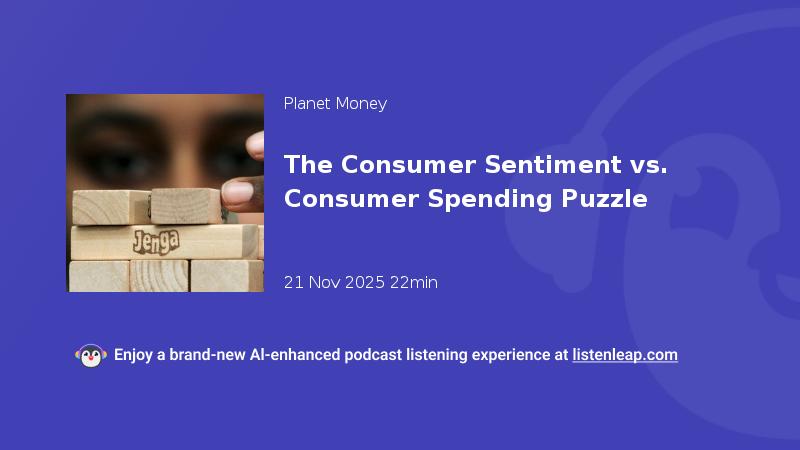
You described our economy as a Jenga tower at the moment.
Sounds not good, but tell me what you mean.
So, I mean, it's a top-heavy Jenga tower.
That is Peter Atwater, an economics professor at William & Mary, apparently also Jenga expert.
So... all of the economic strength in this economy at the very top.
And so our Jenga Tower economy is creating an illusion of prosperity and a prosperity for all.
And when you think about how small a segment of the population truly is benefiting from this, you end up, I think, deceiving yourself in terms of the strength of the American economy today.
After the break, just going to pull this little Jenga piece out here real smoothly.
We're wobbling.
I would not do that.
I'd put it back.
Can't stop playing Jenga set.
That's the rule.
Got to keep going.
This message comes from LPL Financial.
What if you could have more control over your future?
LPL Financial removes the things holding you back and provides the services to push you forward.
Because, when it comes to your finances, your business, your future, LPL Financial believes the only question should be what if you could?
LPL Financial, member FINRA SIPC.
No strategy assures success or protects against loss.
Investing involves risk, including possible loss of principal.
This message comes from Capital One with the Capital One Saver Card.
Earn unlimited 3% cash back on dining and entertainment.
Capital One.
What's in your wallet?
Terms apply.
Details at CapitalOne.com.
This message comes from ADP.
ADP knows.
Any new technology, any old competitor, any trendy thing, even a trendy thing that everyone knows isn't a great idea, but management just wants us to give it a try for a bit can change the world of work.
So, whether it's a last-minute policy change or adding a new company holiday, ADP designs forward-thinking solutions to help businesses take on the next anything.
ADP, always designing for people.
This message comes from NPR sponsor, Odoo Business Management Software.
Some say Odoo is like fertilizer because it promotes growth.
Others say it's a magic beanstalk, scaling with efficiency.
Odoo, exactly what a business needs.
Sign up today at odoo.com.
There is a term for the type of economy that some say we have right now and it is not sadly, top-heavy Jenga tower.
But Peter Atwater, who gave us that great metaphor, did popularize this term, too.
The economy, Peter says, is K-shaped.
When there was this land grab for letters, people choosing V and U and L, the letter K is what, to me, made the most sense.
Wait, what was the land grab for letters?
I'm unfamiliar.
Indeed, it was... during the pandemic?
Oh, so the epidemic had barely hit and economists were predicting how the recovery would take place.
And so you had those saying, oh, it's going to be a V-shaped recovery.
Everybody's going to do well.
Others said no no, no.
We're going to have this long pronounced decline and then it's going to move up.
So it'll be like the letter U.
Others thought it was hopeless and it was just going to be an L And I was like no, it's going to be K.
And what, like, visualize it for me.
What is a K-shaped economy?
A K-shaped economy is one where white-collar workers, investors, those at the top of the economy.
The ones that are the top arm of the K, if you will.
Are moving upward on an escalator.
It's just getting better and better and better for them.
While for those at the bottom... they're falling further and further behind.
So the top of the K is like good and getting better, and the bottom of the K is bad and getting worse.
Noticeably worse, Peter says.
He says that you can see that K shape all over the economy in the numbers.
You have Delta Airlines saying that next year, for the first time in its history, it will have more revenue from the front of the plane than the back of the plane.
For the first time ever?
For the first time ever.
Dang.
You know, today we have twice as many car models that cost over 100000 than cost less than 30000.
Those driving used cars on the highway see that every day.
And so the overabundance at the top is incredibly visible and demoralizing.
Peter says we have a bifurcated economy.
Basically, there are two different economic experiences existing simultaneously.
And companies are focusing on investing in their higher income consumers, like giving them incredible credit card perks, while low income consumers are defaulting on their credit card debt.
The average price of a car right now is 50000, while car loan defaults and repossessions are on the rise.
And listen, inequality, a wealth gap, these are nothing new, but...
Right now, Peter says there's that added layer of a really great performing stock market.
You know, it is often said that the markets are not the economy, but at the top of our economy today, the markets are the economy.
Yeah, and when it comes to the strength or health of the economy right now, Peter says we're actually incredibly dependent on financial markets continuing to perform well.
And really the recent stock market growth is being driven by just a few companies known as the Magnificent Seven.
It's Amazon, it's Apple, Tesla, Meta, the giant tech companies that all have ties to AI.
And that's a very fragile condition for financial markets.
There is overconfidence there in investors' belief that markets only go up and that they will forever be rewarded as a result.
But they believe this because it's been a long time where it's been going up.
It has been proven true.
And we know when that happens, those patterns tend to change unexpectedly and violently.
Basically, if consumer spending right now is being driven by the rich— and the richer spending because they feel extra rich and confident because the stock market is doing great, then Peter says a shock to the stock market is all it could take for the Jenga tower to fall over.
Special thanks to Johnny05isalive, who left us a rating and a review on Apple Podcasts.
Quote Just heard the amazing Planet Money story on people working legit jobs from prison in Maine and felt the need to write a review.
Always interesting stuff on Planet Money, 100%.
Aww.
Yeah.
Thanks so much.
Johnny?
Sarah, you did that show.
Yeah, with a public radio reporter in Maine.
So, go public radio.
Ratings and reviews really, really help other people find this show.
So if you like what we do please, please help us by leaving a rating and a review on your podcast app.
This episode was produced by James Need.
It was edited by Meg Kramer and fact-checked by Sierra Juarez.
It was engineered by Debbie Daughtry and Kwesi Lee.
Alex Goldmark is Planet Money's executive producer, and we wanted to give a special thanks to economist Thomas Ferguson.
I'm Sarah Gonzalez.
And I'm Kenny Malone.
This is NPR.
Thanks for listening.