
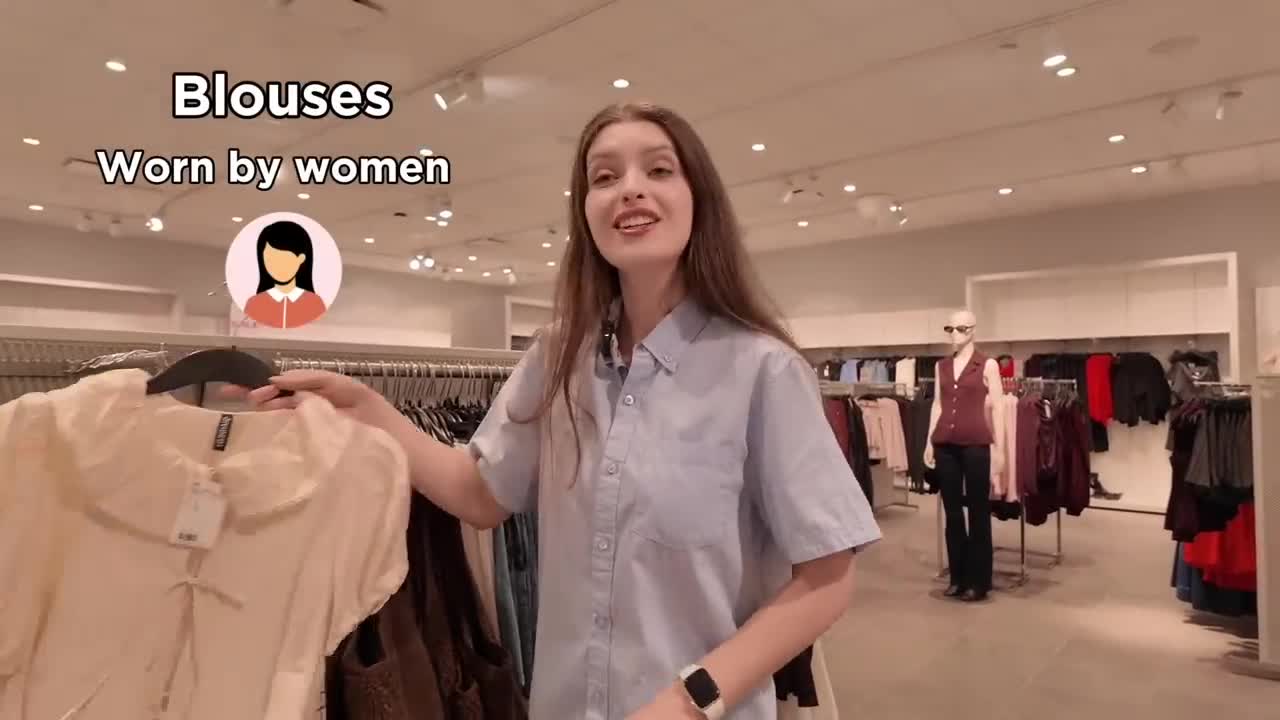
[Mastering Natural English: A Practical Guide to Shopping Vocabulary]-[Common English Mistakes at Clothing Stores]
📋 Summary
Mastering English Through Real-Life Context: A Clothing Store Guide
In this episode, Giovanna takes learners on a practical journey through a clothing store to demystify common English nuances that often confuse non-native speakers. By focusing on real-life interactions, the episode highlights the importance of precise vocabulary and the correct usage of phrasal verbs.
Clarifying Clothing Terminology
One of the first hurdles in fashion-related English is distinguishing between similar items. Giovanna points out that while a "blouse" is traditionally worn by women, a "shirt" is a gender-neutral term. Furthermore, describing the fit and style of pants requires specific terminology. She differentiates between:
- Wide leg pants: Wide from the hips to the ankles.
- Bootcut pants: Pants that begin to widen slightly below the knees.
- Slim fit/Skinny pants: Tight-fitting garments designed to create a leaner silhouette.
- Flared pants: Similar to bootcut but significantly wider at the bottom.
She also clarifies a common sizing mistake: instead of asking for "big pants," learners should distinguish between baggy pants (a style choice) and large pants (referring to size).
The Nuances of Phrasal Verbs
Phrasal verbs are central to natural English communication, and Giovanna emphasizes that "one word can change the whole meaning." She highlights three critical distinctions:
- Try vs. Try on: "Try" is typically reserved for testing food (e.g., "Let me try this cake"), whereas "try on" refers specifically to putting on clothing to see if it fits.
- Try out: This refers to testing something new to see if it functions correctly, such as a hair straightener.
- Take vs. Bring: A frequent error is confusing these two verbs. "Take me" implies moving with someone to a different location, whereas "bring me" is used when requesting an item to be delivered to the speaker.
Emphasizing Descriptors
When discussing fit, Giovanna explains the use of the word "too" to express excess. If a garment is larger than desired, one should say it is "too big" or "too tight," using "too" to emphasize that the state is beyond what is comfortable or necessary.
Creative Learning and AI Tools
To combat the difficulty of memorizing these nuances, the episode introduces the concept of using songs as a mnemonic device. Giovanna demonstrates that learning through music helps information stick "forever." She introduces a tool called Mureka, an AI-powered platform that transforms written ideas into songs. This tool is highlighted as a versatile resource for language learners, allowing users to input prompts in any language to generate educational songs, regardless of their professional editing skills.
Conclusion
By bridging the gap between textbook grammar and the reality of a shopping experience, this episode underscores that language learning is most effective when it is contextual and creative. Whether it is mastering the difference between a rack and a wreck or learning to use "bring" versus "take," the key to fluency lies in consistent practice and the courage to apply new vocabulary in real-world scenarios.
Deep Learning with ListenLeap


