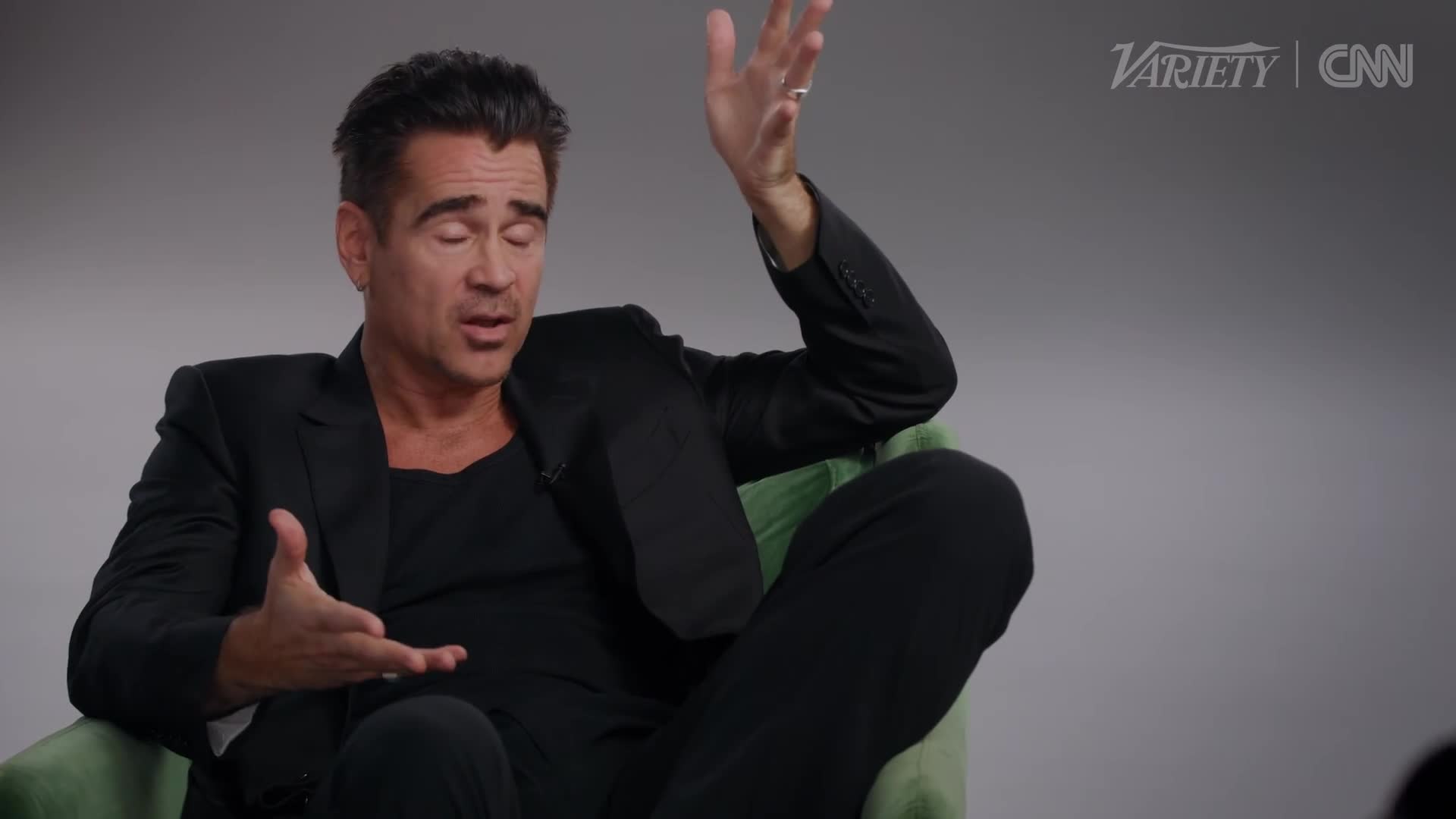
For anyone who's a bit of an actor's lovey-lovey, fuck it.
I love you.
I love love.
Yeah, me too.
Hamlet and Hamlet.
Yeah, Hamlet.
Hamlet, that's the name of my film.
Waymo.
I hate it every time I see one of those.
Oh, my God.
Well done, humans.
I'm so happy to see you.
I'm so happy for you.
For so many reasons.
What's your noggin?
What's your noggin?
I'm like, I'm overly like... shy and like thrilled.
I'm shy as well, because I watched The Havana last night and I started it at about one o'clock in the morning, so thereby ended, of course, at 3am, and just I was astonished.
I worked with Peter Mullen once.
Amazing.
There's no one better.
And then I went to the screen cinema and I saw My Name is Joe and I saw him in that and I couldn't really talk to him the next day and I had a bit of that this morning when I woke up I was like, oh jeez, I don't have to see this one.
Do I have to see her now?
Do I have to see her and sit down to her and talk to her about anything?
But no, delighted to be here.
But I was and I was like, what is it?
Is it intimidation?
Is it? what is it?
But it's just like, honest to God, it's just awe at what you all went through.
This is a moment already we're only three minutes in where anyone who watches this shite can go.
What you went through actors, you know all that kind of nonsense which I get, but just the level of the dignified perspective of a pain that I don't understand but I've imagined because I'm a father.
And you're a mother.
And I've imagined as I think any parent does imagine what is the worst thing that could happen to you in your life.
It's that which could happen to that which you love the most, your children and that which you are.
You are contractually, as a result of just the practical experience of living and the spirits and all of it you are gifted with taking care of and offering shelter and love if something happens to that child, and the dignity with which that pain is explored in the film, and also just the last ten minutes of it, and the amount of healing.
I just didn't think that the film could turn around as extraordinarily as it does and have as much healing and as much forgiveness and as much understanding and as much as the acceptance of the cost of love.
Sometimes, you know, as it does at the end.
I think it's not what stories are like.
They allow those bits that are too hard to hold by ourselves to like transcend and come through.
And the same with yours, like with the kind of race of addiction and ego and trying to run from a life.
I don't know, was there like catharsis, or was it intense doing that, doing that thing?
Yeah, the battle yeah, I mean I was wrecked by the end of it in a way that one should be, but isn't that great feeling.
Yeah, When people say was that hard?
I'm like, are you joking?
Yeah, but it's a beautiful difficulty.
Oh, and you're like trying to touch the edges of whatever the deepest truth of that is meant to be.
And you are really just touching the edges of it.
Totally.
How did you survive this one?
Because it's so, I mean, even from the opening shot, it's so beautiful.
And it's so extraordinary.
It starts with a beautiful image of the sky through the foliage of the canopy of the trees.
And then it comes down this beautiful, complex route which is like the history of civilization in itself.
And then it looks down on you and you're like an embryo about to be born, curled up.
And I feel like your character goes through these very clearly defined chapters in her life where she grows into something else and she grows into something else and she grows.
She's already living in the mystery of communion with nature in a way that is besmirched by the community but is very deep and holy within her and is a direct connection to her mother.
I know who you are.
Who am I?
Well, I don't know you, but I've heard this.
I'm the daughter of a forest witch.
And then she's birthed into romantic love.
And then she's birthed into commitment.
And then she's birthed into parenthood.
And then she's birthed into marriage.
And then the ultimate birthing for us all perhaps which is why it's so crushing is that she's birthed into unimaginable grief and loss.
So her journey is all these kind of full lives that are expressed and lived.
And how the hell did you survive?
Because it's really painful stuff to watch, just really as a human, not as an actor who's about to talk to an actor in 12 hours time 3 o'clock in the morning last night.
It's 1 p.m. now, kids, so the math is not what it ever was.
I know you gave fully of yourself, but what was it like to work on it?
Because it's such true material.
I try whenever I step into the world, like just OK, I'm just going to be in this river for like six weeks, with the lightest of touch.
You know, I don't ever want to.
I always feel like I want to meet.
You know from the first moment you read a script to where it ends up being in front of an audience.
It starts as a stranger that you want to have the greatest love affair with.
And I met Chloe Zhao before I read the book, and there was just something about this woman.
I knew this woman actually so deep inside me.
And yet she was, you know, like all these characters, they're mysteries.
You will live.
I will be sure nothing ever takes you away.
I always have to have a level of unknowability and something scary you know, to touch that grief is I was like I don't know where to go.
You know, where do you even begin with that?
And, I had just come back from filming Bride in New York and I was cracked, wide open, broken.
Chloe just really wants you to be as present as you possibly can.
And she's like that too.
She's working to meet the material herself in that way.
The way she works is so like making a soup, you know, she wants you to be present.
She wants the whole world to be present, like the crew, everything.
And you're all just stepping into the vibrations of what is the most essential essence and potent essence of each scene.
And what happens within it is none of your business.
You know, and I don't want to project any idea of what a grief like that would be, or who this woman is with this man, with these children, until I actually am in those scenes.
And so a lot of this stuff, I didn't know where it was going to take me.
So you didn't rehearse much at all?
You spoke a little bit?
We hardly spoke.
It was like a language that felt right for this character.
And we started being very conscious of our dreams.
Lovely, yeah.
And they became kind of tools for me to, in an abstract way, fever dream around the scenes in some way.
And that became the thing.
I would fever, dream right every night before the scenes and then send them to Chloe, send a piece of music and not talk about it at all.
And then if they showed up, great.
I don't know if they showed up.
Bits of them showed up.
I can see bits of those things.
But I think if I'd come in and try to put some idea of what this... person.
I mean, that's her whole thing.
She's kicking back.
She's so like engaged with her body, with her ancestry, with life and death.
She's so alive to the moment, every moment.
Yeah.
With her mind, with his heart, with his capacity, with you know, and in a very simple way of touch.
Like to touch someone's hand is like we do it all the time.
Yeah, absolutely.
And it's so intimate and raw.
And you can get so much knowledge from just a single touch, which is such a wild, you know like.
To do that now is such a wild, to do it any time is so wild.
But, having been born from the root of this tree, she's like tangibly alive and connected to her body and it wasn't about surviving this, it was about like connecting the tissues.
You know, and maybe in the bits around Hamlet's death I knew I had to go to a place.
I think it's hard when you feel like blocked, or in your head or on your own.
Yeah, when you're on your own yeah, I think that's when it feels hard.
But when you're in a community where the kind of valve of creating something is so open that whatever feelings are needed to come out or relationships that you're like trying to be in and hold with each other can contain those tough things,
It's never, I feel more awake by those things.
Yeah, yeah.
Giving up the idea of ownership as well. of the human experience being an individual experience.
You're saying that it is inevitably a communal experience.
Even if somebody is living a life of isolation or aloneness, they are doing so as the result of somebody walking by them and not paying them attention.
So the lack of communal can be painful.
But in doing what we're lucky enough to do over the years, you get to work with a community of filmmakers in front of and behind the camera, and you get to share all the uncertainties, and you get to share the curiosities, and you get to share whatever love or whatever lack of love you may have felt in your life.
You get to bring it to work.
It's a really beautiful thing.
Yeah.
That's why I don't understand If I leave it there.
I don't understand how there's such a way to be able to practically provide for those you love by doing something that we did so naturally as children.
And that was that we were asked to step away from, which is try and contextualize the mystery through the seeming artifice of drama.
But ironically, finding truth at the center of that drama.
Do you remember the first time you saw the mystery?
Like you saw as a kid, like what was the first, or like a film or theatre that you were like.
I don't know what this is, but I, like you, can almost touch the mystery of it and feel like I want to peek in behind that door.
I remember, no, but I remember I was horrified seeing Close Encounters of the Third Kind.
Did you ever see it?
No.
Oh, it's magic.
It's great.
An earlier Spielberg film.
I was raised on Steven Spielberg films, and John Williams kind of raised me through his scores.
But in that film, and in a lot of his films, there was a central dysfunction of family dynamics.
And then there was all this exciting sci-fi stuff or adventure stuff happening around it.
But there was the Richard Dreyfuss character in it, the father of the family who has a nervous breakdown in it.
And there was a certain aggression and a certain tension and a certain inevitable disassociation that came between him and his family.
I remember being shocked by that as a kid, because I was there to be entertained and I was entertained.
But there was also something that was very painful and very truthful at the centre of this film.
That was a big Steven Spielberg sci-fi film about aliens arriving on planet Earth.
And that's why it worked and that's why it went in so deeply.
So that was the first time I remember being shocked seeing elements of my own family life represented on the screen.
And it didn't have any definitive answers or anything, but it was that thing of just feeling less alone.
Do you know what I mean?
Like, I struggle to say that what we do for a living has any importance, right?
Because I'm Irish and you don't want to see people to think you're taking yourself all that stuff too serious.
But at the same time then, I remember me as a kid and how less alone I felt by watching other lives be explored on a screen, whether the screen was big or small.
But do you remember the first time the mystery revealed itself to you?
The power of story or mythology or...
Yeah, I do.
I remember we didn't have a TV till I was like a teenager.
So and telling stories is so part of an Irish identity in so many ways.
But I remember I went to my local town hall when I was about seven for an amateur dramatic production of Jesus Christ Superstar.
And they'd like taken the... Which I love.
Yeah.
And they'd taken the like church pews and put them into this hall.
And I was so confused because it was like this sound in this hall, like a beehive, like all these people who'd come gathered, you know Mary Johnny, and they're all coming here like a kind of pilgrimage.
Not really for any conscious reason.
They're just coming together.
And then it started.
I was so sure that a man had been crucified. in front of my eyes in the Horace Podrick in Killarney.
I was bereft, like I was wailing on the ground, and my mom had to like bring me backstage to meet Johnny, whatever his name was.
And I could.
It was the first time I saw the like Pandora's box, you know, and I could see the women in the dressing room taking off their tights and This man shook my hand.
It was like all of a sudden both realities were true.
Like it was true that he had died in front of me, but it was also true that he was just somebody who'd waved a magic wand.
And what's mysterious is that unspoken effect between a story and a person, which is, I guess, at the end of Hamlet and Hamlet.
Yeah, Hamlet.
Hamnet, that's the name of my film.
Where she's so kind of outraged that he has stolen something so personal of hers.
A grief like how dare he?
And give it to people that she doesn't know, having left.
She's actually reshaped it with grace.
Yeah, and he's created this portal for something that she can't process by herself.
You know, she's becoming calloused in some way.
We need these bigger places to like, let those things out and to give the community an opportunity to present itself as something that could be fundamentally more loving than it seems to be, particularly in contemporary world.
Like that scene at the end, when Hamlet's hand is and you reach your hand and then everyone else is given permission to reach out to him with a gesture of love and support in his final moments.
It's so huge.
That's the bit that kind of broke me in half as well was not just the pain, because somewhere inside, as horrific as pain can be to observe, whether it's in the real world or even in dramatic contexts that are presented to us, whether it's a piece of art or music, I mean the nature of daylight that is used.
Oh my God, that piece of music is so, and why it was written and was like Max Richter's, all over that film as well.
The leaning into each other seems to be such an essential aspect of the human experience that is very easily lost in a world where we are taught about the individual.
And so grief is as painful as it can be.
What's born of grief?
The transcendence of coming together, the ability for one person to observe another person's grief and not actually try and heal it.
And just observe, and just be present in the company of grief and be present in the company of loss, present in the company of sorrow.
And you see how hard, I mean, your film, and you're so extraordinary in it.
And I can't even imagine how much you must have sweated in that film.
Like how dangerous it is to feel and how much we pad ourselves up with consuming and money and like you know what that whole Uncertainty,
Uncertainty.
And I guess you keep talking about loneliness and how, in some ways, you can protect yourself by being lonely or create a kind of cave for you to hide in an idea of yourself that is so full, like a kind of facade.
Yes.
A gambler with a pair of lucky gloves.
Washed up on the shores of Macau.
When you meet your beautiful woman who dies in that.
Yeah.
And you can just feel like, oh, my God, I can touch something so real.
It's so scary.
I'm going to cry.
Yeah, how scary it is to feel and how much we run as fast as we can away from it in our lives.
And when you're faced with your mortality or faced with your absolute ruin.
Yeah, I think the permission to be overwhelmed is a huge thing to give to each other, to give to our kids, to observe in our parents, if they experience it at a certain stage where we can almost parent those who brought us into the world which inevitably, if you're lucky enough as a child, will happen someday that you'll be able to actually, in real world affections and attention and consideration, be able to return a little bit of what our parents have done for us.
But it's that thing about.
I think and I know I sit here I'm so fucking aware of the amount of privilege that I've experienced in my life and what rare air I fly, in regards to what I do for a living, how I've been able to provide all that stuff.
I'm really aware.
But at the end of the fucking day there's nothing I can do in acting.
There's no check I can get.
That can make sorry to pull this out that can make James talk or have language.
My oldest boy.
Do you know what I mean?
We're all, regardless of the facade, regardless of how the life seems to be, just every T is crossed and every I is dotted, ever so perfectly.
It's a mess.
Oh, it's chaos.
It's a mess.
But don't you think that's... And to be given permission...
To be in the mess.
To be in the mess.
And not have the answer.
Absolutely.
Like, lean into the mystery and know that feeling is only destructive when it is attempted to be oppressed or ignored.
That's the only time feeling is really destructive.
And the more I do this, the more I realise, like, the job is to become more human.
Yeah.
And more take your hands off the steering wheel.
And, like, how do you... How do you...
Drive hands free.
Yeah.
Foot on the gas.
Waymo.
Which are mad.
I hate it every time I see one of those.
Oh my God.
Well done humans.
There'll be 50,000 drivers unemployed within the next two years.
Well done.
How do you travel to be unconscious like that and become more human and become like scared?
Maybe it's not fear.
I don't know.
What is it like?
What's the journey to create I'm curious, why did you want to do ballad?
Like what was the texture of what this character was that you were like?
Oh, I think I can go into that place now because it's really intense.
I mean, I do find I do find that, God, joy, of course, is beautiful.
And I have mad moments of joy in my life and joy and work and joy with my kids.
And I think that I've always felt that the common denominator in regards to experience as humans is pain.
Like the one thing we've all felt really is pain.
And I put fear and uncertainty under that banner.
Not everyone sadly has felt joy.
Not everyone is born into a situation where they can experience even a moment's joy from the start.
And that's a great tragedy.
But so I'm fascinated with pain, and what pain.
I think every single kind of misdeed or every single act of aggression or violence has its root in some kind of either personal or lineal pain that has become personalized.
And so I just find pain to be kind of one of the defining characteristics of the human experience.
And when I read ballad, it was a character that there was no reason.
There's no backstory given in the script.
He just was somebody who was drowning beneath this certain kind of agitative pain and uncertainty that I couldn't really figure out when I read it and I created and concocted whatever fiction for myself in regards to backstory.
But yeah, I just, I just found it really interesting, I just wanted to explore it.
The nature of addiction.
I've had a history of addiction and bits of depression and anxiety and the whole smorgasbord of human frailties as well.
I didn't feel clinically like I'm ready to do this now or I have enough distance for because, of course inevitably, you're always drawing from your own personal experience, but I didn't feel like I was drawing from the experience I had with addiction, which was very particular at that time, and this was very different.
Because it's the human beneath the addiction and obviously the addiction is just a consequence of certain things unanswered or certain uncertainties that are too fearful to even comprehend.
So you pretend that they're not there and you pretend that you have answers where you don't have any business having an answer at that particular point.
You just have to sit in the mystery and the uncertainty of it all and sit with the agitation and the sorrow and the fear of that.
I remember your character in the films as in Macau.
I mean, that must have been amazing to shoot there because it is a kind of fantasy land.
And your character at one point says, I can be invisible here.
I can create anything of myself.
Something like that.
How exciting, you know, to be able to recreate yourself. unrecognizable, you know, in some ways.
That's just a part of the fucking major excitement about what we do, I think.
Yeah.
I've even heard actors say and I think I make up that they're uncomfortable with, as I've experienced my own discomfort in this way, uncomfortable with saying no, there's worth to what I do.
OK, not as much worth as there is brain surgeon and I get it like, but there is worth.
It's really important as human beings that we share stories, because we can't share, very often in a peaceful way, what we say is reality.
So at least in a peaceful way, let us create this drama together and maybe we can find truth and we can sit in a bipartisan way that is beyond ideologies and beyond politics in a dark room together and have an emotional experience.
We don't have to talk about it, but that alone is a kind of a binding experience.
You know, I feel like I've found an education and discovered something that I didn't recognize or see when I was younger, through the stories that I've been lucky enough to play through and the women that I've been lucky enough to play through.
And I never want to let any of them go.
There's no letting go of a character for me.
I'm like, thank you.
You can stay right here.
You're there.
And all the textures of what they are have woke me up to myself and the world and create a bigger landscape and an equal you know, and an empathy and a humanity.
All of us.
And a love and a, you know, you still fight with this.
It's magic, yeah.
Sometimes I find it hard to do the day get in the car, come home, be like how is the weather today?
What did you do?
And I just knew for those two weeks of filming that I just needed to just stay around that material.
It's two weeks.
And so I said to my husband I'm going to just book somewhere near the studio and just stay here for two weeks.
I just need to just give it its commitment.
Just be beneath that cloud for a while.
Out of respect for what it must be like for a parent to lose a child.
And you're lost in trying to figure out how to honour such a horrific thing as that grief.
And I always want to just come with the lightest of touches into everything.
I do, you know, as much curiosity as I can be brave enough to be seen, you know, and to let something be seen in just its absolute essence of the moment.
What do you see?
I see you.
Grown.
And very strong.
Chloe's very like that as well.
You know, if something doesn't serve a moment, she just lets it go and you have to discover the new thing.
Lovely.
Oh, my God.
Did you have that experience on with Terrence Malick?
Yeah, it reminded me a lot.
Which is such a beautiful.
Oh, my God.
It reminds me a lot of that visually, and also to be at the center of this experience of love and to want to capture it like a bird in your hand and hold it and make sure that it's never lost to you again.
But that's impossible.
What was that like making that?
It was extraordinary.
It was extraordinary, it was so alive.
We shot it kind of in continuity.
There was a script and there was an outline and when i read it it was very moving.
But i don't know if it was 60 pages or 100 pages the new world but it was.
I mean objectively, it was this incredibly powerful moment, the implications of which, of course, are still being experienced in america and around the world, and it was the arrival of Europeans into the continent of North America.
But the arrival was an Eden because it hadn't been soiled yet.
There hadn't been conflict yet.
So there was a sense of hope and there was a sense of discovery in this beautiful Eden that America is by virtue of its extraordinary nature and the bounty of its land.
But I loved working with Terrence.
He was very curious himself.
Like to have a director.
I suppose I feel like it's lovely to be with a director who knows what they want to do, in a way, and they have an idea of what the film's, of course, gonna look like, and they, in this case in Chloe's case as well has adapted or written a script.
But you can also feel from them that they are willing to be as lost in the waters of uncertainty as you are.
And that's lovely.
Oh my God.
I mean, when you get somebody that you can be in that space with as a director, you're like It really is lovely.
It's a whole other experience.
And there's no wrong.
No.
And you're sharing.
And I've worked with directors that you do a take and they go.
You know, and maybe I'm weak, but the thing kind of gets me a little.
It doesn't take much to get me shoulders up around my ears.
Do you know what I mean?
Where you get a director, go good.
And what about this?
And OK, let's just go again.
Yeah yeah, so that there's no wrong.
There's just these moments, just moments that are cascading one into the other.
It was never about an end result.
I wouldn't be horrified if you told me that Terry Malick was in Virginia now just picking up a couple of shots to put back.
Do you know what I mean?
It feels like it still lives on.
And so there's a certain point where you have to kind of turn your back on the story and go back to your own life and walk from it.
And you know then, that it's going to go through a process called the edit and all that kind of stuff.
But it's a lovely feeling when you feel like the thing is never fully finished.
And I think that's internal as well.
As you say, that character goes there, this character goes there.
They all become just a part of...
Because I don't.
I was thinking about this when I was saying earlier about actors saying you know, and actors that I love as well.
I've seen them go.
I just lie for a living.
And I'm like, I get it.
It's cute.
I kind of want to say the same and take the piss out of it all.
But is it not potentially more truthful than the human experience that we have every day on the street?
And only because, like every day on the street not only myself you walk around and we're all pretending like we're presenting to each other what we really are.
And none of us, myself included, are.
We just we adopt these personas in moments and we have one generalised persona that we've built up over the years and all that stuff.
And it's all born from yada yada, all the experiences.
Fucking Psych 101 is such bullshit.
But, you know, whereas at least in the dramatic context, there's an agreement with the audience.
You go, we're doing a thing here.
We're going to crucify Christ at the end of this story and we're going to show the repercussions of it that are still directly informing your lives every day, regardless of whether you live in the West or wherever you live.
There's an agreement with the audience that it's artifice, but the pledge or the plea or the hope is that at the center of this artifice you will recognize some truth of your own experience.
You will recognize some joy, some hope, some fear, some loss, some grief, something that will just make you feel.
Because it's one thing to be told you're not alone.
It's another thing to see, by virtue of a person's empathy, that you're not alone, through observation of someone experiencing something that's akin to what you've gone through, what you're afraid of going through.
And so I think, you know, when you go to work or whatever, all you're doing is you're taking.
You're taking your energy and your heart and your head and all that jazz and your life, and you're taking your parents and you're taking your mates and you're taking things you've seen on the news and you're taking bits of poems you've read and music you've listened to and you're taking stuff you can't remember and dreams you're writing down.
You're taking the whole smorgasbord of all it is to be human and you're focusing it, like really intently, as you fall in love with one character.
And that's what I experienced as a kid watching.
Like you asked me earlier, was there one time when the mystery was?
I remember Paris Texas, the first time I saw that.
I love that film.
And it shook me to my core.
Harry Dean Stanton.
Oh, my good Lord.
Oh, my God.
And I mean, Natasha Kinsman was a close second to Marilyn Monroe for me.
Oh, so beautiful.
I felt so in love with her in that.
But that loneliness as well.
The loneliness of that.
That scene where he's on the phone and she's behind him in the glass.
And he's about to tell her their story.
Yeah.
And it's so painful that he turns the fucking chair around.
He can't remember.
She's on the other side and he turns the chair around and she's there.
And he says, he starts with, I knew these people, these two people.
And Harry Dean goes into, with all the patients in the world, this story about these two young people who well, he was quite a bit older than her, but these two young spirits who fell in love with each other and like, saw like and had the most beautiful relationship where everything was turned into magic.
And then he articulates over the space of that seven or eight or nine or ten minute monologue how it all fell apart.
Yeah.
And it was his sickness, his sickness being his humanness and his fear.
Yeah.
And it was the first time I was ever.
I was shaken to my core because until then it was kind of BMX and a bit of an amblin back to the future.
And, you know, still a perfect film, by the way.
That was kind of my cinema diet.
And that was the first time, that film, where I was exposed to the depths of sorrow and the pain and also the joy.
It's a funny film too.
Like his scenes with Hunter, his kid, are fucking brilliant in Paris, Texas.
But he was such a like character, you know, just there was no compromising of his humanity.
No.
Whatever way you met him, he wasn't presenting any... And you say like this of touch.
He's no presenting any idea of... He wasn't trying to sell you on a mood.
Sell you, yeah.
He wasn't trying to sell you on a mood.
I'd be guilty of that myself.
He wasn't trying to sell you on a mood or a feeling or direct your attention in any particular way.
Yeah.
He just smoked his cigarette.
Have you ever seen those clips of him with David Link?
Yeah, they're brilliant.
I mean, if there's ever an advert to take up smoking, it's like watching two coolest men that ever walked the planet smoke together.
Don't watch State of Grace, by the way.
Did you ever see State of Grace with young Sean Penn, Gary Oldman and Robin Wright?
I haven't seen it.
Oh, it's so good.
Came out at the same time as Goodfellas, so it kind of got buried.
But it's about gangsters in New York, Irish mob in New York.
And the lads are young as fucking the smoke.
And my toes were curling.
I was looking at it the other night going, Jesus, money off them.
Money off them a year.
Talking of gangsters, I watched Penguin the other day.
Oh, yeah.
You are extraordinary in that.
Thanks, love.
And it's so hard to work in a mask and see such humanity like burst through that.
He was so total.
Like I know that man.
He like is down the pub in Kerry, hopefully not doing the things that you were doing in that, but the weight of him and, like the hunger of that man, the need of him to like when he's with his mom, I like, oh my god, but I've never seen somebody so dexterous and so human in a mask.
It's definitely not you.
But like if someone was like that's Colin, if I didn't know it was you I'd be like that's James Gandolfini's brother, or something.
Yeah, yeah, yeah.
How did you do that?
There was a lot of like, talk about dream work and Jungian processes and explorations and stuff.
It was a little bit of that as well.
Yeah, yeah.
The last thing I want to say is the mask allowed the real me to come out, you know.
But I certainly have and have had in my life and have at times I can feel ugliness in me.
I can feel moments of envy or I can feel anger.
And I don't know.
I know the anger isn't born of what it says it's being born of in the moment.
It's something from fucking. again seven generations ago, but it's not you and I'm not blaming you.
It's me now.
So all of that stuff, it did give license.
Because my face was covered, I was given such permission.
I really was.
I was hidden.
And so, through being hidden, through being obscured I suppose I was greenlit to experience a kind of a revelation.
It felt like an absolute revelation.
Like I could sit here if I had that makeup on and I could talk to you for 12 hours and not break character.
And I give so much that credit to what Mike Marino's extraordinary design unlocked within me because I didn't know what I was when I read the script for the Batman film.
The penguin had five scenes and I could see how he served the narrative, but I was like I don't know what I could bring to it.
And then I saw the makeup.
I saw the first design of the makeup and I went.
I had an uncanny valley.
What you fucking mean?
That's so I'm gonna be, but like that's really.
And what do from that moment when you see that?
The first moment I put it on.
Really?
Yeah, because when I saw the face, I started to feel a sense of sympathy for which you have to find something.
Oh, but you do.
Something that you can.
You love him.
You have to find something that you can sympathize with.
I want to go and have a plate of pasta with him in life.
And I love that piece of shit, I say without judgment.
I love Oz.
I love him.
And I'd be very protective of him in a way.
Oh, yeah.
There was moments where I was going to do it.
I was thinking of going on a chat show in the thing and doing it.
You know, like trying to do a little Andy Kaufman light.
And I was thinking that would be kind of fun and meta.
Yeah.
And I was like, no, I don't want him to be a joke.
I wouldn't take pictures with kids.
If there was kids outside the set, I was like, is there any way?
Because I don't want to ever say no to a kid.
But I don't want to get pictures of.
I don't want to because it pisses me off how the fourth wall is broken so much now, with so much access to behind the scenes.
Lift the curtain and see the mystery over and over again.
So the two weeks that you booked the hotel and you said to your hubby you know, I'm going to just get this place for these two weeks and I'm close and I'm just going to stay close to where I feel this the climate is now.
I want to stay in this season.
So that obviously that was really respectful of you to not have to push against and try and overextend.
And you're right, it was only two weeks and every moment's important, but it was two weeks and worth it.
Two o'clock in the morning, last night, right?
But there comes a moment, if you're really connected to the story in my experience, where the life of that this is the madness part where the life of that story almost becomes more real than the life you're living outside of it.
So you almost have to assume a character outside of the work.
Like when you go home, you almost have to nearly.
I remember times I would go home and pretend your dad.
Of course your dad.
But you have to, you know, to be present in that.
And it really takes more effort than the rivers of continuous experience you've gotten used to for 14 or 15 hours a day.
You're spending more time in your day.
14, 15 hours a day.
In that.
Focusing on that.
Yeah.
And when you're covered in that and that thing is around your body.
Yeah.
It's so powerful.
Yeah.
Tell me about The Bride.
Because it's a similar... archetypes, but like, you know, these icons of kind of another realm.
Yeah.
Pop cultural.
Yeah.
Yeah.
From the moment I read that it was like being plugged into an electrical socket of another language.
It just ripped through me.
I didn't understand it.
But the energy of it, I was like, oh my God.
OK, and the space of what this character was?
The bride that Maggia created.
You know the iconic iteration of Frankenstein.
The bride has no voice and is born as a mate to this monster.
You know, this monster is born out of loss and born out of loneliness for Frankenstein and the Doctor and Mary Shelley.
And Mary Shelley was this woman of like dark need, dark love, immense loss.
Dark instincts.
And I guess, you know, Maggie was so uncompromising about what is monstrous?
What is our capacity?
To be monsters, as humans, as archetypes and in the vessel of a woman who's born to be a mate, to be a bride, to be a wife, without any autonomy.
What might she want to say about that?
And what is too much within this body in a way?
And once you get kind of offered the idea of the monstrousness of too muchness or too much life, or the ability to love with being able to hold our most monstrous parts of ourselves.
I mean obviously, I want to say yeah OK, it's the biggest canvas I've ever played in, you know, as far as the scale of the film or the potential of the character to go in all sorts of places,
Both, I mean.
The history of it, all of it.
All of it, like the scale of it, the history of it, the potential of it.
Yeah, yeah, yeah.
You know, there was something so recognisable, but also very new, something that had never been given a voice before.
And what could be created from just that space?
Tasty, isn't it?
Exciting, isn't it?
Yeah.
And with Christian Bale, who's... Extraordinary.
Incredible.
And I mean, you've worked with him.
Yeah, well, I didn't work with him.
He was in the film.
Yeah, yeah, yeah.
Never had a scene even, but yeah.
You always know you're going to have to... meet something gigantic, you know, he's a giant.
I mean it was really intense and broke me and opened me and mind, body like was the wildest, most invigorating, deeply kind of.
I just felt like an earthquake in me.
Oh, God, I have no idea what to expect in there.
I can't wait to see it.
And then I finished it and two weeks later went into Hamlet with bleached eyebrows, bleached hair, bleached everything.
And somehow I'm not asking for an explanation on exactly how, but somehow one fed into the other, positioned you emotionally and psychologically and experientially, in a way to
I mean, it's about being born.
You know, these things are about a rebirth, a revolution.
Yeah, yeah, totally.
Something in the ceiling cracking, some new expression, new language.
Like I go from a new language of Pushed out of life and death being reinvigorated, being transcended from one portal of life to death and back and back.
That was the power of the shift that happened within Agnes in those final scenes and those final moments in the theatre.
Yeah.
The change that happened.
And what we were saying earlier, you know, It was an evolution of soul.
It was kind of like an evolution of soul.
Through love, you know.
And Frankenstein, I mean Mary Shelley wrote You know, the creation of the monster is made out of all these broken I mean, it's such an I mean Mary Shelley's mind to create something born out of the most broken, the mess of humanity, the detritus, you know, the stuff that we throw away, and to build this creature and then to be so kind of shocked by your own creation, to have to lock it away in an attic.
And then what loneliness that breeds and the revenge that that loneliness breeds through humanity and that he's still hungry for love and comes back 100 years later, after being created, to seek the love that he never found.
And I guess what's ripped through all of this is like how, What a feat of courage it is to love it all when you might lose everything.
I mean, it's so scary to make an agreement that you really aren't fully aware you're signing up for it, that you are going to experience loss and pain at some stage.
It's the greatest.
It's the most perilous thing in the world.
Yeah. to love somebody and to allow yourself to be loved in return.
It's the most perilous thing.
Also, obviously, the most beautiful.
Yeah.
But it comes at such a price.
I don't regret it.
I love love.
Yeah, me too.
Me too.
And I'm a little bit scared of it as well.
I was thinking, I was like, what's my first ever image of you in my life?
And we've never met really properly.
And I feel like we're only beginning a conversation.
But I was like, my first image of you in my life is you pouring brown sauce into a cup of tea.
And I was like, what?
That's disgusting.
You know, sales went up in Ireland there for a while.
They really did.
Everyone's going to try.
I think you're such a beautiful artist, an incredible man.
Everybody loves you.
And I'm so glad that I've got to meet you and I hope this is just the beginning of our I don't think you're an incredible man I'm not saying here that thank you yeah with the penguin and it's Oz beneath Mike Marino's in the corner I'm so glad to be able to be here with you today yeah and I just love you I love you yeah I do I love you I only met you a couple of weeks ago yeah for anyone who's been actors lovey lovey fuck it I love you there's no you know and you're just brilliant I'm so happy for you I won't say proud because that's bollocks but I'm so happy for you that that Chloe and you know that you're supported in the way that you were and you that you went to where you went because there really is now and there's not there's mad healing in this film and some films are I love just films that are just there for entertainment And I love, I have experienced as an eight-year-old, as a 14-year-old, as a 20-year-old, as a 30-year-old, healing watching films.
I've experienced fucking permission.
I've experienced forgiveness.
I've felt compassion, empathy, love, all of it.
And there's massive amounts of all the above in this.
So, you know, you and Paul and Chloe and the young gentleman who played...
Hamlet, Jack.
He's just beautiful.
And I'm so happy for you.
I'm so happy for you, Jessie.
I love you.
And thanks for today.
Thanks for letting me come and have a chat with you.