Sometimes you make some venture bets and they don't work.
And then you're like, I just invested in the wrong trend.
And in fact, sometimes you invest in the wrong company, but it is the right trend.
And those bad investments cloud your judgment.
Bill, we're back.
I think it's the 10th anniversary.
Congratulations, Philippe and Thomas.
Thank you.
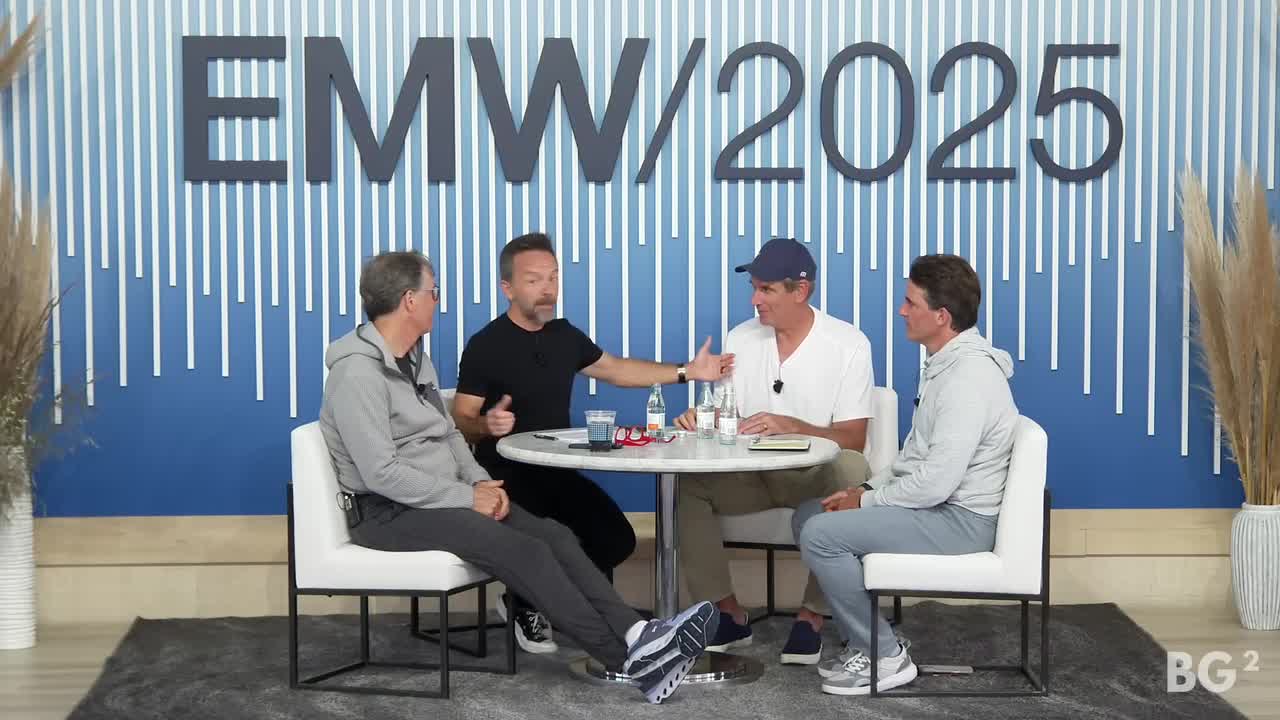
Of course, we're at CO2's East Meets West down here in Los Angeles.
I think it's an event that founders, I certainly know you and I look forward to every year.
As I said to you both, it's hard to put together something that has this much durability, this much impact.
You do this incredible overview on public markets, on venture markets and technology that I think you published today online that everybody should go out and download and take a look at.
We've been at this now for a couple of decades.
Having built something like this is really cool.
I just wanted to say thank you and congratulations on the 10th anniversary.
Bill and I thought, why don't we just go through?
You had this slide today.
We got to sit through and listen to you guys commentate about some of these slides.
We wanted to share it with everybody else.
We're also excited to make our debut as a podcast duo, the world premiere.
We've done them individually, but not as a team.
Or we're announcing our new pod.
Yeah, exactly.
We got BG2 and now we got- What is it?
LB2, Lafon Brothers 2.
Let's go, let's go.
So we're squared squared, but yeah.
By the way, I would just add, I think the conference is kind of a a really amazing gift to the industry and for the founders that get to come like it.
It harkens back to the like when i was really young in this industry the agenda conference.
Everyone would stay for the whole thing, and so your opportunity to network is so much higher.
And a lot of conferences today.
People fly in and fly out, but you know, here you, you've got some amazing people that are around for the entire thing.
It's just incredible.
Yeah yeah agreed well, let's dive in.
Do you have a big budget for smoothies?
You know your smoothie budget really keeps people intact and, by the way, for for people that are listening um, this deck, we're going to reference some of the slides.
The co2 team put it on their website just a few hours ago and so if you want to download it and have that as as we go through this, it might be helpful.
No, you should.
I mean, Philippe, let's just start off.
I mean, you and I, it seems like we spend most of our time talking when things get bad in the world.
And yet this is probably the most optimistic that I've heard you on this stage in the 10 years that you've been doing this.
You talked us through this slide four, which is the AI super cycle slide.
This slide which I thought was incredible, slide six, which is when will AI reach 75 of total US market cap, which I think is incredibly provocative how you compare that to industrials and transport, because everybody's saying it's so big already, it can't get any bigger.
So just kick us off.
You know, contextualizing your level of optimism and this slide like can it really be 75 of total cap?
Yeah, uh.
So listen um, every time i'm optimistic, i'm worried.
This is it.
You know, this is the peak, And now that Thomas and I are doing this podcast together, we're guaranteed to be doomed.
But I think that at the end of the day, That's how everybody thinks, first of all.
So it's never priced in.
Everybody's worried that it's all the time the peak, and yet despite that, things tend to work out.
I think today we've learned from these founders and stuff like that that AI is probably the defining and biggest tech trend that we're going to see.
I showed you the different waves.
There's only been a few waves over the last 70 years or so, going back to mainframes.
And one person made the point that the networking we needed the PCs.
The internet, we needed network PCs.
SaaS, we needed what happened before.
And AI is also built.
So one of the reasons these trends get bigger, they're built On top of each other.
Exactly.
So I think that's one.
Second part we've tried to do and Bill you've been great at it, and Brad you've done too is let's always try to look back at the past.
I find that this concept, that like, even though we're talking about new trends, they've been new trends, you know, since the canals and whale oil and things like that right.
And so you look in the 1800s and stuff.
You know we started having a real finance and real estate industry.
Then probably at some point, especially after the Second World War, we had a real manufacturing industry.
And then we've had also a market dominated by energy.
And right now it's about 50 tech, but we had the CEO of the largest power plant sort of utility with us today.
We had the CEO of the largest equipment maker for utilities today.
You're sort of wondering not just AI is going to become bigger, TMT is going to become bigger, but there's some sectors that should we reclassify them STMT or utilities now, like the next Semicap?
What's the difference between a nuclear energy plant and a Semicap guy?
They're both there at the beginning to help you create something that delivers a tech product.
Yeah.
Said another way, technology, when we got started, Thomas, was 5% of global GDP.
Today it's 15% of global GDP.
And when we're sitting here in 10 years, I think you're saying confidently, while there'll be a lot of noise and a lot of volatility, it's gonna be more than 15 of global GDP you guys talk about again like what the new class of AI entrants are.
So the Mag7 has actually underperformed this year.
But we have AI power, we have AI related software, we have AI semis that are up on the year.
You guys have diversified out philippe into some of these other categories you were just talking about it.
Is that the case that everybody got crowded into mag7 and now you see all of these other companies accelerating this year that that are starting to get some of the benefits, and I think this one maybe Thomas, you should take it and also contrast it to what's going on a bit in the private side, if we can add that too, because there was a time when Mac 7 was the real excitement and now it's changed a bit.
Yeah, so it was interesting seeing that we think that on average, the max 7M is basically flat year over year and yet tremendous value accretion to the top AI companies right.
Whether it's OpenAI or Anthropic or all kind of the following companies.
But to me, my other takeaway looking at this and I was thinking about CoreWeave that recently went public and- That you guys are big shareholders in.
We are and big fans of the management team.
And I think a lot of skepticism around that business and that business model.
But at the end of the day, being an AI pure play, there's very few in the public market.
Right?
And so you know I look at this list.
There's amazing companies on this list, but a lot of them might have legacy businesses or other kind of right.
I think of a Google as an example, right?
Certainly has a lot of good AI, but also has some disruption threats.
So seeing new entrants like CoreWeave that are a pure play on the trend, I think has been a really kind of positive development as well.
Another thing today's an appropriate day to talk about this the stablecoin legislation passed today, which is a major we're going to want to talk to Sachs about this later but a major step forward for the regulatory framework around it.
U.S. finance.
You were funny today, Philippe, on stage talking about Bitcoin.
It's this category that you said is broken out.
You lose sleep over it every single night because you're still not invested from an institutional perspective in it.
Like a lot of us,
And yet You showed this slide 18 where you said maybe the volatility of Bitcoin is coming down, which might put it more into an institutional asset class.
Talk to us a little bit about how you guys think about crypto.
Maybe at the you know We all have post-traumatic stress from the 1920 period.
I think of venture investing in crypto.
Is that changing?
Is it now an investable?
2020.
2020, I mean.
Yeah, yeah, yeah.
I like that, but I was like...
Those were the really early days of venture, you know?
I do think it's actually really interesting to think of Bitcoin as a company for the sake of our investing universe, right.
We do think like the relative market caps becomes really interesting.
So as you see in some of our deck, especially at the end, first thing is awareness.
We need to include the large ones as we think about how they're valued versus kind of other things.
And so how do you think about valuing it? i mean listen uh but just touching back on your point so we we're looking at bitcoin it's like all right the market cap of the world the net worth of the world is like 450 500 trillion equities i think are like 120 or stuff real estate's probably another 100, 150, then there's a value that people have in their homes.
Gold is about 15 to 20 trillion above and under the ground.
And then we're like Bitcoin at two.
And I'm like God.
So Bitcoin it represents, you know, two out of 500 of the net worth of the world, or 400, whatever.
It moves a little bit.
Could it be four?
Could it be five?
And then we're like, well, the largest company, Microsoft today is like three and a half trillion.
Let's say that Microsoft, I don't know, doubles in 10 years.
It would only be growing at 7% per year.
Microsoft will be a $7 trillion company in 10 years.
And could Bitcoin be five or six?
It's a real asset class.
And then on top of that it's very volatile.
Then on top of that, there's a lot of retail people that uh own it and it almost feels like sometimes you know the institutional investor is wrong and the retail investment right.
Sometimes it's the opposite.
Rita gets caught in a little bit of a meme stock and it comes back down And I don't think we can afford to ignore it anymore.
So it doesn't mean like we don't really know exactly when and how to own it.
And then your other point that's really interesting is sometimes you make some venture bets and they don't work.
And then you're like, I just invested in the wrong trend.
And in fact, sometimes you invest in the wrong company, but it is the right trend.
And those bad investment cloud your judgment.
And there's bitcoin.
There's stable coins, which we should talk about.
They're growing incredibly right now.
And then there's all these out coins and you could say okay well, i don't like the out and the meme coins, i don't like necessarily the collectible aspects of things, but i like stable and bitcoin.
So for us, it's more a process where We just need to become better, be willing to change our mind and stay open to the future.
And those are a lot of the conversations that you and I have together.
One thing I'm curious.
If you agree, one of my biggest lessons looking at private market investors versus public market investors is The appetite for institutions in the public market for assets that are perceived to have significant downside, ie like 70 or 80 that are mark to market I have found is just really low.
Yeah.
Right.
Investors on the public side just don't want to take that kind of risk.
Right.
And so versus on the private side, you are because you may have 20 of those.
They're not mark to market.
And you're like, look, maybe five go to zero, but my other 10 go.
So I do wonder how institutions versus retail may be willing to take that risk.
I wonder how institutions will think about an asset like that.
Let me kind of telescope out for a second, and I want to get Bill's opinion on this as well.
I think all of us now a couple decades into this.
I think one of the most powerful things about this conversation is mental flexibility.
Yeah, absolutely.
And I think when you're maybe a little bit younger in the business you're more dogmatic.
You develop an opinion.
You defend it to the hilt right.
And if you're wrong, it can be extraordinarily costly.
And I think crypto was that way for a lot of people.
And, you know, they carved out these positions.
They were like, this is, you know, this is a fad.
And then they're proven right at a moment in time because it'll have a 50% drawdown.
And so rather than reevaluating their priors, they lock in to that position.
Bill, how have you?
Because I find venture particularly tribal about Well look, you're locked in.
You can't sell.
So I think this is something that you guys develop more of an instinct for in the public markets than the private, because you're in, you're in, you're in forever.
Like with the private companies, you can learn lessons along the way, but your windows are really long.
Whereas I think if you're in public stocks, where you can, you know, change your mind and make a decision right away, that's very different.
Yeah, I mean, you referenced Druck and Miller today.
You said you think this may be the most valuable attribute of the great investors.
I mean listen, when he told me I've made 120 of my money on obvious ideas and I've lost 20 elsewhere.
And then you start thinking of Bitcoin and a company being like the fifth largest company in the world.
Now, it's a bit odd what I'm saying.
I recognize it because you could also say well, should we consider gold as the largest company in the world because it's worth 20 trillion, and not necessarily?
But I do think like forcing yourself to think differently And at least being at peace.
Okay, I thought differently.
I came to the same conclusion.
And being able to do that now.
As to us being flexible, the fact that you think that French people are highly flexible people I'm very thankful of that.
I'm not sure it's true, but we'll take it.
You know, two things that are new about crypto that Should lead anyone to reevaluate.
The government's gone from being kind of antagonistic towards supportive.
That's a big shift because regulatory risk was a big question for all this stuff.
And then the stable coin.
You know, based on what people are talking about, this is a high utility use case for people, that companies are using it as part of their workflow process.
That's a new dimension as well.
One additional thing just point on that that I think is interesting is you know, when you talk about the US dollar, the view is always well, what's the alternative?
You know, I'm not gonna go, do I wanna go into Europe?
You know, probably not.
It's kind of interesting.
Well, what if actually the alternative is Bitcoin?
And so that's something I've kind of been spending time on.
We talked a lot today about the dollar and interest rates and what's gonna happen.
And so it'll be interesting to see whether that becomes a legitimate alternative to the overspending of governments.
And when you have a stable coin right, how long is it before a new regulation goes through that allows a stable coin to pay interest?
Sort of odd stable coins can offer rewards but can't pay the industry seems.
And when you have a stablecoin with interest, how long is it before the government creates a one-year stablecoin, a five-year, a 10-year, a 30-year stablecoin which will allow every single person around the world to invest in the USA?
So the government is going to have an incentive to not have these bonds be sold through these weird dealers and this and that.
The government should go direct to the consumer, just like companies do.
So I bet you that in the not too distant future, people will be able to automatically invest in bonds.
And so that's yet another example on top of what you were saying Tom, about the Bitcoin and stuff that I think it's.
Anyway, we need to switch topic, otherwise I'm going to really pull the few hairs that you and I have left.
Back to AI, one of the topics you guys had an incredible audience here.
You had Andy Jassy here talking at lunch, Kevin Weil from OpenAI, and one of the topics was consumer AI.
I thought one of the most incredible pieces of data that you guys shared was looking at the impact that ChatGPT, which is now scaling to kind of a billion users, is having on Google.
And you did this by conjoining a couple pieces of data that you guys had.
So Thomas, do you want to talk to us a little bit?
This is slides 22 and slides 24 and slides 26.
I'll pass it to Philippe for this chart, but I think Bill and I were chatting about this earlier.
Anecdotally, it certainly seems to be the case, right?
The more people I talk to, the more I ask them do you feel like your Google search has been impacted by ChatGPT?
And resoundingly, almost everybody at this point now agrees that that's the case, right?
And we can argue whether the queries are commercial or not.
I think the queries are getting more commercial every day, but without a doubt, it's having that impact.
We could not prove it numerically.
It felt intuitively true.
Obviously, google is telling you it isn't right.
So i think we went about seeing is there, is there a numerical assumption that we can make that would kind of prove this out and i think you should introduce the work.
Yeah and, by the way, as we you know, All these platforms have some businesses that get threatened and other businesses, and Google could still be an amazing company by just saying listen, maybe search is under threat, but YouTube is, with all this new AI content, gonna explode and potentially threaten Netflix, and maybe Waymo is gonna also do incredibly well.
So our judgment, more is around what exactly happens.
I mean the the assets of the android phone and the gmail and and the google docs and like that.
That's a nice set of complimentary pieces that have so many great assets.
It'll be very interesting to see how it plays.
You know, for me, if i were ceo of google, that would be way above my pay scale.
I had no idea how to put it all together.
But god, is it just fun to be alive and just see how.
What's amazon gonna do, what's google gonna do, what all these guys.
So what we try to do here is, as part of the data science that we do, we process probably 100 million credit card receipts a day.
So we have a very fine view of what the US consumer does.
And we have another data set where we know what consumers do based on their email receipts.
And the trick was to try to join those two data sets and, in general in data science, my only lessons learned is data is useless unless you can join data sets that don't speak to each other.
That is the unlock, and so we did that, and what you see on that uh chart is that absent chat GDP chat GPT, maybe Google page views for a particular user are growing 4 per year.
So we are consuming more Google.
Then we get a subscription to chat gdp, which we chat.
Jesus christ, i confused gdp and gpt.
We get a subscription and now we're like ah, this guy's paying 20 bucks a month yes, and then we track once he started paying the 20 bucks a month to OpenAI, what happens to the usage.
And you can see peak to trough, it's down 8% year over year, peak to trough, it's let's say down 11.
So clearly, page views are going down and that's over almost two years, right?
So it's not like it's immediate.
It's not like it's an immediate giant threat.
But one thing we've learned and Thomas and I repeat that to each other all the time is these major shifts, they just start one little step at a time.
And that one little step becomes a gigantic move quickly.
So you can't underestimate these small moves.
And I think this confirms something that we all know anecdotally as we're talking about.
Well, and I think that even Slide24.
When we were talking two years ago about ChatGPT, we knew it was off to a good start.
But the question was, what's going to happen when Meta gets its game going?
What's going to happen when Google launches Gemini?
What's going to happen when Elon launches Grok?
What's going to happen when Claude gets better?
We all thought that... when they got into the game that this line would start to flatten out.
But the fact of the matter is ChatGPT has been radically more resilient and the engagement has increased much faster than I think any of us would have thought with that level.
And Brad, what's interesting about that is that's true in the US, it's true internationally.
It's true whether you look at it on downloads.
It's true whether you look at it on engagement.
It has blips here and there, the deep seek moment and others, but the resiliency to me Bill, it does remind me a little bit of when Uber got started, right.
And it would just.
They established that market share and you know it was just incredibly difficult to disrupt.
For listeners that don't have the slides.
We're looking at chat GPT adoption against Twitter Instagram, Facebook and TikTok.
And it's just fantastic.
You know, straight up and way ahead, way ahead of those adults.
I guess, by the way, those apps had inherent virality, as you know.
I mean, you're kind of the expert of that.
This doesn't.
This has no virality to it.
It's just value to the consumer.
Correct.
Driving adults.
Although I would say that we're starting to see network effects on the data side.
We're starting to see switching costs with permanent memory, as you and I have talked.
What's amazing is you have this level of adoption even before those things begin to kick in.
But it confirms what we kind of know to be true.
We saw this with Google.
We saw this with Facebook, and now we're seeing it again with ChatGPT.
Kevin, who was on stage after you guys talked, made an interesting comment.
I mean, it's tautological, but it still kind of resonated with me.
He said, look, this product's going to get better.
So you have all of this adoption with a product that's not static.
That's what's scary.
The product's getting- It's not even three years old.
Or maybe we did show the usage in terms of minutes.
Yes.
Right. more MAUs, more weekly users, more daily users, and then more time per day by a lot.
Which is also consistent with all of our personal lives.
Yeah.
We're going to keep forging ahead here.
We're going to get crunched on time.
Slide 27 Bill is, I know, a slide you wanted to talk about when we talk about these new hyperscalers.
And what you did here is you were mapping up cloud revenue market share to the share of NVIDIA GPUs.
So Bill, why don't you-?
Yeah, and I'll just describe this so people that are listening can follow along, and then we'd ask you guys to talk about your takeaways from it.
But the CO2 team mapped out cloud revenue market share and you have Oracle at 5, Amazon 44 because of the success of AWS, Google 19 and Microsoft 30.
And then you show right next to it the share of nvidia gpu allocation.
Microsoft and google are about equivalent uh 30 and 20 to what they have in the in the cloud revenue market share.
Amazon notably 44 of cloud revenue market share, but only 20 of NVIDIA GPU allocation.
And then Oracle jumps from five to 19 and CoreWeave comes out of nowhere to be 11.
So tell us why you guys put this together and what are your big takeaways?
I mean for me as a, I'll go ahead and then you go as an analyzer of companies.
This might be my favorite slide because it shows like the competitive dynamics at work and whose strategy will win out.
You know I mean I look at this and one obvious takeaway is that Amazon has half the share of GPUs than their share of AWS.
So that could mean one of two things.
Either AWS is behind in AI that could be one or they're pursuing a different hardware strategy than its competitors, right?
Which Andy spoke specifically about.
So that could be, or a combination thereof, right?
So that's one.
And number two, it shows the reinvention of Oracle, right?
I mean left for dead in the 2000s, left for dead in the SaaS era, left for dead in the AI era, now coming back.
And then also I give Corey a tremendous amount of credit of just entering the market as a pure play.
Had difficulty raising capitals.
None of us ever believed there's no IP.
You're just buying GPUs and reselling them just by being in market and being focused, right?
Started to build that relationship with NVIDIA and now is punching way above its weight.
So it's a.
By the way, the third theory could just be that nvidia would prefer not to have a dominant customer, like they wouldn't want this to be the customer, though it hasn't seemed to impact microsoft and google.
So yes, do you want to add anything?
Yeah, i mean listen.
I would say the one thing on that chart, it's damn hard to get the numbers right.
So there we have to explain the viewers like we could be off by you know five or six percent up or down, but i think where we're not off is the concept that some players are getting more gpu chips than others, and so then the question is are nvidia gpus a prediction of future cloud revenues?
And I think the answer is like and we haven't even included Stargate, which is going to start coming up here, right?
What if Anthropic also becomes its own hyperscater?
You could have a world with more like a dozen hyperscalers than like the two or three that we've had before.
And there's the overseas sovereign cloud.
Then you're gonna have the sovereigns for sure.
You're gonna have some telecom operators, more traditional operators in Europe, this, that.
So there'll be more, right?
But I think what definitely is going on now is there's sort of a battle between people that want to standardize on NVIDIA, pay the Nvidia, rent and get the supply, versus people who also think like hey, I'm bringing a lot of software.
I already have a lot of the data and I can afford a different strategy.
In the internet era, almost every startup started with Oracle and Sun, and five years later they weren't on it.
So there is some precedent.
There is, and I also think the other one that surprised me I even have a hard time believing that those are the numbers is I thought Google was more skewed to TPUs than Nvidia.
So there are some people who are going exclusively with one chip.
There are some people who are going to go in a hybrid way.
Google both has NVIDIA and TPU.
I think Amazon is also choosing a path of like hey, we're still making a ginormous bet on NVIDIA, but we also would like to have our own bet.
And i wouldn't be surprised if, maybe someday, an anthropic or maybe even an open ai would say maybe we should design our own chips.
And then frankly, you might have some very expensive model with enormous reasoning that runs on Nvidia, and maybe a super cheap model just for some very local applications, maybe that could run on a custom chip.
So I think a lot of it is going to morph and change over time, but at least what's fun here is let's go revisit this chart in like five or seven years and be like okay, different people play chess in different ways.
What's happening?
And to me, the thing that stands out most about this slide again.
Slide 27 Microsoft.
You talked about the explosion in terms of token production.
We might be 100 million tokens a month already out of Microsoft.
Microsoft is OpenAI, so you got ChatGPT.
100 trillion.
100 trillion, sorry.
I know you knew that for the audience.
What's really driving inference and this token explosion?
Like consumers first and foremost, and Google's got Gemini right.
Microsoft derivatively is supporting ChatGPT, as is Oracle and CoreWeave on the slide.
Amazon doesn't really have a big consumer application, right?
So their need for those GPUs may also be a little bit lower.
Correct.
Good point, very good point.
I wanna jump ahead a few sections because I wanna get to the private side, the venture side, of this, but I wanna end the public side with the macro backdrop.
Philippe, you're one of the best.
We've been at this a long time.
We know that we invest in companies that are doing extraordinary well.
We look at fundamentals, but you can't ignore the macros, says if you don't do macro, macro does you.
We found that out the hard way too many times in our career.
But if you obsess about it, it can also be your undoing.
One of the things I thought was so interesting.
We're at this moment in time where we've heard from Elon and the guys on the All In pod, David Friedberg and others, who are saying we're in this debt spiral, there's no way out of the debt spiral.
And yet, if you look at the 10 year, the 10 year is still at four, three, four, four.
Despite the calls that it was going to be at 6.5 or 7, we haven't got anywhere close.
We've been in a band between 3.5 and basically 4.8 now for two years.
And you presented an argument on slide 45 about the productivity cycle that may come out of AI right.
That may drive faster growth in the economy, much like we saw in the 90s with the internet.
That could in fact lead to lower inflation and lower rates on a permanent basis.
It's kind of this backdrop that would bring the deficit to GDP below 4.
I know you guys work closely with Larry Summers and others.
And so, as you think, how important is believing this to be true in our overall kind of public investing today.
So your original question, Philippe should we be worried that we all think that AI is a big deal right?
The counter to that is to say okay well, what if we're right on the AI but we're wrong on something else?
And we actually analyze three things. we analyzed, are markets expensive?
And the answer is yes, but markets were expensive in the 90s, during the PC and internet era, and the market did well.
So that's number one.
Number two, we said, well, are tariffs a big deal?
And we said yes, they're important and maybe they haven't gone through inflation yet, but this doesn't feel to us like I like to say that tokens trump tariffs right.
Basically.
And so we're basically left with this deficit.
First thing that's on deficit is having Doge and having people like Elon say that we're spending too much.
It's useful.
And we should repeat that every day.
It doesn't hurt.
But what I was wondering is, since it's so obvious that it seems that we need more Doge, we need to spend less, and stuff like that.
Who are the people who every day are buying bonds, 30 year bonds at four and a half percent?
And I'm sure you're uh, the listeners know that.
But a one-year bond at four and a half percent stays and gives you four and a half percent.
A 30-year bond at four and a half percent on its way to six or seven, you could lose 60 or 70 percent of your money.
You know, once you have a 30 year multiplier on the change in interest from four and a half to six, right?
And our basic instinct was to analyze what happened in the internet and the PC days where we had exceptional productivity gains, when the internet and PC really took off in the 90s, and to say hey, what would happen if we had similar exceptional productivity gains?
And basically, the answer we were trying to solve is, in essence, today we're at 100 debt to GDP, on our way to 140.
And we said what would it take for actually debt to GDP to stay at 100 or maybe even bend the curve and go down to 80?
And what's really surprising, I think if you just show maybe the next slide, or so, I think, if we move forward yeah, just a little bit you'll see that if productivity for the next decade or so was about two and a half to three and a half percent per year, we could achieve substantial reductions in this key ratio of debt to GDP.
And I'm not saying we're there, but I'm saying that at least we've been able to bookend what would productivity need to be to achieve an 80, 100 instead of 140 debt to GDP.
This is slide 51, just for the people following along, which is, you know, again an incredibly important point.
We know there are people buying bonds every day at 4.5%.
So the question is, why are they doing that?
And one of the answers may be exactly what you're saying.
What if they're right?
Exactly.
What if they're right and we're wrong?
And in fact one funny part is, in 1993 debt to GDP was supposed to go from 40 to or 60 to 80 by expert.
And it in fact went from 60 to 40.
So experts can be wrong by a lot.
And so I'm not, a good enough macro guy.
And if tech guys pretend to be good macro guys, you know it's the beginning of the end.
But at least we have a little bit of analytical thinking around what it would take.
And Bill and Thomas.
You guys are much better placed than me in terms of your discussions with all the privates which I think we're leading to now and all these amazing new products, and you're telling me that that's not going to create massive productivity.
I really think it is.
And drawing from that, you would end up with GDP growth.
More like the 5 plus maybe even 6 which, by the way, that was the case for many of the years in the 90s, then sort of product.
And, by the way, the six would represent four in about real terms.
Whereas in the past, you know, most recently, we've more be at, like you know, two or three, which is more like a one in terms of real terms.
So you know, just to wrap up Your flight path.
For the public markets, I think it's fair to characterize as tariffs fairly much being under control.
Multiples are pretty full, but like they were in the 90s, they can stay full.
That the backdrop is okay.
It's like the bond market and rates are still in the fours, and we have this AI super cycle.
With that, on the public side, would you characterize your exposures to the public market, Philippe, as in the top third, middle third, or bottom third of your kind of average exposures? know brad i knew you would ask me that and you know i'm not going to answer that but nice try i tried nice try i try okay nice try let's shoot over let's shoot over to private i think one of the things that was a consistent theme, if you look at slide 60 and 61, is this idea that the private economy, Thomas, we've had three or four years of really nobody getting out of the chutes.
These companies have all stayed private.
The percentage of unicorns as a percentage of the public markets has gone up.
But now we're starting to see an unlock here, both in terms of M&A and in terms of IPOs.
So talk us through the big themes from the slide 60 and 61 today about how AI has reignited this deployment and exits are starting to rebound.
Yeah, I'm curious to get Bill's view here because he probably thinks about this as much as I do.
And I'm curious whether he'll draw the same conclusion.
I think, by and large, we all agree that the environment of 2021 was incredibly unhealthy, both for companies and for LPs.
Too much capital going in, not enough coming out, a kind of a broken cycle, if you will.
You could see that in so many measures, amount of dollars going in, no money coming out, historically low IPOs, even worse than post-financial crisis, which is kind of incredible to think about.
So on almost any metric you looked at, we were kind of in the danger zone.
And I would say more or less that's been true over the past two or three years.
This is the first year and this is the crux of the view.
I'm curious, if you share, where the signals are going from red to, I would say, yellow and potentially green.
We're seeing, first of all, a rebound in IPOs, We're seeing IPOs perform better.
We showed basically the performance of the cohorts and how they've improved substantially since 2021.
One of the data points that shocked me, relooking at this, is that the 2021 cohort, within one year of going IPO, was down 40 and five years later is down 50.
I mean, just pause on that for a second.
That was a shocking slide, that here we are five years after those companies went public and basically the market has gone vertical.
By the way, that's correct.
On a relative basis, they're probably down 75%.
I know, yeah.
You're right.
Slide 71, I think.
Brent, I didn't believe this.
So I actually, I went to look at every single company on this.
This does not include SPACs.
Which is even more extraordinary.
This is just traditional IPOs.
And it's not dollar-weighted, right?
No, no, it's correct.
So there's a lot of scar tissue there, right?
But I think we have signs to see things improving.
So we just talked about the IPO market.
We've now seen some really strong IPOs that have performed well.
Core, Weave, Cirque.
Hey, Thomas, remind me, what does Zerb say?
Sorry to ask such a dumb question, but what does Zerb say?
Zero interest rate policy.
Oh, zero interest rate policy.
Jeez, that's how little I know.
But we're also seeing companies, like one of the things that really impressed me about CoreWeave we had a slide on this.
I can't remember what the number is, but like people are starting to understand how public market thinks.
And I do think they executed incredibly well on the timetable in terms of how they released information, how they explained the business model.
This is kind of slide 75 for people at home. so we have better ipos that are being rewarded and another thing that struck me is we looked at the cohort of ipos right and by and large you can see unsurprisingly that growth and profitability yielding a rule of 40 was kind of the average of the cohort so I thought that was bullish for the ecosystem.
And then finally you've talked about this on the pod before, but the MA environment coming back, different types of structures, Zuck's bold move to pay 100 of a company to only get 100 of the price 49 of the company by the team.
Urgency is now.
I need you tomorrow Alex, to help me fix my business.
I thought that was the best description of the scale deal that I've heard and maybe just click on that again for a second.
So for the audience, most people know that Meta has done this interesting structured deal.
They're buying 49% of the company.
They're paying a $30 billion valuation, so they're paying effectively $15 billion.
They're avoiding regulatory scrutiny.
The CEO of Scale is going to help lead efforts at Meta.
And all the customers have left.
Right.
And so they're leaving kind of a shell company behind.
And also, we don't know if that avoids...
Regulatory scrutiny, exactly.
We're gonna find out.
We're gonna find out.
So I don't know if there's a breakup fee or not.
It'd be interesting to see.
I don't know that either.
But I mean, I think one of the things it shines a light on is the speed at which everything is moving.
Here we are, and we can all say that Zuckerberg is in beast mode.
Meta is one of the greatest companies on the planet.
He's extraordinarily focused on getting AI talent.
But why do you think he was willing to pay 100% of the value of a company and only get 49%.
Is it that the imperative to have talent today is so important?
Because two years from now, you may be so far behind, given the rate at which AI is moving?
I tend to think it's related to two factors, right?
One is the size of the prize.
So I think he clearly sees that this is the biggest prize in tech, right, in the world, frankly.
And so I think, relative to his, while 15 billion to all of us is a massive number, probably in the scale of the multi-trillion opportunity that he sees, he might just think it's a bet I would make all day long.
Yeah, you look at it as a percentage of your market cap and you say- It's like a 1%, right?
Correct, right?
So I think that's number one, scale of the opportunity, no pun intended.
And I think number two is how quickly the ecosystem is moving.
And there's some data point.
I mean, people had this view already that Lama wasn't quite at the top, but this is somewhat confirmatory of that, that he's fixing a problem.
Right.
We've seen anthropic.
We have data in here that I think it took him about a year to get to their first billion in revenue.
It took him three months to get to the next billion, and then it took him two months to get to the next billion.
After that right.
So he's probably seeing how quickly ChatGPT is growing, social users, how quickly...
Anthropic is growing business users through their API and thinking.
I don't have two years to wait in European regulatory purgatory.
I have a question for you, Thomas, on the IPO.
So, simultaneous with seeing more IPOs which is awesome there has been a trend for companies to stay private longer.
I think the Collison's used to hint maybe, and now they're more kind of maybe never.
And some investors in the ecosystem are encouraging that behavior.
What do you think is different about the people that choose to go out now that the window is quote open?
I think, I mean, they each have different reasons.
Some may have just view from a financing opportunity, the ability to tap the public market both on the equity and the debt side.
To be simpler, right as a public company.
I think that's the big piece of it.
Second, look, it could be a brand defining event for a company, right?
For your product, for your employees, giving the level of transparency to your customers, that you're well-funded, that you have a fortress balance sheet all of that.
You can withstand the regulatory scrutiny that comes.
And even just the um, the scrutiny from investors right, that you have the discipline and and with everything that comes, public people looking at your numbers.
So all of those things right.
I happen to believe that all these companies should go public.
I also think, by the way, there's a democratic element to it, where I think the wealth creation belongs to the public market.
I think you attract different types of investors, not just frankly, a public market versus a private market, but also the retail investor.
What can you learn from the retail investor, either positive or negative about your business, right?
I mean, I think it's such an important point. and I made this case to everybody at OpenAI.
I think they're the most important company of the era.
I think it's hugely important from a regulatory scrutiny and from the democratization of finance.
It needs to be a public company.
The idea that we're going to have trillion-dollar companies and the only people who get to participate are the people sitting around this table I just think is unhealthy for our capital markets.
The fact of the matter is we call these companies venture-backed companies, but we all know there's a whole new market that's evolved here that I call quasi-public.
These are companies over $5 or $10 billion in value.
They would have all been public 10 or 15 years ago.
Why?
Because the private markets just didn't have the depth of capital to serve these companies and their voracious capital.
And listen, you know, this is happening as we speak in private equity.
Right.
Some private equity companies just go from a private equity owner to another.
Then you have continuation funds.
Right.
You have big second transaction.
This is happening in the private credit market, where now you have a huge private credit as an asset class.
Exactly.
So this sort of healthy tension between public and private is important.
I just think that these super, super large private companies, if you're not willing to submit yourself to sort of the sunshine and the ray of light of the public markets, you're gonna get it through a regulatory agency.
So pick your poison and be careful that if you think you can live in the public market purely to sort of live in the shadows, that's not gonna work as you become a large company.
You'll be regulated.
And so that's why- Maybe even more correct.
That's why i really hope that these companies will choose to go public.
Uh, you make the democrat.
You know retail investors should have access to these companies, but i just think in general, the concept of mark to market.
It's not perfect and there's increased volatility, but every day we learn something and every day we know it's the price you can get today.
Today, by the way, I thought one of our best speakers, who made this great point of just because I'm public doesn't mean I need to change how I run my business.
Well, maybe we talk about app love and on slides 91 and 92.
The 91 is has Microsoft reached peak employees and 92 was about how app loving has gone, AI first and had massive margin expansion or revenue per employee.
I tweeted about this the other day, I called a game, the golden age of margin expansion, right?
If you look at the Mag7, over the last three or four years they've grown over 20 compounded, but the number of employees, their OPEX, is growing at 2.
We've never seen this. in the history of technology that we've covered.
So why don't you talk a little bit about it?
Can you describe the slide?
I loved this chart on 91.
And previously what we had is we just had the chart without the blue lines, right?
Which basically this chart, for those listening, tracks Microsoft employee count.
What we realized after we did this chart is we realized wow, there's actually three distinct chapters that are kind of being told here.
Chapter one is the Zerp era, it's COVID, software is everywhere.
The only way these companies think they can grow is by hiring more people.
So Reflex, big opportunity.
Which, by the way, made sense because if you grow by producing more code, you need more people for more code.
So I think it was completely logical.
It was a logical thing to do.
We got to hire more.
Okay.
So that's the Zerp era.
Then ironically, just as GitHub Copilot comes in, Brad, familiar with the term, the get fit era.
This is like- Time to get fit.
Hold on.
We need to get fit.
We've gotten too big, right?
And then you can see stabilization of headcount down in a lot of other companies.
Now we're entering the AI era.
And I do think it's kind of a provocative question, which is that has Microsoft reached the peak employee and will they never cross that threshold ever again?
Right.
You know, I had conversation with the CFO of a major company recently and they said thought experiment.
What if our headcount was down 50% in three years?
Right?
Those questions have never been asked for companies that are growing and thriving.
And I do think what I get excited about as a public market investor Philippe, it's not just that we're seeing a reacceleration and top line growth for all these companies.
Every one of these companies, Literally from Uber.
They're growing their top line without growing their headcount, all the way to the largest, of the Mag7, but Applovin has done as good a job as anyone.
Tell everyone about this slide you put down.
This is another one of my favorites.
What this slide does is it will track Applovin a public company run by a brilliant, in my opinion, generational entrepreneur.
And it basically looks at two things.
One, it looks at the revenue of the company annualized since Q2 2021.
So that's the blue line.
And second, the employee count over that same period.
And basically 2021, big opportunity, I got to hire tons of employees to kind of try and capture it.
What else can I do?
Then realizes, oh my God, my company's gone too big.
I've lost control of my culture.
We're not innovating fast enough.
Too many layers of bureaucracy.
We're not set up to capture the opportunity.
Right-sizes the workforce.
At the same time as AI comes in.
Now the company's lean and mean innovates out-competes companies like Google and Meta.
Doubles the size of the company, as the employee count is down over 35.
Think about this.
We just showed the slide of ChatGPT going parabolic.
Google losing page views.
Google has 187,000 employees.
OpenAI, 2,700. we're not gonna be a company of 20,000 employees.
He didn't say we're not gonna be a company of 187,000 employees, right?
He's saying we're going to leverage our models, our agents, our capabilities, which is exactly what Jensen Huang said to us last year.
He said, Brad, I'm gonna 3X the company and our headcount may not grow or only grow a little bit.
And I said, how?
He said, because I'm gonna have agents who are reporting to me.
I'm not going to have employees who are reporting to me.
By the way, I'll tell you what this made me think of.
So back to the Applovin slide.
So in four years, they doubled the revenue per employee.
And now a company with a high growth rate, that's profitable, that's thriving, is lowering headcount because of AI.
It really struck me that there's a level of confidence in a company's use of AI if they're willing to actually reduce headcount.
And a lot of companies give lip service to their using AI, but a willingness to reduce headcount is a different level.
And, by the way, one point Adam would make if he was here, and I think it's important to state he's not doing this because he's a masochist that loves to fire people right.
The reason he did this is he believed that that's the shape the company needed to be in to win and out compete right.
So I think that's really important.
It's not like, oh my gosh, all of a sudden i want to be much more efficient and i think that you know i can create so much more value it's.
I believe this is what the company needs to look like so i can win this market.
We need to make decisions faster.
We need fewer layers, right?
I think the motivation is really important.
Um, and this is just kind of an output of that.
And, and the final thing i would say about this philippe, The thing that should give us confidence about this productivity explosion in the economy is, at the end of the day, our economic productivity is just a combination of all these companies.
If a lot of companies are doing this and you pile them all together, you're going to get more output for a fixed amount of labor and capital.
That's going to drive economic productivity.
The last thing to say on that, which is really important, is someone is going to then say my God, what's going to happen to employment if we have all these companies that become so efficient right?
And I think today someone brought up the concept of Jevons Paradox yes, and i'm gonna actually use my chat gpt to study a little bit more over the next week or so but it is the concept that uh sometimes, as uh, you have less employees and the cost of employment goes down.
Actually, the unemployment rate will go down, not up.
And I'm really summarizing it in terrible terms.
But I think it's really important to say that it's possible that companies need less employment, but more companies get created, because it's much easier to create a company.
Smaller companies, vibrant companies, get created.
Jobs become more interesting.
And so I think there's gonna be a big debate around.
Okay, all this AI, is it gonna increase or reduce unemployment?
And I'm not 100 sure what's gonna happen, but if you force me into an answer, I have faith that it might actually create more jobs, more interesting jobs with more responsibility, versus the other way around.
Yeah, we have two more slides.
We wanna cover that.
I think maybe we're gonna end with the best, because you guys had a couple of powerful things.
The first was slide 98.
After all of this covering what's happening in public and what's happening in venture.
Thomas, I think you summed it up well, which is okay.
So what does this mean for me?
If I'm a founder, if I'm a CEO, what does this mean for me or myself, company?
So bill, why don't you?
Let me?
Let me describe what thomas did and then thomas, you can do the analysis from it.
But he created a quadrant, you know, and on, on one access he has a growth rate above 25 or below 25 and on this access you have profitability.
Either you're cashflow positive or you're not.
And so walk us through, kind of your recommendation for companies that find themselves in each of these four quadrants.
Yeah, and Philippe chime in too.
Look, we're very proud of the work that we put in this deck, but we also want to be mindful that it's a lot of data.
And we thought about how do we crystallize everything that we see in the market, from all the data, all the smart people that we talk to, in terms of generating useful advice for entrepreneurs right?
And so we kind of came up with this matrix.
If you look at the left side, which is basically growing, companies growing in excess of 25%.
And you might argue this is kind of the easiest bucket you're growing 25.
But we do think the Delta is kind of different.
And, by the way, one thing we skipped over.
You guys had two or three slides on the fact that growth has become more scarce.
In the public market, correct.
And there's a big um delta now in revenue multiple for growth and for you know, and and obviously diminishing multiples for people.
So we have seen in the public market now growth be re-rewarded post 2021.
So our advice being to entrepreneurs that if you are growing over 25, you are profitable time to think about whether you should be public.
But that doesn't necessarily mean going public.
As you well know, there's a difference between being IPO ready and going IPO.
But we think certainly putting all the steps into place kind of starts to make sense.
If you're burning, then now might be the time to build a fortress balance sheet.
We just saw OpenAI raise 40 billion, right?
These companies are accumulating massive war chests, so you don't want to lose out time to really kind of built up your strengths.
I think where I think you're going Bill, and what you and I spend also a lot of time thinking about is what about the companies that aren't going?
25.
And you know for Philippe and myself, we take the responsibility of having invested in companies really seriously.
We're on the boards of many of the companies that we are invested in and we don't bail on our entrepreneurs.
You know when we make those commitments.
So what do we do kind of in those companies, right?
I think each bucket is interesting.
The okay, I'm growing less than 25 but I'm profitable is kind of an interesting case study, because that's where you might be complacent.
You might've said, look, I got fit post 21.
You told me to cut my burn.
I'm profitable now.
By the way, the reason I think a lot of companies ended up in these low growth situations is they had a ton of capital.
We had that mini correction in 2021.
Everybody said, get the cash flow break even.
They all ran that way.
But that meant cutting headcount, cutting programs that they might have been doing.
Yeah.
And you end up in a low growth situation.
Yeah.
So we thought that actually this bucket.
Now we're in a potentially generational transformation and architecture shift because of AI.
Time to maybe look at and say, okay, what can AI do for your business?
Is there a new way that you can invest?
Is there an M&A opportunity or something interesting?
So we think now you can afford to be a little bit more on your forward foot, right?
You've gotten the business healthy.
You've shown you can be profitable.
We have a generational architecture shift, time to kind of see how we can play offense.
Would that even include maybe becoming unprofitable?
Potentially.
If you have the signs and you really start to see the growth reaccelerate because of it, potentially absolutely
A lot of AI companies are not profitable right now.
So if you think you can win and you can benefit, I think that makes sense.
This is probably the one I had the most debate about both myself with others is what to do if you're growing less than 25 and you're still burning capital.
And look, obviously no one chooses to be in this position, right?
Circumstances of the business, whether it's competitive dynamics or others, have put you in this position.
And now the question is what to do.
And I went through a lot of different iterations here.
And the best word I could come up with is it's time to reinvent.
And reinvent could mean a lot of different things.
So let me pause it that you might have two businesses.
Let's say you were, 50 million in revenue.
You might have your 40 million core business not really growing.
The unit economics are tough and maybe it's an on-premise product.
And now you've incubated a new SaaS Cloud product.
That's maybe only one or two million in AR, but it's really growing quickly.
It's putting the company back on offense.
The team's really excited.
Might be time to say, hey, let's go all in on this new product even though it's much smaller.
That's one reinvention.
So it might be you have a gem of an asset.
It might be trying to open source something that previously you didn't, right?
That's kind of what I mean by reinventing.
It's the opportunity of looking at this moment and thinking, what can I do?
And also realizing that you as an entrepreneur have an opportunity cost of not doing other things.
So the best word I could come up with is reinvent.
It's gonna mean different things to different people, but we thought now was the time to kind of think about that.
I thought this was amazing.
And I will tell you that I think one of the biggest challenges that these companies in this quadrant and I think there's a lot of them, there may be a thousand of these out there
One of the big problems I think they have is having survive to this point and having succeeded let's say they have revenue of 50 to 100 million dollars they feel like they need to protect something and it puts them on the back foot, not the front foot.
It makes them conservative and i like your word reinvent.
They need to increase risk they actually, because i i think one of the problems is they don't they.
They don't internalize the fact that if they stay low growth at this size, their multiple could go from five to three to one times revenue.
And they're protecting something that doesn't exist.
So I'll leave you with this last thought.
Brad, you and I have talked about this.
There's an amazing element of the venture community.
They too tend to be tribal.
And I think there's a lot of benefits to that.
But I also think there's a lot of benefits to what I'll call more mercenary thinking, right?
Which is more reinventing from the ground up.
And I think that ultimately, the combination of both, of those which tends to be more of a public mindset again, because we do have the ability to sell and venture don't to us bringing those two kind of strains together in the boardroom can yield hopefully, some good outcomes.
Awesome.
Thomas, thank you for being with us.
Thank you for having us at the event.
It's really incredible.
The amount of thought that went into this is extraordinary.
And I would just say, on behalf of all the founders, those people who partner with you, like Altimeter and Benchmark,
What I love about this ecosystem.
Most people think that we compete like dogs, but the truth of the matter is, you're one of the first people I call, or Philippe, when we're trying to figure something out.
And you guys to us.
And that's why Bill and I do this pod, because we actually just want to be smarter and get to the right answer.
And so appreciate you having us and an awesome job again.
Yeah, thank you so much.
Thanks.
As a reminder to everybody, just our opinions, not investment advice.