Discussion keeps the world turning.
This is Roundtable.
Hello, everybody and a warm welcome to a special Spring Festival edition of Roundtable.
I'm He Yang coming to you from Beijing.
And today we're embracing the joy and festivities of the Chinese New Year.
This is the time to honor the richness of culture, the beauty of art and the power of community.
We're absolutely thrilled to bring you this conversation from Beijing and all the way from New York city.
Joining us today via video link are three incredible guests who are bringing the spirit of the Chinese new year to life in their own unique ways in the Big Apple.
First up, we have Robin Kofer, a talented American sculptor whose latest exhibition delves into the elegance of the Chinese culture in so many ways.
Hi Robin! Hi, I'm so happy to be here.
Very excited Thank you for having me Also with us is Helena Xun the organizer behind Robin's exhibition and curator of the Yuan Xun museum Hi everyone So happy to be here Rounding out our incredible panel is Xin Zhen Lao the Senior Vice President of education at the China Institute in America Hi everyone and you can see it here.
From Art to Education, today's discussion will show you how Chinese New Year is connecting people, cultures and communities around the world, so let's jump right in!
This question is for all of you.
How do you celebrate the Chinese New Year?
And what's your favorite part of the festivities considering all three of you are in New York and I bet it's very different from it's like here in Beijing?
Xinjiang, let's start with you.
Sure. Well, as you just said, it's a way of really connecting people.
I love, during the Chinese New Year, meeting friends, having meals together, celebrating with delicious food, and I particularly love gift giving and receiving, of course.
While there's red envelopes, there's a lot of activities that we can do with friends.
I also have a little personal activity.
I like to get a new haircut.
Oh interesting that's a Chinese cultural heritage thing you have to have the haircut before is it the second month of the Chinese traditional calendar for good luck so get that done yes yeah you can have a haircut and there are days that you're not allowed to have a haircut whoops I have to look into that Helena, tell us a bit more about how you're celebrating the Chinese New Year.
Of course. So it's very different, because I am Chinese and I lived in the United States for 12 years now.
I just want to say my family celebrated Chinese New Year in our museum.
In Yuanqian museum, we have reconstructed two Qing Dynasty buildings that were 300 years old.
So we reconstructed them because we protected them and then rebuilt it on site in the museum land.
and every new year, I have about 30 relatives.
So my dad will host this major dinner with three huge roundtables and everybody's sitting in that building, one of the 18th century buildings, and just have dinner there.
That's how we celebrate, and remembering our ancestor.
That building is actually Ancestral Hall.
Ancestral Hall, Tse -Tung, is where everybody go and perform rituals to celebrate their ancestors.
And this year, we're inviting so many of our American friends and American museum curator friends in New York, such as the Metropolitan Museum of Art, the Museum of Art and Design China Institute to come to my dear friend Robin's home to celebrate Chinese New Year and also celebrating her new sculpture series that is also goes with the scene which I'm going to let Robin talk more about her art series.
That's very interesting because it's a dialogue between the contemporary art that she creates with the Chinese antiques from my family's private museum.
And that's how we celebrate this year.
It's a very special event.
Oh, how special that is.
Robyn, I know you're not originally from China, obviously.
So what's the Chinese New Year to you?
Oh yes, well I can get into my connection to China later maybe.
But I've been lucky enough to celebrate Chinese New Year many, many times.
And for one reason, I have dear Chinese friends, but another reason is my husband is a fifth degree black belt in Shotokan, Karate.
And so his school, which is quite large and has many winners of these major tournaments, they celebrate.
And it's a feast, it's a banquet, there are performances, the dragon comes out, it's extravagant, exceptional martial arts demonstrations.
They're amazing. And I've gone to quite a few of them.
It's really a wonderful Celebration see like sometimes as human beings we need these rituals to mark the special Occasions and have a reason to come together and in China traditionally, you know, we have the red packets and shinjang Refer to that as well and now in China, everybody's giving well, not everybody a lot of people are giving each other the digital or virtual red packets instead of the actual red envelopes.
And I guess you can be a little bit more flexible with the amount of money that you're typing into the digital red envelope as well.
Yeah, but I wonder what is it like in the US, in New York.
Do you keep these red packet traditions, the lanterns?
And Robin, you mentioned the dragon dance that comes out.
That's always exciting.
Get into, you know, the festivities.
What is it like to have the Chinese New Year over there?
You know, there are major organizations like China Institute and Asia Society that organize these fantastic events, and in Chinatown, in Manhattan, downtown Chinatown, and they always try to bring up this Chinese New Year vibe.
Even in shopping malls such as Bergdorf Goodman or Bloomingdale's, everybody celebrate Chinese New Year, and everything is red.
It's super fun, you know.
And there are fireworks on Hudson River on the East River that are sponsored by major institutes like Asia society, China Institute, Chinese government also.
So it's really cool.
Yeah, Helena, you're mentioning China Institute.
Well, I'm looking at you and Robin and me.
Like two of us are already wearing red in the studio.
And I'm not. It's true, it's true.
You see the festivity all over.
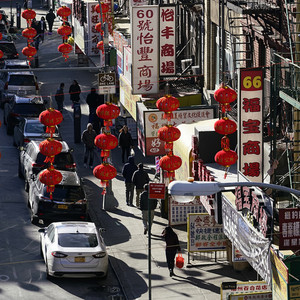
You walk in the street, you see red lanterns.
And well, as Helena mentioned, and while I work at China Institute in America, every year during Chinese New Year, we have a big celebration with the families, particularly with the community, bring children, bring parents and bring students and people from all over the different backgrounds and ages together.
Workshops, line dance, while the celebration always is kicked off by a lively line dance with music.
and we in fact also invite guest artists from across China over so there's a lot to share but I'm sure Robin has a lot to say too.
Robin, take it away!
I'm having these great flashbacks of the red envelopes.
I love them and I like them real versus virtual.
And I love the colour red, the power of it and the vibrancy.
And so I love to see a room full of people wearing red.
I mean, that's, you know, I'm an artist. So everything to me is visual.
Everything, I'm thinking on an aesthetic level.
It's subconsciously, if not literally consciously, but the food is definitely the superstar because the feasts, I've been able to experience.
Whoa. But, you know, New York is, there's everyone here and every nationality, right?
And I've been to Chinese New Year celebrations As Christians, and goodness, are there 12, are there 20 different nationalities at the same table?
I mean, it's very, very cool.
Yes, and that's something pretty special about New York City, right?
It has so many cultures, all vibrant, alive, and interacting with each other, Chinese culture being one of them and this being the time for it to sort of shine.
I think for anybody, just join in and you can feel the festive vibe.
It's just a great feeling also of celebration of togetherness.
And Robyn, well, do tell us your exhibition in a way it's seen as a special way to celebrate the Chinese New Year.
Could you share the theme and you know what inspired your exhibition?
Oh, sure. Yes. So my dear friend, Helena, curator of my show, saw when she came to my studio many of these heirlooms and artifacts I've inherited from my family that spent quite a bit of time in China.
My great grandfather, Frank Lockhart, was the consul general to China during the late 30s and 40s.
He spent a great deal of time there.
My grandmother grew up there, always married there.
So I have these artifacts and I've lived with them for a long, long time and knew for years that I was gonna incorporate them into my art, but didn't really grab a hold of it until fairly recently, maybe the last few years, and the artifacts themselves are so inspiring because the texture, the feel, the look, so particular, whether the carving of the wood, or the jade, or the ivory, the workmanship is so extraordinary.
But they're delicate, right?
The textiles, they're very old, some of them are over 100 years old from my family.
So one problem or a challenge was how do I work with them without damaging it?
So that, you know, I really took my time before I dove in, because I guess there was some fear.
So my first series of headpieces that turned into a series of sculpture was using porcelain from lamps.
They were extraordinary from my great -grandfather's home, and I created a series of at least — I believe there's 10 in the series, maybe 12 sculptures.
If you're in New York City, where can you check out this fantastic exhibition?
It's on the 78th floor of Trung Ho Tower.
You can come see it.
It's amazing. And these sculptures, I've checked them out, they beautifully blend elements of traditional Chinese artistry with obviously modern influences.
And it's creating a fascinating dialogue between the past and present.
The use of headpieces rooted in Chinese culture.
It adds a sense of timelessness and reverence.
And while those blindfolded eyes and covered mouths of some of these sculptures, in my opinion, evoke a powerful sense of silence and introspection, art does have this really powerful force.
Thank you for that.
I mean, my aim is to always go for the eternal, you know, the eternal truths that transcend the transitory mundane life.
I certainly hope that my art at least does some of that.
Straight up beauty is one of our eternal truths, right?
And I love what you said about, yes, blending the East and the West, and that was quite a literal thought that I had to bring them together on a very basic human level.
And of course I want the viewer, the observer of the art, when they are looking at the art, they own the art, right, they're looking at it.
It's their personal experience, so what you get out of it, and how it affects you, that's your experience, that's completely for you, It's my gift to every viewer.
You should have your own personal experience with the work.
And Halina, you being the curator of this exhibition, what are the things you're most proud of?
And what are the things you hope everybody leave the exhibition with?
Oh, thank you. That's a great question.
So I am a curator of my family's art museum in China.
And my father founded it 25 years ago.
So our family's whole mission is about preserving and protecting ancient Chinese artifacts, expanding from Western High Dynasty to Qing Dynasty, and now bring them to the world stage.
So Robin and I have been friends for over a decade now, and we constantly discuss art and differences in culture.
So I thought if we can collaborate, then the Chinese folk art and the Chinese folk art culture can maybe go on to a different stage.
to the Western world, to Trumbull Tower in the heart of New York City, and then have a different life.
So Robin, if you can show everybody right behind you is the piece we are most focused about.
You can take a look at that piece.
On the top of the sculpture's head is bone structures, bone ornaments that's from 3500 years ago, that's from Shang Dynasty of China.
And we're not sure whether it was used as currency or just as jewelry, necklaces and rather than artistically created this piece and used that as a headpiece of this sculpture.
And then, if you look at the sculpture's eyes, these were Song dynasties, ceramic pieces, that are about a thousand years old, okay?
Completely different aesthetics and style, historical.
And then, if you take a look at the neck of the sculpture, these are headpieces from women opera characters from Qing dynasty.
That's 19th century China.
So there is a beautiful dialogue and immersion of the cultures and contemporary art and ancient artwork that's reflected in this series of sculptures.
I'm just giving you one example.
And that's the interesting part of this whole series.
Immediately I'm feeling almost like the weight of history, but also there's a lightness of it travelling through time till today.
Absolutely. It gave me chills.
Yes. Yeah. It gave me chills too.
It gave me chills too.
Well, I was going to say when I completed that particular piece that it may most likely as coins.
They're so uniform and so perfect.
So refined, the workmanship.
I was terrified to touch them for months and months and months.
But all of a sudden it came to me.
The idea of what to do with them came so suddenly.
Probably at midnight, one o 'clock, that's when the muse shows up.
And I stayed up all night making it.
And when I finished the sculpture and looked at it.
I mean, it was it was electric.
I mean, I had chills all over my body.
And do you think the way that you construct your art and sometimes it might be difficult to pinpoint exactly what are the sources that culminate to what you do?
But your personal history might have something to do with it, your connections with China and Chinese culture?
Maybe so, I mean, since a very little girl, when I was in my grandfather's study, I mean I was pointing at things that I wanted to inherit, I mean I was mesmerized by the culture.
Yeah, I have a very deep reverence for it, I always have. And my siblings, they couldn't care less from what I can tell certainly.
And so you know, it's like that.
It was just an immediate connection with the aesthetic for me, and was fascinated with the culture.
I also want to point out that Robin has used Qing Dynasty's infants' baby's bibs as a very important element of her sculpture series.
Those are everyday use of Chinese...
you know, the Chinese historical life in Qing Dynasty, 19th century, where the mothers and the grandmothers of the babies, they handcrafted, embroidered into silk and cotton, and made these little scarves or children's bibs to protect the children because of the high mortality rate in Qing dynasty.
So in those pieces, you will see a very interesting sense of love and care in her sculpture.
That's timeless too.
Think about it. Grandparents and parents love to the kids.
Yes, and that's something still very much real and alive in the Chinese culture.
I think there's love, inter -generation of family, and especially during the Chinese New Year people are really feeling that.
And also that sentiment I suppose is shared across cultures as well.
It reverberates in this really timeless way.
And Xin Zhen, tell us what's happening now.
What kind of activities have you guys put on show for this very special time?
Yeah. Well, while I'm listening to what you're talking about the art, I keep thinking touching people's heart.
That's where, when you have the culture, the activities, the art and what the elements that we can well bring from Chinese culture to New York to touch people's heart, I feel, well, that's what to China Institute has been doing since 1926.
We are, well, I don't like to use the word oldest, but we are around for almost 100 years.
We are founded by two American scholars, John Dewey and Holmen Roh and two Chinese scholars, Hu Shi and Guo Bingwen and many others who really being the founders to see bridging the cultures to be cross -culturally introducing Chinese culture to American public.
It's been a mission for us for almost 100 years, and it's still so relevant to so many of us.
Like me, I'm a student coming from China, the heart of Sichuan province, to New York City to study and to people who love of Chinese culture and find the language that well, even though may not born in China but you really feel connected with Chinese culture.
So for Chinese new year this is the biggest, the most important holiday for Chinese culture in China's tradition and while at China Institute, besides celebrating with a huge crowd over, I would say 500 people, coming to our location in downtown Manhattan on February 2, it's a celebration that we in fact, in collaboration with the prince Kong's palace museum.
Gung Wang Fu. Oh hi Kitty.
We just saw the Kitty joining our discussion.
Right, she's listening.
So we are inviting them and collaborating with them.
We have really fun activities, workshops for families, like the Peking Opera, facial painting, hands -on activities with dumpling making, and also we have a music performances and there's a architecture component looking at the furniture jointery so that the son Ma Jie Gao, something very uniquely that Chinese culture brings to the world that we want to break it down to the level that people from all different ages and with different backgrounds can enjoy.
As we were talking about art, really sculpturing some fleeting moment to make it transcendent, I keep thinking the activities we are doing here on that day is actually creating that fleeting moment, that experience.
It may disappear the next moment, but if that moment touches the heart, it will stay.
It will have a lasting effect, maybe inspire somebody like Robin, an artist who wants to create something wonderful for the future.
And also, since we started a food is big and we are having a Chinese New Year dinner on February 6th.
We are also collaborating and working with many Chinese -Americans and the local community talents while the two chefs who will be putting the dinner together are well celebrated Chinese -American chefs.
So that's something that we are looking forward to.
somehow I already feel my mouth watering a little bit just thinking about all these delicious foods and also a little bit of fusion possibly added to the traditional Chinese cooking and that is just fantastic.
And for all three of you, how do you feel or is there a cautious effort in bringing these combinations of Chinese and American or international influences together but also to engage the local community.
Do you feel like there might be more planning to go into it?
Or, you know, what goes into your mind when you're forwarding your endeavors?
This question is so good.
It's really interesting because three of us all live in New York City and Robin you know in New York is extremely like a melting pot, and all the cultures are celebrated, whether it's Jewish New Year, Chinese New Year, or Christmas New Year.
So a lot of people, you might be surprised, but they know a lot about Chinese New Year already.
So it doesn't take us a lot of effort to educate them.
They already know. They know in February is Chinese New Year, right, Robin?
Am I right? So I don't need to tell them, they know, you know, come over, we'll have dinner in Chinese New Year.
Yeah, I want to add that New York has such an educated audience.
But I would also add, well, because of that, it's so competitive.
It's really all different organizations where we are as well we are having an event where we are big on February 2nd where we are already very popular but all the different organizations like the Japan Society, Korean Society, Flushing Town Hall and many other museums, I went to an exhibition at the Met and they actually also put a small exhibition together celebrating the year of the snake and activities going on.
So there's a lot of different things happening that would capture people's attention.
To get the word out when you have a particular event, that does take effort.
That you have your audience very clearly in your mind and you have – well, this is a dry side – the operational side that you target your audience.
You speak the language and you find the channels that, well, you can reach out to them so that they know this is happening and they come to you.
They come to the 78th floor of the tower to see Robbie's show.
Exactly. Now, more people will know.
Art often has this power to bridge cultures.
So how do you think art can play a role in bringing people together during the Chinese New Year celebrations and with your exhibition currently on, especially in this backdrop of the New York City.
Art brings people together.
Yes, absolutely. I mean, they can change your perspective, it can change your attitude, you can have a eureka, like you look at something and say it's abstract art, you know it, but then, well, you know, it's a Pollock, Jackson Pollock.
But maybe you see a mother and child reconciling.
Maybe there's a whole story within it for you and you have this whole healing moment.
I mean, that's the thing, art is healing.
Psychologically, spiritually, emotional.
Everyone in every culture needs that.
Who doesn't need healing?
We all need healing.
Yeah, so it's good to have a place to turn to and it could be art.
And uplift and to inspire and to motivate and to go above the mundane.
I mean, this is essential, it's certainly, from the artist's perspective, we can't just, you know, go along, go to work, eat our dinner, go to bed, and then da da da da da, and then goodbye.
No, that's not life.
It's part of human nature to have these, you know, more elevated desires and needs.
Xin Zhen, as somebody deeply involved in cultural education, do you think—or how do you think learning about the Chinese New Year and Chinese culture help people to better understand?
what we have to offer and all these traditions that are still very much alive in the Chinese culture.
Yeah, well Chinese New Year is such a wonderful window for people to really experience a lot of different elements of Chinese culture.
You have the food, the activities.
I'm a Chinese language teacher.
We always say in culture you have products.
And that are the objects, the things that you will touch, you will eat, you will, you will engage with.
And you have practices.
And these are the things that we do.
We go visit friends while we make food for families and we bring people together.
And there are perspectives.
These are the values that's behind the things that we create, we interact, and the practices that we do, and we engage.
So Chinese New Year is such a wonderful moment that combine all of this together.
And there are so many elements that we can tell mythological stories from ancient time, or there are so many elements can be combined and reflected and then to create contemporary art or music pieces.
And during this season, there are many concerts putting together related to Chinese music as well.
So I do feel like if we look at the Chinese culture, this is the wonderful window.
And also, it's just to be in New York City, particularly, while this is such a place with all different people coming together, they can really have an experience of something that being part of their life and what to experience in the street, to be mundane for a few days, but also can be elevated.
So, I feel, wow, this is what Chinese New Year would create, that kind of attention.
Some regular days, well, things will go on, as usual, people will worry about their mundane things routinely.
But Chinese New Year, we have this opportunity that we really tell, this is, well, something wonderful about Chinese culture.
Let me ask you one more question.
XinZhen, you attended the CGTN New Year spring festival gala in New York.
What was that like?
Oh, I have just one word. It's fabulous.
It's such a wonderful way to kick off celebrating Chinese New Year in New York.
particularly this year is the first year after Chinese New Year being recognized by UNESCO as the intangible cultural heritage in the world.
It's really showing the recognition and it's a wonderful moment to bring awareness.
The gala itself has such a mixture of showing the uniqueness of Chinese culture.
there's well kicked off by the wonderful Dragon Dance throughout the audience inside to the Gotham Hall in Midtown, and also it's very international as well.
I remember there's one singing, the singer was joined by a group of children doing sign languages, performance with sign languages in both American Sign Language and Chinese Sign Language.
So even on stage, even though they are not speaking, their hand gestures are talking to each other and talking to the audience.
And there's a fabulous fashion show in the end as well.
And also integrating so many Chinese traditional elements and featuring the popular ones like the wukong, the Black Myth, Wu Kong, and Zhe Zhe qingli, the tapestry of landscape, and these are the elements that's infused into the fashion design.
It's just a while, mind -blowing.
Yeah, it's wonderful.
So much thought and also art has gone into this performance, and what a great showcase of the richness of Chinese culture.
You mentioned that the Chinese New Year being added to UNESCO's Intangible Cultural Heritage List. And Halina, how do you feel about this?
I'm very happy and very proud that this festival is finally part of the intangible heritage culture in the world.
Because this festival is honestly the most celebrated festival in China, period.
You know, growing up, every year everybody, all the kids including myself, were looking forward to this day because we will stay to midnight And watching, as you said, the gala on TV.
So many performances.
Each year is so different.
And it's a huge deal.
And then we take off the next 15 days.
No studying, no work, no school.
Just go to our relatives and eat!
From the time you wake up to the time you go to bed.
Just celebrate being with family.
It's so important and I'm so proud of this.
Robin, have you had a chance to catch the China Media Group New Year's Gala?
Yes, I've seen parts of it.
Yes, I've seen excerpts and I was very impressed.
The performances were extraordinary.
Yeah, I was talking to Helena about it, their athleticism and expertise and the drama, the flourish.
I mean, I'm also a performer, so I appreciate an excellent performer.
And there were quite a few of them that I saw, absolutely beautiful, stunning.
Actually, I was just thinking as we were talking about, it's added as an intangible heritage.
and everything we're talking about is actually how to bring it tangible.
It's like well something abstract or we're talking about values, tradition.
These are the words that we cannot actually touch, but well we are.
Whether it's activities, food or art, we are really bringing it tangible and that's the best way to celebrate it, right now, here.
That's beautifully put, yeah.
So I have these ideas and I try to put them into visual terms so that I can impact more people with them and give them, as Helena said earlier, give them a fresh life, right?
Bring the past into the present.
And so they're reborn in that sense and refreshed and people have a fresh appreciation, hopefully.
And lastly, what are your best Chinese New Year wishes for our global audience?
And Xin Zhan, let's start with you.
It's the year of snake.
I'm a snake and I wish everyone, especially those who are born in the year of the snake, well, to carry on to be wise, to be adaptable, to have the transformation like what snake represents.
And don't forget to eat good food.
Oh yes. And also best wishes to you on, Well, this every 12 years you get to celebrate the Zodiac sign of yours.
So wear lots of red and all the best of luck to you.
Thank you. Helena, what do you have to say to our global audience?
First of all, I wish world peace.
That's my number one wish right now.
Second of all, I just wish everyone open their eyes and open their heart to accept, to welcome another culture another type of you know art and culture from different part of the world and communicate open mind open heart open doors that's my wish.
I loved the three opens that you just highlighted for us thank you Helena and Robin what about you.
Oh yes I'm gonna echo Helena absolutely my number one wish is world peace and I wish everyone inner peace and harmony and balance and also flexibility to be able to shift, right?
Shift gears, go in reverse a little bit if you need to, go sideways a little bit, be like the water, right?
In Taoism and go with the flow, but be strong, be wise and prosper.
And thank you so much to our incredible guests, Robin Kofer, Helena Xuan, and Shenzhen Lau for sharing your thoughts and celebrating the spirit of the Chinese New Year with us today.
Your contributions are truly inspiring, and we appreciate you taking the time to be part of this festive discussion.
Thank you so much for having me.
I enjoyed every moment.
Thank you. Peace. Thank you so much for having me here.
I'm very proud and happy to share everything here.
Thank you for having me, joining this conversation.
It's wonderful and Happy New Year.
To our listeners, thank you for tuning in and being part of this special celebration.
We wish you all a joyful, prosperous, and meaningful Chinese New Year.
May it be filled with love, peace, and happiness.