This podcast is supported by On Investing, an original podcast from Charles Schwab.
Each week hosts Liz Ann Saunders, Schwab's chief investment strategist, and Kathy Jones, Schwab's chief fixed income strategist. Along with their guests, analyze economic developments and bring context to conversations around stocks, fixed income, the economy, and more.
Download the latest episode and subscribe at schwab .com slash on investing or wherever you get your podcasts.
So it's Saturday in Baghdad, and we're driving east and a little south.
It's supposed to reach a 121 degrees today, tomorrow, really for most of the next week.
When I was doing this reporting in Iraq, we would leave sometimes at 5 a .m. before first light in order just to be able to bear the heat.
Everything is dusty, and everyone's pretty tired of this level of heat.
As you drove out of Baghdad, there seemed to be no respite to the brownness of it.
We're driving by large stands of dead palm trees with no leaves left, just the trunks standing up, and along the road, usually you would see people herding sheep, you'd see quite a few animals.
And what we began to see was carcasses of cows, bloated and covered with flies.
And this wasn't just one or two cows.
I started to try to count them.
But I stopped counting because there were too many.
There was a feeling of something almost apocalyptic that was happening.
What did you think when you were looking at this Alyssa?
I thought that this was what would happen at the end of the world.
From The New York Times, I'm Sabrina Tavernisi, and this is The Daily.
As the Middle East braces for another year of extreme heat, longtime war correspondent Alyssa Rubin goes to Iraq, one of the hottest places on earth, and tells the story of a new source of conflict — water.
Today, Iraq's water crisis and What it Means for the World.
It's Tuesday, May 6th.
Alissa, you are a war reporter.
You spent over two decades covering Iraq, starting with the US invasion in 2003.
You and I were there together.
We reported on many crises in Iraq, the war over all of those years.
I left and you stayed.
And you've recently turned your attention to a different kind of crisis.
Tell us about that reporting.
Well, as the wars wound down, there was something still deeply unsettling.
And it wasn't just the aftermath of war.
There were cities where people weren't leaving their homes during the day, villages that were half -empty, or even and villages where I saw people leaving, animals abandoned by their owners and just left to die, and really overcrowded hospital emergency rooms in some places.
These are things I expect to see during a war, but this was about something else.
It was actually about the hotter temperatures and ultimately an increasing lack of water.
It was making it impossible to have a kind of civilized normal life.
Yet it seemed like almost no one was talking about it.
It became very clear to you that water should be your focus, that water was going to be the big problem going forward. Yes.
That across the Middle East was going to be the big problem.
It has to do with the change in climate we can see in the last couple of years in 2023 and 2024, there were record temperatures around the world.
But in the Middle East, it's getting hot faster, about almost twice as fast as other parts of the world.
Wow, twice as fast. Yes.
And if you think about it for a moment, that means water's evaporating more quickly in any place, any lake, any river, any irrigation canal.
And this is true in many places, but it was just so stark in the Middle East. And what really struck me is that this used to be a place called The Fertile Crescent.
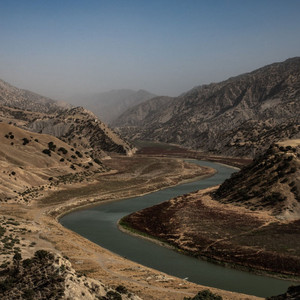
It was Mesopotamia, the land between two rivers, the Tigris and the Euphrates, two of the rivers that many, many people have heard of from their history books, from reading the Bible, from reading all kinds of mythology, and it had changed profoundly.
I wanted to see what it would mean for the people who were living at the edge of these changes, where it was most severe, and what it meant for them and their families, but more than that, for the region as a whole.
What does it mean when a country doesn't have enough water?
So where did you go to answer that question?
Well, along with my translator Ahmed Salah, I went to the edge of Diyala province, which is known as the fruit basket of Iraq or it used to be.
Salaam. Salaam, good morning.
And that's where I met a man named Hachem Kanani and some members of his family.
And they had farmed there for generations.
It was beautiful on the trees of African and figs.
The grandparents, they used to, like, sit here in the afternoon seeing the kids, like, playing.
The woman going to the canal, the water was fewer.
He painted this bucolic picture.
watermelon. They grew all kinds of fruit trees, then grew vegetables for his family.
We had about 1 ,500 cattle.
And they grew the fodder for the cows, and the sheep and the goats.
We had buffalos before.
You had buffalos? Yeah.
Because they'd need a lot of water, don't they?
Yes. And his family made a good living off farming.
They were modest farmers but surrounded by other farmers.
Yeah, we used to fish here.
We used to fish here.
We used not to go to the market at all.
The water from the Diyala river, which fed these irrigation canals that criss -crossed his land, that was a big part of his life.
Before we used to drink from the canal.
And all through his childhood, this had been a place of bounty, of plenty for him.
The change in the temperature happened when desertification has started.
And then he told me, he started to notice a change about 15 years ago.
The water has become less like the rain.
The rains that usually arrived in the winter stopped coming or were very meager.
They were showing the effect of cultivation.
So the plants got damaged.
And the droughts became more frequent and they lasted longer and were more severe.
And now it's gotten to the point where he still plants but hardly anything grows.
We plant corn. It died like a few days ago.
Yeah, if we can walk through, you know, and see it.
OK. He showed me his corn.
He wanted me to actually feel the kernels so that I would understand how much effect the years of drought and heat had had on his crops.
This is totally dry.
Now, recently, dried out.
Yeah, because of the lack of food.
It was shriveled and withered.
Okra, yes. Right. And the okra, which was another big crop of his, was shrunken, and the leaves were all brown.
And even if the water touches the skin, it would affect the skin.
And the irrigation canal was now shallow and brown.
It had a kind of a green algae lying on top of it.
This is sewage water, so no way we can wash it.
It was nothing but sewage water, he said.
You can't feed it to animals even.
You can't water your crops with it.
And that meant they couldn't grow enough grain to feed the cows, and the grass didn't really come up for the sheep because there just wasn't enough water.
The animals, they cannot tolerate drinking from this water with sulfur.
He recalled watching as the buffalo began to scrape at the earth trying to find more water.
Because of the lack of water we sold the buffalos.
That's when his family started to sell off their cattle and their sheep.
And by the time I was visiting him, their 1 ,500 head of cattle was down to only three.
Hashem told me that he didn't know how to keep this farming life that he's had going and how to pass it down to his children.
And yet, it's part of who his family has been.
It's part of who he is.
and it's part of what that whole area of Iraq was like, until now.
Do you think your children will want to stay on the farm?
We will try in every way to, you know, make them stay here and get convinced of the atmosphere of the farm.
So we will do, you know, the best we can to keep them here.
What is become of Hashim?
He's hanging on right now, but there are areas where it's just been too hard for a family for too many years.
And that's when people begin to consider moving and they take everything with them.
So they take the bricks of their house, they take the window, because windows are valuable.
And bricks are valuable.
So they literally disassemble their houses.
They disassemble their house.
So you come to villages which look as if they had been bombed, Sabrina.
People did this themselves.
I saw people loading up a pickup truck with basically everything they had.
Everything will be gone.
It's this sort of deconstruction of a life, of a way of life right in front of you.
What's an example of a place emptying out like that, of people moving?
Well, I went to a village that used to be a village that had been quite agricultural at one time apparently, which was hard to believe, because what had happened there was that the desert had begun to encroach. And the way it works is that literally sand begins to blow and it begins to blow over the roads And then gradually, it actually is like snow.
It covers the buildings.
And we drove sort of through this more and more sand.
And there wasn't a big sandstorm that day.
This was just happening anyway because there were no plants anymore because of the heat and the drought to hold the Earth.
And this was a little community that had had at one time 5 ,000 people.
But there were only 80 people left. So, the village was literally disappearing from the map, in a way?
The people were leaving it, and it was turning into dust. Yes.
And I wondered where do people go, and what is it like for them when they get to wherever they're going?
Is it really any better?
Or are the problems just different ones?
We'll be right back.
The Ford Foundation supports the institutions, individuals, and ideas at the forefront of social justice.
Join us for Ideas at Ford, for conversations with leaders from all walks of life.
Billie Jean King. Matt Damon. Jess Thom.
Roy Wood Jr. Sparkle.
As they share unique perspectives on innovative solutions we need today.
Tune in to Ideas at Ford for ideas that can enlighten, inspire, and transform the world.
Visit FordFoundation .org slash the daily to learn more.
This episode is supported by HubSpot.
Growing a business can feel impossible, but HubSpot's customer platform can help.
It's powered by Breeze, their suite of AI tools, so you can generate more leads, close more deals, and scale your service fast. With Breeze agents handling the busy work, customers are cutting sales cycles in half and saving hours on work each week.
Best of all, you can see results in days, not months.
Visit HubSpot .com slash AI to learn more.
So, the land is drying up, farming is becoming untenable as a way of life and people are fleeing their villages.
You set out to see where they were going.
Tell me about that.
Well, my expectation had been that people might go far away, but in fact, what I found is that first people's instinct is to stay close to home.
They move a few miles to a place where they think there might be either more water and they could do a little farming if they're farmers or where they think they'll be able to get jobs.
But where they tend to end up is on the periphery of, in Iraq's case, its largest two cities, Baghdad and Basra.
And around the periphery of those cities, what's developed are very quite large, sprawling, informal settlements that are not officially part of the city.
So they're kind of the worst of both worlds.
The streets are not paved, the houses are makeshift, sometimes patched together.
They're made of mud and concrete and whatever people have been able to put together.
And there's a very strong smell of sewage.
Because in fact, ironically, people were looking for water.
But if anything, there's water because in poor countries you might find pipes and some kind of sewage system.
But in these informal settlements, there's not even that.
The chance of education is less, probably less than if they'd stayed in their village.
And many people have trouble finding work, they end up in manual jobs like construction, where you're paid a small amount and a day rate and it may not last. Or there are brick factories which are horrible because They're so hot.
So the upshot here for people who move like this is pretty grim.
I mean, essentially they're impoverishing themselves by moving.
They're impoverishing themselves.
And they are severed from a landscape they knew, and often community networks that at least supplied a sense of solace and familiarity.
In the new place, it will work differently.
Urban areas are not kind.
They're difficult places to know how to maneuver.
People in rural areas in the countryside, they're aware that life on the edges of big cities will be difficult.
What you get is people were actually taking up arms in some of these stressed villages and fighting to make sure they don't have to move and even killing each other.
Like war over water.
When there's a lack of water, in general, what it does is create an awful lot of tension, an awful lot of antagonism and hatred and the kind of environment in which it's very easy to foment violence.
And I couldn't even believe it until I went and talked to some of the people in those villages and understood how it worked.
And it's pretty straightforward. Upstream villages in places that are water stressed will build like a little dam or put in a gate that stops the water from flowing downstream.
And then they take the water until they've taken as much as they need.
and then there's not so much to go to the next downstream village and even less for the village after that.
And after this happens several times over, people get angry and they're willing to attack people in the neighboring village who are doing that.
Another piece that feeds into conflict is that because people are poor and it's hard to find jobs and especially young people They're at the beginning of their lives, but they don't have much to hope for.
It's very fertile ground for recruitment by different kinds of armed groups and extremists.
These are groups that are, you know, they will pay to have you work as a soldier, essentially.
And that's at least something people can bring home.
And if you don't have other options, you're willing to consider that.
It's not necessarily because they've become believers in it.
So in other words, a lot more young people, particularly young men, unattached and kind of unmoored who because of this water problem are potentially fertile ground for recruitment?
Yes, that's right. So Alyssa, what can Iraq do?
It seems pretty stuck.
Well, what they have been trying to do for years is to get their upstream neighbors to allow more water into Iraq through the rivers.
Both of those very large rivers, the Tigris and Euphrates, begin in Turkey but the Tigris is also fed substantially by Iran.
And both Iran and Turkey, both of them are part of this same water -stressed region of the Middle East. And both are, like Iraq, countries with growing population, and like Iraq, have large farming sectors and need the water themselves in a time of climate stress and faster rising temperatures.
those are all true of those two countries as well.
So, you have in a sense too much demand on those two rivers now, from the region as a whole.
I would imagine that that adds up to some reasonable amount of conflict as well, right?
That these countries are kind of at odds over the sharing of the water.
More and more. And a couple of years ago, Iraq threatened to take, I think, Iran to the world court.
they never did. They have threatened and tried to negotiate in varying amounts with Turkey, mostly trying to negotiate.
And sometimes Turkey will allow a small amount more water in for a short period, but it doesn't really resolve the problem.
Okay, so that's an international avenue it's trying.
What else is Iraq doing here?
What other options does it have on its plate?
Well, one thing they could do is conserve more water, especially in their farming methods.
Right now, about 75 percent of Iraq's water is used for farming.
And the reason for that enormous amount is that their irrigation techniques go back to Sumerian times when it was the Fertile Crescent.
So, they so flood their fields and it's hotter now more water evaporates, water runs off, but getting people to change how they farm, how they've done something for generations is really difficult.
So, Iraq's been trying but it's probably going to take at least a generation, right?
And there are other options in the region that are not so available for a variety of reasons.
One of those is what smaller countries like the Gulf countries are able to do, like cloud seeding.
They have a lot of money, they put chemicals into the clouds and that helps sometimes briefly produce more rain.
That's something Iraq hasn't been able to do.
And why can Iraq not do it?
It's quite expensive to set that up and it works a little bit if you can do it in in a small area.
Iraq's a big country, so that's not a particularly fruitful avenue for them.
Another avenue is desalination.
That's something a lot of countries in the Gulf do.
Saudi Arabia does it.
More and more countries in the Mediterranean are doing it now too.
Israel does it. Yeah, but Iraq, if you look at the map, remember Sabrina, it has a very, very small coastline.
Right. There's not much coast. It's tiny.
Where would it get that water?
It's largely a landlocked country.
And desalination plants are expensive, very expensive.
So that's not easy for them.
So Alyssa, stepping back for a moment here and just looking at the big picture, Iraq is, in many ways, an extreme case when it comes to the effects of climate change, and all of these things we've been talking about that could possibly happen in the future as the world heats up are actually happening now in Iraq.
But given that the country is such an extreme case, what does it actually mean for the rest of us?
Like how should we understand it as an example?
Well, what I felt as I watched it was that it was a window on my future wherever I might be living, because this is happening in places all over the world – in smaller places, Maybe it's the hottest areas of California or the wildfires that we just recently saw there, or the increase in hurricanes in Florida.
There are many places now that are having periods that are very hot.
And there are countries now which are almost completely without any fresh water resources at all.
And that is true, really, almost across the Middle East. There are a few exceptions, but not many.
This is like more than the canary in the coal mine.
It's just a little ahead of where a whole raft of places in the world are going to be.
And some places, the United States might be one of them, will figure out ways to muddle through.
They're organized. They have a government that more or less works.
They have money. And they're able to focus on making changes.
Countries that are poor, countries that have weak government or very nearly failed states, or if you look at the Middle East, countries that keep having conflict, Syria, Lebanon, they can't do long term planning.
It's just not part of what's possible when you have conflict.
So they are going to become harder and harder and more and more awful to live in.
And people will get poorer, the places become more unstable, and that spills over into neighboring countries, into various kinds of climate migration and leads to a rather not just a poorer future, but one with an awful lot of suffering.
living in heat with too little water is a recipe for instability but also disease and a complete lack of hope for large areas.
Fundamentally, the common thread is a less stable world.
A less stable world and a more selfish world, Sabrina.
That's the way I would think of it.
— Alissa, thank you.
— Thank you, Sabrina.
— So do you think it will be better next year, or do you think things are going to get better?
No, I don't think so.
But it couldn't get any worse than it already is.
We'll hope that's true.
Thank you. We'll be right back.
Shopify is the commerce platform behind 10 % of all e -commerce in the US.
From household names like Mattel and Gymshark, to brands just getting started.
That iconic purple shop pay button that's used by millions of businesses around the world is why Shopify has the best converting checkout on the planet.
Your customers already love it.
If you want to see less carts being abandoned, it's time for you to head over to Shopify Sign up for your $1 per month trial and start selling today at Shopify .com slash NYT.
Go to Shopify dot com slash NYT, Shopify dot com slash NYT.
You just realized your business needed to hire someone yesterday.
How can you find amazing candidates fast?
Easy, just use Indeed.
And listeners of this show will get a $75 -sponsored job credit to get your jobs more visibility at Indeed .com slash The Daily.
Just go to Indeed .com slash the daily right now, and support our show by saying you heard about Indeed on this podcast. Indeed .com slash the daily.
Terms and conditions apply.
Hiring Indeed is all you need.
Here's what else you should know today.
On Monday, Israeli Prime Minister Benjamin Netanyahu warned that Israel was preparing for a major new military operation in Gaza, and his cabinet it approved a plan to mobilize tens of thousands of Israeli soldiers to seize and hold territory there.
The threat comes after two months in which Israel has blockaded and bombarded Gaza, and appeared to be its latest attempt to pressure Hamas into resuming the release of Israeli hostages.
And, the Trump administration said that it would begin offering a $1 ,000 cash stipend and a free flight to undocumented immigrants who willingly leave the United States, its latest attempt to encourage self -deportations.
It's unclear how enticing the compensation will be.
The White House said that one migrant from Honduras has already taken the government up on the offer and flown from Chicago back to his home country.
Today's episode was produced by Richelle Bongia and Claire Tonnesketer.
It was edited by Liz O 'Baylin with help from Paige Cowett, contains original music by Alicia Ba 'i Toup, Dan Powell, Marion Lasano, Pat McCusker and Sophia Landman, and was engineered by Alyssa Moxley.
Our theme music is by Jim Brunberg and Ben Landsberg of Wonderly.
That's it for The Daily, I'm Sabrina Tavernissi.
See you tomorrow.