From The New York Times, I'm Rachel Abrams, and this is The Daily.
In the contentious fight over how to address climate change in the United States...
Recycled lead is a feel-good story.
It can be processed with techniques that keep workers safe and reused in batteries that power millions of vehicles around the world.
But a new Times investigation reveals how this environmental initiative comes at a major human cost.
Today, Peter Goodman explains the dirty business of a supposedly clean technology.
Peter, welcome to the show.
Thanks for having me.
You are one of our foremost experts on the global economy and you just came out with this really eye-opening investigation on recycled batteries and lead poisoning, which I will bet is not something that most people know a lot about.
So I'm very curious to know two things.
One, how did you even get on this investigation?
And number two, How much did you, Peter, know about recycled batteries when you first started?
I knew zero about recycled batteries.
And that's rounding up.
Okay.
So I got a call from a guy at the examination, which is this relatively new – independent investigative newsroom that specializes in global public health.
And they have this really terrific reporter, a guy I'd never met, though I'd heard about him, Will Fitzgibbon.
He had done a fair bit of work already in Africa.
He was a lead expert.
He dug into the lead research. cycling industry.
And this is the industry that supplies a lot of the car batteries that we find under the hoods of cars in the US.
We're talking new cars, used cars, places like AutoZone, Home Depot Walmart, and a lot of the lead that we're using to make car batteries in the US is coming from outside of the US because we've run out of supply domestically.
So the industry's gone out looking around the world for new sources of lead, and one of the places it's now looking quite aggressively is Nigeria.
Will had already spent a fair bit of time looking into what this business actually looks like on the ground.
He'd already figured out that the process of recycling lead was being done in a way that was really quite horrific to see up close.
It was really harmful to people.
And he'd have this terrific idea, which was that, you know, we would actually go and test people.
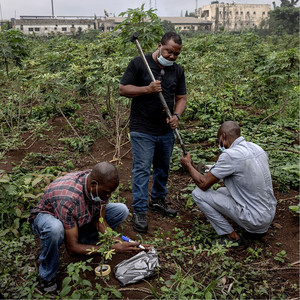
We would find people willing to volunteer for blood tests and quantify just exactly how much lead was reaching people's bloodstreams.
And we'd also test soil to look into the tainting of the food supply.
And so I got enlisted to try to take a run at figuring out who was buying it, how the terms of trade were going down, all the logistics along the way.
They wanted me because I've been writing versions of complex supply chain stories now for 25 plus years around the world and I didn't know anything about this particular industry.
But I did have some inkling about shipping logistics and I was certainly intrigued to try to make the connection between this public health catastrophe in West Africa and the auto industry in the United States.
That connection sounds incredibly challenging to make.
Yeah, it's enormously challenging, especially because we're talking about a trade that's secret.
I mean, the participants have no interest in talking to anybody about this stuff.
There's limited publicly available data.
And so I found myself taking on what, quite honestly, was the most difficult reporting assignment of my career.
Where did you actually start the reporting journey?
So Will had already done a lot of this legwork.
He already had sources in Nigeria.
He understood where these factories were.
And then I went there with Will to nail down the real-life consequences for the people living in villages right next to these plants and also to go talk to people in Lagos who could tell us about the Nigeria supply chain, part of it before this lead gets put into shipping containers and sent across the water for ports around the world.
So where exactly did you go and what did you see there?
So I went to a place called Ogijo, which is just north of Lagos, which is a sprawling, you know, enormous metropolitan area.
And Okiejo is sort of a combination of an industrial and rural, where there are a bunch of smelters, including the one that we wound up focusing on called True Metals.
And we picked it not only because it's really bad in terms of the pollution that it puts out, but also because it only deals in lead.
And these are large factories where people are feeding.
This lead into these giant furnaces that send smoke wafting throughout the area, including in these villages that are right next to the factories.
So I spent a lot of time just sitting with families, talking to them about the struggle of living next door to these plants.
People were coughing.
People were complaining of all sorts of ailments that are linked in the literature to lead poisoning, indigestion and various gastrointestinal distress, unrelenting headaches.
And I saw children in schools that were literally next to these factories.
So I was just blown away and really horrified by what I was seeing up close.
And it gave me a real sense of, this story's really important.
So what you're seeing in this town is all these signs of pollution that is coming from this lead battery recycling process.
Before we get any further in the story, I just want to have you explain how and why a battery gets recycled the correct way, and then what you saw in Nigeria and how that was different.
Sure.
So you know, it's important to note that virtually every car on the road has a lead battery under there somewhere, even electric vehicles.
And if we didn't have lead batteries, we'd notice real fast.
And it happens to be one of the most recyclable elements on earth.
And the auto industry has really leaned into that in promoting itself as the exemplar of the circular economy.
They do recycle. most of these old batteries and have very sophisticated plants that recycle.
They have automated processes that break apart the old batteries and extract the lead safely.
They dispose of the acid that's in there.
They have emissions controls that prevent lead dust and smoke from spewing out into communities.
All that stuff costs millions of dollars.
And so as regulations have gotten stricter in places like the United States we've had— smelters move, So that's eliminated local supply.
At the same time, demand has increased because population's growing.
We got more people driving around in cars.
And so battery manufacturers have had to go around the world to go find more lead.
And what I saw in Nigeria was something very different than what you would see if you managed to get invited into a lead recycling plant in North America.
I saw, first of all, people in so-called breaking yards.
These are the places where they get the spent batteries.
They're brought by these people known as pickers, who come in by rickshaw bicycle motorbike, truck and they bring these old batteries into these yards.
And then men, often shirtless with no protective gear whatsoever, use machetes to break apart the plastic cases.
Just hammering at them.
Yeah.
And this is what would have been done by machines in the United States in a tightly controlled environment.
Correct.
This sounds incredibly dangerous. incredibly dangerous.
You can just sense it.
You don't need some sort of PhD in environmental science to understand that it's not a good idea to have no safety goggles, to have no gloves, to not have a shirt on, to be taking a machete, slamming it into an old battery with acid spewing out in every direction.
The smaller operations, they take the acid and they actually dump it into waterways.
It's just horrifying, right?
So that's just the battery breaking operations.
Then there's the furnaces.
This is where most of the pollution comes from.
The furnaces are these giant facilities that take the old lead taken out of spent batteries and they melt it down, they cook it at incredibly high temperatures into this molten liquid that's poured into molds that then form these ingots that can then be, you know, moved around, trucked to battery manufacturers that make new batteries.
And if you saw a plant, a furnace in the US, you'd see equipment used to vacuum up dust.
You'd see machinery that prevents smoke from getting out into the communities.
You'd see all sorts of automated systems to prevent workers from poisoning themselves by touching things with their bare hands.
What I saw in Nigeria was just open air.
I mean you could see the smoke with your bare eyes, just getting out between the sheets of corrugated metal that are the roofs of these factories.
You could smell it.
I was invited into people's homes.
I talked to a man who said, yeah, my walls are black.
And you could see it.
Just the smoke is so intense.
The impacts of this are just so obvious and so palpable that it was impossible to not be moved by this.
So it sounds like these places are operating with very little regulation.
How did you end up tracing what happens to the lead that they produce?
We had trade data.
You know Will, at the examination, built a terrific database that had all the publicly available information.
So typically a trading company will identify sources of recycled lead around the world.
They'll buy it.
They'll ship it to an endpoint in the United States, typically the port of Baltimore.
And then the story ended.
So my job was to figure out, well, then what happens?
So how did you do that?
So I quickly figured out...
There's no expert to call.
There's nobody who did a dissertation on this.
There's no book.
YouTube documentaries to watch for tips.
There isn't even, you know, Reddit to go get dubious, you know, tips.
Reddit for everything.
Yeah, it was just a black box.
And I started to reach out to people who worked for these trading companies.
The one I was most focused on was this company called Trafigura.
And to be clear, Trafigura is basically a middleman here.
Correct.
Yeah.
Trafigura's job is to buy and sell commodities.
They're the ones who are most experts.
What's available?
What's the price?
And so we had transactions.
We could see in the database where traffickers buying lead from these smelters we're focusing on in Nigeria and shipping it to the port of Baltimore.
But I had no idea who was buying it. at that point.
And so I did a bunch of different things.
I signed up to go to trade shows, hoping I would run into people who would help tell me the story.
I spent a lot of time on LinkedIn. just mass messaging anybody who had worked at Trafigura.
And that was pretty lonely and felt fairly futile.
Most people ignored me.
Some sent me to the communications people who then ignored me.
And then...
Eventually a handful of people started helping me in a really critical way.
And they started to name the same likely purchaser over and over again.
They named east Penn, which is the second largest battery manufacturer in the United States.
It's this family-owned business.
They're not publicly traded.
They're very quiet and they don't like to deal with the press, and they certainly didn't want to deal with me.
So at this point I know and I put that in quotation marks, like I know, on deep backgrounds, right with no names attached and no documents that East Penn is buying lead From trading companies that are bringing it into the port of Baltimore.
But I can't prove it.
You can't report it yet.
I can't report it.
You have good reporting, but it's not reportable yet.
It's certainly not going to be a satisfying, significant part of the story based on that sourcing.
I needed something stronger.
So I went to the port of Baltimore, actually spent a whole day there with a really excellent photographer who had probably the most unexciting day of her life.
It was kind of a fairly futile day.
We actually chartered a little fishing boat and we just like tooled around the harbor in Baltimore and we were able to see the dock where some of these shipments come in.
We saw a trucking yard where they unloaded from the water and we got a sense of the geography, but there was no vessel bringing in lead on this particular day.
But I did learn something And because of that reporting, because of what I learned at the truck yard, I reached out to this logistics company where a guy who ran the yard did, very reluctantly and somewhat elliptically, confirm that they handled lead incoming from West Africa purchased by Trafigura.
And they sent some of it out to Pennsylvania, to East Penn.
But we still... really needed to talk to East Penn about all this.
Because let's remember, this is the second largest battery manufacturer in the United States.
It's not a household name.
It's not a company most of us ever think about. but it's there and we're participants.
They're making batteries under the hoods of millions of cars that are out there on the road.
They're the ones actually profiting off of this and depending upon the supply in Nigeria.
So I wanted to understand what sorts of due diligence they were undertaking to ensure that this lead they were buying from Nigeria was in compliance with their social and environmental standard.
So I'd had calls out to East Penn and they were just They weren't responding to my calls.
I wasn't getting responses to my emails.
Just no response.
And it became clear to me that I was going to have to figure out how to confront East Penn.
We'll be right back.
Peter, I spent many years as a reporter, so I can absolutely relate to this idea that you have questions, you have to get in front of the people you're writing about, give them an opportunity to respond, and you are getting nowhere, trying to go in through the front door, which is what sounds like it was happening to you with East Penn.
So I imagine you had to get creative about how to actually give them an opportunity to comment?
I had to make a spectacle of myself.
Excellent.
That's actually how it happened.
So the big break was in San Antonio, where the Battery Council International has this gathering.
It's this big golf resort.
And there are people from battery companies and lead recycling and companies that make equipment used.
And they're all golfing and drinking and dining and having a good time.
And the second...
I identify what story I'm working on.
They either don't know anything about it, because most people, when I would tell them the story, they'd say Nigeria.
No way.
We're not buying lead from Nigeria.
That's just not even possible.
How could they even have lead?
Wow.
Okay.
They didn't even know.
And then the handful of people who did know were like the last thing I want to do is talk about this subject with someone from the New York Times.
And I figured out that the head of East Penn, the then CEO of East Penn, this guy, Chris Pruitt, is getting this Distinguished Service Award from the Battery Council International.
And I'm planning to go, because it's gonna be my only shot.
At this point, I've got calls out to their various marketing people.
I've just gotten nowhere.
So I know Chris Pruitt's there, I really wanna talk to him.
The communications guy says this is supposed to be honoring him and if you're there asking these uncomfortable questions, that'll really be awkward.
Now the reporter in me is like well, I don't really care, I work for the reader.
I have to go ask these questions.
But I thought well, if I'm not gonna get anywhere anyway and I'm just gonna make a spectacle of myself, There's no upside to that.
You won't ambush him.
I won't ambush him.
But out of that I'll get some basis for a more productive engagement and maybe go visit him in Pennsylvania.
I do finally hear from an outside PR firm for East Penn And I start to engage with them.
Eventually, I was able to persuade Chris Pruitt and other executives at East Penn to talk to us.
And what did he actually say to you?
Well, he said that Our reporting had caused him to do a lot more thinking than he'd previously done about the origins of the lead and that previously he had talked to trading companies like Trafigura and had said you know, I need this particular purity.
And oh, by the way, of course you're guaranteeing that this is not causing social or environmental problems.
Oh, no, of course not.
The trading company would say, you know, we have audit processes.
You know, all this is good.
Okay then, just as long as you can deliver the quantity and the purity that we need at the guaranteed price, all good.
And since our reporting he'd actually dug into his own supply chain, had become concerned about the process of due diligence that trading companies were doing.
And, as he put it out of the utmost of caution, decided that he didn't want to buy any more lead from Nigeria.
So I did ask him at one point about moral culpability.
And I said well, given that we now know that Trafagura's due diligence leaves a lot to be desired, and we could see with our own eyes what was playing out in these villages next to these smelters.
Where do you fit in terms of the moral culpability for this?
And he said...
He said, look, was I too trusting?
I'll take that shot.
What did you make of that?
I thought that summed up the reality of complicated supply chains.
There's so much sort of plausible deniability built in that any given participant can say plausibly oh, I thought somebody else was looking out.
Well, to that point though, This is East Penn acknowledging that what's happening on the ground is not okay, right.
Like, it's not up to their standards as an American company.
Right.
But what about Trafigura?
Like, have they made any kind of pledge to change or modify their behavior?
So Trafigura gave us this kind of general statement, but they say that they have an audit process that ensures that they're complying with their official social and environmental standards.
And we actually talked to a consultant who does the audits for Trafigura in Lagos who pushed back on the idea that it's just like performative superficial.
He said, I really go when I look.
First question I had is, okay, do you go to the battery breaking yards?
No.
No, I just go to the smelter.
Okay, so right off the bat, you don't know anything about the raw materials that are coming in or the impact for the people who are working in those places, or where the acid's going.
Is it going in a stream?
You know none of that, right.
So then even at the smelter, I said, well, what do you do?
He said, well, I look very, you know, carefully.
But the consultant said I give them a real list of problems that I identify.
But the way this goes and I confirmed this with people who've worked at Trafigura is the auditor will say okay, it really would be good if you handed out safety goggles on a regular basis.
It really would be good if you put in a system to control the lead dust.
It would be great if you put in battery-breaking equipment.
And the smelter will say, okay, thank you very much for your suggestion.
We will certainly hand out safety goggles.
And the trafficker says, great. your audit's done, now let's talk about the volume of the next deal.
I mean, this is not a process that can end up in derailing a deal.
This is a process that is informed by a desire to reach a conclusion at which the deal carries on.
And that's the problem.
So there is due diligence.
There are inspections.
There are recommendations.
There are recommendations.
There's an action plan.
But there's no compulsion to do the right thing or the business doesn't happen.
And meanwhile the person who's buying it on the other side of the ocean, in this case Chris Pruitt and East Penn, doesn't know anything any of that.
And it's certainly not getting on a plane to go to Nigeria to make sure Trafigura is really engaging in a rigorous audit process.
So at this point it sounds like you know the answer to The part of the investigation that you were responsible for from that initial phone call you got about this partnership.
Right.
What about the other question, the question about what kind of medical harm was being caused to the people in these towns in Nigeria by this lead poisoning?
So this is where the examination did an extraordinary amount of legwork.
So Will had commissioned this team of independent scientists in Nigeria who found 70 volunteers.
And we're talking about 14 children, 16 people who worked at these lead smelters.
And these were people who live very close to these smelters.
You know, imagine a village And in the very center of the village, you know, churches right up against the walls of these factories, schools right up against the walls of these factories.
So life is playing out all around.
And we tested 70 people, volunteers right in the vicinity, and roughly seven out of 10 of them had levels of lead in their blood deemed dangerous by various medical authorities.
So...
One of the things that we were focused on was this comparison with the worst lead disaster at a battery manufacturer in Southern California more than a decade ago, which was a federal emergency.
I mean the feds went in, they shut the place down, tested people, they took over.
They're still managing this.
And there was a soil test conducted at a preschool there that found 95 parts per million lead.
Let me give you that number again, 95 parts per million.
We tested a school in Ogejo where we found 1,900 parts per million.
My God.
Yeah.
At that level of contamination, what kind of health effects would you expect immediately?
Well, first of all, you're talking about irreversible brain damage, especially for children.
You're talking about respiratory problems, relentless headaches exhaustion, just a lack of, And that's the lead right.
And then there's just the reality of you're living in a place where there's smoke and terrible fumes all the time and people are coughing.
It's just a living nightmare.
So what happened after you did all this testing?
After we did the testing, our research partner shared some of this data with the Nigerian government, the environmental authorities,
And within you know, just a few days, the five worst smelters in Ogijo were destroyed, shut down.
The heads of these companies were summoned up to Abuja, the capital of Nigeria, to have a conversation around how they could supposedly make some improvements, and then they were given permission to restart.
So it sounds like the Nigerian government took pretty swift action. you know, it's complicated.
So the Nigerian government has been receiving reports of these health problems going back at least to 2018.
And they got what they described to me as promises to make all of these improvements at these plants.
But when somebody showed me a copy of the actual protocol that these factories had to sign, this supposedly enforceable document, it didn't have any of the details of these promises that they claim they got.
And it specifically had a two to three year timeline for a very vague promise to improve technology at the plants.
So it seems pretty clear that, whatever technology was said in the room with the heads of these smelters, there is no enforceable document that compels these companies to do anything differently anytime soon.
And when I was back on the ground talking to workers at these smelters, what they said is oh yeah, now they're giving us safety goggles.
They didn't used to do that.
Oh, they used to give us gloves once a week.
Now they're giving them to us twice a week.
And presumably it's fair to say that the Nigerian government knows that it probably should be doing a lot more than just handing out gloves and goggles if it wants to protect people, given the high levels of lead that is showing up in these test results, right?
I mean what has to happen at these plants?
They have to put in serious emission controls and it's going to cost millions of dollars.
If they put in battery-breaking equipment, that's going to cost millions of dollars.
This is not something that's going to be fixed with a bunch of gloves and goggles.
I do just wonder though, given your experience covering global supply chains, knowing what the incentives are for the various actors here, knowing how hard it is to reform an entire industry.
How confident are you that in five years or 10 years or however long, somebody will be able to purchase a car in the United States and feel confident that the battery in that car was made in a safe and humane way?
I think there are serious reasons to doubt that that positive outcome will happen, for the simple reason that the incentives that created this situation that we've been reporting on have not changed.
And those incentives are...
You have large brands like East Penn that actually make lots of batteries under other brands.
So it's not as if a consumer can go off to the battery store and say don't give me one of those East Penn batteries.
There are lots of others that they make for other brands.
We also know that Nigeria is hardly alone, as being a country where there are large numbers of people who are desperate enough just to figure out how to get dinner on the table tonight that they will accept horrific pollution.
I mean, not that the people in the communities want the pollution.
They're horrified by the pollution.
But in terms of the situation for the policymakers, for the environmental regulators, They would like the plants cleaned up, but they're also cognizant that if they push too hard, this industry will shift somewhere else, where some other government will cut a deal with the companies that need lead and other companies, minerals.
That's how this business tends to go.
I mean my history of looking at supply chain cases now going back decades, is that when you get a public revelation, when you find out that say, a fashion brand learns that they've been relying on a supplier that's been playing so dangerously that people have died in a fire or in the collapse of a building, or rivers or drinking water is being poisoned.
I mean, what tends to happen is the supply chain gets even more complex.
Pieces shift somewhere else.
Companies change their names.
Under the guise of safety, perhaps, right?
Like there's consumer pressure and then they say, we're going to make these reforms.
Then the end result is what you're talking about.
Let's just say, for the sake of argument though, that in this case, in terms of battery recycling, that every player involved wants to do this the right way.
They want to make a safe battery and make it in an environmentally friendly way.
What would the increase in cost of that battery to the end buyer actually look like?
Well, it's a hypothetical.
It's one that we wrestled with in reporting this story, and we concluded that there's no satisfying answer, because no battery is going to be made exclusively with lead from one country or another at all.
It basically ends up getting blended together.
The best we could figure out is you're talking about pennies on the dollar, assuming that Every participant in the chain passes on their extra costs to the next player.
You're talking about a single-digit dollar number to the consumer at the end of the day in the U.S.
That's our best guess.
There's a lot of assumptions into that, but certainly not a larger amount of money.
And I think that it's fair to say that the verdict of the global marketplace on the question of what's it worth to poison entire villages in Nigeria is not that much.
Peter, thank you so much.
Thanks so much for having me, Rachel.
In the days following publication of the Joint Times investigation, Nigerian officials once again closed down several smelters in the Ogijo region.
Officials also promised new investigations from the federal government and said they would conduct additional blood testing of local residents.
We'll be right back.
But here's what else you need to know today.
On Monday, Ukrainian President Volodymyr Zelensky met for hours with French President Emmanuel Macron in Paris.
The meeting was part of a blitz to shore up support from European allies in the midst of negotiations over a US-led plan to end the war with Russia.
While Macron reiterated Europe's commitment to Ukraine, the United States has put increasing pressure on Zelensky to agree to a deal, even as Russia has signaled its opposition to some of the plan's proposals.
And the Transportation Security Administration announced that, beginning February 1st, travelers without a Real ID compliant form of identification will have to pay a 45 fee to fly.
Passengers can prepay the fee up to 10 days before they come to the airport.
Many travelers have already begun flying with passports and other documents considered compliant with the program.
The TSA did not immediately reveal how to pay the new fee and other details about the program.
Today's episode was produced by Diana Nguyen, Anna Foley, and Rochelle Banja.
It was edited by Chris Haxell and Michael Benoit, contains music by Dan Powell and was engineered by Alyssa Moxley.
Special thanks to Will Fitzgibbon and Finbar O'Reilly.
That's it for The Daily.
I'm Rachel Abrams.
See you tomorrow.