This episode is brought to you by State Farm.
You might say all kinds of stuff when things go wrong, but these are the words you really need to remember.
Like a good neighbor, State Farm is there.
They've got options to fit your unique insurance needs, meaning you can talk to your agent to choose the coverage you need, have coverage options to protect the things you value most, file a claim right on the State Farm mobile app, and even reach a real person when you need to talk to someone.
Like a good neighbor, State Farm is there.
were. Spring Savings are in the air and at Ross where they have savings on all the brands you love.
From the latest fashion to outdoor decor, and even pet supplies savings are in every aisle.
Go to Ross and save 20 to 60 % off other retailer's prices on your favorite spring finds.
The History Channel Original Podcast. History this week, May 5th, 1862.
I'm Alana Casanova -Burgis.
It's a spring morning in Puebla, a city around 80 miles southeast of Mexico City, about 3 days on horseback.
Bartolo Bautista is standing on the walls that fortify the city, looking out into the distance.
The day is grey. The pressure is dropping.
It feels like it's going to rain.
But Bautista isn't watching the weather.
He's looking to the horizon.
And then he sees it.
Way out in the distance.
A sea of blue and white with flashes of gold.
The French Army. Six thousand men marching towards him.
Matching towards Puebla.
The family story goes the French were approaching.
That's Bartolo Bautista's great -great -grandson, David Hayes Bautista, and many of the men fighting at Puebla on May 5th, 1862 are just like his ancestor.
They were part of, they were called civiles armados, they're armed civilians.
Just called up as cannon fodder, given a rifle said go fight the French. The Mexican army is in a pinch, their forces and their funds are depleted from a recent civil war.
They need civilians like Bautista just to have the numbers to fight.
And now, they're facing down one of the most formidable armies in the world.
A military machine with top -of -the -line training and weapons.
The Mexicans are outnumbered by some estimates as much as 3 to 1.
But, Tolo Bautista watches the French army get closer and closer until they stop and line up and charge.
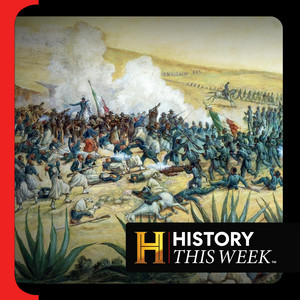
All of a sudden Bautista is in the middle of a battle.
Smoke, gunfire, chaos.
Soon he's surrounded.
And they got cut off, captured by the French. Bartolo and his fellow soldiers are told, prepare to die." The French lined them up against the wall.
They were going to be executed." They tell the soldiers to take off their shirts.
The French army needs clothing and don't want it bloody.
My grandfather took off a shirt and suddenly the rifles were lowered.
The French soldiers confer amongst themselves then one of them point straight at Bartolo Bautista.
Why? So the story goes he had a birthmark in the form of a hand right over his heart.
The birthmark saved him, or so the family story goes.
The French soldiers are superstitious.
Shooting a man with that birthmark would be bad luck.
So detailed you can even see the fingernails on the fingers.
So they let him go.
I used to think, that's a pretty good story.
It must be true, all that detail.
Until I discovered other stories from other people have this exact same detail.
I now say it's a family tale, possibly apocryphal, but certainly a rollicking good story.
Yes. Other families have lore about their ancestors involving a birthmark shaped like a hand.
So, whether or not that particular detail is true, it is a fact that thousands of soldiers, like Bartolow Bautista, fight that day.
And most of them, they aren't captured, because that day, the Mexican Army does something extraordinary.
They hold the French off, they force a retreat, they win.
Over a century and a half later, the Battle of Puebla has become the stuff of legend.
but not just in the Bautista family.
Maybe you've even heard of it, Cinco de Mayo.
I went to Mexico as a student and discovered they don't celebrate Cinco de Mayo in Mexico.
Today, the story behind Cinco de Mayo.
How did a Mexican victory become a day that's celebrated in the United States?
about this. And what, exactly, is being celebrated?
The origins of Cinco de Mayo do have their roots in Mexico, but not today's Mexico.
Mexico used to encompass what's now California, Texas, Utah, Nevada, Arizona, New Mexico, and parts of Colorado, Wyoming, Oklahoma, and Kansas.
And at this moment, the region that will become the state of California is on the precipice of radical change.
Along comes what I call the Latino big bang.
The 10 days that changed the spanish -speaking world.
Not only in California, not only in Mexico, but around the Western Hemisphere.
That's David Hayes Bautista again.
In addition to having a family connection to this story, he's also a professor at UCLA who wrote book on the history of Cinco de Mayo.
And this Latino Big Bang he describes?
Within just 10 short days, two things will happen that will change the country and the world forever.
The first in the foothills of the Sierra Nevadas.
Gold. It's discovered in California in 1848.
Lots of it, and people start heading west to make their fortune.
But there's other people who are actually heading north.
It set off a huge wave of in -migration from Mexico, Central America, South America, the Caribbean, Brazil, even Spain, into California, seeking gold.
This flood of migration, the beginning of the gold rush, had already begun when the second major change hits California 9 days later.
On February 2, 1848, it becomes a part of the United States.
People who, on February 1, went to bed as citizens of the Republic of Mexico woke up the next morning as citizens of the United States.
The U .S. essentially buys 525 ,000 square miles of land from Mexico for $15 million dollars in the Treaty of Guadalupe Hidalgo, including the newly gold -rich territory of California.
For those living in those 525 ,000 square miles, this is a shock to the system.
If they choose to stay in the United States, they're going to be subject to a whole new set of laws.
Mexico's constitution was much more progressive than the U .S.'s.
It banned slavery. It promoted racial equality.
And overnight, all of those rights have been pulled back.
And these former Mexican citizens are upset.
Well, Latinos did not like that, so they went to the California Constitutional Convention and they argued in Spanish.
And they win. So actually, California came in as a state very different from the other states—bilingual, no slavery, racial equality, married women having rights.
Largely due to the gold rush, California's Latino population is growing, and a brand new, bilingual, bicultural community flourishes.
But the gold rush also brings in white migrants from all over the U .S. And as a result, Latinos face severe discrimination.
Unfair foreign miners taxes, predatory land laws, even lynchings.
Still, there was strength in numbers.
And this new Latino -American culture thrives.
Operas. Theaters. Newspapers.
In spite of all the lynchings and everything else, Latino civil society really took root.
An essential part of this new cultural boom are those Spanish language newspapers.
The first one, in Los Angeles, was started by a young typesetter named Francisco P.
Ramírez. Francisco P.
Ramírez learned his craft just being, you know, a printer's boy, and then set up his own newspaper when he was 17 years old.
Ramírez's newspaper, El Clamor Público, would play a vital role in the political life of Latinos in California.
And it isn't the only one.
Newspapers like Ramirez's connect readers to current events in both the U .S. and in Mexico.
Some of those readers have been citizens of both of these fledgling democracies.
They care about the future of both countries.
But those futures? They're about to come under threat.
Because, soon, two wars will be fought.
One in the U .S. and one in Mexico.
Two democracies will fight for freedom, their values, and their survival.
And Latinos are going to play a major role in both.
History This Week is now in its sixth season – kind of crazy – and we love bringing you these stories.
All of our work is supported by the ads you hear on the show.
But if you don't want to hear those ads, we're now introducing History This Week Plus, available exclusively on Apple Podcasts.
For just $2 .99 per month, you'll get all of our new episodes without any of the ads and we'll be adding ad -free versions of our older episodes, too.
So subscribe now and get your first week free.
History This Week Plus, exclusively on Apple Podcasts.
Eczema isn't always obvious, but it's real.
And so is the relief from Evglis.
After an initial dosing phase of 16 weeks, about four in 10 people taking Eblis achieved itch relief and clear or almost clear skin.
And most of those people maintain skin that's still more clear at one year with monthly dosing.
Eblis Librachizumab LBKZ, a 250 milligram per 2 milliliter injection is a prescription medicine used to treat adults and children 12 years of age and older who weigh at least 88 pounds or 40 kilograms with moderate to severe eczema also called atopic dermatitis that is not well controlled with prescription therapies used on the skin or topicals or who cannot use topical therapies.
Ebglis can be used with or without topical corticosteroids.
Don't use if you're allergic to Ebglis.
Allergic reactions can occur that can be severe.
Eye problems can occur.
Tell your doctor if you have new or worsening eye problems. You should not receive a live vaccine when treated with Ebglis.
Before starting Ebglis, tell your doctor if you have a parasitic infection.
Searching for real relief?
Ask your doctor about Ebglis and visit eblis .lily .com or call 1 -800 -Lily -rx or 1 -800 -545 -5979.
I'm Emma Greide and I've spent the last 20 years building, running and investing in some incredible businesses.
I've co -founded a multi -billion dollar unicorn and had my hand in several other companies that have generated hundreds and hundreds of millions of dollars.
The more success I've had, the more people started coming to me with questions.
How do you start a business?
How do you raise money?
How do I bounce back from failure?
So it got me thinking, why not just ask the people I aspire to the most?
How did they actually do what they do?
I'm so incredibly lucky to know some of the smartest minds out there and now I'm bringing their insights along with mine, unfiltered directly to you on my new podcast Aspire With Emma Greed, I'll dive into the big questions everyone wants to know about success in business and in life.
Through weekly conversations, you'll get the tangible tools, the real no BS stories and undeniable little hacks that actually help you level up.
Listen to and follow Aspire With Emma Greed, an order.
See podcast available now wherever you get your podcasts.
Out here there's no one way of doing things.
No one written rules.
And no shortage of adventure because out here the only requirement is having fun.
Bank of America invites kids 6 to 18 to golf with us.
For a limited time sign them up for a free one year membership giving them access to discounted teatons at thousands of courses.
Learn more Bank of America .com Golf With Us.
What would you like the power to do?
Bank of America. Restrictions apply.
seba .com slash golf with us for complete details copyright 2025 bank of america corporation the american civil war has officially begun and like the rest of the country latinos in california are picking sides the vast vast vast majority of latinos said well who's fighting for slavery who's for freedom equality and democracy well abraham lincoln who's fighting for equality versus white supremacy well abraham lincoln who's fighting for democracy versus elitist plantation, little Abraham Lincoln.
We're going to support Abraham Lincoln not only in votes and in money, but also in terms of joining the US military.
You had whole units of Spanish -speaking United States cavalry here in California.
As Latinos head off to fight for their new country, Mexico is just ending its own internal conflict.
There had been a civil fight, almost civil war in Mexico, between the Liberals who were propounding this new constitution and there were conservatives who always had in the back of their mind bringing back some member of nobility to rule Mexico.
The Liberals are led by president Benito Juárez, a Zapotec orphan who had made a name for himself as a lawyer, then a judge, and now the country's first indigenous president.
Juarez is an advocate for freedom, democracy, and civil rights.
He's more progressive than his U .S. counterpart Abraham Lincoln.
He advocates not only for no slavery, but also for expanded rights for the poor, workers, and women.
And after years of fighting forces opposed to his constitutional rule, Juarez has finally triumphed.
But this victory has created a new set of problems. Juarez inherited a government that had contracted large debts with French, British and Spanish banks.
So the British, the French and the Spanish governments got together, formed a triple alliance to go into Mexico and demand that this debt be paid.
Mexico is broke and in debt to three of the world's biggest military powers, France, Britain and Spain.
They haven't made any loan payments in two years.
And in December 1861, those powers land on the shores of Veracruz in southeast Mexico and demand payment.
After some tense negotiations, Juárez reaches some agreements.
Juárez was able to convince the British and the Spanish bankers look, I've got nothing here.
Let's get our economy going first. And so they withdrew.
But that left the French. The French. The French aren't willing to absolve the debt.
They're led by Napoleon Bonaparte III, nephew to Napoleon, the one you think of when people say Napoleon.
Napoleon III is a distinctive man—red hair, a bushy beard, and a pointed mustache.
He's elected President of France in 1848, but soon declared himself Emperor—just like his uncle.
And Napoleon—he's after more than just Mexico's money.
He's eager to reassert France's power on the world stage and expand his empire.
Mexico's debt is the perfect excuse for an intervention, one he can leverage into a full takeover.
He even has the perfect puppet to replace President Juárez.
Someone with a pedigreed bloodline from the House of Habsburg whose favor would benefit Napoleon's political ambitions in Europe – the Austrian archduke, Maximilian.
Napoleon wants to conquer Mexico, install Maximilian as leader, and then look north… Napoleon III loved the Confederates.
He hated the United States, he hated the idea of democracy, he hated Abraham Lincoln.
Napoleon III's personal sympathies might lie with the Confederacy, and for a time, it looks like he is considering intervention.
But the Union Navy is blockading the entire eastern seaboard of the U .S. Napoleon figures, if he can secure Mexico, he can establish a supply line straight to the Confederacy up from the south and help defeat Lincoln.
Benito Juárez needs to stop Napoleon, both to preserve his own democracy in Mexico and democracy across the continent.
This existential battle is felt by Latinos in the US.
They have a stake in both wars.
For Latinos, here in California, it was one war with two fronts, one front against the Confederates and one front against the French. In December 1861, Napoleon's army lands at Veracruz.
The French proclaim France's flag has been planted on Mexican soil and this flag will not retreat.
Let fools dare fight it.
The French are here to take the country.
They capture Veracruz.
President Juarez flees north to Mexico City and 6 ,000 French troops set off after him.
But before they could get to Mexico City to take over the government and then bring in Maximilian, they had to pass to the town called Puebla.
But the French aren't worried.
They'd already taken Veracruz with little resistance.
Was Puebla really going to give them a fight?
It's May 1862 and the word has already spread through Puebla and the surrounding towns.
The French are coming.
Thousands of men take up arms. Among those men is likely Bartolo Bautista.
Their leader, a young man appointed by President Juárez himself, General Ignacio Saragossa.
Things are looking bad.
The French are marching towards Mexico City.
And what happened on the morning of May the 5th, the French who were probably pretty cocky because they hadn't encountered much opposition ever since they left the stronghold of Veracruz.
They charged, just thinking this will be over by noon.
But General Saragosa is ready.
They were repulsed, so they gathered their forces, and they charged again and they were repulsed and they charged again and they were repulsed.
By the end of the day, the 5th of May, Cinco de Mayo, the French haven't taken Puebla.
In fact, they've lost around 1 ,000 men, a sixth of their troops.
We get to the next day, May 6th, the French army lines up, and then it retreats.
The casualties were just too high.
For the first time since the Napoleonic War, the French army left the field of battle.
Puebla remains free.
Juarez remains president.
The French retreat back to Veracruz.
They're not leaving Mexico.
But this is still a huge victory.
And news travels fast. All of this is being reported in great detail by the Spanish -language newspapers here in California.
For Latinos in the US, this victory is a relief.
They need the good news because there's another front to what they see as this broad, continental struggle, and that other front, the American Civil War, is not going their way.
People up and down the state of California and into Nevada heard of this victory.
And when it was compared to a defeat after defeat after defeat for Abraham Lincoln's army of freedom and democracy.
Suddenly, here's this little ragtag Mexican army beats the French. For Latinos who've been following the civil war, it's like, wow, we want a big one.
These communities break out in spontaneous celebration up and down the state.
Parties marches through the street.
But these communities do more than cheer.
They start organizing.
write. After the initial enthusiasm died down, they felt they needed to honor the victorious General Zaragoza.
They decide to make him a ceremonial sword, what they call a sword of honor.
The newspapers just basically sort of said, gee, it'd be nice if suddenly people started sending money in.
A lot of money, like thousands of dollars.
They hire a jeweler in San Francisco to make the sword. The pommel of the sword had a California bear with rubies for eyes, but then also on the other side was the Mexican eagle.
Zaragosa falls ill shortly after the battle of Puebla and dies before the sword can reach him.
But this project is invigorating to the organizers.
My God, we can raise thousands of dollars overnight.
they decided to continue doing so to help Juarez and so they organized what were called Juntas Patriocations Mexicanas Mexican Patriotic Assemblies.
As the Juntas begin organizing, it becomes increasingly clear.
Both Lincoln and Juarez need their support spiritually and financially.
You had to promise to support both Juarez and Lincoln, give wages every month for as long as these Two battles shall be fought.
Both wars are at crucial junctures.
The Union is suffering loss after loss even as Lincoln issues his famed emancipation proclamation on New Year's Day 1863.
And Juarez, after almost a year in Mexico City, is now under threat again because the French have gathered reinforcements.
Once more, they're marching towards Puebla, This time with a chip on their shoulder.
Ladies, you'll end up shopping for your guys deodorant, right?
So try Degree's original Cool Rush.
You see, last year Degree changed the formula and men were mad.
One guy even started a petition, so Degree admitted they messed up and brought the original Cool Rush scent back.
It's clean, crisp and actually smells like someone you want to cuddle.
and it's in Walmart, Target and other stores now for under $4 so toss one in your cart and find out why it's the best -selling men's antiperspirant for the last decade.
Degree Cool Rush is back and it smells like victory.
By March of 1863, Napoleon III is gearing up for another attempt to take Puebla and he's determined to do it before May 5th the one year mark of his defeat.
Napoleon III took it as a personal affront that a group of Indians would be the mightiest army and of course he was shamed that the French army left the field of battle.
You're supposed to fight to the last person.
So he needed to go back for him as a point of honor to go back take Mexico and he had to go through Puebla.
But Napoleon has learned he can't underestimate the Mexican army And this time he comes prepared.
He quintupled his forces.
Originally, he had about 6 ,000 French that lost at Puebla.
He then sent about 30 ,000 troops over.
And they came back to Puebla, and they encircled it and laid siege to it so that no food or supplies could enter.
The city is cut off and again, just like the year before, the French attack.
Once a day almost regular as it can be, the French charge and get repulsed.
The next day charge, get repulsed.
The next day charge, get repulsed.
So this is like a two month long sudden -death basketball game.
And real about the death.
I mean this is for keeps.
But every day, are they going to take us now?
Are they going to take us now?
And they kept them at bay for two months.
May 5 is approaching, the anniversary of the French defeat at the first battle of Puebla.
Napoli has said, we have to take Puebla before the Cinco de Mayo.
We can't let them have the honor of the first annual celebration of Cinco de Mayo.
But he failed. As of May 5, 1863, the Mexican army still holds Puebla.
And when news reaches Latinos in the U .S., they celebrate once again.
They're commemorating the anniversary of the resistance the year before, and this continued resistance at Puebla a year later.
The parties in Los Angeles are particularly festive.
It wasn't just a private dance.
It was like a whole huge thing where they had an honor guard, bonfires at night, huge parade the next day, speeches, events.
Newspaper man Francisco P.
Ramirez is chosen to give a speech. He tells the crowd that the struggle for Mexico is one for all of Latin America.
He praises the work of the Juntas Patreóticas and he ends his speech. Hurrah for independence, hurrah for liberty, hurrah for the Mexicans living in California.
So there is this big celebration on Cinco de Mayo and the Mexican flag still flies over Puebla.
But that flag starts to falter.
The effects of the siege were taking place, the Mexican troops ran out of ammunition, they ran out of food.
Around about the middle, about May 15th or thereabouts, they finally said, okay, come and take us, we can't resist. At 5 30 a .m. Puebla raises the white flag.
After 62 days of siege, they surrender.
The Mexican army was taken prisoner, and of course that had an immediately deflating effect on all this euphoria because just two weeks early as, hey Mexico, rah, rah, rah, so two weeks, oh my god, they're taking Puebla.
On June 10th, 1863, French forces capture Mexico City.
Napoleon lll installs his puppet, Maximilien, as the Emperor of Mexico.
Yes, the French are ultimately successful.
But that year -long delay between the two battles of Puebla may have proved pivotal in the US Civil War.
Gettysburg was a close -run thing, for three days it could have gone either way.
Remember, Napoleon wanted to establish a supply line to aid the Confederacy.
By the time he captured Puebla and Mexico City, it was too late.
Lincoln and the Union Army are already on the path to victory.
The Battle of Puebla in 1862 postponed the French ability to help until 1863, and by then, by the skin of his teeth, Lincoln was able to preside over the victory at Gettysburg.
The Union carries this momentum through the end of the Civil War and defeats the Confederacy in April of 1865.
When Lincoln is assassinated just days later, it lands as a double blow to the Mexican -American community in the Western States.
Throughout the Civil War, Haze Bautista says, Lincoln and Juarez had been their two guiding lights.
Latinos marched in the funeral processions in San Francisco.
Even the little mining towns would have their own vigils mourning the death of Lincoln.
That other guiding light, Benito Juarez, was on the run until the tide starts to shift in Mexico.
Although Napoleon makes Maximilian leader of the so -called Mexican Empire, Juarez never relinquishes his power.
Juarez flees, but he takes the constitution and all the law books with him.
Basically, wherever Juarez was, was the seat of Mexican government.
And over the next few years, the resistance against Maximilian grows.
The French Empire, or the, I'm sorry, Mexican empire, lasted about four years, that never really completely conquered the whole area, because Juarez was able to maintain support.
Eventually, Napoleon III withdraws.
He leaves behind Maximilian, now a sitting duck.
He was captured and he was tried as a traitor, although he had Mexicanized quite a bit, and believe that he was shot he took off his hat and said viva mexico and he was shot on juneteenth 1867.
Once again Mexico is independent Juarez remains president until his death in 1872 and in the U .S. the communities that broke out into celebration for Cinco de Mayo in 1862 and 1863 continue in 1864, 5, 6, and on and on.
In those early years, it's a holiday commemorating resistance, bravery, and independence.
Generations later, the holiday looks a little different.
The story behind Cinco de Mayo has largely been forgotten.
But it's one worth celebrating.
I would like it to be celebrated today for the same reason it was celebrated back in 1862 when Latinos marched in the streets to let the world know where they stood on the issues of the American Civil War, that they supported freedom and opposed slavery.
They supported racial equality.
They opposed white supremacy.
They supported a government of the people, by the people, and for the people.
It was about human rights, civil rights.
It's gone a long way from that, but I'd like for us to bring it back because these issues are very real.
They're still polarizing this country to this day.
I would just like people to remember this is our skin in that game.
It was called Cinco de Mayo.
Thanks for listening to History This Week, a Back Pocket Studios production in partnership with the History Channel.
To stay updated on all things History This Week, sign up at historythisweekpodcast .com.
And if you have any thoughts or questions, send us an email at History this Week at History .com.
Special thanks to our guest, David Hayes -Bautista, distinguished professor of medicine and director of the Center for the Study on Latino Health and Culture at the David Geffen School of Medicine at UCLA, and author of El Cinco de Mayo, an American Tradition.
This episode was produced and sound designed by Ben Dixstein.
It was also produced by Katherine Isaac and was hosted by me, Alana Casanova -Burchas.
For Back Pocket Studios, our Executive Producer is Ben Dickstein.
From the History Channel, our Executive Producers are Eli Loehr and Liv Fidler.
Don't forget to follow, rate, and review History This Week wherever you get your podcasts and we'll see you next week.