All right, we are going to do some natural spoken English phrases for everyday conversation.
Now, this lesson is a repeat after me in chunks lesson.
We're going to do one little chunk at a time.
That's the best way to practice.
And I want you to mimic my pronunciation, my flow, the way I say it.
Just say it like I say it.
All right, here we go.
Let's jump into it.
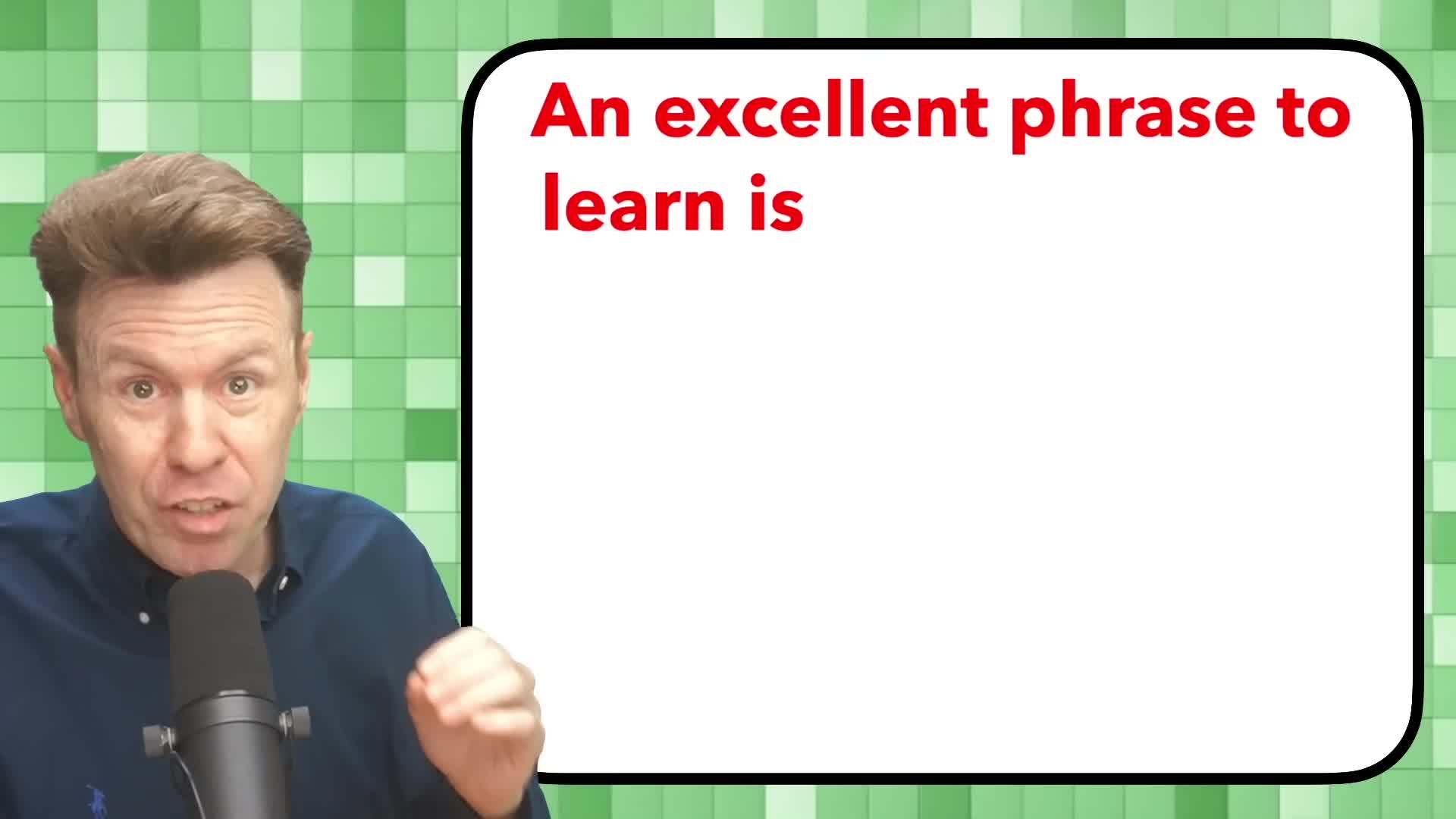
An excellent phrase to learn is... An excellent phrase to learn is... That's a good point.
That's a good point.
You use this when someone says... Something smart or helpful.
Yeah, you use this when someone says something smart or helpful.
That was fast, huh?
All right.
And you want to acknowledge it.
And you want to.
Now, want to can be wanna.
And you want to.
You want to or wanna.
And you want to acknowledge it.
For example, in a discussion about what to do on the weekend.
In a discussion about what to do on the weekend.
Your friend says, if we go early, we'll avoid traffic.
If we go early, we'll avoid traffic.
If we go early, we'll avoid traffic.
Hey, if we go early, we'll avoid traffic.
You respond, that's a good point.
Let's leave it around eight.
Did you catch that?
Did you hear me add something?
I added a word.
I said, that's a good point.
Let's leave at around 8.
But you don't need at because this is spoken English here.
That's a good point.
If it was like textbook English, you would say, let's leave at around 8 o'clock.
Leave around 8.
Leave around 8.
Let me do that sentence.
That's a good point.
Let's leave around eight.
That's a good point.
Let's leave around eight.
That's a good point.
Let's leave it around, at around eight.
I just want to add that at.
This phrase makes your conversations respectful.
This phrase makes your conversations respectful and shows that you're listening carefully.
And shows that you're listening carefully.
Let's move ahead with another common polite phrase.
Did you repeat after me?
Repeat after me.
Let's move ahead with another common and polite phrase.
Okay.
Excuse me.
That's super common.
Excuse me.
This phrase is extremely useful, you know, in many daily situations.
You can use it to get someone's attention.
You can use it to get someone's attention.
To ask a question.
Or when you accidentally bump into someone.
Or when you accidentally bump into someone.
Or when you accidentally bump into someone.
Good, good.
For example, if you're trying to get past someone, if you're trying to trying to trying to get past someone in a crowded hallway, in a crowded hallway, you can say excuse me, excuse me, excuse me.
All right, in a gentle tone, in a gentle tone.
Excuse me, excuse me.
You hear how I'm saying it?
I'm not saying, excuse me.
That's kind of rude.
It's more like this.
Excuse me.
It starts with an S. Excuse me, excuse me, excuse me.
In a soft, gentle tone, and that is a very polite way to say, get out of the way.
I'm coming through.
Move.
Excuse me.
Pardon me.
All right.
Or if you want to ask a stranger for directions.
Or if you want to ask a stranger for directions, you can start by saying.
You can start by saying excuse me.
Can you tell me how to get to the train station?
All right.
It's respectful and makes your interaction smoother.
Yeah, it's respectful and it makes your interaction smoother.
Closely related to that is the phrase.
Closely related to that is the phrase.
Sorry about that.
Sorry about that.
This is a casual way to apologize for a small mistake or inconvenience.
Yeah.
This is a casual way to apologize for a small mistake or inconvenience.
Imagine forgetting to reply to someone's message.
Imagine forgetting to reply to someone's message.
That's me.
I'm always forgetting.
I always read a message and I think, oh, I need to reply to that message.
And then I forget to reply.
I'm bad.
I'm not very good at that.
All right.
Or. accidentally, accidentally, accidentally interrupting them.
Or accidentally interrupting them.
You can say, sorry about that.
Sorry about that.
To acknowledge your mistake.
Yeah, you can say sorry about that.
To acknowledge your mistake.
People appreciate it when you use simple, polite language.
People appreciate it when you use simple, polite language.
For example, if you walk into a meeting a few minutes late.
If you walk into a meeting a few minutes late, you can say sorry about that.
Sorry about that.
The traffic was really bad today.
The traffic was really bad today.
Excuses.
Sorry about that.
The traffic was really bad today.
It's not my fault.
All right, this shows good manners.
This shows good manners.
And makes the other person feel respected.
And makes the other person feel respected.
Next we have, let's catch up.
Let's catch up.
You say this when you want to meet someone after a long time to talk and reconnect.
You say this when you want to meet someone after a long time To talk and reconnect.
To talk and reconnect.
For example, it's been ages.
Let's catch up sometime.
It's been ages.
Let's catch up sometime.
It's been ages.
Let's catch up sometime.
It's been a long time since we talked to each other.
We need to get together and talk about our lives.
It shows you value the relationship.
It shows you value the relationship.
You can also use it casually when...
You can also use it casually when ending a conversation, such as I have to go now, but let's catch up later, okay?
I have to go now, but let's catch up later, okay?
I have to go now, but let's catch up later, okay?
It's friendly.
And keeps the connection going.
Yeah, it's friendly and keeps the connection going.
Let's look at one more phrase that happens.
Oh, I read that completely in the wrong tone.
That happens.
Let's look at one more phrase that happens.
Another way to say that is shit happens, but I didn't teach you that.
All right, that happens.
Stuff.
Stuff happens.
You can use this when someone makes a mistake or something goes wrong and you want to reassure them.
I'm going to go to the top.
I'm going to say that again.
Ready?
Oops.
Let's look at one more phrase.
That happens.
You can use this when someone makes a mistake or something goes wrong and you want to reassure them.
And you want to reassure them.
I contracted at that time.
And you want to reassure them.
Reassure them.
I cut the TH off, right?
I said, and you want to reassure them.
And you want to reassure them.
Yeah, that's the contracted version and then the long version.
And you want to reassure them.
All right, good.
For example, your co-worker says, I forgot to send the email.
I forgot to send the email.
And you say, it's okay, that happens.
It's okay, that happens.
No big deal.
It shows you understand.
It shows you understand.
And you're not upset.
And you're not upset.
It makes others feel supported.
It makes others feel supported.
And less embarrassed.
Yeah, you want your colleagues to feel less embarrassed, right?
Unless you really want to embarrass them.
Then, well, just like you, always making mistakes.
That's what you can say to them.
No, don't say that.
Be a good coworker.
All right.
I hope you enjoyed this lesson.
Boom.
Good workout.
Away to go.
This is more than the contents of the lesson is the speaking practice.
That's the important part.
I want you to keep that in mind.
And don't think, oh, I know this English.
It's too simple.
It doesn't matter.
It doesn't matter that the English is simple.
We are just working on speaking in chunks.
All right.
That's it.
Keep moving forward one step at a time.
I'll see you in the next video.