You would not believe what I've stumbled across down here in the Squiz Kids vault.
I just came down to check whether last year's Christmas decorations ever got put away.
Spoiler alert, they did not.
And behind a very tangled string of fairy lights, I found this little festive gem.
It's our shortcut to Christmas traditions around the world.
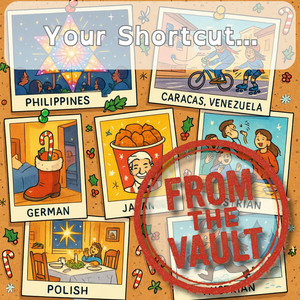
The one where Amanda and Bryce take us roller skating through Venezuela, lantern spotting in the Philippines, plate licking in Japan and ceiling splattering in Ukraine.
So, before you dive into a world of wrapping paper, reindeer biscuits and end of term chaos, let's revisit a world of weird, wonderful and downright delicious Christmas traditions.
Enjoy and keep your ears out for the squiz at the end.
This is a Squiz Kids podcast.
Your fresh take on what's happening in the world around you.
Two billion people celebrated each year, some in roller skates and some with a 12-course meal which ends with dessert stuck to the ceiling.
This is your Squiz Kids shortcut to Christmas traditions around the world.
The podcast where we dive into the who, what, when, where, why and how of the big news stories.
I'm Amanda Bower.
And I'm Bryce Corbett.
Bryce.
Over the next two weeks, people in 160 countries will be doing all sorts of things to celebrate Christmas.
Now, of course, not everyone in the world does observe Christmas.
Jewish people celebrate Hanukkah sometime in November or December each year.
The African-American festival of Kwanzaa will start on December 26th.
Diwali is the biggest Hindu festival and the Islamic holiday Eid is extremely important to Muslims.
But today we'll take you through where in the world some of our favourite Chrissy traditions are celebrated, what kinds of Christmas food different cultures eat and why you should watch out for the Krampus.
Listen carefully.
There's a squiz at the end.
Where?
Bryce, usually on Shortcuts, you ask the questions and I go off and do all the hard work to answer them.
But today we're mixing it up.
We've both gone off and found some cool Christmas traditions to tell each other about.
So have at it, boss.
Where are you taking me?
Well, we're going to start by going to the Christmas capital of the Philippines, the city of San Fernando, where all the residents of nearby villages compete against each other to build the most beautiful gigantic lanterns to celebrate the start of the Christmas season.
How big are we talking?
Well, this tradition has its roots, meaning it started out with the Filipino Catholic tradition of using small colorful lights to shine on the pathway to Christmas Eve church services.
Right, each village builds one lantern that's about seven meters tall and illuminated yeah, i know so, and they're all illuminated, which means they're lit up with up to 10 000 led lights.
That must look amazing.
Yeah, completely.
The really beautiful thing is that people in each village spend ages planning and building the lanterns, which are then on display from december 16 until after new year's day, so It really brings people together for the season.
I do love Christmas traditions that start early in December so you can really get into the spirit.
Now, you know, Bryce, I lived in Germany when I was a teenager.
Oh, yeah, yeah, yeah.
Yeah, yeah.
It's Kampus, by the way, not Krampus.
And they have the fabulous St.
Nikolaus Day, which is on December the 6th.
Yep.
Nice and early.
So you put your shoes outside your bedroom door before you go to sleep, similar to our tradition of hanging a stocking on Christmas Eve.
And in the morning, if you've been good, Saint Nikolaos will have left you a small present.
No matter how stinky your shoes are, presumably.
What happens though if you've been bad?
Well, then you might get a lump of coal or a twig of wood.
And you know what?
My uncle Rob, famously in my family, once had a very naughty year when he was a kid and he really did get a rotten potato.
So it can happen.
Okay.
Well, look, I don't know if you meant to take me to Germany or not.
Was that your turn?
No, no, no, no.
I have a really good one for you that I researched especially.
We are heading to Caracas in Venezuela.
Yes, where every Christmas Eve morning the streets are all blocked off because people roller skate to church.
Why on earth would they do that?
Is it to get some exercise before pigging out on Christmas Day?
Well, that wouldn't be the worst idea, but that's actually probably not the reason.
No one actually knows how it got started, but one theory is that it's sort of a warmer country's version of sledding, because it never gets cold enough there to sled.
Yeah.
The coolest thing though, is that apparently, kids go to bed the night before with a string tied around their toe and the other end of the string hanging out the window.
And when people skate past they gently, we hope, tug on the string and wake the kids up, and then the kids get their skates on to go to church in the morning.
That's amazing.
My turn again.
Now we're heading to somewhere quite different.
Or off to Japan.
Huh.
Interesting.
I didn't really think Christmas was celebrated there.
Well, it's not really, except for at KFC.
What?
Yeah, I know.
Over the past few years, it's become a bit of a thing that the cool kids do at Christmas time.
They order KFC.
And each year there's a special commemorative Christmas plate, a festive bucket, if you like, and a special dessert.
Now I can't read Japanese, but the website for KFC in Japan at the moment shows the biggest feast ever costs a cool 5900 yen, which is 74 for a bucket of Christmas chicken.
Wow.
I guess it's not so far from a Christmas turkey to a Christmas fried chicken.
Speaking of which, what kinds of Christmas food traditions have you discovered, Bryce?
What?
Honestly, I think the funniest thing I've discovered is that lots of people are still amazed that in Australia and other places where Christmas falls in the summertime, They are amazed that we often have barbecues or eat seafood or cold lunches.
Ooh, so we're exotic to the folks up in chilly Europe and North America, aren't we?
We sure are.
And one tradition I really liked learning about was in Poland, where families always set an extra seat at the table in case someone arrives last minute in need of a meal.
Oh, I love that.
Yeah, it's nice, isn't it?
And then they wait to eat until the first star appears in the sky.
How poetic.
I guess that works really if you're in the middle of a Polish winter, but we'd be eating pretty late here if we waited for a star in the sky.
Night falls very, very early in Europe during winter.
I also loved learning about a dish called jug jug, which is eaten with a pineapple Christmas ham in Barbados.
It's made with beef, pork, herbs and pigeon peas.
And apparently it was created as a substitute for the Scottish dish of haggis, which is made out of a sheep heart, liver and lung.
Oh, yeah.
I'm not sure about haggis or jug jug, to be honest, although they both do have completely excellent names.
Yeah, good names.
Now personally, I love the sound of something called kutya, which is eaten at Christmas time in the Ukraine.
Oh, yeah.
But because they follow the Orthodox calendar, in Ukraine the holiday is actually celebrated on January, the 7th.
And get this, Bryce, they have a 12-course meal.
Whoa, that is a lot of food.
Yeah, so it symbolises the 12 apostles who followed Jesus Christ.
And as a reminder, it's his birth that's celebrated at Christmas.
And the kutcha is apparently the most anticipated dish.
Oh, yeah.
Christmas is the only time that this sweet wheat raisin honey nut pudding is made, and it takes up to six hours to cook it.
Oh, wow.
It sounds like my mother's plum pudding.
I bet everybody wants a big bowl of it if it took that much effort.
Well, actually, everyone eats from the same bowl to sort of symbolise unity and family togetherness.
And they always leave some behind, no matter how delicious it is.
Number one, to remember loved ones who have died.
And number two, and possibly the best part, they throw a spoonful at the sink.
You what?
Isn't that brilliant?
So if it sticks, they believe that there's going to be a good harvest that year.
And even if they're not farmers in that family, I'm guessing that everyone still kind of has fun throwing pudding at the ceiling.
Food at the roof.
Who doesn't love throwing food at the roof?
Now, Bryce.
We've spent a lot of time talking about some really happy and lovely traditions, but I think it's time to talk about why some little Austrian kids are a bit scared of Christmas.
Why?
Now, what on earth could be scary about Christmas?
Delicious food, beautiful lights, presents, family.
Absolutely.
But in Austria, there's also Krampus.
Now, remember that I mentioned how St.
Nikolaus visits children in Europe on December the 6th and leaves presents in their shoes?
Well, in Austria the story goes that he's helped by Krampus, and Krampus is a hairy, horned figure who's in charge of punishing the naughty kids.
Oh.
Now I'm pretty sure he's not real, but there are things like compass runs where people dress up as compass and then do a 5K fundraiser.
What?
That's just weird, which takes us right back to having fun and the Christmas spirit.
Exactly.
I wonder if anyone's dressed up as compass and gone around on roller skates kind of a mash-up of that Venezuelan and Austrian tradition.
Time for the...
Quiz.
This is the part of the podcast where you get to test how well you've been listening.
Question number one.
Which country has the giant lantern festival with thousands and thousands of electric lights?
MUSIC That's right.
Well done for remembering that.
It was the Philippines.
Question two.
What rather unusual Christmas meal has emerged in Japan?
MUSIC
Yeah, it's Kentucky Fried Chicken.
Question three.
Why do people in the Ukraine throw their Christmas dessert at the ceiling?
That's right.
It's to see if they're going to have a good harvest next year.
That's all we have time for today.
Thanks for joining us as we explored the who what how where, when and why of Christmas traditions around the world.
And as we say every day on the podcast, now get out there and have a most excellent day.
Over and out.