Discussion keeps the world turning.
This is Roundtable. Hello everybody, welcome to Roundtable.
Coming to you from Beijing, I'm Ha Young, on a day's show.
Ever wished you could download knowledge directly into your brain like Neo in the Matrix?
Well we might not be there yet, but we're getting a lot closer.
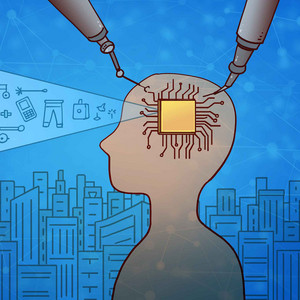
Today's technology allows us to control a computer with just our thoughts and even operate a robot with a lab-grown human brain.
From mirror links, human trials, to China's robots with artificial brains, we're exploring the wild world of brain computer interfaces.
So put on your thinking caps or should I say, neuroimplants and let's dive into this electrifying topic.
And we take a look at the booming goods circle in the ACG or animation comics or games world.
Where a coveted single item can fetch more than 10,000 yuan in an auction.
What fuels the craze for merchandising?
And how does it impact the ACG industry?
For today's program, I'm joined by Yushun and Steve Hathorley in the studio.
First on a day's show. As the slogan goes, a mind is a terrible thing to waste, but a wonderful thing to invest in.
And invest they are. Earlier this year, Elon Musk's company Neuralynx successfully implanted their N1 chip into a human being.
And now Chinese scientists from Tingen University and the Southern University of Science and Technology have built a robot capable of performing critical tasks.
And artificial brain grown from human stem cells.
So why don't we start with just a brief overview of what's happened before we dive into the specifics?
So first of all, according to the official website of Tienjin University, the latest invention by scientists from Tienjin University and the Southern University of Science and Technology namely, Organoid.
A robot controlled by a lab-grown artificial brain is a significant breakthrough.
According to reports from China Daily while making a brain from stem cells often referred to as brain-organoid, which is quite different from a real human brain, it's not that rare.
And how to enable it to receive orders or even control machines like the villain Crane in Ninja Turtles did remains a challenge.
And the process looks easy but involves decoding the brain, converting its thought process into electrical signals and then sending the signals to the machine in order to control it.
And also there has to be a channel for the brain to receive feedback from the robotic arms it is supposed to control.
And the research team has trained the brain for a robot obstacle avoidance and tracking, grasping in other tests and the completed the inspiration work of various kinds of brain computing.
So they designed this brain to be inserted into this robot.
And then they programmed the brain to be able to tell the robot what to do.
And you said that the robot can move out of the way if there's something in the way, it can track objects or targets and it can also pick up stuff with the tans as well.
It's pretty amazing in terms of science and in terms of advancements.
This is really exciting and it's really cool too isn't it?
Of course. I think it's definitely cool but there's also this a little bit of a nerving aspect to it.
And every time we talk about the brain and also growing a brain not specifically maybe from a petri dish but certainly in a lab and then you know letting it operate the robot.
That's all just very sci-fi and very I guess brand new people and I think that's also the exciting part to talk about.
Yeah it's the exciting part and I think it's the part that makes people uncomfortable too.
Yeah. This brain-organoid when we learn about a story like this there's so much to unpack I think including the vocabulary right because for laymen like us and we have to learn exactly the ins and outs of what this means.
So this brain or this brain-organoid this is grown in vitro and it's tissue that resembles a human brain and these are grown by culturing stem cells and when they grow them they turn into this three-dimensional object and it can be maintained for years if scientists can figure out how to get it all the things that a brain needs.
If you look at the pictures in the articles you'll see the robot with this big pink brain sitting on top of it right.
That's for aesthetic purposes only.
That's not the whole brain.
It's actually the organoid is actually much smaller than that.
I'm sorry but what you said just this is possibly just going to make some people uncomfortable but there's this great delicacy of pig brain in certain parts of China such as the Tron province in a way.
Now it's so interesting to see that the scientists are growing this in a lab and also the stem cells.
It is a type of cell that forms brain tissue in the body and were used to build this brain.
Then they paired it with a computer chip that passes instructions to the robot's body.
This mixture of human cells and computer chips allows it to function like a human brain.
The capabilities of stem cells are incredibly powerful actually.
We know that they have the ability to divide and proliferate and play a crucial role in tissue repair within the reserve functions of each organ.
It's really functioning like a human brain.
They put the neural implant into the tissue that they grew in the lab in vitro, that chip that they inserted.
It interacts with the neurons in the brain that they grew and together working together between the neurons and the electrode or the chip, it communicates to the robot and that's how it allows it to pick up stuff and move out of the way and track targets all the things that you should mention before.
It's really scientific and there's just a lot to learn here.
That's kind of the science part when we learn about the chip and we learn about the brain.
Yes. This technology essentially is using brain computer interfaces or BCI technology.
It's basically allowing a person to control a computer directly with your brain.
This interface, it's the same system and maybe we'll get to Elon Musk in a little while, but this is the same system used to create Elon Musk's neural link chip that was implanted as you mentioned earlier on in the show into a human patient's brain.
This development here in China is kind of growing on the heels of or following the success of neural links success with the implant into a human.
I don't know whether this is more unsettling or maybe a little bit less unsettling for people that it's being experimented on a lab-grown brain.
We can see that scientists are pushing the boundaries of what's possible when we merge minds with machines if it's meant to function like a human brain.
That has to create challenges for scientists and what are these challenges?
First of all, the Chinese scientists have not revealed how they trained the organoid to know when the robot should perform specific tasks.
Researchers explained that the robot does not have eyes and only responds through the electrical and sensory signals sent by the neurons.
Ming Dong, vice president of Tianjin University, said that unlike traditional technologies that primarily use the human brain or other biological brains as experimental subjects, the brain on chip has emerged as an important new branch in the field of brain computer interfaces.
Ming also noted that the research is expected to have a revolutionary impact on developing cutting-edge scientific fields such as hybrid intelligence and brain-like computing.
Yeah, to answer your question about the problems that they have, the human brain, the brains that we have on the tops of our hands right now, they're quite sensitive as a matter of fact and they have a lot of needs to operate properly.
They need fluids, for example.
They need nutrient lines, for example, temperature control.
You can't have a brain that's overheated or too cold at the same time.
It also needs to have a protective casing.
Can you hear that? Ming knocking on my head.
Well, that means that's okay if I knock on my head because my brain is protected by our skulls.
These are the problems that the science, not the problems, but these are the issues that the scientists are facing when they're looking at maintaining these brains that they're growing in vitro over a long period of time.
Some of the stuff they're doing right now is intentionally trying to create a stronger network in the neurons so that they can maintain these brains for a really long time.
It'll be another great advancement when they get there.
And what exactly are the scientists hoping to accomplish here?
Yes, also according to the China Daily Report, the significance of this breakthrough, we will say, is that the cultivation of the brain organoid has improved, enhancing the hope of any such kind of organoid growing into a real brain in the future.
Thus opening the door wider toward the sci-fi scenario that we saw in the movie or a lot of these series of artificial brains controlling machine bodies.
Unlike in the animation described, I mean the one that I saw before, they won't be used by this crane or the villain, but by doctors to help paralysis patients stand up again.
So Steve, are we talking about the possibility of also a brain transplantation in the future?
Yeah, that's kind of the long-term goal of the scientists here.
In the short term, sure, they put this into a robot and it's a really impressive thing that they've done, but they have medical aspirations as well.
And in the paper that they released, it said the transplant of human brain organoids into living brains is a novel method for advancing organoid development and function.
The graphs or the things that they grow in the lab, they have a host-derived functional vasculature system and they exhibit advanced maturation.
That's a very long-winded way of saying what they want to do is they want to take these brain cultures that they grew in the lab, insert them into actual people's brains who have suffered from some sort of paralysis or neurological condition where their neurons have been damaged in their brain.
And what they're helping in the future is that they can successfully take the lab-grown brain, place it in a person's brain and have those two things kind of fuse.
I don't know if fuse is the right word, but interacts successfully so that they can perhaps repair the damage that has been done to the brain.
And if they can achieve that, we're talking about things like repairing vision for someone who has lost their eyesight.
And this is such an exciting development because that actually happened not with a person but with a mouse.
They did this study at the University of Pennsylvania and researchers inserted human neurons into the brains of rats.
Now those rats had damaged visual cortices and that led to some of the affected areas to spring back to life.
These neurons that were dead before, all of a sudden with this new implant, they were able to have that electricity started firing in the neurons again.
It's amazing. Yeah, and I think what is important is that they are trying to repair the part of the brain because brain is the most substicated part, I would say, in human beings.
It's not like limbs. It's not like our just legs or something else.
It's not easily accessible.
You can't just pop the top off your head like you can a colabotel or something like that.
Maybe that's next to nose.
So from what I understand is that in the future, if a person's brain suffers damage, that results in the loss of their maybe eyesight or ability to move, and then by implanting an artificial brain into their brain, and this function can be restored.
It's incredible, isn't it?
It is. I was just thinking about all the folks who suffer, let's say, from a stroke or spinal cord injuries, and if this can work, then we're talking a whole new ballpark of what to do.
Or what's possible. That's where Elon Musk fits into all of this as well.
His company, Neuralink, maybe you've seen it in the news 10 million times because it's there all the time.
Well, that company got started in 2016.
Here's their mission statement.
This is where we see the division of two separate goals.
This is what Neuralink's mission statement says.
To create a generalized brain interface to restore autonomy to those with unmet medical needs today, that is mission statement number one, if you will, unmet medical needs.
But here's the end of that sentence, and unlock human potential tomorrow.
So this is communicating two key approaches here, and the short term Neuralink is focusing on individuals with the medical needs.
But in the long term, their vision extends beyond the world of medicine, and they allude to a goal of augmenting human potential.
And what does that mean?
Well, that means inserting an electrode or a neural implant into your brain to help you focus better to help you process information faster to make your brain a better version of itself.
The long term goal, the other side of that mission statement, is not medical related at all.
We're not talking about people with neurological disorders.
We're talking about people who are okay, they're healthy, but an inserted chip into their brain in the future to make their brain a better brain.
Right. So I just read this, I was quite astonished, and I felt quite uncomfortable about the second part of this statement, because I just feel it could be opening potentially a whole can of worms that we don't want to face.
But with a little bit more researchers in this field, in China, as well as in the US, what they've been doing, or at least the philosophy that they hold, it's not like Elon Musk is all that amavric in wanting this, because some people in the tech community believe that BCI is going to be a major mainstream technology in the future, not just for people with disabilities, but for basically anyone.
And that the next big platform shift might not be people putting computers on our heads like VR's, like Vision Pro, what we talked about the other day, but it may be people putting computers in their head, and eventually we will all be walking around with these brain implants.
And I mean, could this technology create a new class divide between superhumans with enhanced cognitive abilities and ordinary humans who might be left behind or even exploited and let me just add, could there be a third class on top of these two that are the people who control the brain implants and operate these brain implants?
Well, I think the goal is to not have a stranger be operating your brain implant in the future, but that's a fair question.
Computers get hacked, right?
And that's one of the concerns for people.
You know, talking about Elon Musk, and he's not the only person who's involved in this field of study, and this field of study itself is not really new at all, as a matter of fact, they've been doing this for decades, and there have been really significant advances over the years.
In 2012, that's when they had the first brain-controlled robotic arm by human in 2017, a human-controlled cursor mentally to type out words and sentences.
One of the biggest, I think, advancements, not advancements, but accomplishments, we could say, was in 2015, that's when Eric Sorteau, if you don't know that name, he's a 34-year-old American man.
He was unable to move his arms or legs for more than a decade.
He got shot. That's how he got injured, and he was living basically paralyzed for 10 years, and then he was the first person in the world to have a neural prosthetic device implanted in a region of the brain, where he could make a thought about moving things, and he was successfully able to do that.
He said, obviously, it changed his life.
So my point is, Elon Musk isn't the only person who's been doing this.
There's tons of researchers on this topic as we speak, and they've been on it for a really long time.
Yeah, and also, I think what is new this time is that this research teams are really developing the experiments on the fact that it's not a one-way control of the nerves, because triggering an object to move is actually not that rare to see.
But rather, it requires mutual feedback between the artificial brain and the nerves.
The artificial brain not only needs to control the nerves, but also needs to receive and read this kind of signals from the nerves indicating that the action has been completed.
And also, all of these examples, Steve listed, they are all cabled.
Yes. Yeah, and what you mean by that, you should know, is that they were basically plugged in.
Like Neo. Oh, second Neo reference of the day.
Like Neo from the Matrix.
If you remember, he was plugged into a cable.
These patients before, that's exactly what they were as well.
You can see videos, you can see images, and that's one of the big advancements from N1.
N1 is the name of the chip from Elon Musk's neural link.
His chip is fully implantable, so you don't know it's in there.
If you don't know, then you don't know.
It works from Bluetooth, and also the number of electrodes as well.
The scientist in the past, I'm referencing Dr.
Paul Newy Joukey in here.
I was watching a video about him.
He works at Stanford University.
How smart must this guy be?
He directs the brain interfacing laboratory at Stanford, probably a pretty impressive resume.
Anyway, he was saying that one of the big advancements for N1 is that there are no cables.
The patients are not plugged in to a computer outside.
This is done through Bluetooth connection, and the number of electrodes or wires, if you will, is all contained within that chip.
And that chip, you probably think it's the size of a soccer ball or something.
No, it's not. It's the size of a coin.
Wow, that is really amazing.
And I happened to watch an interview done by the New York Times with the 30-year-old Nolan Albra.
He was the patient that they put.
Patient one. Yeah, right.
Of neural link and one chip.
And it was mind blowing.
This guy is so chatty and definitely having a great time with life now.
He's been paralyzed for eight years because of a terrible accident.
And then he talked about his experience of going under and getting the chip implanted into his brain.
And like you guys said, there are no cores, no cables, and it was done really quickly, only in a matter of like more than two hours.
The surgery was that quick.
And also he said they woke me up using Bluetooth connection.
And does that mean in your brain you're here?
Bluetooth connected. No, you don't hear anything.
I don't want to go as well for you, brother.
And then basically, you know, they wake you up with this implant with a little coil, almost the same thing, such as what we put our phone down on a plate to charge.
And for him to charge the thing, he goes to bed sometimes wearing a hat.
And then that charges the chip.
And now he says that he enjoys the independence of playing computer games in the middle of the night and reading a book and doing all these things that he couldn't do because of a lack of mobility.
And now he can do all these things.
And those listeners of our show might remember I could be a little bit on the critical side when we talk about Elon Musk.
Right, with what his company is doing on this front, it's really impressive.
That's what his supporters say.
There are critics in the scientific community though that aren't really happy with the way that Elon Musk is going about things.
For example, they feel like when these reports are on the news, the patients kind of become like celebrities in a way.
And I'm not even sure that that's a fair criticism because of course they're going to be in the news.
Of course, they're going to get a lot of attention.
But maybe there's criticism as to that's one of his ways to recruit potential patients in the future as well.
So there are critics out there, you know, ethically, of Elon Musk.
And of course, everyone has critics.
But yeah, there are people that are not so happy with the way that he's going about.
Yes. Also, this is undoubtedly a very ambitious vision, but the industry also hopes that their experimental process and results can be more transparent.
Can we say a little bit more about the ethical mind field that we are potentially going into?
And yes, we see that even the scientific community is kind of divided on this.
And what about the average Joe's and James?
Joe's and Lowe's are thinking about this.
Yeah, right. So if we switch from the medical side of things to the human potential side of things, you shouldn't.
Would you consider getting an implant, a brain implant and see, look at the reaction now, it's kind of like, it sounds ridiculous, doesn't it?
But it's not. We're here right now.
We're about to be here. No, actually, I was thinking, oh, that's the question.
Now, I don't think I would intentionally implant machines or chips just doing hands my ability, like mental calculation or physical strength, like what you can see in cyberpunk in 2077.
But if you never know if faced with unavailable circumstances, and the cost is within a, I would say, bearable scope, I think.
Yeah, why not give it a try?
Unavoidable circumstances, meeting medical purposes.
Yes. Yeah, right. But not for just your own abilities.
I would. I'd do it. Make my brain smarter.
Yes, please. As we stand on the brink of a new era in brain computer interface technology, it's important that we navigate these advancements with caution and ethical foresight, in my opinion.
How do we balance the incredible potential of brain on chip technology with the need to protect individual rights in societal values?
Well, let's think about that.