Discussion keeps the world turning.
This is round table.
Hello, welcome to Roundtable where we serve up piping hot debates on the issues that sizzle in China and beyond.
I'm Niu Honglin.
China's campuses are witnessing a quiet yet notable cultural shift.
A nationwide survey shows that over 96 of university students express interest in dialects and nearly 99 say they are willing to contribute to their preservation.
From dialect poetry competitions to AI-powered documentation projects, young people are reshaping how original languages survive and evolve.
Today we look at what's fueling this new, renewed enthusiasm and what it means for cultural identity, education and language policy in a rapidly modernizing society.
For this episode, I'm joined by Steve Hatherly and Yushan.
Now grab your virtual compass and follow us to the heart of the discussion.
Dialect content is trending again.
From campus competitions to dialect meme culture, young creators are remixing old sounds into new forms.
But this isn't just nostalgia.
It's revival, it's creativity, and it's a cultural movement powered by the Gen Zers.
I can't wait to find out how students are using short videos, AI tools and grassroots clubs to make dialects tool relevant and alive.
It's a cool thing.
And I'm wondering, to start with, really 90%, over 90%, sometimes even 99%.
What's about the survey?
Yeah, that's a very interesting survey.
I think it's worth doing and I'm so glad that it's conducted on a total of 3360 valid responses among university students nationwide.
And here's what they discovered.
So nearly 40 of respondents.
They are very good and fluent in a dialect, and nearly one-third of them can use it fluently in daily communication, while another one-quarter about 25 said they can understand it but feel hard to speak it themselves.
So using it fluently is still a bit challenging for that quarter of the respondents.
And, like you said, Honglin.
Over 96 of them show strong interest in dialects, while over 60 hope to gain a deeper understanding of their hometown's cultural roots through dialects.
I see this as a really positive thing.
The thing that kind of struck me the most is and I think many of our non-Chinese listeners might find this to be new information as well the number of languages that are spoken in China is kind of surprising.
We'll get to those numbers in a second.
The number of dialects as well.
The fact that there's still a lot of interest in young people in protecting those dialects is a really great thing, because there's so much history in China today.
And there's so much history in those languages and there's so much history in those dialects and they're absolutely worthy of attention.
So these types of statistical responses are really, really inspiring, I think.
Here's another couple of numbers.
80 of the students said that they're worried about the decline of dialects and 99 are willing to contribute in some way to the inheritance and protection of dialects.
99%.
Who's that 1% that said... No, it's...
We're good.
Who's that person?
Well, I'd like to know that answer to a fun answer.
It's like when they say four out of five dentists recommend this toothpaste.
Like, well, what about the other dentist?
There are a lot of regional migration between families, too.
So perhaps this kid has their family roots elsewhere, that speaks a certain dialect, but he or she doesn't feel related to it that close after their family migrated to somewhere else.
Maybe.
So that will make sense for that 1%.
Hey, I'm doing my best to to defend you guys.
Well that, yeah.
That being said, in China, in the Chinese language, in Mandarin even, we have a lot of sayings describing the situations in different counties, in different villages.
We say, even two villages are only apart from each other for 10 miles.
They might have different customs, they might speak different languages or at least they have different dialogues.
It has something to do with the terrain, with the situation, some places with hilly area,
One.
The villages are located in the kind of areas that are not that easy to go out to communicate with others.
They form their very own habits and everything.
But I didn't know that we have over 100,000
30 languages and 10 major dialects.
Oh, see, this is the number that I was kind of excited about.
But even you didn't know about that.
I didn't know that is that many.
The number is that huge.
And there are different types of major language families.
And please educate me with those, you know, knowledge.
Just for the record, this is the first time I've ever heard of these data and information too.
See?
China apparently, is one of the world's most linguistically diverse nations, which is also home to five major language families.
There are the Sino-Tibetan language family, the Altaic, and the Indo-European, and several more.
So this incredible diversity has led to so many dialects, and also these Chinese dialects and Mandarin also share common roots in ancient Chinese history and language as well.
So the ancient Chinese language not only lay the foundation for the development of modern Mandarin, but also kind of contributed to the evolution of regional dialects, and all together they form an inheritance system for the Chinese cultural say prolonging and also just inheritance in general.
So I think this can all be dated back to, as far as I know, that's the Warring States period.
That's from 475 to 221 BC.
And that's a time when a large area of what we call China today was formed together by seven major feuding Chinese kingdoms and quite a few smaller ones as well, whose career collectively constitute an era in Chinese history.
So that was one of the most fertile and influential period of time in the Chinese history that not only saw the rise of many of the great philosophers, such as Confucian himself, and also witnessed the establishment of many of the governmental structures and cultural patterns and also like folk culture and language usage that were to characterize China for the next 2000 years.
That's all where it rooted from and that's still sort of how we use it today.
So, if I may have just one more minute on this topic, I had the honor of interviewing someone in the city of Hainan, which is a small city near the picturesque tourism city of Hangzhou in eastern China's Zhejiang province, back in 2023.
And that gentleman is a renowned local photographer.
And he brought me to a local restaurant to try the local food.
Very kind of him.
But in the meantime, I noticed when he was speaking to me, It's all Mandarin.
But when chatting with local people, especially those vendors that he know, it's immediately transferring back to Hainan accent.
So it kind of got me curious.
So I asked him about like, how often do you guys speak Hainan accent?
And his answer to me is like it's been so long that nearly all Hainan people, as long as we're local, like we grew up here and we feel belong to this place,
It's what we speak in daily life instead of Mandarin.
And also that accent he told me has a long historical background, all the way back to the Warring States period when the ancient kingdom of Wu was dominating that area in eastern China, also regioning the nearby regions.
So we can still find that trait not only in Hainan and Zhejiang and Fujian provinces, but also in Shanghai.
Some of the Shanghai dialect also has its main features coming all the way from the ancient Wu language back in the Wu kingdom 2000 years ago.
Question.
Did you understand him when he was speaking with a Hainan accent?
No way.
Not a chance.
Sorry to interrupt.
Was it just the accent or was he using different language?
I would call it a dialect.
But that dialect belongs to a bigger language system that's locally renowned and used very often.
Yes, that's why I was asking that question as well.
That is, we try to differentiate between dialect and accent.
And I think the simplest way to put it is that usually a dialect would allow you to understand well, would allow the language to have more different ways of addressing the same kind of notion or item.
It has its own vocabulary to start with, and sometimes even grammar.
Whereas an accent you are.
No matter how hard to understand the accent can be, it's still within the same language.
Yeah, you're using the same vocabulary, you're using the same grammar structures.
I remember the first kind of hint I got from this was when we were in Xi'an and there was a show that we watched and on the stage there was kind of a warm-up comedian and he was asking people where they were from um around china, where did you come from to see our show tonight?
And then when they would answer oh, i came from this province, then he would do that accent from there.
And then he would ask someone else and they would say a different province and he would do the accent or the dialect from there.
And that was kind of the first hint that i got.
That taught me oh oh, not everyone speaks exactly the same in china, because I'll blame ignorance and a lack of education about the country.
But I think for many people who don't live in China, who've never been to China, the impression might be oh well, there's Mandarin, there's Cantonese, and then that's it and that's what people speak and everybody talks the same.
That is not the case at all.
Going back to why these students are interested in protecting these dialects, there was a study that was published by Comparative Study of Cultural Innovation a couple of years ago.
And among those 130 languages that are spoken here in China, 68 of them have fewer than 10000 speakers.
48 of them have fewer than 5,000 speakers.
25 of them have fewer than 1,000 speakers.
And in fact, some of the languages here in China are spoken only by a dozen people or so.
And it's...
The shrinking population of those speakers.
That highlights the urgency for the documentation and preservation efforts.
And I think that's maybe part of the reason why young people are giving these dialects so much attention these days.
This is actually very interesting because I think at least 20, maybe even 30 years ago, what we were talking about is the popularization of Mandarin, because we wanna make sure that people would have the opportunity to work in different places, to be able to communicate with others.
So we want to make sure that kids would have a good enough level of Mandarin command.
And that is why I remember, when I was in primary school, our school teacher.
Some of the teachers are able to speak Mandarin quite well.
Some relatively older senior teachers who can do really well in teaching have a strong enough accent that I didn't quite grasp very well, because I was kind of grow up in one city and start school in another.
So the dialects are a bit different and the accent is a bit different.
So I find it a little hard understanding them.
And fast forward to university, Our principal in the university.
When he was delivering a speech, we could understand him quite well.
Yes, he's having an accent, but we could understand him.
But the students from the southern part of the country, they couldn't understand a word.
It was a little bit funny.
But at that moment we understood the importance of making sure that people are able to speak Mandarin well.
But recent years we see especially the younger generation who master the language quite well, started to feel a little bit nostalgia, a little bit regret, even for myself, on behalf of myself.
For example, I cannot really speak my local dialect.
Oh, really?
I can't.
Because you've forgotten it?
Or because you grew up not speaking it?
I grew up not speaking it because my parents were speaking Mandarin to me, because they want to make sure that from the very beginning, I'm able to do the language, to speak the language well.
And then I never, well, I understood, but I can never say it properly.
Mm-hmm.
And also my family member make fun of me when I tried to do that because I couldn't do it well.
Not when I was little, but grow up a little bit.
Can I ask you, why do you feel that regret?
Because I think that kind of gets to the heart of why young people are trying to preserve these dialects.
Yes.
The superficial reason, especially in college days, was that everybody knows more than two languages.
And I couldn't.
When my roommates were on the phone with their parents, they switched to their local dialect.
I could understand some of them, couldn't understand most of them.
And I feel like they are more talented than I was.
And I thought I was talented in languages.
And that was the superficial reason.
But again, after growing older, you started to miss the part of your life where you were a little kid and your parents, your grandparents, your old relatives are speaking that language.
That moment is a sweet memory in your life that you always cherish.
And if you could bring it back, even bring it a bit livelier, with you yourself, using that language, even speaking to yourself, that would be much better and much different.
Yeah, I think that's so true because nowadays young people Totally echo with that as well.
In that same survey over 77 of all the young Chinese university students.
So basically most of them feel the same as you do, Honglin.
They think speaking their dialect is very close and intimate and provides a direct connection to their home identity.
Yeah, identity.
Yeah, this whole motivation to preserve languages or dialects is deeply personal and emotional to them as well.
So what are they doing to?
Well, I mean, 99 of them have committed to do something to protect their local dialect, or all the local dialects that are there.
Are they specifically doing something or what are some activities they have already started?
I think one very interesting example that I got is located in the city of Xiamen in southern China's Fujian province.
So the Xiamen dialect of the of the city of Xiamen apparently is one of the representative varieties of the Minnan language family.
So as a birthplace of Minnan culture as well, Xiamen has been actively preserving the dialect through various.
They call it bilingual, but it's both Mandarin and Minnan language.
They've been trying to broadcast in both languages in public announcements and cultural programs and various intangible heritage initiatives.
So in the University of Xiamen or rather Xiamen University, of course the students are answering to that there's been a minnan language society ever since in recent years, i think.
So that's joined not only by local students but also people who's interested in the minnan language, and they're.
According to the china youth daily reports, there's also been international interests shown in the minnan language language society there.
There's one malaysian student who's ancestral hometown was in putin, in fujian province, and that student said that, upon interviewed, that he can speak minnan dialects and the mandarin and malaysian, plus he had.
He also has a strong sense of identification with china because of his ancestral origin, and that's attracting not only chinese students but also international students in xiamen university.
So that's a good way student clubs and hubs to showcase their interests yeah, to help keep it alive.
Students are actively engaging with the older people in their families or in their communities.
That was part of the survey too.
Over 56 said that they're learning authentic local vocabulary and proverbs too from um, from those groups.
They're choosing to speak the dialect in different settings, which is cool and it makes it very personal.
It brings it to a grassroots level and it keeps it close to home um.
Now more on the tech side of things.
There are things on social media platforms like short videos and podcasts and a lot of digital content creation that's talking about or promoting these local dialects as well.
70 of university students are willing to participate in dialect preservation through new media creation.
30% have already created or shared dialect-related content.
Ever since 2015, China's Language Resource Protection Project has been racing against time, basically.
We have field teams record and catalog languages across 34 provincial-level regions, including Hong Kong, Macau and Taiwan, and building the world's largest linguistic database.
And by June 2004, they had surveyed more than 1800 sites and documented nearly 130 languages and dialects that we mentioned, and that is why locally, local governments, universities have also rolled out different ways to save, to protect and maybe to put their local dialects and language in in real life.
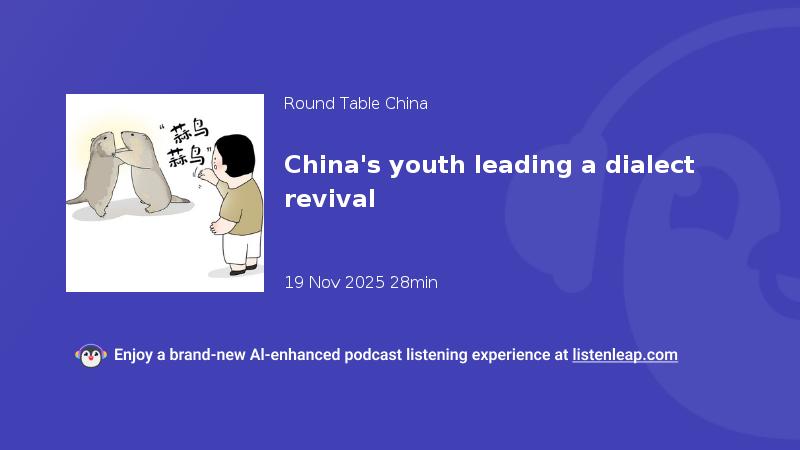
We see that at a, the 2025 China Cultural Tourism Industry Expo, dialect-themed products from the kind of garlic bird.
Garlic bird in Wuhan language is suan niao.
See, Wuhan dialect, you got it.
Suan niao means let it go, never mind.
But it's a bird.
It's a real garlic bird inspired by the local dialect of wuhan.
Yeah, that's the transliteration.
Yes yes, dialect.
It's not really that.
They're using a garlic bird as a dialect.
What's a garlic bird?
No, it's the direct translation of the two characters.
Oh yes right yes, and the meaning of the word is let it go, but the uh characters themselves is garlic and bird and they are inspired by that.
And uh invented this little recreational cultural, recreational little souvenir.
It's a cute example of protecting the local dialect and you see, that message sent very clearly in the popularity of how much people love dialects, even though you don't really belong to that specific place that speak that certain dialects.
It's because dialects, by expressing things in their own unique ways, they are also delivering ways of thinking and the local spirits, if not attitude towards things, in so many ways that people, even from outside of that region, feel curious and interested.
So I kind of don't really have a good example, since Beijing is not really a dialect, it's an accent.
But agree with me or not?
Please do let me know folks if you don't agree with me on this.
I feel like this space style of speech here in Beijing carries this kind of easygoing generosity, in a way that everything is negotiable and there's no need to fuss or over small things.
For example, we have such an interesting example that when we're stepped on the foot, very local Beijingers will, instead of saying hey, you're stepping on my foot, please remove your foot away.
And they would say according to my mom I don't even say it, my mom doesn't even but her grandma would say oh, excuse me, is my foot blocking yours from reaching the ground?
That's passive-aggressive.
That sounds so Canadian.
Oh, really?
Oh, I'm sorry that my foot was in the way of your foot.
When you say that, you're genuine.
You're not sarcastic.
So the charm lies in using indirect descriptions and simple phrases to make a point clearly.
The voice.
Long-winded lectures, yet still lands one message without coming across as blunt we're losing ground.
That's interesting.
Yeah, just small details like that make dialects so attractive.
But I mean, that's more of the culture of the city though, isn't it?
More than the speech.
But yeah, back to that point.
In Canada, if I'm standing on the sidewalk and someone walks along and bumps into me, I'll say sorry.
Yeah.
It's a very strange Canadian thing.
It's a British thing, too.
It has something to do with a collective personality, for sure.
But in some other dialects or local languages, for example in Wenzhou, which is a county in Zhejiang province as well, their way of saying someone is very, very happy is that they
Instead of saying 性高采烈, which is a Mandarin idiom, they say 头跳尾跳, so your head is jumping up and down, your tail is jumping up and down, your entire person is jumping up and down because you're happy.
See, it's a very vivid and very cute way of expressing.
And like Yushan said, it carries how local people might act. their way of understanding the world.
Initially, I was trying to ask the question why do we still need to protect local dialects or accents?
Because there are so many other things that are more, from a cost effective point of view, worth our time and energy and money, in the sense that those are practical things.
Those are the things.
For example, if you develop technology, you would be able to bring more food to more people's, more families tables.
If you develop or you continue exploring the universe, you might find resources that would solve the problem of entire humanity.
Why would we spend time and money and energy in something that is romantic nice sentimental, yet not that practical?
Because it's part of who we are as human beings.
Those dialects and those languages are like libraries in themselves, both of the words and of the culture.
And when those disappear... There's a song... I'll kind of switch topics, but I have a point here.
There's a song by a dance group called the Basement Jacks.
And the title of the song is, If everybody looked the same, we'd get tired of looking at each other.
Right?
So if we all spoke the same language, if the entire world spoke English, or if the entire world spoke Mandarin?
A bit boring, don't you think?
Yes.
And that is why, after the discussion, already feel like maybe when we talk about diversity in the ecosystem, in the nature,
We talk about the diversity in the DNA database.
It's the same thing.
Culturally, we also need diversity.
We need to be inspired by something that has been someone else's history and culture for a long enough time that it's rich, it's beautiful, it's diversified and colorful.
Yet, we are yet to be exposed to that.
And when we actually are.
Not only is that diversity part of history and culture very useful and important in understanding that part of history, it can also inspire other people, maybe us, to create something beautiful for humanity.
And if we only do practical things, what's the fun?
Yeah yeah, and just to back you guys up a bit, i feel like dialects are the moving, keep on evolving type of live museum that captures a certain amount of time that could date back to thousands of years ago, but still used and heard today.
And another thing that just pops up in my head would be you know sometimes, young people, we comment on other people's video with a term called at least it's passed down like for intangible cultural heritage, for a certain type of of traditional dances and for dialects, when especially when used in memes and jokes, at least is passed down, whichever form that is passed down to be.
Nowadays, for example, there are lion dances that i see um, that's been adapted into modern, like street pop dances, but in the form of two dancers in the lion.
So lion dance is still, but but kind of modified to a modern way, but at least it's passed down right.
For dialects, same thing.
If nobody speaks it, it dies away.
But at least nowadays, the majority of them pass down.
And it's not only China, isn't it?
Oh, in Canada, I mean.
Yeah, I made the point about how maybe people who have never visited China before or have no experience with the language might assume, and fairly I guess, that it's kind of a uniform language way of speaking here in the country.
People make that assumption about Canada too.
Canada has two official languages, English and French.
There are places in Quebec, communities in Quebec, our French-speaking, prominently French-speaking province, where communities don't even speak English, which is a really wonderful and cool thing.
But the example I'd like to give is from Newfoundland, which is our most eastern province.
It's this gorgeous island stuck out in the Atlantic Ocean.
It's our newest province as well.
It hasn't been with the country for that long.
And they have their own dialect there.
First of all, if you ever have a chance to go, please do.
Nicest people in the world.
It's almost weird how nice they are.
Do you know what I mean?
They're so friendly.
They're lovely.
But I'll give you a couple of examples of the Newfoundland dialect.
Where are you to?
Where are you going?
What do you think that means?
Where are you going?
Where are you?
To means like the location of something.
Where are you at?
Yeah.
So where's my pen to?
It means like, where is my pen?
And my roommate in university was from Newfoundland and he would always say to me where are you two by?
And I was like, what?
And I'm from a neighboring province, and I still didn't get it.
So that's just one of many examples, which I think are really lovely examples.
Yes.
And across the world, people are protecting local languages, local dialects, because I think we all share the same sentiment and a little bit romanticism when it comes to our cultures.
And I see not only in the traditional forms but, like you've mentioned, with the development of technology, people are trying to put the data of different dialects and languages in the AI database so that it can help people better learn the language, study the language.
And even on Duolingo, I think Wales is one of the languages you can choose and learn, which is cool.
And hopefully, I think our actions today could shape the linguistic landscape of the decades to come.
So yeah.